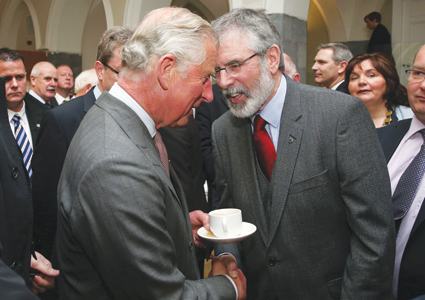
 Unresolved: Prince Charles and Gerry Adams shake hands at the National University of Ireland on May 19. They later met in private (photo: Brian Lawless/WPA Pool/Getty Images)
Seventeen years after the Good Friday Agreement, which resolved the Northern Ireland Troubles in 1998, the place seems as fixated as ever on what happened during that 30-year conflict. You might think the focus would be on the organisation that was by far the single greatest life-taker, the Provisional IRA. Instead, it has been trained firmly on the actions of the British security forces. On the eve of Prince Charles’s recent “reconciliation” mission to Ireland, the President of Sinn Féin, Gerry Adams, spoke of the “good work” already done between his former IRA comrade Martin McGuinness and “the English Queen” before somewhat gracelessly adding: “There remain unresolved injustices. These must be rectified.”
The next day Adams bounced into Charles’s private space as he sipped a cup of tea. Photographs captured this counterfeit moment of mutual respect as the heir to the throne and the diehard republican exchanged what the BBC described as a “firm and lingering” handshake. Charles smiled the dutiful smile of a Royal, betraying none of the contempt I imagine he feels for the man said by the Special Brance to have been the IRA’s Adjutant General in 1979 when they blew his “infinitely special” 79-year-old great-uncle Lord Mountbatten to pieces, along with an 83-year-old woman and two teenage boys.
There do indeed remain many unresolved injustices in Northern Ireland. But having lost the bloody and irregular war, Adams — who helped to start it — has been determined to focus attention on just one set of injustices: killings by the security forces. There were 1,785 fewer of those than there were killings by republicans. Undaunted, Adams has sought to establish a moral equivalence between the British state and the IRA, who killed vastly more innocents trying to drive the British out of Northern Ireland against the wishes of the majority in Northern Ireland.
Hence the self-righteousness with which McGuinness described the post-handshake private meeting he and Adams had with Charles: “We didn’t ask anybody in that room to apologise for anything.”
It is remarkable how Adams especially and Sinn Féin have managed to rewrite history considering that the IRA, in effect, surrendered, having reconciled themselves to the fact that their organisation had been so successfully penetrated by army police and MI5 agents it was holed like a Swiss cheese. Yet Adams and Sinn Féin have managed to turn the tables by portraying the security forces as terrorists while sanitising what the real terrorists actually did.
They have done this by relentlessly drawing attention to security force collusion with loyalist murder gangs against the IRA — a narrative that now occupies much of the work of some NGOs and lawyers.
No state can fight terrorism without some compromise over peacetime legal and moral standards. The problem for the British state is that Adams does have a bone to gnaw on. For many years now one stone after another in the undercover “dirty war” has been lifted — mostly by journalists (myself included) and NGOs — and what we have found underneath is not pretty. Recently declassified papers discovered by researchers from the Pat Finucane Centre in Derry show there did indeed exist an unhealthy alliance between the state and loyalists in the early years of the conflict. The bloodiest year was 1972, when almost 500 died; there was a bombing or a shooting every 40 minutes. At up to 50,000 strong, the largest loyalist paramilitary organisation was the Ulster Defence Association. By the summer of 1972, with their masks, dark glasses and khaki fatigues, the UDA were strutting around Belfast, some members brandishing offensive weapons. Their message to the army was: “You deal with the IRA or we will.”
The declassified documents show that the General Officer Commanding, Lieutenant General Sir Harry Tuzo, enlisted the UDA as a sort of fifth column. He let them act as auxiliaries to patrols by the Royal Ulster Constabulary in loyalist areas to free up soldiers to take on the IRA in republican strongholds. “It may even be necessary to turn a blind eye to UDA arms when confined to their own area,” Tuzo wrote to the Northern Ireland Secretary, Willie Whitelaw. “Vigilantes, whether UDA or not, should be discreetly encouraged in Protestant areas to reduce the load on the security forces.”
Sinn Féin have successfully presented this alliance as the natural evolution of British counter-insurgency operations in end-of-empire conflicts like Kenya where the British brutally colluded with tribes hostile to the Mau Mau movement.
It is obviously true that in the IRA, the British army and the UDA shared a common enemy. Senior army officers in Northern Ireland believed that working with the UDA was an alliance born of necessity. They did not consider 30,000 troops sufficient to be able to fight a war on two fronts, against not just the IRA but also the loyalists. So the army cosied up to the loyalists even though they had begun to kill Catholics randomly, sometimes in the most sadistic ways imaginable. That did not deter Whitelaw either. The day after two Catholic workers at the Rolls-Royce plant in east Belfast were murdered, he met UDA leaders to seek their help.
The army also tolerated UDA barricades. Thus emboldened by the slack cut them, the UDA stopped some Catholics and took them away for “interrogation” before murdering them in cold blood.
In the hope that loyalist frustration could be channelled into a “constructive and disciplined direction”, the British had established a part-time security force, the Ulster Defence Regiment. UDA members were allowed to join the UDR. “I am sure that this moderate line towards UDA supporters is the right one in view of the role of the UDA as a safety valve,” Army HQ in Northern Ireland told the Ministry of Defence in London.
Before long, weapons from UDR bases were finding their way into the hands of the UDA and other loyalist paramilitaries like the Ulster Volunteer Force. By early 1973, some 222 guns had gone “missing” from the homes of UDR soldiers, had been “stolen” from UDR armouries or were “lost in transit”. In some areas 15 per cent of UDR soldiers were members of loyalist paramilitaries. By then, there had been some 140 sectarian murders, mostly carried out by the UDA.
Early evidence of this security force-loyalist collusion was gathered by Sean Donlan, a senior Irish diplomat on his trips to the north. Little escaped the notice of Protestant and Catholic neighbours in rural Northern Ireland. Trusted Catholic confidents told Donlan of Protestants who had joined the UDR and were lending their weapons to paramilitaries. Donlan reported this to MI6 officers based at a British government house outside Holywood in County Down. Even though Northern Ireland was part of the United Kingdom, in those days MI6, the foreign intelligence-gathering service, not MI5, was the lead agency there. Donlan says MI6’s response was, “So be it”. He warned them, “If you don’t deal with this, this little seed will grow.”
And so it did. Between 1973 and 1978, some two dozen serving and former police officers and soldiers actively colluded with the UVF in an area of Armagh and Tyrone that became known as “the murder triangle”. Some operated from a farm at Glenanne, County Armagh, then owned by a part-time policeman. “As well as being a weapons storage base there was other anecdotal intelligence and evidence that showed that his farm was used as a planning centre for several of these attacks,” says Dave Cox, a former Metropolitan Police Commander who headed the recently disbanded Historical Enquiries Team in Belfast which reviewed the files on some 50 murders of Catholics carried out by members of the so called “Glenanne gang”.
Sinn Féin have successfully presented this alliance as the natural evolution of British counter-insurgency operations in end-of-empire conflicts like Kenya where the British brutally colluded with tribes hostile to the Mau Mau movement.
It is obviously true that in the IRA, the British army and the UDA shared a common enemy. Senior army officers in Northern Ireland believed that working with the UDA was an alliance born of necessity. They did not consider 30,000 troops sufficient to be able to fight a war on two fronts, against not just the IRA but also the loyalists. So the army cosied up to the loyalists even though they had begun to kill Catholics randomly, sometimes in the most sadistic ways imaginable. That did not deter Whitelaw either. The day after two Catholic workers at the Rolls-Royce plant in east Belfast were murdered, he met UDA leaders to seek their help.
The army also tolerated UDA barricades. Thus emboldened by the slack cut them, the UDA stopped some Catholics and took them away for “interrogation” before murdering them in cold blood.
In the hope that loyalist frustration could be channelled into a “constructive and disciplined direction”, the British had established a part-time security force, the Ulster Defence Regiment. UDA members were allowed to join the UDR. “I am sure that this moderate line towards UDA supporters is the right one in view of the role of the UDA as a safety valve,” Army HQ in Northern Ireland told the Ministry of Defence in London.
Before long, weapons from UDR bases were finding their way into the hands of the UDA and other loyalist paramilitaries like the Ulster Volunteer Force. By early 1973, some 222 guns had gone “missing” from the homes of UDR soldiers, had been “stolen” from UDR armouries or were “lost in transit”. In some areas 15 per cent of UDR soldiers were members of loyalist paramilitaries. By then, there had been some 140 sectarian murders, mostly carried out by the UDA.
Early evidence of this security force-loyalist collusion was gathered by Sean Donlan, a senior Irish diplomat on his trips to the north. Little escaped the notice of Protestant and Catholic neighbours in rural Northern Ireland. Trusted Catholic confidents told Donlan of Protestants who had joined the UDR and were lending their weapons to paramilitaries. Donlan reported this to MI6 officers based at a British government house outside Holywood in County Down. Even though Northern Ireland was part of the United Kingdom, in those days MI6, the foreign intelligence-gathering service, not MI5, was the lead agency there. Donlan says MI6’s response was, “So be it”. He warned them, “If you don’t deal with this, this little seed will grow.”
And so it did. Between 1973 and 1978, some two dozen serving and former police officers and soldiers actively colluded with the UVF in an area of Armagh and Tyrone that became known as “the murder triangle”. Some operated from a farm at Glenanne, County Armagh, then owned by a part-time policeman. “As well as being a weapons storage base there was other anecdotal intelligence and evidence that showed that his farm was used as a planning centre for several of these attacks,” says Dave Cox, a former Metropolitan Police Commander who headed the recently disbanded Historical Enquiries Team in Belfast which reviewed the files on some 50 murders of Catholics carried out by members of the so called “Glenanne gang”.
Cox strongly suspects elements of this gang were responsible for the bloodiest day of the conflict — May 17, 1974, when car bombs in Dublin and Monaghan killed 33 people. Even though UVF members were almost certainly involved, the British government continued with its plans to de-proscribe the organisation a week later.
At night, part-time soldiers posed as real soldiers at bogus checkpoints in the countryside. Five Catholics were shot dead this way. Mass casualty attacks on Catholic bars were also favoured, executed with such insouciance that the perpetrators seemed to have assumed they would never be caught. Some belonged to an elite RUC unit, call sign “Orange”, named after the Orange Order who sometimes staged provocative marches through Catholic areas wearing orange sashes and banging lambeg drums.
Serving police officers who attacked the Rock Bar in Granemore in June 1976 using guns and a bomb packed with nails and pieces of metal actually escaped in a police car. Lying on the ground, having been machine-gunned in the stomach, one survivor noticed his would-be killer was wearing police boots. Another gang member returned to the scene an hour later in uniform to take statements from survivors.
“Our role was to carry out attacks against the nationalist and republican community,” former police sergeant John Weir told the Irish state broadcaster RTE recently. “If ordinary Catholics were shot nobody was too worried about it.” Most of the Glenanne gang’s victims were “ordinary” Catholics.
Evidence uncovered by Cox and his team of ex-mainland detectives suggests that some in Special Branch were on to Weir and his murderous colleagues by the autumn of 1976, if not before. If so, those Branch officers never shared this intelligence with the CID officers investigating the bombings, a pattern that marked SB-CID relations for the entire conflict. “In many, many cases we found examples that intelligence had not been passed on to the investigators and no satisfactory explanation for it in the papers at all,” says Cox. The clear implication is that Branch agents, even those involved in murder, were being protected, prioritising intelligence-gathering over justice.
Weir and some of his fellow perpetrators were only brought to justice when one of them ended up in a psychiatric ward and started talking, although “justice” dignifies the sentences handed down by the Lord Chief Justice of Northern Ireland Robert Lowry on those officers involved in the Rock Bar attack. They received one- or two-year suspended sentences because Lowry did not regard them as terrorists. “I must remember that whatever sentence is just, it would follow that it would be imposed on a different and lower scale from that appropriate to terrorists,” he said. The police officers’ conduct, Lord Lowry insisted, had sprung “from a feeling of frustration . . . that what I might call ordinary methods had proved relatively ineffective in dealing with terrorists”.
It was, of course, true that the IRA were wreaking death and destruction on a much greater scale than loyalists. The mind boggles, however, at how the Lord Chief Justice reached a verdict that excused taking it out on uninvolved Catholics.
The unpalatable truth is that as the conflict extended into the 1980s and 1990s collusion between loyalists and the security forces continued at a greater level than successive British governments have been prepared to admit. “I didn’t think it was anything like on the scale which we now know it was,” the former Northern Ireland security minister Michael Mates recently told me.
We now know that in 1985 MI5 assessed that 85 per cent of the UDA’s targeting material came from security force records. A “very senior RUC officer” was also suspected by MI5 of “assisting loyalist paramilitaries to procure arms”. The UDA’s five Belfast “Brigade” areas were in contact with some 100 police officers.
At night, part-time soldiers posed as real soldiers at bogus checkpoints in the countryside. Five Catholics were shot dead this way. Mass casualty attacks on Catholic bars were also favoured, executed with such insouciance that the perpetrators seemed to have assumed they would never be caught. Some belonged to an elite RUC unit, call sign “Orange”, named after the Orange Order who sometimes staged provocative marches through Catholic areas wearing orange sashes and banging lambeg drums.
Serving police officers who attacked the Rock Bar in Granemore in June 1976 using guns and a bomb packed with nails and pieces of metal actually escaped in a police car. Lying on the ground, having been machine-gunned in the stomach, one survivor noticed his would-be killer was wearing police boots. Another gang member returned to the scene an hour later in uniform to take statements from survivors.
“Our role was to carry out attacks against the nationalist and republican community,” former police sergeant John Weir told the Irish state broadcaster RTE recently. “If ordinary Catholics were shot nobody was too worried about it.” Most of the Glenanne gang’s victims were “ordinary” Catholics.
Evidence uncovered by Cox and his team of ex-mainland detectives suggests that some in Special Branch were on to Weir and his murderous colleagues by the autumn of 1976, if not before. If so, those Branch officers never shared this intelligence with the CID officers investigating the bombings, a pattern that marked SB-CID relations for the entire conflict. “In many, many cases we found examples that intelligence had not been passed on to the investigators and no satisfactory explanation for it in the papers at all,” says Cox. The clear implication is that Branch agents, even those involved in murder, were being protected, prioritising intelligence-gathering over justice.
Weir and some of his fellow perpetrators were only brought to justice when one of them ended up in a psychiatric ward and started talking, although “justice” dignifies the sentences handed down by the Lord Chief Justice of Northern Ireland Robert Lowry on those officers involved in the Rock Bar attack. They received one- or two-year suspended sentences because Lowry did not regard them as terrorists. “I must remember that whatever sentence is just, it would follow that it would be imposed on a different and lower scale from that appropriate to terrorists,” he said. The police officers’ conduct, Lord Lowry insisted, had sprung “from a feeling of frustration . . . that what I might call ordinary methods had proved relatively ineffective in dealing with terrorists”.
It was, of course, true that the IRA were wreaking death and destruction on a much greater scale than loyalists. The mind boggles, however, at how the Lord Chief Justice reached a verdict that excused taking it out on uninvolved Catholics.
The unpalatable truth is that as the conflict extended into the 1980s and 1990s collusion between loyalists and the security forces continued at a greater level than successive British governments have been prepared to admit. “I didn’t think it was anything like on the scale which we now know it was,” the former Northern Ireland security minister Michael Mates recently told me.
We now know that in 1985 MI5 assessed that 85 per cent of the UDA’s targeting material came from security force records. A “very senior RUC officer” was also suspected by MI5 of “assisting loyalist paramilitaries to procure arms”. The UDA’s five Belfast “Brigade” areas were in contact with some 100 police officers.
Army records also show that in 1987 the agent-running arm of military intelligence called the “Force Research Unit” (FRU) recruited a member of the UDA to help ensure “the proper targeting of Provisional IRA members . . . prior to any shooting”. The agent, Brian Nelson, was paid nearly £50,000 by the FRU, which arranged for him to be set up as a mini-cab driver. This gave him cover to enter hard-line republican areas to help identify IRA targets. The FRU operated “almost as if it was a maverick unit”, says Sir Hugh Orde, the former Chief Constable of the Police Service of Northern Ireland (PSNI).
Eventually, the FRU reported that thanks to Nelson, UDA targeting had become “more professional”. Rarely was that so: more uninvolved Catholics were killed than IRA members, despite Nelson claiming to only want “to attack legitimate targets.”
Nelson was also involved in targeting the Belfast solicitor Pat Finucane, who represented several high-profile IRA clients. Finucane had bullet after bullet fired into his head and neck at a distance of 18 inches after two masked gunmen burst into the kitchen as the Finucane family sat down to supper in February 1989. “It’s not a place I care to go,” says Finucane’s eldest son Michael, who witnessed the murder together with his mother, younger brother and sister. At least one Special Branch officer appears to have known Finucane was being targeted, as did MI5, who had effectively helped to set him up as a target by using one of their agents in the UDA to profile him as an “IRA solicitor” in a loyalist magazine.
Between them, the FRU, MI5 and the Special Branch ran scores of agents. Most, though, were run by the Branch, which has most questions to answer in Northern Ireland’s “dirty war”.
Many lives were unquestionably saved by the Branch. But you don’t get actionable life-saving intelligence from milkmaids. That came mostly from agents deep within the terrorist organisation who often had to prove their loyalty to those organisations by participating in terrorism, even murder. This was the central dilemma for all three intelligence agencies: to what extent should the state turn a blind eye to crimes committed by its paid agents for the greater good? An agent “can’t sort of say ‘Oh, hang on — I don’t do shootings but I will do bombings,’ you know, ‘come back next week and invite me to do one’,” says a former head of the Branch, Ray White. “No, an agent does exactly what he is asked in relation to those matters.”
However, in some cases it is by no means clear that any greater good did actually come from the more collusive relationships between Branch handlers and agents. The former Police Ombudsman for Northern Ireland Nuala O’Loan says “hundreds and hundreds” died because these agents were not brought to justice — a figure disputed by the Police Service of Northern Ireland Chief Constable George Hamilton. Some, however, are alleged to have been serial killers.
One loyalist agent in the UVF in North Belfast, Garry Haggarty, is now facing no fewer than 212 charges, including five murders, six attempted murders and 31 conspiracies to murder with a further 300 offences to be taken into consideration. Some Branch officers are said to have indulged this level of criminality for a decade.
Several CID officers have told me the Branch often obstructed their investigations into killings in which agents were involved.
In my view, however, attempts by Sinn Féin and others to portray the loyalists as “state-sponsored” forces systematically protected by a sectarian police force don’t actually stack up. For a start, the loyalists were remarkably unsuccessful, never managing to kill off the ruling IRA army council. Nor do the large numbers of loyalists prosecuted by the RUC sit easily with this version of history.
Eventually, the FRU reported that thanks to Nelson, UDA targeting had become “more professional”. Rarely was that so: more uninvolved Catholics were killed than IRA members, despite Nelson claiming to only want “to attack legitimate targets.”
Nelson was also involved in targeting the Belfast solicitor Pat Finucane, who represented several high-profile IRA clients. Finucane had bullet after bullet fired into his head and neck at a distance of 18 inches after two masked gunmen burst into the kitchen as the Finucane family sat down to supper in February 1989. “It’s not a place I care to go,” says Finucane’s eldest son Michael, who witnessed the murder together with his mother, younger brother and sister. At least one Special Branch officer appears to have known Finucane was being targeted, as did MI5, who had effectively helped to set him up as a target by using one of their agents in the UDA to profile him as an “IRA solicitor” in a loyalist magazine.
Between them, the FRU, MI5 and the Special Branch ran scores of agents. Most, though, were run by the Branch, which has most questions to answer in Northern Ireland’s “dirty war”.
Many lives were unquestionably saved by the Branch. But you don’t get actionable life-saving intelligence from milkmaids. That came mostly from agents deep within the terrorist organisation who often had to prove their loyalty to those organisations by participating in terrorism, even murder. This was the central dilemma for all three intelligence agencies: to what extent should the state turn a blind eye to crimes committed by its paid agents for the greater good? An agent “can’t sort of say ‘Oh, hang on — I don’t do shootings but I will do bombings,’ you know, ‘come back next week and invite me to do one’,” says a former head of the Branch, Ray White. “No, an agent does exactly what he is asked in relation to those matters.”
However, in some cases it is by no means clear that any greater good did actually come from the more collusive relationships between Branch handlers and agents. The former Police Ombudsman for Northern Ireland Nuala O’Loan says “hundreds and hundreds” died because these agents were not brought to justice — a figure disputed by the Police Service of Northern Ireland Chief Constable George Hamilton. Some, however, are alleged to have been serial killers.
One loyalist agent in the UVF in North Belfast, Garry Haggarty, is now facing no fewer than 212 charges, including five murders, six attempted murders and 31 conspiracies to murder with a further 300 offences to be taken into consideration. Some Branch officers are said to have indulged this level of criminality for a decade.
Several CID officers have told me the Branch often obstructed their investigations into killings in which agents were involved.
In my view, however, attempts by Sinn Féin and others to portray the loyalists as “state-sponsored” forces systematically protected by a sectarian police force don’t actually stack up. For a start, the loyalists were remarkably unsuccessful, never managing to kill off the ruling IRA army council. Nor do the large numbers of loyalists prosecuted by the RUC sit easily with this version of history.
Moreover, the kind of collusive relationships that existed between the British state and its informants existed to a much greater extent between the state and its informants in the IRA. The FRU, for example, ran the head of the IRA’s so-called “nutting squad” as an agent. Whilst informing to the British, his IRA role was to identify fellow traitors to the IRA. Some were then tortured into confessing before being executed. To protect this top agent, other lesser agents are said to have been sacrificed. The full truth of this case has yet to emerge but it rather suggests that compared to the agents they were running in the IRA some of the Branch’s loyalist agents “look[ed] like choirboys”, as one ex-Branch officer put it.
How was it that such collusive relationships were allowed to develop in the first place? We now know the answer: there were no proper rules for counter-terrorist agent handling operations. And for the Northern Ireland intelligence-gathering agencies this posed a dilemma that had never confronted Britain when it was fighting its small colonial wars because in places like Cyprus and Kenya there was no domestic media to account to, and the victims were not British citizens.
For Northern Ireland security ministers like Michael Mates (who had also served in the province as a soldier), confronting for the first time a terrorist threat from within our own shores “carried out by people who were our own citizens” (even though they saw themselves as Irish) posed a “unique set of challenges as to what to do with things like agent-handling”.
As head of the Special Branch in Belfast, Ray White confronted Mrs Thatcher directly with this dilemma when she visited the city in the late 1980s.
“I just took the opportunity almost off the cuff: ‘Well, Prime Minister, I would welcome detailed guidance and regulation in relation to what we do’,” explains White. “We were operating in a very grey area in which there was no case law. As a police service, we were making up guidance for ourselves as to how we should morally and professionally behave ourselves and live within the law.”
The then RUC Chief Constable Sir Jack Hermon also asked ministers to provide an agent-handling legal framework. MI5 Director General Sir Patrick Walker also raised this with Mrs Thatcher. Yet such a framework was only finally agreed 13 years later in 2000, two years after the Good Friday Agreement. “The facts speak for themselves,” says today’s PSNI Chief Constable George Hamilton.
Officials did make a stab with a draft framework in 1992 — five years after the matter was first raised — but it was so ineffectual that in a handwritten note the Solicitor General, Sir Derek Spencer, wrote: “the thrust of para[graph] 4 appears to be ‘Don’t get caught’! This is unpromising territory for Ministerial approval.”
Despite the security services’ request for a framework, they don’t appear to have pressed the case home to ministers with much urgency. Nor, it seems, did ministers see the need to respond in a hurry. That amounts to a “wilful and abject failure by successive governments”, concludes the former UN chief war crimes prosecutor Sir Desmond De Silva QC, in a review commissioned by David Cameron of Patrick Finucane’s assassination. According to Mates, the security services “thought it would be better if ministers didn’t know the fine detail of these things because they might be asked to account for them and if they didn’t know they could say they didn’t know”.
However, the state’s failure to regulate agent-handling during the conflict has given credence to Adams’s mantra that there should be “no hierarchy of victims”, by which he means an IRA man shot dead by the security forces while attempting to commit murder in cold blood is as much of a victim as anyone murdered in cold blood by a terrorist. Yet when it comes to accountability, Adams seems quite happy for there to be a hierarchy — again, in the IRA’s favour.
How was it that such collusive relationships were allowed to develop in the first place? We now know the answer: there were no proper rules for counter-terrorist agent handling operations. And for the Northern Ireland intelligence-gathering agencies this posed a dilemma that had never confronted Britain when it was fighting its small colonial wars because in places like Cyprus and Kenya there was no domestic media to account to, and the victims were not British citizens.
For Northern Ireland security ministers like Michael Mates (who had also served in the province as a soldier), confronting for the first time a terrorist threat from within our own shores “carried out by people who were our own citizens” (even though they saw themselves as Irish) posed a “unique set of challenges as to what to do with things like agent-handling”.
As head of the Special Branch in Belfast, Ray White confronted Mrs Thatcher directly with this dilemma when she visited the city in the late 1980s.
“I just took the opportunity almost off the cuff: ‘Well, Prime Minister, I would welcome detailed guidance and regulation in relation to what we do’,” explains White. “We were operating in a very grey area in which there was no case law. As a police service, we were making up guidance for ourselves as to how we should morally and professionally behave ourselves and live within the law.”
The then RUC Chief Constable Sir Jack Hermon also asked ministers to provide an agent-handling legal framework. MI5 Director General Sir Patrick Walker also raised this with Mrs Thatcher. Yet such a framework was only finally agreed 13 years later in 2000, two years after the Good Friday Agreement. “The facts speak for themselves,” says today’s PSNI Chief Constable George Hamilton.
Officials did make a stab with a draft framework in 1992 — five years after the matter was first raised — but it was so ineffectual that in a handwritten note the Solicitor General, Sir Derek Spencer, wrote: “the thrust of para[graph] 4 appears to be ‘Don’t get caught’! This is unpromising territory for Ministerial approval.”
Despite the security services’ request for a framework, they don’t appear to have pressed the case home to ministers with much urgency. Nor, it seems, did ministers see the need to respond in a hurry. That amounts to a “wilful and abject failure by successive governments”, concludes the former UN chief war crimes prosecutor Sir Desmond De Silva QC, in a review commissioned by David Cameron of Patrick Finucane’s assassination. According to Mates, the security services “thought it would be better if ministers didn’t know the fine detail of these things because they might be asked to account for them and if they didn’t know they could say they didn’t know”.
However, the state’s failure to regulate agent-handling during the conflict has given credence to Adams’s mantra that there should be “no hierarchy of victims”, by which he means an IRA man shot dead by the security forces while attempting to commit murder in cold blood is as much of a victim as anyone murdered in cold blood by a terrorist. Yet when it comes to accountability, Adams seems quite happy for there to be a hierarchy — again, in the IRA’s favour.
There is manifestly a greater onus on the state to account for its actions than terrorists turned politicians. Even so, you would think the way Adams has placed almost the entire onus on the British state to account for deaths during the Troubles in Northern Ireland might at least bring a blush to his cheeks. The IRA, let us not forget, killed nearly four times as many civilians as the security forces. Evidently this is not a consideration that seems to trouble Adams.
And here’s a reminder of the manner of so many of those deaths: car bombs set off in crowded places; part-time soldiers and policemen shot in the back or in front of their families; bombs in packed bars; the torture and cold-blooded execution of suspected informers. And for all Adams’s later talk about “my Protestant brothers and sisters” the IRA was also not above naked sectarianism, lining up Protestant workers to be machine-gunned just because they were Protestants.
Adams has acknowledged that “republicans inflicted great hurt”, so signing up to the Stormont House Agreement last year which provides a mechanism for “information retrieval” about the past, might seem like a bold step for him and Sinn Féin. The Independent Commission for Information Retrieval (ICIR) will “enable victims and survivors to seek and privately receive information about Troubles-related deaths of their next of kin”. Besides the police and Ministry of Defence, the ICIR will also approach paramilitaries for assistance.
But the IRA no longer exists as an organisation. And when it did, it did not keep records. So when it comes to questions such as which former members of the IRA ordered what IRA atrocity, the IRA’s heir Sinn Féin will legitimately be able to say it can only give very limited help. No doubt that will apply particularly to Adams since to this day he insists he was never in the IRA. “I am completely honest in that,” he says, with straight-faced chutzpah. “Gerry was a major, major player in the war yet he’s standing there denying it,” said his once close friend, the IRA commander Brendan “Darkie” Hughes, who died in 2008, and whose coffin Adams helped to carry.
However, the tables may yet be turned on all this obfuscation. Whilst the PSNI Chief Constable George Hamilton is candid enough to admit that collusion involved “something more” than just “a few bad apples” in the security forces, he is also weary of the one-sided focus on the past.
The Stormont House Agreement also established the Historical Investigations Unit and Hamilton recently allowed RTE to film a high security vault, containing millions of police documents which will assist HIU inquiries. Here lie many of the untold stories of the past. To date, the vault has only been explored for material relating to police and army activity. “I don’t think we should be exempt from scrutiny from investigation in the police service, past or present,” says Hamilton, “I think that’s good, if uncomfortable accountability, but I actually think other people have stories to tell and questions to answer.”
He means, of course, the IRA and loyalist paramilitaries. And while they may not have kept records, as Hamilton says: “We did keep records and I’m not just talking about intelligence documents, I’m talking about plans for covert operations, I’m talking about minutes of meetings.”
And then the Chief Constable adds, deadpan: “There will be material there that will present challenges for individuals and opportunities for investigators. That’s the way it works.”
We may yet see an end to the one-sided reckoning that has so far dominated the history of the Northern Ireland conflict.
And here’s a reminder of the manner of so many of those deaths: car bombs set off in crowded places; part-time soldiers and policemen shot in the back or in front of their families; bombs in packed bars; the torture and cold-blooded execution of suspected informers. And for all Adams’s later talk about “my Protestant brothers and sisters” the IRA was also not above naked sectarianism, lining up Protestant workers to be machine-gunned just because they were Protestants.
Adams has acknowledged that “republicans inflicted great hurt”, so signing up to the Stormont House Agreement last year which provides a mechanism for “information retrieval” about the past, might seem like a bold step for him and Sinn Féin. The Independent Commission for Information Retrieval (ICIR) will “enable victims and survivors to seek and privately receive information about Troubles-related deaths of their next of kin”. Besides the police and Ministry of Defence, the ICIR will also approach paramilitaries for assistance.
But the IRA no longer exists as an organisation. And when it did, it did not keep records. So when it comes to questions such as which former members of the IRA ordered what IRA atrocity, the IRA’s heir Sinn Féin will legitimately be able to say it can only give very limited help. No doubt that will apply particularly to Adams since to this day he insists he was never in the IRA. “I am completely honest in that,” he says, with straight-faced chutzpah. “Gerry was a major, major player in the war yet he’s standing there denying it,” said his once close friend, the IRA commander Brendan “Darkie” Hughes, who died in 2008, and whose coffin Adams helped to carry.
However, the tables may yet be turned on all this obfuscation. Whilst the PSNI Chief Constable George Hamilton is candid enough to admit that collusion involved “something more” than just “a few bad apples” in the security forces, he is also weary of the one-sided focus on the past.
The Stormont House Agreement also established the Historical Investigations Unit and Hamilton recently allowed RTE to film a high security vault, containing millions of police documents which will assist HIU inquiries. Here lie many of the untold stories of the past. To date, the vault has only been explored for material relating to police and army activity. “I don’t think we should be exempt from scrutiny from investigation in the police service, past or present,” says Hamilton, “I think that’s good, if uncomfortable accountability, but I actually think other people have stories to tell and questions to answer.”
He means, of course, the IRA and loyalist paramilitaries. And while they may not have kept records, as Hamilton says: “We did keep records and I’m not just talking about intelligence documents, I’m talking about plans for covert operations, I’m talking about minutes of meetings.”
And then the Chief Constable adds, deadpan: “There will be material there that will present challenges for individuals and opportunities for investigators. That’s the way it works.”
We may yet see an end to the one-sided reckoning that has so far dominated the history of the Northern Ireland conflict.