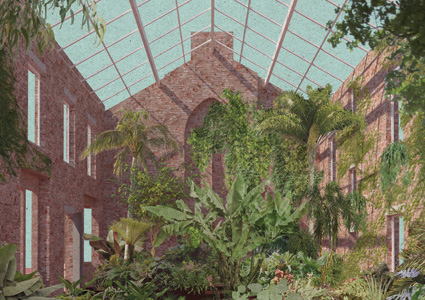
 Transformation: The architectural collective Assemble plans to convert a derelict house into a greenhouse as part of their Granby Four Streets project (image: Assemble)
The week after the Toxteth riots, The Times ran a full page of photographs of this area of south Liverpool. The Rialto club, smoke rising from its burnt-out bar and banquettes. Fire engines in Lodge Lane and Upper Parliament Street. Cars tipped on their sides. The looted Tesco store in Smithdown Road, a mess of glass and overturned tills. The riots were 34 years ago, but these are the images of Toxteth that endure. They have cast a long shadow.
There was much anxiety about my going to Toxteth. Anyone I told wanted to know: was I going alone? Would someone pick me up from the station? Was it safe? Not only is it safe, no troublemaker would dare so much as pick a pocket. Toxteth, known to its residents as Granby or Liverpool 8, is under constant surveillance. No sooner has one camera crew departed, another arrives. You can’t keep local dignitaries away. When I arrive, deputy mayor Ann O’Byrne is clacking up Granby Street in stack heels, a loud suit and matching Vivienne Westwood necklace and earrings.
Granby Four Streets, a resident-led Community Land Trust (CLT) project, has been — improbably, wonderfully — nominated for the Turner Prize. It is the first time a housing estate has been considered for the Turner. One of the judges, Alistair Hudson, has said: “In an age when anything can be art, why not have a housing estate?”
Officially, the nomination is in the name of Assemble, the young architecture collective behind the redevelopment, but Granby is glowing. The winner will be announced in December. After three cursed decades of being known for the Toxteth Riots, could these streets be rehabilitated by the Toxteth Turner Prize?
On the night of Friday 3 July, 1981, a black teenage motorcyclist, Leroy Cooper, was arrested for speeding and bundled into the back of a police van. While the van was stationary, he jumped from the back, still handcuffed and legged it. He cried police harassment — he hadn’t been speeding, hadn’t done anything wrong. Word spread. It was July, it was hot, and discontented Toxteth began to mass on the streets.
On the Sunday night long-nursed resentment of the police became a riot in Toxteth, a poor and predominantly black area. The Rialto and Racquets clubs and the National Westminster Bank were burnt to the ground. Rioters set fire to the family-owned Swainbanks furniture store. The Princes Park Geriatric Hospital was evacuated; rioters let ambulances through one at a time to take away the 96 patients. Families left burning homes with suitcases of clothes and possessions. A BBC television team was attacked by a masked gang with pick-axes, who smashed a £12,000 camera.
Rioters broke into the Unigate Dairy and ten milk floats and a cement mixer were driven at police officers, before being used to blockade the streets. Tear gas was released for the first time in mainland Britain. One policeman was speared through the head by a six-foot spiked railing. David Alton, Liberal MP for Liverpool Edge Hill, described the events of the weekend as “urban savagery”.
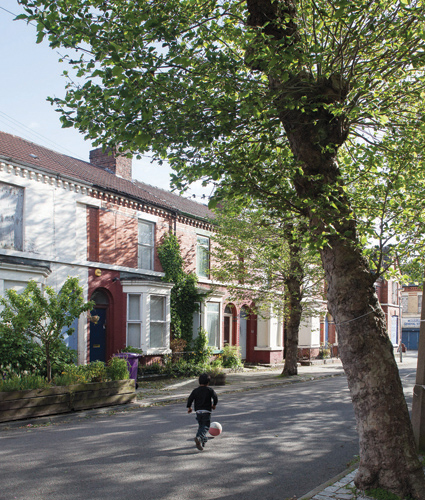
The Granby Four Streets today, reclaimed and replanted by Toxteth residents (photo: Assemble)
Toxteth followed riots in Brixton three months before and ignited copycat protests that same weekend in Wood Green and Southall in London, and Manchester’s Moss Side. A Gerald Scarfe cartoon in the Sunday Times had a pterodactyl-beaked Margaret Thatcher peering through the Downing Street curtains at balaclava louts smashing windows and lighting fires, and wondering aloud: “That’s funny. Are we expecting anyone?” A graph behind her shows unemployment skittering off the chart.
What happened in Toxteth was blamed on unemployment and strained relations between the police and the black community. In 1981, 22 per cent of the economically active population of Liverpool was unemployed. In Toxteth it was 37 per cent — and 47 per cent among young, black men. Across Merseyside, there were 500 unemployed for each unskilled vacancy. Meanwhile, among Liverpool’s 5,000-strong police force, there were only four black officers.
In the week after the riots, one black man in his thirties, unemployed and married with three children, told a Times reporter:
I feel good after the riots. Living with the police here is like having phlegm on your chest. You have to cough it out. When you’ve done that you can sleep sound at night.
Our fight is with the Merseyside police, they are a bunch of racists.
If you have a car in this town it must be stolen. If you have a white girl she must be a prostitute. If you are coming from a club you must be carrying drugs.
My aim was to kill a policeman. We wanted to leave a few of them in the middle of the road with their arms and legs broken. We warned them weeks ago that this town was about to go up.
In the days and weeks that followed there was soul-searching and committee-forming and action-planning. In Toxteth, four churches offered an amnesty to anyone who brought back goods looted during the riots. All that was returned was a bag of sweets.
Sir Geoffrey Howe, then Chancellor of the Exchequer, said more cash was not necessarily the answer. The Prime Minister visited, as did Home Secretary Willie Whitelaw, who did not endear himself to Toxteth residents when he refused to leave his ministerial car.
Michael Heseltine was appointed de facto “Minister for Merseyside”, charged with spending a fortnight in the city and coming up with a “rescue plan”. His car was pelted with eggs and rotting vegetables when he visited an environmental improvement scheme in Princes Avenue. Roy Hattersley, the Shadow Home Secretary, called the enterprise farcical, “throwing ministers at the city instead of money”.
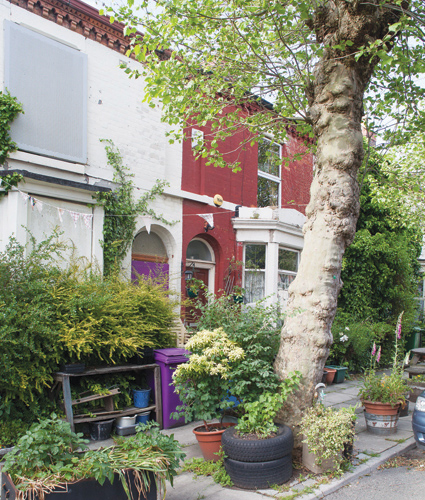
In bloom: Formerly derelict houses on Cairns Street, in Granby, have been renovated (photo: Assemble)
And what did Heseltine come up with? “Let a thousand flowers bloom!” the Minister for Merseyside announced in July 1982, a year after the riots, quoting — to the bafflement of many — Chairman Mao. He called for “entrepreneurial energy” and committed £13 million to a new international horticultural centre to open on the banks of the Mersey in Dingle in 1984. It was hoped the centre would be “the envy of Europe”.
The Festival Gardens, at least, opened by the Queen in 1984, were a success: 3.8 million people visited that summer to admire the pagodas, bridges and 60 ornamental gardens. A local girl in a fetching mermaid costume posed for photographs on a rock above a sailing lake at the grand opening.
In 2012, Heseltine was awarded the Freedom of Liverpool in recognition of his efforts to regenerate the city after the riots, particularly the restoration of the Albert Dock, a 25-year project to clean up the Mersey and handing greater powers to local government.
He had less success, perhaps, when it came to housing. Ray O’Brien, chief executive of Merseyside County Council, scoffed at the time that this regeneration scheme was doomed to be as unsuccessful as all the others: “Show me one brick that has been laid upon another as a result of any of these initiatives.”
For 30 years regeneration schemes had been tried in Toxteth. After the riots, novelist Beryl Bainbridge wrote a sorrowful account of what had happened to her part of town:
Bainbridge described how her daughter, still living in Liverpool 8, couldn’t get anyone out to mend her washing machine. No tradesman would come and no taxis would take a fare to Toxteth.
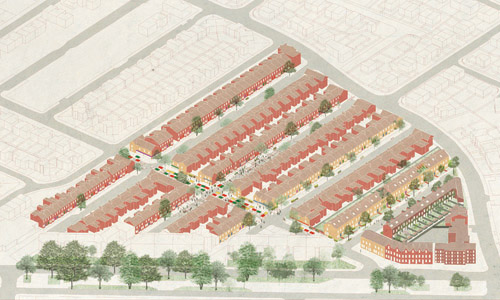
Saved: An axonometric view of the Granby Four Streets project. Toxteth residents had consistently fought government plans for demolition (image: Assemble)
The Festival Gardens, at least, opened by the Queen in 1984, were a success: 3.8 million people visited that summer to admire the pagodas, bridges and 60 ornamental gardens. A local girl in a fetching mermaid costume posed for photographs on a rock above a sailing lake at the grand opening.
In 2012, Heseltine was awarded the Freedom of Liverpool in recognition of his efforts to regenerate the city after the riots, particularly the restoration of the Albert Dock, a 25-year project to clean up the Mersey and handing greater powers to local government.
He had less success, perhaps, when it came to housing. Ray O’Brien, chief executive of Merseyside County Council, scoffed at the time that this regeneration scheme was doomed to be as unsuccessful as all the others: “Show me one brick that has been laid upon another as a result of any of these initiatives.”
For 30 years regeneration schemes had been tried in Toxteth. After the riots, novelist Beryl Bainbridge wrote a sorrowful account of what had happened to her part of town:
I left Liverpool for London in 1964 and didn’t return for eight years. Liverpool 8 lay beneath a cloud of dust. The authorities were going to bring back the people to the heart of the city. An orgy of organised smashing and erasing and bulldozing was in progress. Then the money ran out.
For nearly 20 years, the rubble and the devastation have multiplied — street after street of mangled houses, lead stripped from the roofs, chimneys toppled into backyards, balconies hanging like bedsteads. Acres of wasteland, dozens and dozens of half-demolished churches and mission halls and factories and warehouses, ton upon ton of bricks and girders and broken glass. Once hidden behind the buildings, and now exposed like rotten teeth, rise the concrete stubs of the ghettos for the local residents, the lower windows of the flats protected by wire grills like the cages at a zoo.
A whole generation has grown up in Liverpool 8, listening to the lullaby sound of houses falling down.
Bainbridge described how her daughter, still living in Liverpool 8, couldn’t get anyone out to mend her washing machine. No tradesman would come and no taxis would take a fare to Toxteth.
Saved: An axonometric view of the Granby Four Streets project. Toxteth residents had consistently fought government plans for demolition (image: Assemble)
Heseltine’s scheme came at a time of cuts to the national housing budget. The promised investment did not materialise and successive councils operated a principle of “managed decline”. Houses were left to fall derelict through the 1990s. Residents who could move out did, others were relocated to new council flats. There was a tacit arrangement to let the area deteriorate to such an extent that the remaining houses could be bulldozed and the 19th-century brick terraces be replaced with new council homes. As far as the council was concerned, anyone who didn’t want to leave, even residents who had lived in their house for three generations, could go hang.
Erika Rushton, Chair of Granby Four Streets Community Land Trust, explains: “Toxteth was systematically closed down after the riots. Nightclubs were all shut down. Pubs had their licences taken away.” Housing was allowed to fall into ruin; no one on the city council could agree on what should be done with the place. “Granby,” she says, “represents the politics of indecision.”
What the council hadn’t reckoned on was the doughty retirement-age ladies of Granby. While younger families had moved away into new council homes, older residents had refused to budge. In 2012, 140 houses stood empty and derelict and only 60 residents remained. Those who had stuck it out, says Erika, were “sick and tired” of living in streets abandoned by the council.
They decided to take matters into their own hands, beginning by sweeping the streets. Some of the women — and the odd useful man with a stepladder — in the streets east of Princes Avenue began a campaign of “guerrilla gardening”. They planted window boxes and troughs along the fronts of condemned houses and painted cheery domestic scenes on the tin panels nailed to doors and windows: curtains, vases on windowsills, a cat sunning itself. Anything to improve on bricked-up windows and signs saying “DANGER: KEEP OUT”.
When I visited on a glorious sunny morning in June primroses and cornflowers were growing on the scraps of verges around the estate. There were pots of daffodils and the bowl of an old, chipped ceramic loo had been planted with flourishing ferns. Picnic tables with cheerful oil-cloth covering were set up in the pavements. Every Christmas for the last four years, lunch has been served on long tables and chairs the length of one street, with the residents wearing jumpers and hoodies to keep out the cold.
Fluorescent plastic pigeons nest on lamp-posts and crumbling chimneys. Joe Farrag, an industrious man-with-a-ladder, found them their perches. The residents started a Saturday street market with food stalls, crafts, clowns, face-painting, donkey rides, poetry readings and fairy cakes. “We wanted to say: ‘We’re still here’,” says Theresa MacDermott. “It was a way of cheering ourselves up.” More than that, they were restoring streets the council had not thought worth saving.
In 2008, Saving Britain’s Heritage, a campaign group, introduced the Granby CLT to Steinbeck Studios, a social enterprise investor. It was Steinbeck who approached Assemble to turn a run of ten derelict Granby houses into affordable family homes. Assemble’s previous projects had been unconventional: a brick folly under a motorway flyover in Hackney Wick, a barn-like studio faced with concrete tiles in Stratford, both in east London; a petrol station converted into a cinema in Clerkenwell, central London.
At Granby, the priority so far has been housing. Now the CLT is set on attracting businesses to the abandoned units on the four corners of the old Granby market. Joe Farrag talks of canopies and benches, street food stalls and a pavement café.
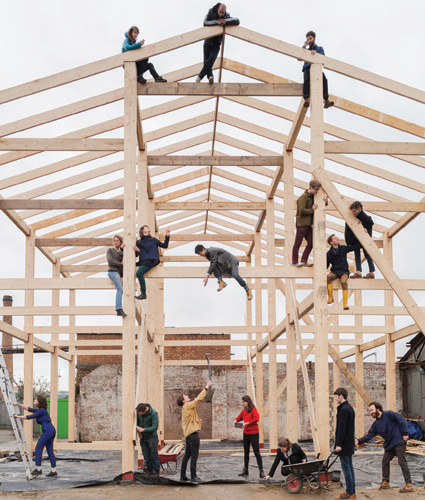
The architectural collective Assemble, pictured during the construction of their “Yardhouse” project in East London (photo: Assemble)
Theresa MacDermott says that taxi drivers used to refuse to drive to Toxteth. They’d say: “No one lives in Granby.” Now they drop passengers outside the Baby Dolls Beauty Salon, opened by Delucia Emina, a Granby local, in a formerly shuttered unit. A black cab arrives with a bottle-tanned, bottle-blonde in the back. She pays and trots into the salon on very high heels.
“Liverpool girls are very glam,” Erika tells me with a reproachful look at my plimsolls. Then, brightening: “You can get your Scouse brows done here!”
What does Granby make of the Turner nomination? Theresa MacDermott heard the news while she was on holiday. A producer from Radio Merseyside called asking for her reaction. “Bloody hell,” was her first response, then: “So what category are we under?” She thought there must be a special category for “community stuff.” She couldn’t believe that an art establishment which celebrated “stacks of bricks, a fish in a tank, and a bed” could be interested in Granby.
Assemble may be the name on the Turner Prize ticket, but the architects are quick to say they arrived late on the scene and that the residents had been battling for years without the Turner taking a jot of notice. Lewis Jones, a founding member of Assemble says: “We are totally inspired by what they have done. After campaigning for so long they got their hands dirty and started sweeping the streets and planting gardens.” The Turner nomination is “a real transformative moment”.
The relationship between residents and the 18-strong architecture collective from London, most of them Cambridge graduates in their twenties, is cheerful and warm. One of the houses has been turned into a base camp with floor plans pinned either side of the fireplace and mugs of tea piled in the sink. Someone from Assemble is on site most days. “We didn’t want a war room in London with blokes pulling tanks around,” explains Erika Rushton. “We wanted the troops on the ground involved.”
There has been no trouble, no hostility: “Not even a bag of nails stolen,” says Rushton. One of the project managers, living in the site office, has her legs waxed at Baby Dolls.
When the four nominations for the Turner Prize were announced in May, one headline summarised the shortlist as: “Three women — and a housing estate.” The contenders are Bonnie Camplin, an installation artist “exploring what ‘consensus reality’ is and how it is formed, drawing from physics, philosophy, psychology, witchcraft, quantum theory and warfare”; Janice Kerbel, an audio and performance artist who “borrows from conventional modes of narrative in order to create elaborate imagined forms”; and Nicole Wermers, also an installation artist, whose works “explore the appropriation of art and design within consumer culture”. Reading such guff, how can anyone not hope Granby’s primroses and neon pink pigeons will triumph?
Granby fought to save its brick terraces when the rest of Liverpool would have seen them crumble. Granby has defied ministers, councillors and regeneration schemes which came to nothing.
Remember Heseltine’s International Horticultural Centre? The day the Centre was announced in 1982, one detractor said with dry understatement: “I don’t think the people of Granby are too strong on gardening.” How wrong he was.
Erika Rushton, Chair of Granby Four Streets Community Land Trust, explains: “Toxteth was systematically closed down after the riots. Nightclubs were all shut down. Pubs had their licences taken away.” Housing was allowed to fall into ruin; no one on the city council could agree on what should be done with the place. “Granby,” she says, “represents the politics of indecision.”
What the council hadn’t reckoned on was the doughty retirement-age ladies of Granby. While younger families had moved away into new council homes, older residents had refused to budge. In 2012, 140 houses stood empty and derelict and only 60 residents remained. Those who had stuck it out, says Erika, were “sick and tired” of living in streets abandoned by the council.
They decided to take matters into their own hands, beginning by sweeping the streets. Some of the women — and the odd useful man with a stepladder — in the streets east of Princes Avenue began a campaign of “guerrilla gardening”. They planted window boxes and troughs along the fronts of condemned houses and painted cheery domestic scenes on the tin panels nailed to doors and windows: curtains, vases on windowsills, a cat sunning itself. Anything to improve on bricked-up windows and signs saying “DANGER: KEEP OUT”.
When I visited on a glorious sunny morning in June primroses and cornflowers were growing on the scraps of verges around the estate. There were pots of daffodils and the bowl of an old, chipped ceramic loo had been planted with flourishing ferns. Picnic tables with cheerful oil-cloth covering were set up in the pavements. Every Christmas for the last four years, lunch has been served on long tables and chairs the length of one street, with the residents wearing jumpers and hoodies to keep out the cold.
Fluorescent plastic pigeons nest on lamp-posts and crumbling chimneys. Joe Farrag, an industrious man-with-a-ladder, found them their perches. The residents started a Saturday street market with food stalls, crafts, clowns, face-painting, donkey rides, poetry readings and fairy cakes. “We wanted to say: ‘We’re still here’,” says Theresa MacDermott. “It was a way of cheering ourselves up.” More than that, they were restoring streets the council had not thought worth saving.
In 2008, Saving Britain’s Heritage, a campaign group, introduced the Granby CLT to Steinbeck Studios, a social enterprise investor. It was Steinbeck who approached Assemble to turn a run of ten derelict Granby houses into affordable family homes. Assemble’s previous projects had been unconventional: a brick folly under a motorway flyover in Hackney Wick, a barn-like studio faced with concrete tiles in Stratford, both in east London; a petrol station converted into a cinema in Clerkenwell, central London.
At Granby, the priority so far has been housing. Now the CLT is set on attracting businesses to the abandoned units on the four corners of the old Granby market. Joe Farrag talks of canopies and benches, street food stalls and a pavement café.
The architectural collective Assemble, pictured during the construction of their “Yardhouse” project in East London (photo: Assemble)
Theresa MacDermott says that taxi drivers used to refuse to drive to Toxteth. They’d say: “No one lives in Granby.” Now they drop passengers outside the Baby Dolls Beauty Salon, opened by Delucia Emina, a Granby local, in a formerly shuttered unit. A black cab arrives with a bottle-tanned, bottle-blonde in the back. She pays and trots into the salon on very high heels.
“Liverpool girls are very glam,” Erika tells me with a reproachful look at my plimsolls. Then, brightening: “You can get your Scouse brows done here!”
What does Granby make of the Turner nomination? Theresa MacDermott heard the news while she was on holiday. A producer from Radio Merseyside called asking for her reaction. “Bloody hell,” was her first response, then: “So what category are we under?” She thought there must be a special category for “community stuff.” She couldn’t believe that an art establishment which celebrated “stacks of bricks, a fish in a tank, and a bed” could be interested in Granby.
Assemble may be the name on the Turner Prize ticket, but the architects are quick to say they arrived late on the scene and that the residents had been battling for years without the Turner taking a jot of notice. Lewis Jones, a founding member of Assemble says: “We are totally inspired by what they have done. After campaigning for so long they got their hands dirty and started sweeping the streets and planting gardens.” The Turner nomination is “a real transformative moment”.
The relationship between residents and the 18-strong architecture collective from London, most of them Cambridge graduates in their twenties, is cheerful and warm. One of the houses has been turned into a base camp with floor plans pinned either side of the fireplace and mugs of tea piled in the sink. Someone from Assemble is on site most days. “We didn’t want a war room in London with blokes pulling tanks around,” explains Erika Rushton. “We wanted the troops on the ground involved.”
There has been no trouble, no hostility: “Not even a bag of nails stolen,” says Rushton. One of the project managers, living in the site office, has her legs waxed at Baby Dolls.
When the four nominations for the Turner Prize were announced in May, one headline summarised the shortlist as: “Three women — and a housing estate.” The contenders are Bonnie Camplin, an installation artist “exploring what ‘consensus reality’ is and how it is formed, drawing from physics, philosophy, psychology, witchcraft, quantum theory and warfare”; Janice Kerbel, an audio and performance artist who “borrows from conventional modes of narrative in order to create elaborate imagined forms”; and Nicole Wermers, also an installation artist, whose works “explore the appropriation of art and design within consumer culture”. Reading such guff, how can anyone not hope Granby’s primroses and neon pink pigeons will triumph?
Granby fought to save its brick terraces when the rest of Liverpool would have seen them crumble. Granby has defied ministers, councillors and regeneration schemes which came to nothing.
Remember Heseltine’s International Horticultural Centre? The day the Centre was announced in 1982, one detractor said with dry understatement: “I don’t think the people of Granby are too strong on gardening.” How wrong he was.