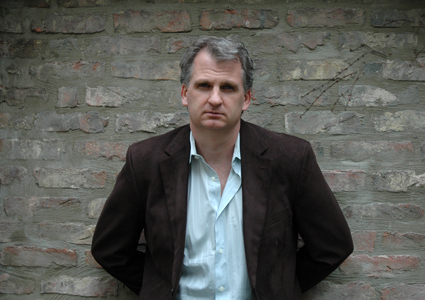
 Timothy Snyder: In “Black Earth” the Yale historian sets out to explain why the Holocaust happened and comes up with problematic answers (photo: Ine Gundersveen)
To state that Timothy Snyder’s heavily trailed book, Black Earth: The Holocaust as History and Warning (Bodley Head, £25) is bad history does not begin to express its shortcomings. It is a muddled hotchpotch of political prejudices masquerading as academic analysis. The volume needs to be understood against the background of the Yale history professor’s activities as a prime agitator in the new Cold War against Vladimir Putin’s Russia and on behalf of an increasingly powerful European Union. It also reflects the anti-Israel stance of his intellectual milieu. Indeed, the justification for paying attention to the book at all is the prominent role in current European politics being played by some of the ideas he and others are advocating.
Black Earth is the sequel to Bloodlands: Europe Between Hitler and Stalin, which was translated into 35 languages between 2010 and 2014. In Bloodlands, Snyder drew attention to the prevalence of mass murders of civilians by Joseph Stalin and Adolf Hitler in Eastern Europe from 1933 to 1945. It was in this territory that most Jewish victims were killed.
In Black Earth, the author now sets out to help us understand why the Holocaust happened, “a subject that is crying out for explanation”, he said in his 2013 Girard lecture at Stanford University.
His thesis is simple and, for those unfamiliar with recent German-language publications, surprising. Summarily rejecting what he has called the “standard” reasons, he argues that the Holocaust had two causes: Hitler’s “ecological panic” (the fear that German housewives would not have enough food to feed their families in comfort) and the breakdown of sovereign states in Eastern Europe. He asserts that “[t]he German murder of five and a half million Jews, more than three million Soviet prisoners of war, and about a million civilians in so-called anti-partisan operations all took place in stateless zones”.
This interpretation leads Snyder to issue his main “warning” for the future. We are in an age of global warming. The resulting desertification of some areas and the flooding of others lead to a risk of failed states. The result may well be another catastrophic struggle to control bread-producing lands such as the fertile expanses of Ukraine. It is in this context that Snyder has been engaged in such active pro-Ukrainian advocacy while it has been under attack from Russia.
Apart from Snyder’s disputable views about present-day European politics, something considered later in this essay, his historical approach is open to criticism on a series of grounds.
First of all, he is too imperious in sweeping aside alternative theses about why the Holocaust occurred. In Black Earth, he ignores some of the main rival interpretations to such an extent that it is necessary to listen to his views on them given briefly in presentations and lectures available on YouTube (for example, at Stanford on March 13, 2013 and at the London School of Economics on March 12, 2014). In his Stanford lecture, he asserted that the Jewish Holocaust is
Snyder proceeds to the ridiculous conclusion from the facts he cites repeatedly that only 3 per cent of the Jews murdered under Hitler were German and that most killings took place outside German soil:
This ignores the fact that many German Jews survived only because they were pressured to emigrate (in numbers far greater than Snyder states) in the opening years of Nazi rule; it ignores the fact that the proportion of German Jews among Holocaust victims was obviously low because the Holocaust embraced almost all of Europe whereas a small proportion of European Jewry lived in Germany; and it ignores the fact that the non-German killers of Jews were normally acting under German command. Germany’s core involvement in the Holocaust derived not from the number of its Jews who perished compared with the number of Polish Jews but from its status as the main perpetrator. That Snyder should deliberately ignore all this in his rhetoric is perverse. Using the same logic, the United States’ role in its military operation against Saddam Hussein deserves “no more than an introduction” because it took place in Iraq and the Normans were only peripherally involved in 1066 in the Battle of Hastings because Hastings is not in Normandy.
an event whose explanations as yet have not attained the kind of . . . penetration one would need. After all, if one were to recite the standard reasons that we give for the Holocaust, none of them really can withstand much more than a moment or two of scrutiny.
If it was because of the way that the Germans are, then one would also have to accept that the Germans are not just good at being National Socialists, they were also very good at being Communists and probably the best in the world at being capitalists.
So, an explanation from German nature or from German history even tends to fall apart very quickly.
Snyder proceeds to the ridiculous conclusion from the facts he cites repeatedly that only 3 per cent of the Jews murdered under Hitler were German and that most killings took place outside German soil:
[T]he idea that this was a breakdown in German civilisation . . . and yet most of the Holocaust didn’t happen in Germany; most German Jews survived; most of the perpetrators were not German; the first Jews who were killed had never been touched by German power until the moment they were killed. And so a story that involves things that happened in Germany certainly can be no more than an introduction.
This ignores the fact that many German Jews survived only because they were pressured to emigrate (in numbers far greater than Snyder states) in the opening years of Nazi rule; it ignores the fact that the proportion of German Jews among Holocaust victims was obviously low because the Holocaust embraced almost all of Europe whereas a small proportion of European Jewry lived in Germany; and it ignores the fact that the non-German killers of Jews were normally acting under German command. Germany’s core involvement in the Holocaust derived not from the number of its Jews who perished compared with the number of Polish Jews but from its status as the main perpetrator. That Snyder should deliberately ignore all this in his rhetoric is perverse. Using the same logic, the United States’ role in its military operation against Saddam Hussein deserves “no more than an introduction” because it took place in Iraq and the Normans were only peripherally involved in 1066 in the Battle of Hastings because Hastings is not in Normandy.
The function, if not the intention, of Snyder’s dismissal of any need to inquire into the factors which may have led German citizens into acquiescence with Hitler is to provide the country with an historical free ride.
Snyder is then dismissive of anti-Semitism as a cause of the Shoah:
This reduces what surely should be the core issue of Holocaust explanation to a slick debating point. It also ignores the importance of examining anti-Semitism as a motivation of the German architects of the Holocaust rather than “local” anti-Semitism (presumably among Baltic, Polish and Ukrainian and other populations).
Second, Snyder devotes an undue amount of space, including an entire chapter, to pre-war contacts between Poland’s anti-Semitic government and Zionist Revisionist Jews, the precursors to Benjamin Netanyahu’s Likud Party in Israel. Poland was willing to train and arm Zionist hardliners so that they could expel the British from Palestine by acts of terrorism, create a Jewish state and enable millions of Polish Jews to emigrate there from Poland. Though this is an interesting and already much recorded episode, it is open to question why Snyder gives it such prominence in a book that sets out to explain the Holocaust. Shortly before the outbreak of the Second World War, some members of the Irgun (later the main Jewish terrorist organisation in Palestine under Menachem Begin) received clandestine training in Poland, but the numbers were small. Crucially, the alliance of convenience between the Irgun and the Polish authorities had few effects and had no significant influence on the Shoah. Certainly, it was not a cause of it.
Third, Snyder returns yet again in Black Earth to a theme he has explored several times before: namely that the Holocaust was about much more than Auschwitz and that millions of Jews were shot rather than gassed. To some degree, he is justified in pointing out that Auschwitz is far better known than other major killing sites. But he greatly exaggerates the novelty of this observation. As Sir Richard Evans rightly states in a highly critical review of Bloodlands, republished in his recent collection of essays The Third Reich in History and Memory (Little Brown, £20), “We know about the events Snyder describes already, despite his repeated assertions that we don’t.”
Snyder is then dismissive of anti-Semitism as a cause of the Shoah:
[W]e fall back then to the anti-Semitism among the people among whom the Jews lived and to be sure there was a great deal of anti-Semitism among the peoples among whom the Jews lived in Eastern Europe. Jews lived for five hundred years in Eastern Europe. This was the demographic homeland of the Jewish people for five hundred years . . . and they lived among a great deal of anti-Judaic and modern anti- Semitic feeling. However, there’s so much of it that to explain . . . there’s so much of it. It’s so ubiquitous that it can’t really be the explanation. You see, to explain the Holocaust by the presence of local anti-Semitism is like explaining a hurricane by the presence of air.
This reduces what surely should be the core issue of Holocaust explanation to a slick debating point. It also ignores the importance of examining anti-Semitism as a motivation of the German architects of the Holocaust rather than “local” anti-Semitism (presumably among Baltic, Polish and Ukrainian and other populations).
Second, Snyder devotes an undue amount of space, including an entire chapter, to pre-war contacts between Poland’s anti-Semitic government and Zionist Revisionist Jews, the precursors to Benjamin Netanyahu’s Likud Party in Israel. Poland was willing to train and arm Zionist hardliners so that they could expel the British from Palestine by acts of terrorism, create a Jewish state and enable millions of Polish Jews to emigrate there from Poland. Though this is an interesting and already much recorded episode, it is open to question why Snyder gives it such prominence in a book that sets out to explain the Holocaust. Shortly before the outbreak of the Second World War, some members of the Irgun (later the main Jewish terrorist organisation in Palestine under Menachem Begin) received clandestine training in Poland, but the numbers were small. Crucially, the alliance of convenience between the Irgun and the Polish authorities had few effects and had no significant influence on the Shoah. Certainly, it was not a cause of it.
Third, Snyder returns yet again in Black Earth to a theme he has explored several times before: namely that the Holocaust was about much more than Auschwitz and that millions of Jews were shot rather than gassed. To some degree, he is justified in pointing out that Auschwitz is far better known than other major killing sites. But he greatly exaggerates the novelty of this observation. As Sir Richard Evans rightly states in a highly critical review of Bloodlands, republished in his recent collection of essays The Third Reich in History and Memory (Little Brown, £20), “We know about the events Snyder describes already, despite his repeated assertions that we don’t.”
Snyder’s chapter in Black Earth on “The Auschwitz Paradox” propagates the view that “while Auschwitz has been remembered, the rest has been largely forgotten”. This remark certainly does not apply to many previous works, including classics such as Sir Martin Gilbert’s The Holocaust: The Jewish Tragedy or to Christopher Browning’s and Daniel Goldhagen’s differing and much-discussed interpretations of the mass shootings of Jews in the Baltics in Ordinary Men and Hitler’s Willing Executioners. Fourth, the book gives only scant credit to historians such as Christian Gerlach, who have already explored much of the territory covered now by Snyder.
Fifth, Black Earth includes chapters which string together moving stories about rescuers of Jews — “The Grey Saviours” and “The Righteous Few”. These are written in a compelling style and they are informative about the tangle of good and evil acts in extreme circumstances. But they seem to be appendages added to create human interest with little relevance to Snyder’s professed explanatory task.
Sixth, this brings us to one of Snyder’s two explanations of the Holocaust, namely that the mass murder of Jews was facilitated by Hitler’s creation of “stateless zones”. It is the only point calling for review. Snyder’s other explanation, Hitler’s “ecological panic” and the danger of another holocaust caused by global warming, wanders too far from an analysis of the mass murder of European Jewry to require discussion here. The author’s concluding chapter about global warming even strays into a critique of United States policy in Iraq after the overthrow of Saddam Hussein.
Following Hannah Arendt, Snyder stresses the protection offered by citizenship and a passport even in circumstances where the authorities of the issuing countries were in no position to offer direct protection. For example, the Nazis did not venture to murder Jewish Americans who became their prisoners of war. Anti-Semitic allies of Hitler such as Ion Antonescu in Romania protected their Jewish citizens from deportation by the Nazis provided they lived in the country’s undisputed territory. By contrast, Antonescu indulged in the mass murder of Jews living in territories such as Bessarabia and Bukovina (“stateless zones”) which had been lost to the Soviet Union and had then been retaken following the Nazi attack on the Soviet Union in June 1941. In German-occupied France, Jewish refugees from other countries were at far greater danger than Jews who were French citizens. While Hungary remained allied to Germany and refused until 1944 to permit Hitler to deport its Jewish citizens, Jews living in Hungary’s extended territories without Hungarian citizenship were deported in their thousands in 1941 to Nazi-occupied Galicia where they were murdered by the Nazi Einsatzgruppen at Kamenets-Podolsk.
Snyder is undoubtedly correct in pointing to the travails of statelessness, especially in dangerous times. He is realistic as well in stressing that the chaos of war made it far easier to commit mass murder. Jews were in the gravest danger in areas such as the Baltic countries, which were occupied in short succession by the Soviet Union (following the Molotov-Ribbentrop Pact of August 1939) and then by Nazi Germany in June 1941.
Fifth, Black Earth includes chapters which string together moving stories about rescuers of Jews — “The Grey Saviours” and “The Righteous Few”. These are written in a compelling style and they are informative about the tangle of good and evil acts in extreme circumstances. But they seem to be appendages added to create human interest with little relevance to Snyder’s professed explanatory task.
Sixth, this brings us to one of Snyder’s two explanations of the Holocaust, namely that the mass murder of Jews was facilitated by Hitler’s creation of “stateless zones”. It is the only point calling for review. Snyder’s other explanation, Hitler’s “ecological panic” and the danger of another holocaust caused by global warming, wanders too far from an analysis of the mass murder of European Jewry to require discussion here. The author’s concluding chapter about global warming even strays into a critique of United States policy in Iraq after the overthrow of Saddam Hussein.
Following Hannah Arendt, Snyder stresses the protection offered by citizenship and a passport even in circumstances where the authorities of the issuing countries were in no position to offer direct protection. For example, the Nazis did not venture to murder Jewish Americans who became their prisoners of war. Anti-Semitic allies of Hitler such as Ion Antonescu in Romania protected their Jewish citizens from deportation by the Nazis provided they lived in the country’s undisputed territory. By contrast, Antonescu indulged in the mass murder of Jews living in territories such as Bessarabia and Bukovina (“stateless zones”) which had been lost to the Soviet Union and had then been retaken following the Nazi attack on the Soviet Union in June 1941. In German-occupied France, Jewish refugees from other countries were at far greater danger than Jews who were French citizens. While Hungary remained allied to Germany and refused until 1944 to permit Hitler to deport its Jewish citizens, Jews living in Hungary’s extended territories without Hungarian citizenship were deported in their thousands in 1941 to Nazi-occupied Galicia where they were murdered by the Nazi Einsatzgruppen at Kamenets-Podolsk.
Snyder is undoubtedly correct in pointing to the travails of statelessness, especially in dangerous times. He is realistic as well in stressing that the chaos of war made it far easier to commit mass murder. Jews were in the gravest danger in areas such as the Baltic countries, which were occupied in short succession by the Soviet Union (following the Molotov-Ribbentrop Pact of August 1939) and then by Nazi Germany in June 1941.
It is a pity that he takes this valid and important observation too far, thereby falling prey to vagueness, inconsistency and error.
Vagueness results from the different meanings he gives to the concept of “stateless zone”. The core meaning of such a zone is a territory in which sovereignty has been lost and in addition where the apparatus of government and the rule of law have disintegrated. A territory may or may not become a “stateless zone” following occupation by a foreign power. It depends on what happens to its machinery of government and law. Following its defeat in 1940, France suffered occupation but did not become a zone of lawlessness. The analytical problem is that the criteria of statehood and statelessness become unclear. States may have varying degrees of statehood. Thus, in explaining why a higher percentage of Jews were murdered in occupied Holland than in occupied France, Snyder is forced to explain that the Netherlands “were, for several reasons, the closest approximation to statelessness in Western Europe”. The SS, he explains, had greater dominance in the Netherlands. The problem is that Snyder’s reasoning risks becoming circular and thus loses much of its explanatory force. If the degree of statelessness depends on that of Nazi dominance, why not merely conclude that the Nazis killed Jews most easily where they enjoyed the greatest dominance — true but banal?
There are further difficulties. It is not accurate to assert that German murders of Jews all took place in stateless zones. German Jews who failed to emigrate or to hide were liquidated; Germany certainly was not a stateless zone as defined by Snyder at the time it murdered its remaining Jews. That most of them were deported to the East before being killed there hardly affects the issue. In Hungary, the government of Admiral Horthy agreed in March to June 1944 to deport nearly a half million of its Jewish citizens, most of whom were then gassed at Auschwitz. Though under pressure from its senior ally in Berlin, Hungary was not a stateless zone at that time.
Snyder’s analysis also fails to accommodate mass murders by governments of their own citizens, which do not occur in “stateless zones”. Stalin’s starvation of kulaks in the 1930s, the deaths by starvation and violence during Mao Zedong’s “Great Leap Forward” in China from the late 1950s, the Indonesian regime’s murders of Communists in the 1960s, Pol Pot’s killings in Cambodia as well as all too recent numerous events in Africa are examples.
His finding that the breakdown of nation states was a prime causal factor of the Holocaust leads him to conclude that nation states are indispensable. This, of course, is inconsistent with his avid support for the European Union. The essence of its “European Project” is to weaken the role of nation states. Indeed, when interviewed in Bratislava in June 2015, he accused Russia under the “tyrannical” Putin of wishing to destroy the EU by turning it “into a big mass of nation states”.
Seventh and finally, Snyder’s concept of the character and role of historical explanation is questionable. This is especially the case with application to the Holocaust. He argues (again in his Stanford lecture) that historical explanation “can only work if its arguments apply both to the past and to the present . . . if it brings an event of the past into our own present understanding . . . in the sense that it enlightens our present and may give us a hint about what’s going to happen in the future”.
Vagueness results from the different meanings he gives to the concept of “stateless zone”. The core meaning of such a zone is a territory in which sovereignty has been lost and in addition where the apparatus of government and the rule of law have disintegrated. A territory may or may not become a “stateless zone” following occupation by a foreign power. It depends on what happens to its machinery of government and law. Following its defeat in 1940, France suffered occupation but did not become a zone of lawlessness. The analytical problem is that the criteria of statehood and statelessness become unclear. States may have varying degrees of statehood. Thus, in explaining why a higher percentage of Jews were murdered in occupied Holland than in occupied France, Snyder is forced to explain that the Netherlands “were, for several reasons, the closest approximation to statelessness in Western Europe”. The SS, he explains, had greater dominance in the Netherlands. The problem is that Snyder’s reasoning risks becoming circular and thus loses much of its explanatory force. If the degree of statelessness depends on that of Nazi dominance, why not merely conclude that the Nazis killed Jews most easily where they enjoyed the greatest dominance — true but banal?
There are further difficulties. It is not accurate to assert that German murders of Jews all took place in stateless zones. German Jews who failed to emigrate or to hide were liquidated; Germany certainly was not a stateless zone as defined by Snyder at the time it murdered its remaining Jews. That most of them were deported to the East before being killed there hardly affects the issue. In Hungary, the government of Admiral Horthy agreed in March to June 1944 to deport nearly a half million of its Jewish citizens, most of whom were then gassed at Auschwitz. Though under pressure from its senior ally in Berlin, Hungary was not a stateless zone at that time.
Snyder’s analysis also fails to accommodate mass murders by governments of their own citizens, which do not occur in “stateless zones”. Stalin’s starvation of kulaks in the 1930s, the deaths by starvation and violence during Mao Zedong’s “Great Leap Forward” in China from the late 1950s, the Indonesian regime’s murders of Communists in the 1960s, Pol Pot’s killings in Cambodia as well as all too recent numerous events in Africa are examples.
His finding that the breakdown of nation states was a prime causal factor of the Holocaust leads him to conclude that nation states are indispensable. This, of course, is inconsistent with his avid support for the European Union. The essence of its “European Project” is to weaken the role of nation states. Indeed, when interviewed in Bratislava in June 2015, he accused Russia under the “tyrannical” Putin of wishing to destroy the EU by turning it “into a big mass of nation states”.
Seventh and finally, Snyder’s concept of the character and role of historical explanation is questionable. This is especially the case with application to the Holocaust. He argues (again in his Stanford lecture) that historical explanation “can only work if its arguments apply both to the past and to the present . . . if it brings an event of the past into our own present understanding . . . in the sense that it enlightens our present and may give us a hint about what’s going to happen in the future”.
The danger of this doctrine of “explanation” is that it lends itself to making the Holocaust a tool of contemporary politics with different persons and groups twisting it or invoking it for what will inevitably be unsuitable or even trivial purposes. This danger applies to political uses of memory in many contexts, including Israeli as well as European discourse.
Given Snyder’s self-confessed approach, it becomes relevant to look to his own political attachments and statements as public intellectual for a key to understanding the probable impulse behind Black Earth.
Following doctoral research at Oxford supervised by the Euro-confederalist Timothy Garton Ash, Snyder has become closely linked with a number of pro-EU, anti-Russian bodies. He wrote a book with the terminally ill Jewish anti-Zionist Tony Judt and is married to another anti-Zionist Jewish scholar, Marci Shore. For the past decade, he has led a project at the Vienna-based Institute for Human Sciences (IWM) to create a united European history. The institute is funded by the Austrian and Polish governments as well as by George Soros. The stated aim of the institute’s history project is to create what it calls a “synthesis that embraces various points of view”. This must include the input of the Baltic states admitted to the EU a decade ago. According to the IWM: “The new member states generally bring to the EU a common interest in comparative totalitarianism, born out of their experience of especially brutal German occupation practices during World War II, and then of four decades of communist rule thereafter. An experience that is unknown to the West European members of the European Union.”
As Snyder said in a lecture on May 15, 2014 to the Kyiv-Mohyla Academy, “Europe itself becomes the way we think about the past.”
Unfortunately, this project involves giving weight to the strongly anti-Semitic cultures within some of these newly admitted EU members. I was constantly confronted with this (alongside much personal kindness) when I spent time in the Baltics advising two of their governments on anti-corruption policy on behalf of the EU as part of their preparation for admission as members. The attempt of Snyder’s project to “produce a new sort of history of Europe that addresses subjective problems indirectly, by way of a synthesis” smacks of social engineering rather than free and plural academic pursuit. It asks us to integrate unacceptable aspects of Eastern European culture into our own historical understanding.
In a June 2015 statement in Slovakia, Snyder declared that “[t]he EU is essentially the best way of life ever offered in the history of the West.” In a strongly anti-Russian speech at the European Parliament, he called for a “European model of coming to terms with the past”. The problem he faces is that at least part of this “model” oozes with anti-Semitism and with stated or implied Nazi-Soviet parity of horror.
Given Snyder’s self-confessed approach, it becomes relevant to look to his own political attachments and statements as public intellectual for a key to understanding the probable impulse behind Black Earth.
Following doctoral research at Oxford supervised by the Euro-confederalist Timothy Garton Ash, Snyder has become closely linked with a number of pro-EU, anti-Russian bodies. He wrote a book with the terminally ill Jewish anti-Zionist Tony Judt and is married to another anti-Zionist Jewish scholar, Marci Shore. For the past decade, he has led a project at the Vienna-based Institute for Human Sciences (IWM) to create a united European history. The institute is funded by the Austrian and Polish governments as well as by George Soros. The stated aim of the institute’s history project is to create what it calls a “synthesis that embraces various points of view”. This must include the input of the Baltic states admitted to the EU a decade ago. According to the IWM: “The new member states generally bring to the EU a common interest in comparative totalitarianism, born out of their experience of especially brutal German occupation practices during World War II, and then of four decades of communist rule thereafter. An experience that is unknown to the West European members of the European Union.”
As Snyder said in a lecture on May 15, 2014 to the Kyiv-Mohyla Academy, “Europe itself becomes the way we think about the past.”
Unfortunately, this project involves giving weight to the strongly anti-Semitic cultures within some of these newly admitted EU members. I was constantly confronted with this (alongside much personal kindness) when I spent time in the Baltics advising two of their governments on anti-corruption policy on behalf of the EU as part of their preparation for admission as members. The attempt of Snyder’s project to “produce a new sort of history of Europe that addresses subjective problems indirectly, by way of a synthesis” smacks of social engineering rather than free and plural academic pursuit. It asks us to integrate unacceptable aspects of Eastern European culture into our own historical understanding.
In a June 2015 statement in Slovakia, Snyder declared that “[t]he EU is essentially the best way of life ever offered in the history of the West.” In a strongly anti-Russian speech at the European Parliament, he called for a “European model of coming to terms with the past”. The problem he faces is that at least part of this “model” oozes with anti-Semitism and with stated or implied Nazi-Soviet parity of horror.
Apart from his main position at Yale, he is a visiting professor at the College d’Europe’s Warsaw branch at Natolin, an EU institution. After Sir Martin Gilbert and other leading Holocaust scholars resigned in protest from the Lithuanian government’s historical commission in protest against Lithuania’s outrageous actions in pursuing the head of Yad Vashem, the Israeli Holocaust commemoration centre, as a possible war criminal, Snyder was one of those who agreed to join. Following controversial diplomatic activity, Yad Vashem itself agreed to rejoin the commission. Snyder accepted a place on the commission after the Lithuanian government sponsored and passed a resolution of the Organisation for Security and Co-operation in Europe — the Vilnius Declaration of 2009 — “equating,” as reported by the BBC, “the roles of the USSR and Nazi Germany in starting World War II”.
Snyder has repeatedly excoriated Russia for aggression against Ukraine, contrasting German virtue with Russian vice. Urging CDU/CSU Bundestag deputies on June 10 to take a more robust line in support of Ukraine, he assured them that Germany’s actions to take responsibility after the Holocaust have been “exemplary” and that Germany is “better than everyone else in carrying out historical discussions”. On June 20, he attended the high-level annual Global Security Conference in Slovakia where he urged an enlargement of the EU to include Ukraine. Reverting to his concern in Black Earth about land, and chillingly oblivious of the throwback to Hitler’s quest for Lebensraum, he suggested that Ukraine has a lot to offer the EU because “it has quality agricultural land which the EU doesn’t have so much of”.
The strength of Snyder’s praise for present-day Germany and his harsh criticism of Russia must add to the suspicion that an objective of Bloodlands, Black Earth and of Snyder’s essays in the New York Review of Books and elsewhere is to shift some Holocaust blame from Hitler to Stalin. In his review of Bloodlands, Evans wrote that Snyder’s account constituted “a narrative that homogenises the history of mass murder by equating Hitler’s policies with those of Stalin”.
Speaking in 2012 at the US Embassy in Lithuania, Snyder insisted that those who suggested he had made such an equivalence either had not read his book or were “animated by bad faith”. His account of the struggles in Poland and the Baltic states between the Nazi and Communist superpowers focused on the interaction between them and the effects of such interaction on local attitudes to their Jewish populations. This, he argued, was different from a comparison between the relative evils of the two regimes. Moreover, though he had not set out to make a comparison, the findings of his book showed that Hitler was worse than Stalin both in the numbers he murdered and in his genocidal intent.
Whatever conclusion is drawn about the purpose and impact of Snyder’s work, it is impossible to ignore the background of his controversial activities in the field of public diplomacy in Central and Eastern Europe.
Snyder has repeatedly excoriated Russia for aggression against Ukraine, contrasting German virtue with Russian vice. Urging CDU/CSU Bundestag deputies on June 10 to take a more robust line in support of Ukraine, he assured them that Germany’s actions to take responsibility after the Holocaust have been “exemplary” and that Germany is “better than everyone else in carrying out historical discussions”. On June 20, he attended the high-level annual Global Security Conference in Slovakia where he urged an enlargement of the EU to include Ukraine. Reverting to his concern in Black Earth about land, and chillingly oblivious of the throwback to Hitler’s quest for Lebensraum, he suggested that Ukraine has a lot to offer the EU because “it has quality agricultural land which the EU doesn’t have so much of”.
The strength of Snyder’s praise for present-day Germany and his harsh criticism of Russia must add to the suspicion that an objective of Bloodlands, Black Earth and of Snyder’s essays in the New York Review of Books and elsewhere is to shift some Holocaust blame from Hitler to Stalin. In his review of Bloodlands, Evans wrote that Snyder’s account constituted “a narrative that homogenises the history of mass murder by equating Hitler’s policies with those of Stalin”.
Speaking in 2012 at the US Embassy in Lithuania, Snyder insisted that those who suggested he had made such an equivalence either had not read his book or were “animated by bad faith”. His account of the struggles in Poland and the Baltic states between the Nazi and Communist superpowers focused on the interaction between them and the effects of such interaction on local attitudes to their Jewish populations. This, he argued, was different from a comparison between the relative evils of the two regimes. Moreover, though he had not set out to make a comparison, the findings of his book showed that Hitler was worse than Stalin both in the numbers he murdered and in his genocidal intent.
Whatever conclusion is drawn about the purpose and impact of Snyder’s work, it is impossible to ignore the background of his controversial activities in the field of public diplomacy in Central and Eastern Europe.
Snyder has been welcomed by Central and Eastern European governments, which have been promoting highly undesirable initiatives within the EU formally to establish “impartiality” between Nazi and Soviet “totalitarianism” (the term “totalitarianism” itself being a throwback to Cold War thinking). In practice, such an approach has come to involve an almost complete emphasis on Communist misdeeds. In Vilnius, the Museum of Genocide Victims consisted until recently of exhibits devoted to Communist victims alone despite the fact that the building had served as the Gestapo headquarters. Finally, a single basement “Holocaust room” was set up in token response to heavy international pressure.
The dogma of “double genocide” — Nazi/Communist equivalence — was declared in the Prague Declaration of 2008 signed by Vaclav Havel among others and promoted by the Czech government. In 2009, the European Parliament endorsed the same doctrine in a resolution on “European conscience and totalitarianism”. This called for the establishment of a Platform of European Memory and Conscience specialising in the subject of totalitarian history and for the proclamation of August 23 as a Europe-wide day of remembrance of victims of “all totalitarian and authoritarian regimes”. In adding that they were to be remembered “with impartiality”, the resolution clearly hinted that Jewish victims of the Holocaust had unjustifiably claimed favourable historical treatment. The Platform for European Conscience and Memory was duly set up in 2011 in Prague with partial EU funding. In 2012, an initiative of German and Polish politicians led to the creation by the Platform of a legal group to draw up proposals for an international institution of justice devoted to “crimes committed by the Communist dictatorships”. These are merely a few of the initiatives by official European bodies to shift the focus of historical attention to terror under the Communist regimes which governed much of the European continent until 1989-90.
In the UK too, there have been official attempts ahead of David Cameron’s negotiations leading to the forthcoming referendum on British membership of the EU to influence historical perceptions. When the regius professor of history at Cambridge, Christopher Clark, who had written sympathetically about Germany’s role in the events leading to the First World War, was knighted in June 2015, his honour was awarded not on academic grounds but as part of the Foreign and Commonwealth Office’s list for his contribution to Anglo-German relations.
On June 26, 2015, the Queen and the Duke of Edinburgh paid a visit to the Bergen-Belsen concentration camp. The Duke’s mother had been declared a “righteous gentile” by Yad Vashem for her role in hiding Jews in Greece during the German occupation. The dignified and carefully arranged event came right after the Queen’s speech at a state dinner in Berlin in which she went out of her way to put the visit into context. It had been preceded by another royal visit to Dresden (thus implying matching British guilt for bombing the city in 1945). The visit to Belsen would “underline the complete reconciliation between our countries. Germany has reconciled with all her neighbours. I pay tribute to the work of the German statesmen since the Second World War who reinvented Germany and helped to rebuild Europe.”
The dogma of “double genocide” — Nazi/Communist equivalence — was declared in the Prague Declaration of 2008 signed by Vaclav Havel among others and promoted by the Czech government. In 2009, the European Parliament endorsed the same doctrine in a resolution on “European conscience and totalitarianism”. This called for the establishment of a Platform of European Memory and Conscience specialising in the subject of totalitarian history and for the proclamation of August 23 as a Europe-wide day of remembrance of victims of “all totalitarian and authoritarian regimes”. In adding that they were to be remembered “with impartiality”, the resolution clearly hinted that Jewish victims of the Holocaust had unjustifiably claimed favourable historical treatment. The Platform for European Conscience and Memory was duly set up in 2011 in Prague with partial EU funding. In 2012, an initiative of German and Polish politicians led to the creation by the Platform of a legal group to draw up proposals for an international institution of justice devoted to “crimes committed by the Communist dictatorships”. These are merely a few of the initiatives by official European bodies to shift the focus of historical attention to terror under the Communist regimes which governed much of the European continent until 1989-90.
In the UK too, there have been official attempts ahead of David Cameron’s negotiations leading to the forthcoming referendum on British membership of the EU to influence historical perceptions. When the regius professor of history at Cambridge, Christopher Clark, who had written sympathetically about Germany’s role in the events leading to the First World War, was knighted in June 2015, his honour was awarded not on academic grounds but as part of the Foreign and Commonwealth Office’s list for his contribution to Anglo-German relations.
On June 26, 2015, the Queen and the Duke of Edinburgh paid a visit to the Bergen-Belsen concentration camp. The Duke’s mother had been declared a “righteous gentile” by Yad Vashem for her role in hiding Jews in Greece during the German occupation. The dignified and carefully arranged event came right after the Queen’s speech at a state dinner in Berlin in which she went out of her way to put the visit into context. It had been preceded by another royal visit to Dresden (thus implying matching British guilt for bombing the city in 1945). The visit to Belsen would “underline the complete reconciliation between our countries. Germany has reconciled with all her neighbours. I pay tribute to the work of the German statesmen since the Second World War who reinvented Germany and helped to rebuild Europe.”
There have been brave attempts by British political figures such as Dr Denis MacShane to protest against the “double genocide” movement. In Vilnius, several foreign ambassadors, led by the British ambassador, complained to the Lithuanian President in 2010 about “spurious attempts . . . to equate the uniquely evil genocide of the Jews with Soviet crimes against Lithuania. Which, though great in magnitude, cannot be regarded as equivalent in either their intention or result.”
The UK and the West have ample reason to be alarmed about the state of politics within Putin’s Russia and indeed about the serious turn of events in Ukraine, where there can be no reasonable doubt that the separatist forces are Russian or Russian-backed. The quest for reconciliation with Germany is justified, though in my view not yet nearly as complete as many wish to believe if only because of Germany’s refusal to accept that slave labour imposed by the Nazis was illegal. At the same time, Britain has good reason to avoid entanglement with the dark forces at work within several countries in Central and Eastern Europe where implied or overt anti-Semitic statements are becoming all too common. The government ought also to take care to avoid adjusting history to fit diplomatic needs.
In a utopian enthusiasm for a constantly widening European Union which will replace nation-states, too many of its intellectual advocates have identified Russia as the common enemy in face of which they can press for ever closer union. Certainly, much that has been going on under Putin deserves serious alarm. At the same time, the European Union expansionism explicitly favoured by Snyder and others has provided too great an incentive to reinterpret and skew the study of 20th-century historical tragedies. “History wars” are part of a process which is leading us back to the days of the Cold War and to an unpredictable conflict between a dangerous Russia and an expansive European Union influenced by Central and Eastern European member countries seeking vengeance for their sufferings as Soviet satellites.
Any attempt to “explain” the Holocaust which is motivated by the desire to justify this new Cold War risks becoming poor history and ill-considered politics.
The UK and the West have ample reason to be alarmed about the state of politics within Putin’s Russia and indeed about the serious turn of events in Ukraine, where there can be no reasonable doubt that the separatist forces are Russian or Russian-backed. The quest for reconciliation with Germany is justified, though in my view not yet nearly as complete as many wish to believe if only because of Germany’s refusal to accept that slave labour imposed by the Nazis was illegal. At the same time, Britain has good reason to avoid entanglement with the dark forces at work within several countries in Central and Eastern Europe where implied or overt anti-Semitic statements are becoming all too common. The government ought also to take care to avoid adjusting history to fit diplomatic needs.
In a utopian enthusiasm for a constantly widening European Union which will replace nation-states, too many of its intellectual advocates have identified Russia as the common enemy in face of which they can press for ever closer union. Certainly, much that has been going on under Putin deserves serious alarm. At the same time, the European Union expansionism explicitly favoured by Snyder and others has provided too great an incentive to reinterpret and skew the study of 20th-century historical tragedies. “History wars” are part of a process which is leading us back to the days of the Cold War and to an unpredictable conflict between a dangerous Russia and an expansive European Union influenced by Central and Eastern European member countries seeking vengeance for their sufferings as Soviet satellites.
Any attempt to “explain” the Holocaust which is motivated by the desire to justify this new Cold War risks becoming poor history and ill-considered politics.