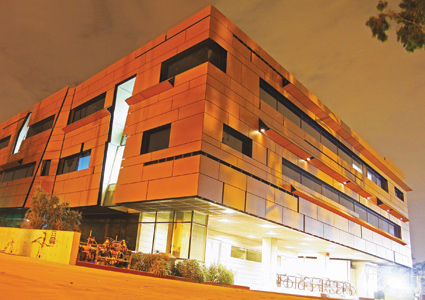
 Independence or the State? The Cahill Centre for Astronomy and Astrophysics (top) at Caltech, a private American university ranked first in the world (photo: Flickr/Dhilung)
If the Conservative government plays one card right, Britain could soon boast of the best university system in the world — better even than America’s or Australia’s. The previous Conservative government of 1979-1997 devastated higher education, so let’s hope the current one redeems the party’s record.
On coming into office in 1979, the Tories actually started well by introducing tuition fees for international students, who had hitherto been educated at the British taxpayer’s expense. That step required courage because the new fees were universally denounced, yet after the initial hiccup of a year’s fall in rolls the numbers of international student numbers then soared, and their fees have since helped keep our universities financially as well as culturally viable.
Margaret Thatcher then cut the universities’ core income (which also translated into cutting their research income) and that too required courage as that cut, too, was violently denounced: in 1985, indeed, the University of Oxford insulted her by first offering and then withdrawing an honorary degree. But Mrs Thatcher argued that Britain was spending more per capita on higher education than almost any other OECD country yet our economy had tanked. She needed to make savings and the universities had proved a poor investment.
She was right, but as the economy recovered during the later 1980s and ’90s the Tories failed to increase the universities’ income pari passu, and when in 1992 John Major turned the former polytechnics into universities — while simultaneously imposing an unpleasant regulatory regime on the older institutions — British higher education hit a nadir of low quality, poor funding, low morale and oppressive supervision. By 1997 the UK was spending only 1 per cent of GDP on higher education (19th out of the 27 OECD member states) while over the previous five years its expenditure per student had fallen by 21 per cent, down to 12th in the OECD. And we were only 19th in the OECD for the proportion of young people enrolled in university. In short, our universities had descended to the level of continental Europe’s.
One of the great international paradoxes of higher education is the poor quality of French, German, Italian and other continental universities, many of which are little better than institutions of mass alienation where remote academics pontificate at anonymous students across impersonal lecture theatres. The British university, in contrast, has always aspired to be an alma mater where student drop-out rates are low and where staff and students engage in the joint enterprise of education, but by 1997 that aspiration was almost forgone. And then Tony Blair won.
Blair believed in universities. He increased their government funding, he increased their private funding by introducing undergraduate fees of £1,000 pa, and he reformed the regulations. Then in 2003 he proposed increasing the undergraduate fees to £3,000 p.a. His intention was not only to increase the universities’ income but also to help shift their culture into one of greater independence and entrepreneurship. That step required vast courage because those fees were opposed by, inter alia, almost every Labour and Lib Dem MP — and by the Tories, who seemed to rejoice in the squalor to which they had reduced the sector.
Labour MPs could be whipped and the Lib Dems ignored but the Tories almost scuppered the legislation. Led by Michael Howard and David Willetts, both of whom had sent their children to private schools, the Tories argued that there was no place for a market in education, but the Bill squeezed through by five votes (famously Alan Johnson, the junior education minister, said that he and his boss Charles Clarke got the Bill through by a charm offensive, with him providing the charm and Clarke the offensive). Yet again, the doom merchants were proved wrong when, after an initial fall in rolls, student numbers soared.
Then during the 2010s the Coalition raised the fees to £9,000 pa. That decision was forced on ministers because the Treasury was demanding vast economies, and the budget of the Department of Business, Innovation and Skills (which, oddly, houses science and the universities) is dominated by science and higher education rather than by business. Since the science budgets are sacrosanct (they are a form of corporate welfare, and BIS values corporate welfare) the bulk of the savings had to be made by the universities. And yet again the doom-mongers were proved wrong when, after a decline in rolls for a year, student numbers (especially those of working-class students) soared. In its Education at a Glance 2012 the OECD found that England’s tuition fees had produced the world’s most “advanced” support for students without damaging social justice.
And, wondrously, before they left office, Vince Cable and a redeemed David Willetts, of the Coalition government, abolished one of the sector’s last two remaining Leninist shackles, namely the caps on student numbers. Until recently, a university wanting to open a new course (or indeed wanting to close an old one) or wanting to change the numbers of students on a course, had to ask permission of some civil servant. And that permission would be denied if the civil servant feared that such a change might intensify competition between different universities, because competition is not allowed in the corporate state. But — and with every homage to Friedrich Engels — the state is now withering away from the universities.
In 1979, some 85 per cent of the universities’ income came from the state. Today, the bulk of their income comes from student fees and research grants. And as the universities have been forced into the market, so they have excelled. The best international university league table is provided by Times Higher Education, which incorporates 13 different indicators including measurements of teaching, research and reputation; and the first 10 universities in its current rankings are:
1. Caltech
2. Harvard
3. Oxford
4. Stanford
5. Cambridge
6. MIT
7. Princeton
8. Berkeley
=9. Imperial/ Yale
That is an astonishing list. It tell us that seven of the 10 top best universities are American (six of which are private) and that the remaining three are British (and also, despite the myth, private). In a world where the majority of universities are state-owned and neither American nor British, that dominance by private Anglophones needs explaining.
Then during the 2010s the Coalition raised the fees to £9,000 pa. That decision was forced on ministers because the Treasury was demanding vast economies, and the budget of the Department of Business, Innovation and Skills (which, oddly, houses science and the universities) is dominated by science and higher education rather than by business. Since the science budgets are sacrosanct (they are a form of corporate welfare, and BIS values corporate welfare) the bulk of the savings had to be made by the universities. And yet again the doom-mongers were proved wrong when, after a decline in rolls for a year, student numbers (especially those of working-class students) soared. In its Education at a Glance 2012 the OECD found that England’s tuition fees had produced the world’s most “advanced” support for students without damaging social justice.
And, wondrously, before they left office, Vince Cable and a redeemed David Willetts, of the Coalition government, abolished one of the sector’s last two remaining Leninist shackles, namely the caps on student numbers. Until recently, a university wanting to open a new course (or indeed wanting to close an old one) or wanting to change the numbers of students on a course, had to ask permission of some civil servant. And that permission would be denied if the civil servant feared that such a change might intensify competition between different universities, because competition is not allowed in the corporate state. But — and with every homage to Friedrich Engels — the state is now withering away from the universities.
In 1979, some 85 per cent of the universities’ income came from the state. Today, the bulk of their income comes from student fees and research grants. And as the universities have been forced into the market, so they have excelled. The best international university league table is provided by Times Higher Education, which incorporates 13 different indicators including measurements of teaching, research and reputation; and the first 10 universities in its current rankings are:
1. Caltech
2. Harvard
3. Oxford
4. Stanford
5. Cambridge
6. MIT
7. Princeton
8. Berkeley
=9. Imperial/ Yale
That is an astonishing list. It tell us that seven of the 10 top best universities are American (six of which are private) and that the remaining three are British (and also, despite the myth, private). In a world where the majority of universities are state-owned and neither American nor British, that dominance by private Anglophones needs explaining.
Europe’s universities were born private and democratic. The first, Bologna, was founded around 1100 by students seeking an education in law. Then Padua and Montpellier were founded, also as private democratic student initiatives, teaching medicine and the sciences. Soon afterwards the northern universities of Paris, Oxford and Cambridge were created, by scholars, and like their predecessors they were private and democratic, though run by the scholars rather than by the students. But soon thereafter universities were created by the Church (often from pre-existing cathedral schools) or by monarchs, and those were neither private nor democratic — the key appointment of the vice-chancellor or equivalent generally being in the gift of the Church or crown.
Worse, the Church then took control of the erstwhile independent universities. As Pope Boniface VIII stated in 1294: “You Paris masters think that the world should be ruled by your reasonings but it is to us, not you, that the world is entrusted.” The authorities thus forced the oversight of the Church onto the universities, which is why so many academic titles such as Dean or Doctor are ecclesiastical. Subsequently, under inquisitions, absolutism and Napoleon, continental Europe nationalised its universities. But after 1689 England’s took an independent course.
In 1687 James II expelled the President and 25 fellows of Magdalen College, Oxford to replace them with Catholics. Protestants were outraged — Mary, wife of William of Orange, sent the fellows £200 — and the episode helped precipitate the Glorious Revolution. That in turn spawned the Bill of Rights of 1689, whose third article stated: “That the commission for erecting the late Court of Commissioners for Ecclesiastical Causes, and all other commissions and courts of like nature, are illegal and pernicious” which, translated, meant that in 1689 England recognised the ancient rights of its universities to independence.
Although they were thus confirmed in law as private bodies, England’s — later Britain’s — universities did not spin out of 1689 fully independent, and for a further century monarchs, politicians and bishops continued to interfere: during the 1760s, for example, the Duke of Newcastle would confer degrees on his cronies by royal mandate. But the universities were on an independent trajectory and by the late 19th century they had become fully autonomous.
The American Ivy League followed the same trajectory. North America had seen nine colonial colleges created before independence in 1776: Harvard (1636), William & Mary (1693), Yale (1701), Princeton (1746), Pennsylvania (1751), Columbia (1754,) Brown (1764), Rutgers (1766) and Dartmouth (1769). The colonial colleges were, importantly, not founded by the colonial governments but, rather, by local clergymen, as theological academies. Consequently they were always private bodies, with self-governing structures modelled on the colleges of Oxford and Cambridge; and to this day, in recapitulation of their Oxbridge roots, the Presidents of Harvard and Yale chair their governing bodies as executive chairs.
Worse, the Church then took control of the erstwhile independent universities. As Pope Boniface VIII stated in 1294: “You Paris masters think that the world should be ruled by your reasonings but it is to us, not you, that the world is entrusted.” The authorities thus forced the oversight of the Church onto the universities, which is why so many academic titles such as Dean or Doctor are ecclesiastical. Subsequently, under inquisitions, absolutism and Napoleon, continental Europe nationalised its universities. But after 1689 England’s took an independent course.
In 1687 James II expelled the President and 25 fellows of Magdalen College, Oxford to replace them with Catholics. Protestants were outraged — Mary, wife of William of Orange, sent the fellows £200 — and the episode helped precipitate the Glorious Revolution. That in turn spawned the Bill of Rights of 1689, whose third article stated: “That the commission for erecting the late Court of Commissioners for Ecclesiastical Causes, and all other commissions and courts of like nature, are illegal and pernicious” which, translated, meant that in 1689 England recognised the ancient rights of its universities to independence.
Although they were thus confirmed in law as private bodies, England’s — later Britain’s — universities did not spin out of 1689 fully independent, and for a further century monarchs, politicians and bishops continued to interfere: during the 1760s, for example, the Duke of Newcastle would confer degrees on his cronies by royal mandate. But the universities were on an independent trajectory and by the late 19th century they had become fully autonomous.
The American Ivy League followed the same trajectory. North America had seen nine colonial colleges created before independence in 1776: Harvard (1636), William & Mary (1693), Yale (1701), Princeton (1746), Pennsylvania (1751), Columbia (1754,) Brown (1764), Rutgers (1766) and Dartmouth (1769). The colonial colleges were, importantly, not founded by the colonial governments but, rather, by local clergymen, as theological academies. Consequently they were always private bodies, with self-governing structures modelled on the colleges of Oxford and Cambridge; and to this day, in recapitulation of their Oxbridge roots, the Presidents of Harvard and Yale chair their governing bodies as executive chairs.
By 1776, though, the colonial colleges had already embraced their first governance revolution when many of the academics on their governing bodies were replaced by politicians. In colonial days church and state were not separated, so governments readily funded the largely theological colleges, which in turn were prepared to lose some autonomy as a quid pro quo. And the loss of autonomy was real: at Yale, for example, Connecticut’s Governor, Deputy Governor and six state senators sat on the governing body.
But following the separation of church and state after 1776, the Ivy League embarked on its second governance revolution: it ejected the politicians, replacing them on its councils with private donors. Why? Because the politicians withheld their money. Whenever a dispute arose between a state government and its local university — and such disputes were perennial because the universities had learned to defend their rights — the politicians stopped giving public money to a private body. Whereupon the colleges ejected them, to survive by alumni giving and fee income alone.
The politicians tried, of course, to retain control, and in 1815 the government of New Hampshire compulsorily nationalised Dartmouth College. But the famous 1819 ruling by the Supreme Court confirmed that the former colonial colleges were private bodies that could not be nationalised against their will; so Dartmouth was re-privatised, and higher education in America was confirmed on its trajectory of independence.
Higher education and scholarship are conventionally described as public goods that require government money, so economic theory predicts that the former colonial colleges should, on losing their public subventions, have gone bust. Instead, on breaking free from political control and government subsidies, they flourished, and thanks in part to the vast endowments they have since accumulated (Harvard: $31.7 billion; Yale: $19.3bn; Princeton: $17bn; Stanford: $16.5bn) they now dominate the international university league tables. By operating “needs blind admissions”, moreover, so no one is refused entry if they can’t pay, the Ivy League also shows how social justice can be entrusted to the private sector. Not for the first time, economic theory has been found wanting.
Ironically, though, the Americans have proved truer to Britain’s trajectory of independence than has Britain itself. Between 1689 and 1919 the British created the new, private, universities of London (1826/1836), Durham (1837), Manchester (1851), Newcastle-upon-Tyne (1852), Birmingham (1900), Liverpool (1903), Leeds (1904) and Sheffield (1905). Typical in its foundation was Birmingham University, endowed by Josiah Mason, a local industrialist who, on laying the foundation stone in 1875, said: “I, who have never been blessed with children of my own, may yet, in these students, leave behind me an intelligent, earnest, industrious and truth-loving and truth-seeking progeny for generations to come.”
Earlier, in 1799, the Royal Institution in London was created to foster research — solely on private money. By 1800 it had raised no less than £11,047, and in 1801 it appointed Humphry Davy as a lecturer (whereupon he discovered six new elements: potassium, sodium, barium, strontium, calcium and magnesium) before he proceeded to mentor his great student Michael Faraday (who in 1831 discovered electromagnetic induction, among other things).
But following the separation of church and state after 1776, the Ivy League embarked on its second governance revolution: it ejected the politicians, replacing them on its councils with private donors. Why? Because the politicians withheld their money. Whenever a dispute arose between a state government and its local university — and such disputes were perennial because the universities had learned to defend their rights — the politicians stopped giving public money to a private body. Whereupon the colleges ejected them, to survive by alumni giving and fee income alone.
The politicians tried, of course, to retain control, and in 1815 the government of New Hampshire compulsorily nationalised Dartmouth College. But the famous 1819 ruling by the Supreme Court confirmed that the former colonial colleges were private bodies that could not be nationalised against their will; so Dartmouth was re-privatised, and higher education in America was confirmed on its trajectory of independence.
Higher education and scholarship are conventionally described as public goods that require government money, so economic theory predicts that the former colonial colleges should, on losing their public subventions, have gone bust. Instead, on breaking free from political control and government subsidies, they flourished, and thanks in part to the vast endowments they have since accumulated (Harvard: $31.7 billion; Yale: $19.3bn; Princeton: $17bn; Stanford: $16.5bn) they now dominate the international university league tables. By operating “needs blind admissions”, moreover, so no one is refused entry if they can’t pay, the Ivy League also shows how social justice can be entrusted to the private sector. Not for the first time, economic theory has been found wanting.
Ironically, though, the Americans have proved truer to Britain’s trajectory of independence than has Britain itself. Between 1689 and 1919 the British created the new, private, universities of London (1826/1836), Durham (1837), Manchester (1851), Newcastle-upon-Tyne (1852), Birmingham (1900), Liverpool (1903), Leeds (1904) and Sheffield (1905). Typical in its foundation was Birmingham University, endowed by Josiah Mason, a local industrialist who, on laying the foundation stone in 1875, said: “I, who have never been blessed with children of my own, may yet, in these students, leave behind me an intelligent, earnest, industrious and truth-loving and truth-seeking progeny for generations to come.”
Earlier, in 1799, the Royal Institution in London was created to foster research — solely on private money. By 1800 it had raised no less than £11,047, and in 1801 it appointed Humphry Davy as a lecturer (whereupon he discovered six new elements: potassium, sodium, barium, strontium, calcium and magnesium) before he proceeded to mentor his great student Michael Faraday (who in 1831 discovered electromagnetic induction, among other things).
But this autochthonic picture in the UK changed after 1914-18 because the Great War bankrupted the universities: both of their major sources of income (fees and endowments) evaporated. The fee income disappeared as the young men abandoned their studies for the Western Front, and — more gravely in the long-term — the universities’ endowment income also collapsed: between 1815 and 1914 the value of sterling had actually risen (deflation) so, rationally, the universities had long invested in fixed-income vehicles. But between 1914 and 1918 the pound lost three-quarters of its value — and inflation continued after 1918 — so the universities’ endowment income collapsed.
By 1919 the universities were reporting vast deficits, and some may even have been trading insolvently, so in that year the government’s University Grant Committee was instituted with an annual budget of £1 million; and that committee was eventually to mutate into John Major’s Higher Education Funding Councils (HEFCs) that, thanks to their vast budgets and power mania, were to treat the universities as subordinate branches of the civil service, until Tony Blair started the process of de facto privatisation.
But the continent of Europe has remained true to its nationalisations, and though it has always paid lip service to Wilhelm von Humboldt’s ideas of Lernfreiheit (the right to study freely) and Lehrfreiheit (the right to teach freely), in practice their universities have been only too supine. Indeed, Spain is but one of many countries where academics really are civil servants, while Hungary is but one country where the appointment of rectors (i.e. vice-chancellors) has to be confirmed by the minister of education.
Why does university independence translate into excellence? One answer is monopoly: when a government has nationalised the universities and — as generally happens — abolished fees, then that government enjoys a monopolistic control of higher education. Why, therefore, would it put into the universities a penny more than the absolute minimum? Yet the consequences are, as the EU Commission reported in its 2003 Role of the Universities in the Europe of Knowledge that “American universities have far more substantial means than those of European universities — on average, two to five times higher per student . . . The gap stems primarily from the low level of private funding of higher education in Europe.” Since one source of university excellence is money, free-market America beats monopolistic Europe because students and their parents will contribute more in fees than will governments.
Competition is another source of excellence and, when students pay, independent universities compete to satisfy them where state universities need not. Equally, in their search for reputation, independent universities compete for research monies in ways that state universities need not. And the more independent a university, the more it is run by the academics themselves, and — as Oxford, Cambridge, Harvard and Yale confirm — academics know better than anyone else how to run a university. Government ministers and bureaucrats are menaces, and even university councils of non-executives can be obstacles to progress.
By 1919 the universities were reporting vast deficits, and some may even have been trading insolvently, so in that year the government’s University Grant Committee was instituted with an annual budget of £1 million; and that committee was eventually to mutate into John Major’s Higher Education Funding Councils (HEFCs) that, thanks to their vast budgets and power mania, were to treat the universities as subordinate branches of the civil service, until Tony Blair started the process of de facto privatisation.
But the continent of Europe has remained true to its nationalisations, and though it has always paid lip service to Wilhelm von Humboldt’s ideas of Lernfreiheit (the right to study freely) and Lehrfreiheit (the right to teach freely), in practice their universities have been only too supine. Indeed, Spain is but one of many countries where academics really are civil servants, while Hungary is but one country where the appointment of rectors (i.e. vice-chancellors) has to be confirmed by the minister of education.
Why does university independence translate into excellence? One answer is monopoly: when a government has nationalised the universities and — as generally happens — abolished fees, then that government enjoys a monopolistic control of higher education. Why, therefore, would it put into the universities a penny more than the absolute minimum? Yet the consequences are, as the EU Commission reported in its 2003 Role of the Universities in the Europe of Knowledge that “American universities have far more substantial means than those of European universities — on average, two to five times higher per student . . . The gap stems primarily from the low level of private funding of higher education in Europe.” Since one source of university excellence is money, free-market America beats monopolistic Europe because students and their parents will contribute more in fees than will governments.
Competition is another source of excellence and, when students pay, independent universities compete to satisfy them where state universities need not. Equally, in their search for reputation, independent universities compete for research monies in ways that state universities need not. And the more independent a university, the more it is run by the academics themselves, and — as Oxford, Cambridge, Harvard and Yale confirm — academics know better than anyone else how to run a university. Government ministers and bureaucrats are menaces, and even university councils of non-executives can be obstacles to progress.
And then there’s academic freedom. In his 2008 book Academic Freedom in the Wired World, Robert O’Neil, the former president of the state-owned University of Virginia, reported how a politician, on clashing with an academic, threatened him: “Your institution will pay for this.” The professor replied: “I’ve just moved to the [independent] University of Richmond.” It is no coincidence that many of the challenging thinkers of our time, from Milton Friedman (Chicago) on the Right to Noam Chomsky (MIT) on the Left, have been based in independent universities.
We can see therefore that Britain’s recent renaissance in higher education can be attributed directly to its ever-greater independence, but one last step needs to be made: the cap of £9,000 a year on fees needs to be removed. If that cap were to go, so that British university fees could approach American levels, then the last remaining barrier to global superiority would be removed. Obviously the government should ensure that no British university would ever refuse a home application because of cost — any British university wishing to charge more than £9,000 a year should create its own student loan company to extend the necessary loans — but let us realise the full potential of our institutions by removing, Ivy League-style, any restrictions on their freedom to trade and to set their own prices.
Only 16 per cent of American students attend an independent charitable university such as Harvard or Yale. The rest attend either a state university (75 per cent) or a private-for-profit university, yet the state universities are not nearly as good as the charitable independent universities, while the private for-profits are scandalous disgraces that are universally excoriated.
In short, the American system is potentially much less independent than ours, and if we in Britain provide all our universities — which are already independent charities — with the commercial freedom of the American independent charitable sector, we will be so much better placed that not three but three times three of the top 10 universities globally will eventually be British.
Everything depends on the willingness of David Cameron, Business Secretary Sajid Javid and Jo Johnson, minister of state for universities and science, to copy Tony Blair and to take an unpopular decision. In the medium term the decision will look inspired, but those three men will have to weather a year’s criticism before the doomsters are proved wrong and the universities establish themselves on the trajectory of global dominance. But how can we stiffen those ministerial sinews?
We can see therefore that Britain’s recent renaissance in higher education can be attributed directly to its ever-greater independence, but one last step needs to be made: the cap of £9,000 a year on fees needs to be removed. If that cap were to go, so that British university fees could approach American levels, then the last remaining barrier to global superiority would be removed. Obviously the government should ensure that no British university would ever refuse a home application because of cost — any British university wishing to charge more than £9,000 a year should create its own student loan company to extend the necessary loans — but let us realise the full potential of our institutions by removing, Ivy League-style, any restrictions on their freedom to trade and to set their own prices.
Only 16 per cent of American students attend an independent charitable university such as Harvard or Yale. The rest attend either a state university (75 per cent) or a private-for-profit university, yet the state universities are not nearly as good as the charitable independent universities, while the private for-profits are scandalous disgraces that are universally excoriated.
In short, the American system is potentially much less independent than ours, and if we in Britain provide all our universities — which are already independent charities — with the commercial freedom of the American independent charitable sector, we will be so much better placed that not three but three times three of the top 10 universities globally will eventually be British.
Everything depends on the willingness of David Cameron, Business Secretary Sajid Javid and Jo Johnson, minister of state for universities and science, to copy Tony Blair and to take an unpopular decision. In the medium term the decision will look inspired, but those three men will have to weather a year’s criticism before the doomsters are proved wrong and the universities establish themselves on the trajectory of global dominance. But how can we stiffen those ministerial sinews?