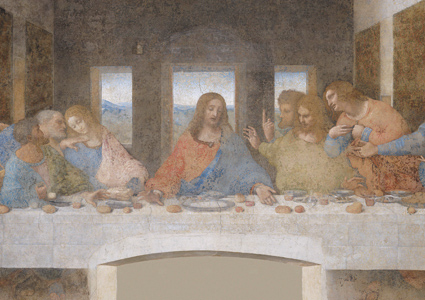
 Leonardo’s greatest disaster: “The Last Supper”, 1495-1498, in Milan
Milan is unquestionably one of the great cities of Italy, but it is at the same time surely the least loved of them all as far as Brits beguiled by the appeal of the warm south and of Rooms with Views are concerned. Nevertheless, and not just for opera fans in pursuit of the incomparable treat of a night at La Scala, this year lovers of the arts have been flocking to Milan for the Expo, or to be more precise for the associated exhibitions.
Of these, the most memorable — which ran from April 16 to July 19 at the Palazzo Reale, virtually in the shadow of Milan’s spectacular gothic cathedral — was devoted to Leonardo da Vinci (1452-1519). Organised by two eminent authorities on the artist, Pietro C. Marani and Maria Teresa Fiorio, it managed the rare feat of combining a whole procession of illustrious old favourites with the odd surprise, necessarily from among the works by Leonardo’s contemporaries included for purposes of comparison. One or two of these surprises were genuinely all but unknown works, while others were illuminated by the company they kept here. A case in point was the anonymous panel painting of an Ideal City from Urbino, whose grandiose geometrical rationalism is inconceivable without the example of an earlier painter-cum-scientist, Piero della Francesca. It is undeniably the work of a major artist, but its authorship remains frustratingly enigmatic.
It may sometimes feel as if there is hardly even time to catch one’s breath between the closing of one Leonardo show and the opening of the next, but there is almost nowhere — even including Florence and Paris, which between them share most of his paintings — where it makes more sense to celebrate his achievement than Milan. The two-horse town of Vinci (population in 2008: 14,375) is a mere 27 miles from Brunelleschi’s dome, but as a matter of fact Leonardo spent more of his adult life in Milan — roughly 20 years in two goes — than in the capital of his homeland. Amusingly enough, we know that he never lost his Florentine accent, in which the intial c’s become h’s so that Coca-Cola is pronounced Hoca-Hola, because an early Milanese source refers to the Mona Lisa — La Gioconda in Italian — as “La Honda”.
This Leonardo exhibition was in no way exclusively focused on his time in Milan. Instead it sought to present his weird and wonderful career in its entirety, but there was a different kind of connection with his adopted home. For most of its run, the Leonardo show overlapped with a stunning exhibition elsewhere in the Palazzo Reale entitled Lombard Art: From the Visconti to the Sforza (March 12-June 28), which in effect set the scene for Leonardo’s arrival in the Lombard capital by presenting a superb anthology of paintings, sculptures, and illuminated manuscripts from the region dating from the 14th century to the end of the 15th.
What it revealed was the fact that Milan was absolutely not an artistic backwater, but at the same time that in the main the work which was being produced there was scarcely affected by the kinds of new developments that were the calling-cards of the Florentine renaissance. As a result, scientific perspective of the sort pioneered by Brunelleschi, Donatello, and Masaccio in the first quarter of the 15th century was only of minor interest to most of the artists represented even decades later, and moreover they were still perfectly happy to set their figures against depth-denying gold-leaf backdrops that smack of the previous century. In view of all this, Leonardo really was a breath of fresh air in Milan, and unsurprisingly had a huge effect on the local school of art.
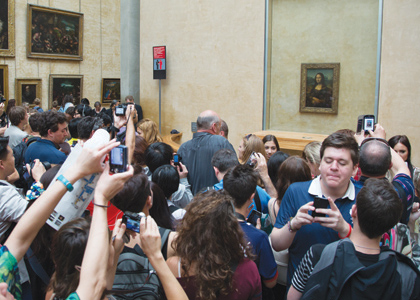
Leonardo’s barely visible chef d’oeuvre: Crowds struggle to view the “Mona Lisa” (photo: Victor Grigas/CC BY-SA 4.0)
What might be described as posthumous reviews of exhibitions have their place in the specialist scholarly literature, but not elsewhere, and my principal intention here is not to explore the minutiae of the Palazzo Reale show, but rather to examine what it is about Leonardo that sets him apart from all other artists.
One aspect of his achievement that is genuinely other is his full-blooded engagement with scientific experiment and discovery, but the fact that he was able to bestride the Two Cultures is surely not of itself enough to explain our fascination with him, not least since most of us are entirely incapable of evaluating the extent of his contribution on the scientific front. Every so often articles appear in the newspapers implying that he was the inventor of something that led the way to the Lord knows what — the parachute, the microwave, the mobile phone — but one invariably takes them with a pinch of salt, and what might be described as the Da Vinci Code phenomenon is, of course, a reflection of his fame as opposed to the cause of it. It hardly needs to be added that — with all due respect to Dan Brown — nobody would ever have referred to Leonardo as “da Vinci”, for the simple reason that it is not a surname.
In the end, it is his art that matters, and the first thing to be said in this connection is that it would be a big mistake to assume that he has always enjoyed the unique status he does today. It is undeniably the case that he has never been thought of as anything other than an artist of the first rank, but that is by no means the same thing. In his own day, he was clearly immensely highly regarded, and his employment by Ludovico Sforza and Gian Giacomo Trivulzio in Milan and at the end of his life by King François I in France, in whose arms he is alleged to have died (the scene was painted in soupily pre-Hollywood style by Ingres), underlines his exceptional success, and at the same time his crucial role in elevating the standing of artists so that they dared think of themselves as gentlemen and not mere paint-bespattered artisans.
By the time of Vasari, whose Lives of the Artists was published in two very different editions in 1550 and 1568, Leonardo’s reputation as one of the three founding fathers of the art of the 16th century — along with Michelangelo and Raphael was firmly entrenched. Nevertheless, Vasari was less persuaded of what might be described as his professionalism. For Leonardo was not only almost heroically unproductive, but added insult to injury by failing to finish a number of the select few pictures he actually started to paint. The main culprits, which are all the more fascinating to modern sensibilities by virtue of being works in progress, are his Adoration of the Magi in the Uffizi and his Saint Jerome in the Vatican, which were both left at the underdrawing stage. Moreover, even his Virgin and Child with Saint Anne in the Louvre, which is admittedly altogether more advanced, lacks that supreme smoothness of finish that Leonardo cultivated. As far as Vasari was concerned this was unforgivable, and it is revealing that towards the beginning of his biography he actually refers to Leonardo as “unstable”, and elsewhere regards his scientific adventures as “follies”.
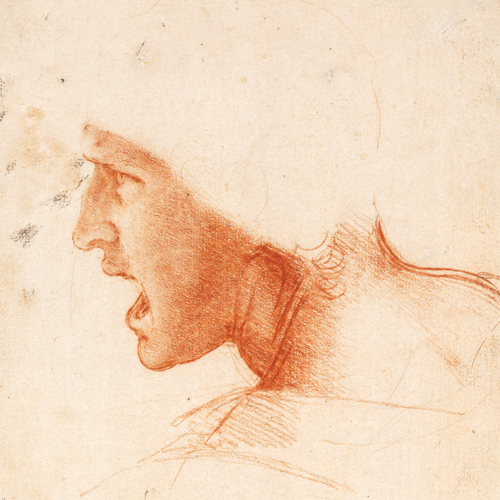
Breathtaking savagery: “Study of a Warrior’s Head for the Battle of Anghiari”, c.1504-05, by Leonardo
What should have been his two supreme triumphs — the Last Supper and The Battle of Anghiari — both ended in disaster. Because of his refusal to employ the tried and tested technique of fresco painting, which required artists to work against the clock on wet and swift-drying plaster, the former, now a heartbreaking, ghostly what-might-have-been in the refectory of the Milanese church of Santa Maria delle Grazie, was already a ruin by Vasari’s time. As for The Battle of Anghiari for the Palazzo della Signoria in Florence, all the evidence points to the fact that it was never brought even close to completion, and the efficient if uninspired Vasari subsequently frescoed over whatever traces had remained in his day. However, a number of Leonardo’s autograph drawings, both of the overall conception, but also of individual head studies (including two breathtaking close-ups of human savagery in Budapest, respectively executed in red and black chalk), together with accurate records in the form of copies of the central group of fighting horsemen known as the Battle for the Standard, leave no doubt of its extraordinary power.
Leonardo never wholly fell from grace, but by the 18th century he was certainly not regarded as the greatest artist who had ever lived: tellingly, the painter Ismael Israel Mengs — in a spirit of nomen est omen — christened his son, who grew up to be a painter of real distinction, Anton Raphael after Correggio and Raphael, and in that order.
It would appear that the tide turned in the 19th century, and one of the most compelling manifestations of the new mood — and to some extent its creator — is the essay on Leonardo in Walter Pater’s The Renaissance of 1873. Above all celebrated — and not wrongly — for its purple prose evocation of the Mona Lisa (“She is older than the rocks among which she sits; like the vampire, she has been dead many times, and learned the secrets of the grave; and has been a diver in deep seas, and keeps their fallen day about her; and trafficked for strange webs with Eastern merchants . . .”), which W.B. Yeats was to cut up into lines and print as the first “poem” in his Oxford Book of Modern Verse of 1936, Pater’s conception of Leonardo is as an unfathomable outsider. It concludes by speculating how the dying Leonardo “looked forward now into the vague land, and experienced the last curiosity”.
The Mona Lisa — and through her, her creator — was to enjoy a bit of serendipitous good fortune on August 21, 1911, when it was stolen by an Italian patriot called Vincenzo Peruggia, who thought it should go back home to Florence and took it there — in spite of the fact that Leonardo brought it with him to France, where it remained for 400 years. Vasari, who was born in 1511, penned a virtuoso eulogy of its beauties (“The mouth, with its opening, and with its ends united by the red of the lips to the flesh-tints of the face, seemed, in truth, to be not colours but flesh”), but can never in fact have seen the original, which he misguidedly believed to be yet another unfinished Leonardo. It was not returned to the Louvre until 1913, and a film was even made of the story in Germany (The Theft of the Mona Lisa, 1931, directed by Géza von Bolváry).
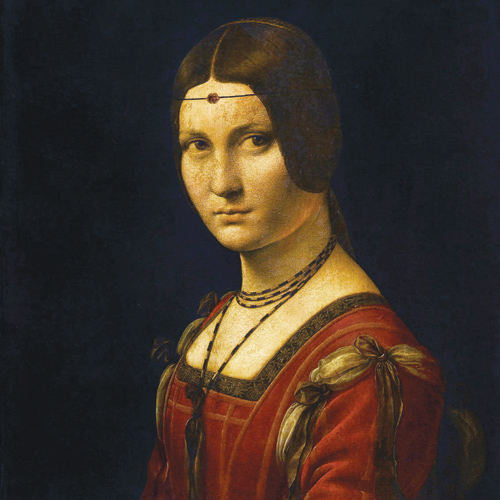
Penetrating intensity: The Louvre’s “La Belle Ferronière”, 1493-95, by Leonardo
The Surrealists were fascinated by the painting, and it was the subject — or should one say victim? — of all sorts of homages, notably but by no means exclusively by Marcel Duchamp and Salvador Dalí. The consequence is that it is not only the best-known painting in the world, but also — and paradoxically — the least visible of masterpieces, for all that it is on public display in a museum. In Kenneth Clark’s generally still excellent monograph on Leonardo, originally published in 1939, he indulges in an entirely forgivable bit of one-upmanship in connection with it when he writes: “Anyone who has had the privilege of seeing the Mona Lisa taken down, out of the deep well in which she hangs, and carried to the light will remember the wonderful transformation that takes place.” Nowadays, behind its bullet-proof glass and cordoned off in such a way that no one can get anywhere near it, it is a tragic prisoner of its own fame, to such an extent that it is unclear whether even directors of the Louvre are ever allowed a proper look at it.
In spite of this absurd state of affairs, among his paintings it is Leonardo’s portraits that best reveal his genius. Amazingly enough, there are only four of them in addition to the Mona Lisa, and the three best are all of beautiful young women. In this summer’s show in Milan, the Musician from the city’s Biblioteca Ambrosiana was joined by the Belle Ferronière from the Louvre, which is a stunningly penetrating image, in which — as is also the case with the Ginevra de’ Benci in Washington and of course the Mona Lisa — the sitter confronts our gaze with such intensity that it is far from clear who is looking at whom. The one exception to this rule among the portraits is the incomparable Lady with the Ermine, who gazes away to her left. Although it was lent to the National Gallery’s Leonardo exhibition of 2011, it is normally on display in the National Museum in Cracow, on loan from the Czartoryski Foundation, and therefore — like the irresistibly tender and intimate early Benois Madonna in the Hermitage in St Petersburg — maddeningly far away.
In contrast, for all their mastery, Leonardo’s remaining religious paintings, unless one agrees with the organisers of the Milan exhibition — I do not — that Washington’s admittedly enchanting Dreyfus Madonna is by him, are uniformly unlovable. A fine example of their almost chilling impenetrability is the very recently rediscovered — if sadly far from perfectly preserved — Salvator Mundi, which has the rare distinction of having been universally accepted as autograph by the current crop of Leonardo experts.
Where Leonardo never disappoints is in his drawings, and that is what makes exhibitions that include them so special, because drawings must not be exposed to the light day in and day out, with the result that temporary shows are the only way for non-specialists to see the originals.
Before Leonardo, the idea of using sequences of preparatory drawings to make paintings was in its infancy, and it is surely not by chance that incomparably more drawings by Leonardo survive than by any of his predecessors. What is more, the speed with which it was possible to put thoughts down on paper — especially when employing a pen — perfectly suited Leonardo’s quicksilver intelligence.
Ironically enough, Leonardo was also the virtual inventor of the notion that drawings could be regarded as works of art in their own right, although sadly the pioneering sheet in question — a Neptune which he gave to a great friend of his called Antonio Segni — has not come down to us, and is only known in the form of a first idea in black chalk in the Royal Collection, where the overwhelming majority of Leonardo’s drawings are preserved. Another particular feature of Leonardo’s drawings is their celebration of the grotesque, not least in the form of caricatures, which is almost absent from his paintings.
In the world of drawings, of course, the otherwise rigid divide between art and science vanishes, and one of the star pieces of the exhibition in Milan was the famous sheet with the Vitruvian Man from the Accademia in Venice, where the rest of the page is absolutely covered with Leonardo’s annotations and commentaries in his immediately recognisable mirror-writing (he was left-handed).
Many of his diagrams also share the informality of his finest drawings for artistic projects, and what they have in common in terms of their appeal is the sense they give us of looking over the master’s shoulder as he works. Leonardo the man may remain almost entirely unfathomable — as it happens, this is true of the overwhelming majority of renaissance artists — but whereas in his paintings he is almost without fail unapproachably Olympian, in the best of his drawings he comes across as being reassuringly human.