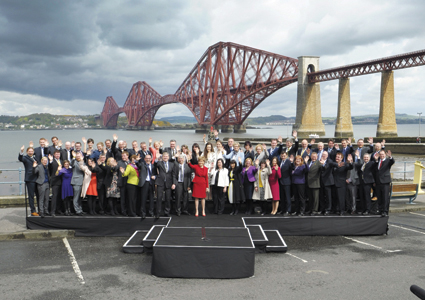
 Triumphalist: Nicola Sturgeon and the 56 new SNP MPs pose near the Forth Bridge. Some English people would like to cut them adrift (photo: Andy Buchanan/AFP/Getty Images)
Exasperation is understandable. In the run-up to the referendum on Scottish independence last September, the holes in the “Yes” campaign’s platform were made embarrassingly plain; but the nationalists suffered no embarrassment. Since then one hole has grown even larger; yet the Scottish National Party’s star continues to rise.
During the referendum debate about the crucial issue of the currency, Alex Salmond shamelessly plucked the heartstrings of nationalist sentiment by defiantly asserting what no one actually denied — the right of the Scottish people to exercise their sovereign will in choosing to keep the pound. What he artfully passed over was the equal but awkward truth that the Scots’ sovereign will had neither the right nor the power to dictate how the rest of the United Kingdom would respond. Salmond argued that it would be in everyone’s interests to enter into a formal currency union. True or not, such a proposal attracted two problems. One was that it would inevitably involve Scotland agreeing to compromise its independence by suffering constraints on its tax and spending policies. The other was that the leaders of the UK’s main political parties, backed up by the Canadian Governor of the Bank of England, had all said that it would not be in the rest of the UK’s interests to enter into a formal currency union with an independent Scotland, and that they wouldn’t agree to it.
Without a formal currency union, the Bank of England would set interest rates to suit the rest of the UK’s economy, not Scotland’s. Sooner or later the situation would arise where Scotland needed higher rates, say, to calm a property boom, but the rest of the UK needed lower rates, say, to stimulate a sluggish economy. In that case, the Bank of England would not act in the Scots interests but in everyone else’s. This is exactly what happened in the Republic of Ireland in the run-up to the financial crisis of 2007. The value of property there was rocketing unsustainably because the European Central Bank, with its eye fixed mainly on Germany, kept interest rates low at 2 per cent. The result: the Irish property bubble burst, with values tumbling by up to 50 per cent.
As long as it remains part of the UK, Scotland has a seat at the table of the Bank of England’s deliberations, in which its needs will continue to figure. But were it to leave, it wouldn’t. Thus an independent Scotland could keep the pound unilaterally, but only at the price of losing all control over its own interest rates. Hence the incoherence at the heart of the “Yes” campaign’s position: that its kind of independence would actually amount to less economic self-determination.
Since the referendum another major plank of the “Yes” platform has come seriously unstuck. During the campaign, the separatists had claimed that an independent Scotland would be economically viable on the basis of an oil price of $110 per barrel. Critics had warned of the vulnerability of an independent Scotland’s economy to the volatility of oil prices. These warnings, like so many others, were breezily dismissed as “negative”. A mere four months later, however, the price of oil had plummeted to $50 per barrel, which rudely intruded an £18.6bn shortfall into the “Yes” campaign’s tax-and-spending forecasts for the first three years of independence. Pressed on this point during First Minister’s Questions at Holyrood in January, the best response that SNP leader Nicola Sturgeon could muster was to recite her blind faith in nationalist dogma: “I believe and always will believe that the best way forward is to be in charge of our own resources, so we don’t have to be subject to the kind of cuts coming at us from the UK government, but instead could be masters of our own destiny.”
The reckless irrationality of the case for Scottish independence of the kind hawked by the SNP is plain to anyone with the eyes to see. Notwithstanding this, 44.3 per cent of those casting votes last September opted for it. And then in last May’s general election the Scots chose to put SNP candidates into 56 of Scotland’s 59 seats. What on earth were they thinking? If they wilfully insist on shielding their nationalist faith from the facts, then there’s really no saving them. Maybe the only way of bringing the Scots to their senses is to give them the rope to hang themselves. At least that would stop their interminable bleating.
Exasperation is understandable. I have heard it from others south of the border, and Anglo-Scot and unionist though I am, I have muttered it myself. However, as Lord Canning wisely resolved in the wake of the Indian Mutiny, we too ought not to govern — or do politics — in anger. Besides, things are importantly not as they seem.
It is true that the SNP enjoyed an electoral landslide in May’s election. However, they did so with only 50 per cent of the vote: half of Scotland’s voters did not support them. The landslide happened primarily because of Britain’s first-past-the-post electoral system. Had some kind of proportional representation system been in place, the Scots would still have returned 30 SNP members of parliament, but they would also have returned 14 Labour members, nine Conservatives and four Liberal Democrats.
What is more, it has long been observed that a small minority of those voting for the SNP do not actually want independence. There are some good reasons to suppose that that proportion became larger in May. It would have been rational enough for some unionist voters to reason that, with a decisive vote cast against independence in September, it was safe to support the SNP for other reasons in May — the most of obvious of these being to maximise Scottish clout in negotiations over further devolution of powers within the Union.
The reckless irrationality of the case for Scottish independence of the kind hawked by the SNP is plain to anyone with the eyes to see. Notwithstanding this, 44.3 per cent of those casting votes last September opted for it. And then in last May’s general election the Scots chose to put SNP candidates into 56 of Scotland’s 59 seats. What on earth were they thinking? If they wilfully insist on shielding their nationalist faith from the facts, then there’s really no saving them. Maybe the only way of bringing the Scots to their senses is to give them the rope to hang themselves. At least that would stop their interminable bleating.
Exasperation is understandable. I have heard it from others south of the border, and Anglo-Scot and unionist though I am, I have muttered it myself. However, as Lord Canning wisely resolved in the wake of the Indian Mutiny, we too ought not to govern — or do politics — in anger. Besides, things are importantly not as they seem.
It is true that the SNP enjoyed an electoral landslide in May’s election. However, they did so with only 50 per cent of the vote: half of Scotland’s voters did not support them. The landslide happened primarily because of Britain’s first-past-the-post electoral system. Had some kind of proportional representation system been in place, the Scots would still have returned 30 SNP members of parliament, but they would also have returned 14 Labour members, nine Conservatives and four Liberal Democrats.
What is more, it has long been observed that a small minority of those voting for the SNP do not actually want independence. There are some good reasons to suppose that that proportion became larger in May. It would have been rational enough for some unionist voters to reason that, with a decisive vote cast against independence in September, it was safe to support the SNP for other reasons in May — the most of obvious of these being to maximise Scottish clout in negotiations over further devolution of powers within the Union.
The other reason to think that a larger portion of SNP voters in the general election were unionist is that the polls indicate that the relative proportion of “Yes” and “No” supporters is about the same now as at thetime of the referendum. According to the authoritative What Scotland Thinks website, polls from October to December 2014 indicated that “Yes” had overtaken “No” by between one and five percentage points. This year, however, “No” has recovered its lead in all but two of 13 polls, and in YouGov’s survey of May 21 it was five points ahead — exactly the same as the very last poll on the eve of the referendum vote. The actual result, of course, doubled that.
Therefore in the coming months and years it will be very important for unionists to beware of succumbing to three illusions, all of which Alex Salmond is already doing his very best to conjure: first, that the serried ranks of SNP MPs stand for all Scots; second, that they represent a mandate for a fully independent Scottish state; and third, that such independence is inevitable. They don’t and it isn’t.
Understanding “independence”
In last year’s referendum a confusing ambiguity clung to the question put to voters: “Should Scotland be an independent country?” This was confusing because the issue was never whether or not Scotland should be independent, but rather how independent it should be. In the Union Scotland has always been somewhat self-governing, possessing its own kirk, law, and education system. With the establishment of the Scottish parliament in 1999 its autonomy expanded dramatically to include control, for example, of the Scottish NHS. And in 2012 the Westminster parliament overcame SNP opposition to pass the Scotland Act and increase the Scottish government’s tax-raising and borrowing powers. Taken literally, therefore, the question asked of voters in September made a negative response awkward for anyone who affirmed the autonomy that Scotland has always enjoyed and recently increased. It played right into the hands of the “Yes” campaign. Had the question been more precisely, “Should Scotland leave the United Kingdom?”, the “No” vote would have been much stronger.
Scottish separatists with one eye firmly fixed on the far horizon of fully sovereign statehood knew that. So Alex Salmond and Nicola Sturgeon were content to campaign last year for something only approximating their ultimate goal but currently more palatable to a wider range of voters: an “independence” that would have retained both the British monarchy and the British pound.
“Independence” means different things to different Scots. Only a minority of them hanker after embassies that fly the Saltire instead of the Union Jack, or after a Scottish Defence Force entirely separate from the Royal Navy, British Army and Royal Air Force. Many more of them, however, want Scotland to have the power to determine its own policies for public spending, not least on economic development and social welfare.
Therefore in the coming months and years it will be very important for unionists to beware of succumbing to three illusions, all of which Alex Salmond is already doing his very best to conjure: first, that the serried ranks of SNP MPs stand for all Scots; second, that they represent a mandate for a fully independent Scottish state; and third, that such independence is inevitable. They don’t and it isn’t.
Understanding “independence”
In last year’s referendum a confusing ambiguity clung to the question put to voters: “Should Scotland be an independent country?” This was confusing because the issue was never whether or not Scotland should be independent, but rather how independent it should be. In the Union Scotland has always been somewhat self-governing, possessing its own kirk, law, and education system. With the establishment of the Scottish parliament in 1999 its autonomy expanded dramatically to include control, for example, of the Scottish NHS. And in 2012 the Westminster parliament overcame SNP opposition to pass the Scotland Act and increase the Scottish government’s tax-raising and borrowing powers. Taken literally, therefore, the question asked of voters in September made a negative response awkward for anyone who affirmed the autonomy that Scotland has always enjoyed and recently increased. It played right into the hands of the “Yes” campaign. Had the question been more precisely, “Should Scotland leave the United Kingdom?”, the “No” vote would have been much stronger.
Scottish separatists with one eye firmly fixed on the far horizon of fully sovereign statehood knew that. So Alex Salmond and Nicola Sturgeon were content to campaign last year for something only approximating their ultimate goal but currently more palatable to a wider range of voters: an “independence” that would have retained both the British monarchy and the British pound.
“Independence” means different things to different Scots. Only a minority of them hanker after embassies that fly the Saltire instead of the Union Jack, or after a Scottish Defence Force entirely separate from the Royal Navy, British Army and Royal Air Force. Many more of them, however, want Scotland to have the power to determine its own policies for public spending, not least on economic development and social welfare.
Or at least they think they do. In fact, according to the hard social scientific data of the 2010 British Social Attitudes survey, Scotland is only “somewhat more social democratic than England” and “appears to have experienced something of a drift away from a social democratic outlook during the course of the past decade, in tandem with public opinion in England”. Even the late Stephen Maxwell, nationalist intellectual and founder of the modern SNP, agreed, writing shortly before his death in 2012 that there is “nothing in Scotland’s recent political record to suggest a pent-up demand for radical social and economic change waiting to be released by independence”. The fact that the current nationalist government at Holyrood has so far declined to use the Scottish Parliament’s power (granted in 1998) to raise the rate of income tax upwards by 3 per cent, so as to increase funding for public services, suggests that they know that Maxwell spoke the truth.
Still, so long as Scots think that they want greater fiscal autonomy, the clamour for independence will continue. Happily, they are about to be given more of what they want. This year and next the Scotland Act 2012 will come into effect, giving the Scottish government the power to raise income tax by 10 per cent and to borrow up to £2.2 billion per year. Moreover, the Scotland Bill currently before Parliament proposes to implement the Smith Commission Agreement, making the Scottish government responsible for setting all the rates and bands of income tax for Scottish taxpayers, as well as giving it the power to create new welfare benefits for those with “additional needs” and to top up reserved benefits such as universal credit and child benefit, should the UK government decide to cut them. In a nutshell, the combined effect of the 2012 Act and the 2015 Bill (should it pass) would be to give Scottish ministers the power to do something substantially different if they don’t like the tax and spending decisions taken in Westminster. This fiscal effect should then generate a healthy political one: making it more difficult for nationalists to fill the airwaves with complaints about Westminster, and easier for their opponents to focus attention on the nationalist government’s actual policies. The nationalists say that they want more independence to do things differently in Scotland, and about half of Scots agree with them. Shortly they shall have it. Let’s watch what they do, and scrutinise the gap between leftward mouth and rightward money.
Understanding what the UK is good for
The SNP, of course, is keen to keep attention fixated on the constitutional issue and Nicola Sturgeon is already pressing David Cameron to go beyond the Smith Agreement. The Prime Minister would be wise to resist, to wait and see how the Scottish government uses the rope it’s been given, and to watch how that affects the popular appetite for more.
In the meantime the UK government needs to equip itself with a cogent and confident understanding of the value of the Union, for only then will it be clear what further kinds of Scottish independence are compatible with it, what are not, and why it matters. During the referendum campaign it was deeply dismaying to witness the faltering inarticulacy of unionists in explaining what the United Kingdom is good for, and therefore why some kinds of independence would be bad for the Scottish people. In retrospect, this was a symptom, not of the Union’s intellectual bankruptcy, but rather of the natural difficulty of describing the very ground upon which we stand. One of the benefits of the referendum was that it provoked unionists like me to lift up our feet and look down.
Still, so long as Scots think that they want greater fiscal autonomy, the clamour for independence will continue. Happily, they are about to be given more of what they want. This year and next the Scotland Act 2012 will come into effect, giving the Scottish government the power to raise income tax by 10 per cent and to borrow up to £2.2 billion per year. Moreover, the Scotland Bill currently before Parliament proposes to implement the Smith Commission Agreement, making the Scottish government responsible for setting all the rates and bands of income tax for Scottish taxpayers, as well as giving it the power to create new welfare benefits for those with “additional needs” and to top up reserved benefits such as universal credit and child benefit, should the UK government decide to cut them. In a nutshell, the combined effect of the 2012 Act and the 2015 Bill (should it pass) would be to give Scottish ministers the power to do something substantially different if they don’t like the tax and spending decisions taken in Westminster. This fiscal effect should then generate a healthy political one: making it more difficult for nationalists to fill the airwaves with complaints about Westminster, and easier for their opponents to focus attention on the nationalist government’s actual policies. The nationalists say that they want more independence to do things differently in Scotland, and about half of Scots agree with them. Shortly they shall have it. Let’s watch what they do, and scrutinise the gap between leftward mouth and rightward money.
Understanding what the UK is good for
The SNP, of course, is keen to keep attention fixated on the constitutional issue and Nicola Sturgeon is already pressing David Cameron to go beyond the Smith Agreement. The Prime Minister would be wise to resist, to wait and see how the Scottish government uses the rope it’s been given, and to watch how that affects the popular appetite for more.
In the meantime the UK government needs to equip itself with a cogent and confident understanding of the value of the Union, for only then will it be clear what further kinds of Scottish independence are compatible with it, what are not, and why it matters. During the referendum campaign it was deeply dismaying to witness the faltering inarticulacy of unionists in explaining what the United Kingdom is good for, and therefore why some kinds of independence would be bad for the Scottish people. In retrospect, this was a symptom, not of the Union’s intellectual bankruptcy, but rather of the natural difficulty of describing the very ground upon which we stand. One of the benefits of the referendum was that it provoked unionists like me to lift up our feet and look down.
On reflection, I discovered that the Union is good for three things. The first is the stronger security of political liberty. This year we celebrate the 800th anniversary of Magna Carta, when the English Church and barons compelled King John to accept certain limitations on royal power. Partly as a consequence of this, foreign observers in the late medieval period — not least in France — remarked on the extraordinary extent to which English monarchs were held accountable by parliament. And one reason that some Scots in the 16th and 17th centuries hoped for unification with England was that English law might come to constrain the arbitrary feudal powers of the Scottish nobility. After the Union of England and Scotland in 1707, the English and the Scots together — that is, the British — pursued a political path that led to increasing constraints upon royal power and increasingly accountable government. This path was not universal: many other countries didn’t follow it, and in the 19th and early 20th centuries Britain’s democratic model was widely admired by liberals throughout Europe. However, after the end of the Second World War in 1945 with the defeat of Nazism in Germany, and especially after the end of the Cold War in 1989 with the collapse of the Soviet Union, liberal democracy became more widespread, not least in Europe. As a consequence the political model that the British have pioneered came to appear less exceptional and more normal. As a Foreign Office official once put it to me, we British had become the victims of our own success.
Sometimes, however, appearances deceive, and they do so here. Recent developments in the world should remind us that the liberal democratic political system that we, the British, have played a leading part in developing is not a piece of the cosmic furniture. It’s not the natural, default position of human political life. It’s contingent and vulnerable and precious. It’s an important historical achievement, which cost our forebears much to build and defend, and which we could lose. In the light of Russia’s recent veering in an autocratic and aggressively nationalist direction, in the light of the rise of an increasingly belligerent China ruled by a Communist Party that is neither liberal nor democratic, and in the light of the atrociously inhumane politics of ISIS and other jihadist movements in Nigeria and Sudan, it should now be clearer to us that the political liberty, accountability and humanity that we have achieved in Britain should not to be taken for granted. They may not be unique in the world, but nor are they universal or secure.
Of course, if Scotland were to secede from the Union, it would most probably continue to maintain the liberal democratic political institutions and customs that the British had developed, notwithstanding the illiberal, cyber-intimidating, street-thuggish elements that certain reaches of Scottish nationalism have spawned or the habitual preference for centralised control that the Scottish government has exhibited. Nevertheless, there’s no doubt that a United Kingdom would be stronger both diplomatically and militarily, and so better able to secure liberal democracy, than would an independent Scotland and a British rump.
Sometimes, however, appearances deceive, and they do so here. Recent developments in the world should remind us that the liberal democratic political system that we, the British, have played a leading part in developing is not a piece of the cosmic furniture. It’s not the natural, default position of human political life. It’s contingent and vulnerable and precious. It’s an important historical achievement, which cost our forebears much to build and defend, and which we could lose. In the light of Russia’s recent veering in an autocratic and aggressively nationalist direction, in the light of the rise of an increasingly belligerent China ruled by a Communist Party that is neither liberal nor democratic, and in the light of the atrociously inhumane politics of ISIS and other jihadist movements in Nigeria and Sudan, it should now be clearer to us that the political liberty, accountability and humanity that we have achieved in Britain should not to be taken for granted. They may not be unique in the world, but nor are they universal or secure.
Of course, if Scotland were to secede from the Union, it would most probably continue to maintain the liberal democratic political institutions and customs that the British had developed, notwithstanding the illiberal, cyber-intimidating, street-thuggish elements that certain reaches of Scottish nationalism have spawned or the habitual preference for centralised control that the Scottish government has exhibited. Nevertheless, there’s no doubt that a United Kingdom would be stronger both diplomatically and militarily, and so better able to secure liberal democracy, than would an independent Scotland and a British rump.
Stronger external security of liberal democracy is one thing that the UK is good for. The second is international peace, trust, and solidarity within the British Isles. We often forget, especially if we’re English, that the UK is a multinational state, comprising a union of English, Welsh, Scottish, and Irish peoples. Each of those peoples has maintained its own national customs and has either retained or acquired its own institutions. Within the UK, the Scots have always preserved their own law, established Church, and education system; the Welsh language flourishes far more strongly than the Irish language does in the Republic across the water; and Northern Ireland had its own legislative assembly long before either Wales or Scotland. So successful has our Union been that the thought of violent conflict erupting between its constituent peoples is almost unimaginable.
However, contrary to Alex Salmond’s glib reassurances that the “social union” between England and Scotland would survive Scottish independence, my own view is that a “Yes” vote last September would have kindled a degree of mutual hostility that these islands have not witnessed since the 18th century. The negotiation of separation would have been tough and fraught. The separating Scots would not have got all that they wanted, they would have been frustrated, and their traditional resentment of England would only have deepened. For their part the English, having woken up to the costs and risks of the dissolution of the UK, including the permanent weakening of Britain’s international prestige and power, would have discovered a general resentment of the Scots that they had never before had reason to feel.
Maybe the mutual alienation would only have lasted a generation or two, maybe no blood would have been shed — but maybe not. One of the nobler intentions of the Union was precisely to end recurrent warfare between Scotland and England, and it has been one of its finest achievements to make bloody conflict so unimaginable as to appear impossible. But appearances deceive here too: imagination is no constraint upon possibility. Anglo-Scottish peace (like European peace) is a fragile historical achievement — not a cosmic fixture. And as we know from the 30-year-long Troubles in Northern Ireland, which formally ended only in 1998, history can roll alarmingly backwards.
Peace, however, can be more than just the absence of violence; it can also be widespread trust and solidarity, and in Britain it has been. In this respect the United Kingdom already is what the European Union can only dream of becoming. In general, taxpayers in wealthy London do not complain when their taxes are used to support poorer people in Wales, Scotland, or Northern Ireland. That is because, in general, they identify with the Welsh, Scottish and Northern Irish, recognising them as their own people — as fellow-Britons. Compare that with the appalled reaction of most Germans to the prospect of having to bail out the crippled economies of Greece or Italy in the wake of the recent financial crisis. The contrast brings to the surface the extraordinarily high degree of international solidarity that we have achieved here in the UK.
However, contrary to Alex Salmond’s glib reassurances that the “social union” between England and Scotland would survive Scottish independence, my own view is that a “Yes” vote last September would have kindled a degree of mutual hostility that these islands have not witnessed since the 18th century. The negotiation of separation would have been tough and fraught. The separating Scots would not have got all that they wanted, they would have been frustrated, and their traditional resentment of England would only have deepened. For their part the English, having woken up to the costs and risks of the dissolution of the UK, including the permanent weakening of Britain’s international prestige and power, would have discovered a general resentment of the Scots that they had never before had reason to feel.
Maybe the mutual alienation would only have lasted a generation or two, maybe no blood would have been shed — but maybe not. One of the nobler intentions of the Union was precisely to end recurrent warfare between Scotland and England, and it has been one of its finest achievements to make bloody conflict so unimaginable as to appear impossible. But appearances deceive here too: imagination is no constraint upon possibility. Anglo-Scottish peace (like European peace) is a fragile historical achievement — not a cosmic fixture. And as we know from the 30-year-long Troubles in Northern Ireland, which formally ended only in 1998, history can roll alarmingly backwards.
Peace, however, can be more than just the absence of violence; it can also be widespread trust and solidarity, and in Britain it has been. In this respect the United Kingdom already is what the European Union can only dream of becoming. In general, taxpayers in wealthy London do not complain when their taxes are used to support poorer people in Wales, Scotland, or Northern Ireland. That is because, in general, they identify with the Welsh, Scottish and Northern Irish, recognising them as their own people — as fellow-Britons. Compare that with the appalled reaction of most Germans to the prospect of having to bail out the crippled economies of Greece or Italy in the wake of the recent financial crisis. The contrast brings to the surface the extraordinarily high degree of international solidarity that we have achieved here in the UK.
These are the terms in which Gordon Brown explained his vision for the future of the UK in his rather good book, My Scotland, Our Britain: A Future Worth Sharing (2014). The rationale for the Union, according to Brown, is to be found in the common advantages that all Britons enjoy from having an integrated economy, from the pooling of risks, and from the transfer of resources from richer to poorer across the whole territory of the UK. That’s why it’s vital that the Westminster government continues to insist upon retaining control over such things as national insurance and the state pension, and to refuse the Scottish nationalists’ reckless, dogmatic demands for full fiscal autonomy. It’s vital for the well-being of all the British peoples, not least the Scots themselves.
Stronger external security and common economic advantage are two things that the Union is good for. A third is the habit of taking responsibility for upholding a liberal and humane global order, if necessary by deploying hard power. This, of course, is the legacy of empire and manifests itself in Britain’s retaining a place among the permanent members of the UN Security Council.
Scottish nationalists typically despise this, seeing Scotland’s becoming independent, dissolving the United Kingdom, and adopting a more “Nordic” role in international affairs as an act of repentance from Britain’s immoral tradition of imperial aggression and domination. They regard the British policy elite’s hankering after the imperial power and role of global policeman, albeit now with the reduced status of deputy to the US’s sheriff, as at once delusory, pathetic and immoral. It’s delusory, because Britain no longer has the power to rule the world as she once did. It’s pathetic because it makes the British play poodle to America. And it’s immoral, because it involves threatening and dominating other peoples, often by waging war against them, sometimes in violation of international law. Instead, they argue, the UK should shake off its post-imperial hangover, follow Europe rather than America, surrender its nuclear weapons, concentrate on wielding soft power, and limit its military activity to UN peacekeeping operations. And if the UK will not choose to do that, then Scotland will force her — by breaking the Union.
There are several grounds on which to refuse this notion. First, the history of the British Empire was not one of relentless aggression and oppression. Yes, it presided over the infamous massacre at Amritsar in 1919 and the outrages of the Black and Tans in Ireland in 1920-22, but it also pioneered the suppression of the slave trade in the 19th century and was the only opponent of European fascism in the field from May 1940 until June 1941. The present fact of the Commonwealth is evidence that the empire’s historical record is not simply execrable. Rather, it is morally mixed — as is the record of any nation-state.
Second, it simply isn’t true that post-war Britain has always meekly trotted along behind the US. Harold Wilson refused to send British troops to Vietnam; Margaret Thatcher arm-twisted Ronald Reagan into supporting the ejection of the Argentines from the Falkland Islands in 1982; and Tony Blair publicly embarrassed a very reluctant (and resentful) Bill Clinton into deploying US military force in Kosovo and Serbia in 1999.
Stronger external security and common economic advantage are two things that the Union is good for. A third is the habit of taking responsibility for upholding a liberal and humane global order, if necessary by deploying hard power. This, of course, is the legacy of empire and manifests itself in Britain’s retaining a place among the permanent members of the UN Security Council.
Scottish nationalists typically despise this, seeing Scotland’s becoming independent, dissolving the United Kingdom, and adopting a more “Nordic” role in international affairs as an act of repentance from Britain’s immoral tradition of imperial aggression and domination. They regard the British policy elite’s hankering after the imperial power and role of global policeman, albeit now with the reduced status of deputy to the US’s sheriff, as at once delusory, pathetic and immoral. It’s delusory, because Britain no longer has the power to rule the world as she once did. It’s pathetic because it makes the British play poodle to America. And it’s immoral, because it involves threatening and dominating other peoples, often by waging war against them, sometimes in violation of international law. Instead, they argue, the UK should shake off its post-imperial hangover, follow Europe rather than America, surrender its nuclear weapons, concentrate on wielding soft power, and limit its military activity to UN peacekeeping operations. And if the UK will not choose to do that, then Scotland will force her — by breaking the Union.
There are several grounds on which to refuse this notion. First, the history of the British Empire was not one of relentless aggression and oppression. Yes, it presided over the infamous massacre at Amritsar in 1919 and the outrages of the Black and Tans in Ireland in 1920-22, but it also pioneered the suppression of the slave trade in the 19th century and was the only opponent of European fascism in the field from May 1940 until June 1941. The present fact of the Commonwealth is evidence that the empire’s historical record is not simply execrable. Rather, it is morally mixed — as is the record of any nation-state.
Second, it simply isn’t true that post-war Britain has always meekly trotted along behind the US. Harold Wilson refused to send British troops to Vietnam; Margaret Thatcher arm-twisted Ronald Reagan into supporting the ejection of the Argentines from the Falkland Islands in 1982; and Tony Blair publicly embarrassed a very reluctant (and resentful) Bill Clinton into deploying US military force in Kosovo and Serbia in 1999.
Third, if the UK is expected to give up the use of hard power, is that because no one should use it at all or because someone else should use it instead and better? Unless we buy into an impossibly sunny view of human nature and ignore the obvious lessons of history, we have to acknowledge that intractably malevolent leaders can sometimes move nation-states (like empires) to do atrocious things. And unless we’re pacifist, we also have to acknowledge that sometimes atrocious things must be stopped by armed force. Perhaps we think that the UN should do the policing — but the UN has only as many regiments as nation-states choose to loan it. No doubt a thoroughly post-imperial, “Nordic” Britain would lend its troops for peacekeeping purposes. But who, then, would fight the wars to make the just peace to be kept?
Maybe what the nationalists want is not exactly the UK’s abandonment of hard power so much as its strict submission to the collective will of the UN Security Council. If so, they would be content for the enforcement capacity of the UN to be at the mercy of the threat of veto by Putin’s Russia and the Communist Party’s China, neither of whose records of humanitarian concern are famous. They would also join Alex Salmond in condemning Nato’s 1999 military intervention to end ethnic cleansing in Kosovo as a “misguided” policy of “dubious legality and unpardonable folly”. Embarrassingly, however, this would align them against the then UN Secretary-General, Kofi Annan. It would also set them at odds with most international lawyers. Commenting on the Kosovo intervention, the leading historian and philosopher of international law, Martti Koskenniemi, has written that “most lawyers — including myself — have taken the ambivalent position that it was both formally illegal and morally necessary”.
The truth is that, in the world as we have it, the upholding of international order and the avoidance of atrocities sometimes require the naked use of armed force. That is a lamentable and tragic fact, but it is a fact nonetheless. Hard power, then, is morally necessary and we need some liberal-democratic states to be ready to exercise it. Very few European ones are willing and able to do so, however: two generations after the end of the Second World War most of them still prefer to free-ride on US power. Understandably, the Americans are getting increasingly fed-up. For Britain to take the nationalists’ preferred “Nordic” option, then, would be a major desertion of international duty and leadership, and it would probably be the last straw that broke the US’s wavering faith in Europe. The United Kingdom shouldn’t kick its post-imperial habit; it should keep it — for the world’s sake.
How to tell the unionist story (and wrong-foot the nationalist one)
The United Kingdom is good for stronger external security, for international trust and common economic advantage within the British Isles, and for a liberal international order beyond them. Complete independence for Scotland would inflict serious damage on each of these, and should be vigorously resisted. Full fiscal autonomy — for which the SNP is now pushing despite authoritative warnings of a consequent £7.6 billion shortfall in Scotland’s finances — would eventually usher in complete independence, since it would undermine British social solidarity and with it the immediate, emotional springs of felt loyalty to the UK. So that, too, should be resisted. (The signs are, however, that at least some nationalists know that they couldn’t afford what they pretend to want, so the resistance probably won’t need to be terribly vigorous.)
Maybe what the nationalists want is not exactly the UK’s abandonment of hard power so much as its strict submission to the collective will of the UN Security Council. If so, they would be content for the enforcement capacity of the UN to be at the mercy of the threat of veto by Putin’s Russia and the Communist Party’s China, neither of whose records of humanitarian concern are famous. They would also join Alex Salmond in condemning Nato’s 1999 military intervention to end ethnic cleansing in Kosovo as a “misguided” policy of “dubious legality and unpardonable folly”. Embarrassingly, however, this would align them against the then UN Secretary-General, Kofi Annan. It would also set them at odds with most international lawyers. Commenting on the Kosovo intervention, the leading historian and philosopher of international law, Martti Koskenniemi, has written that “most lawyers — including myself — have taken the ambivalent position that it was both formally illegal and morally necessary”.
The truth is that, in the world as we have it, the upholding of international order and the avoidance of atrocities sometimes require the naked use of armed force. That is a lamentable and tragic fact, but it is a fact nonetheless. Hard power, then, is morally necessary and we need some liberal-democratic states to be ready to exercise it. Very few European ones are willing and able to do so, however: two generations after the end of the Second World War most of them still prefer to free-ride on US power. Understandably, the Americans are getting increasingly fed-up. For Britain to take the nationalists’ preferred “Nordic” option, then, would be a major desertion of international duty and leadership, and it would probably be the last straw that broke the US’s wavering faith in Europe. The United Kingdom shouldn’t kick its post-imperial habit; it should keep it — for the world’s sake.
How to tell the unionist story (and wrong-foot the nationalist one)
The United Kingdom is good for stronger external security, for international trust and common economic advantage within the British Isles, and for a liberal international order beyond them. Complete independence for Scotland would inflict serious damage on each of these, and should be vigorously resisted. Full fiscal autonomy — for which the SNP is now pushing despite authoritative warnings of a consequent £7.6 billion shortfall in Scotland’s finances — would eventually usher in complete independence, since it would undermine British social solidarity and with it the immediate, emotional springs of felt loyalty to the UK. So that, too, should be resisted. (The signs are, however, that at least some nationalists know that they couldn’t afford what they pretend to want, so the resistance probably won’t need to be terribly vigorous.)
But resistance alone is not enough; saying “No” will not suffice. Nor will saying “No” with better reasons than “Yes”. As indicated last January by Nicola Sturgeon’s resort to quasi-religious confession in the face of hostile economic facts, Scottish nationalism’s power is fuelled by a spiritually intoxicating brew of political idealism, moral purism, and self-righteous scapegoating — the same brew that kept alive the revolutionary flame in Irish breasts a hundred years ago, despite the absence of objective injustice. For sure, it remains important to keep on fingering the nationalist vision’s sincere naivetés, less-than-honest inconsistencies, and unjust slander, for, as penitent Islamists testify, the best way to undermine a political fanatic’s faith is to sow seeds of doubt and confusion and then allow time for the penny to drop. But it’s always much easier to leave, if one has somewhere else to go to. So unionists need to develop and broadcast a positive story about the Union, articulating the ground beneath our feet and bringing back to common consciousness all the things it’s good for. A sustained and nationwide public discussion is needed to let such a story gather momentum and take to the air. While professional integrity would prevent the BBC itself from telling the story, it could nevertheless occasion it by staging a series of national conversations about Britain’s constitutional future. If a more urgent public service is needed right now, I don’t know what it is.
But unionists need to do more than talk; we also need to show. Whenever the European Union funds a project, it advertises it for all to see, loudly and proudly, on billboards. The United Kingdom should start doing the same. Since many Scots appear to have forgotten what the UK does for them, the UK needs to remind them. What’s more, since many Scots have never set foot in England, let’s take up Adam Tomkins’s proposal and twin every schoolchild in Scotland with one in England and pay for them to visit each other and learn each other’s ways. And how about strengthening communication across the Union by building, if not bridges, then railways, and extending HS2 beyond Manchester and Leeds to Glasgow and Edinburgh?
And since the future of the Union now lies primarily in its hands, it is vital that the Conservative government add substance to its talk about “One Nation”. If it isn’t true that George Osborne’s planned tax credit reductions will seriously hinder some of the poorest and most vulnerable among us, then the government must say so and explain long and loudly. And if it is true, then it needs to have the courage to admit it and adjust the policy. Otherwise the Tories’ reputation as the “nasty party” — nowhere stronger than in Scotland — will only deepen, the appearance of a widening gulf between political cultures north and south of the border will only thicken, and the nationalist story’s plausibility will only grow.
If the United Kingdom is to survive — and it would be a tragedy for all its peoples, and for other peoples too, if it didn’t — then its virtues need to be asserted and broadcast and demonstrated in ways that any citizen can appreciate. More than half of Scots are still appreciative and hungry for encouragement, support, and leadership. Behind recent electoral appearances and Alex Salmond’s smokescreen many others lie open to persuasion. So go on, Mr Cameron: seize the initiative and deploy the resources of your government to show us what the Union’s good for.
But unionists need to do more than talk; we also need to show. Whenever the European Union funds a project, it advertises it for all to see, loudly and proudly, on billboards. The United Kingdom should start doing the same. Since many Scots appear to have forgotten what the UK does for them, the UK needs to remind them. What’s more, since many Scots have never set foot in England, let’s take up Adam Tomkins’s proposal and twin every schoolchild in Scotland with one in England and pay for them to visit each other and learn each other’s ways. And how about strengthening communication across the Union by building, if not bridges, then railways, and extending HS2 beyond Manchester and Leeds to Glasgow and Edinburgh?
And since the future of the Union now lies primarily in its hands, it is vital that the Conservative government add substance to its talk about “One Nation”. If it isn’t true that George Osborne’s planned tax credit reductions will seriously hinder some of the poorest and most vulnerable among us, then the government must say so and explain long and loudly. And if it is true, then it needs to have the courage to admit it and adjust the policy. Otherwise the Tories’ reputation as the “nasty party” — nowhere stronger than in Scotland — will only deepen, the appearance of a widening gulf between political cultures north and south of the border will only thicken, and the nationalist story’s plausibility will only grow.
If the United Kingdom is to survive — and it would be a tragedy for all its peoples, and for other peoples too, if it didn’t — then its virtues need to be asserted and broadcast and demonstrated in ways that any citizen can appreciate. More than half of Scots are still appreciative and hungry for encouragement, support, and leadership. Behind recent electoral appearances and Alex Salmond’s smokescreen many others lie open to persuasion. So go on, Mr Cameron: seize the initiative and deploy the resources of your government to show us what the Union’s good for.