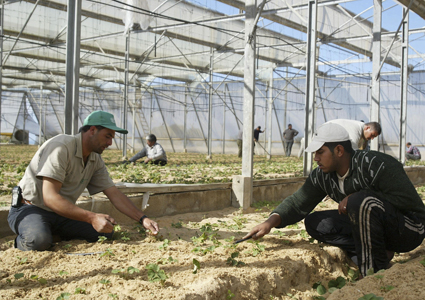
 Palestinian farmers working in a former settlers’ greenhouse in November, 2005. Border crossing disputes meant much of the harvest was lost (photo: Abid Katib/Getty Images)
In August 2005, the Palestinian businessman Dr Bassil Jabir was watching the events unfolding in the Gaza Strip with a mixed sense of trepidation and excitement. On the flickering TV screen, Israeli soldiers were carrying out Israeli settlers and placing them on buses which would take them out of the narrow coastal enclave, never to return.
The Israeli withdrawal from Gaza after a 38-year occupation presented new opportunities for the Palestinians. As CEO of the Palestine Economic Development Company (PED), Jabir had a daunting task before him, yet one which could produce the crowning achievement of his career so far. He would spearhead the first major economic project in Gaza that could turn round the fortunes of his people. The project carried great risks but also immeasurable rewards, perhaps even for the future of the Palestinian state as a whole.
Until August 2005, close to 8,000 Israeli Jewish settlers lived in the Gaza Strip. Occupying approximately 30 per cent of the land, they were guarded by thousands of Israeli soldiers, who imposed restrictions on the movements of the approximately 1.5 million Palestinian residents.
Ask former Israeli settlers about life in Gaza at the time, and many will wax lyrical about the “paradise on earth” — the endless sandy beaches, the bountiful farms, the sense of community with others who had decided to establish a home on territory conquered from Egypt during the 1967 Six Day War.
Ask a Palestinian the same question and you will get the distinct impression that you are talking about two separate continents, not the same meagre strip of land measuring 45 kilometres in length and just five kilometres in width at its narrowest point.
Five years before David Cameron and others called the coastal enclave a “prison camp”, many Israeli NGOs had already been using the term to describe life in Gaza. Since 1967, Israel exercised a military occupation, controlling its airspace and territorial waters. This was relaxed after the Oslo Accords, but following the Palestinian suicide bombings, rocket attacks and angry protests of the Second Intifada in the early 2000s, Israel reimposed restrictive measures that took a heavy toll on the lives of the Palestinians: strict entry and exit regulations, and control of airspace and naval borders. Egypt controlled Gaza’s southern entry crossing. Gazan militants continued fighting, firing more than 500 rockets and 3,000 mortar shells into southern Israel between 2000 and 2005; 124 Israelis and hundreds of Palestinians in Gaza were killed, with many more injured. Palestinian trade was curtailed and unemployment rates soared sky-high as people struggled to make ends meet. Poverty rates in Gaza had risen by more than 40 per cent in just five years, the Israeli NGO B’tselem reported.
Life under military occupation meant two tiers of existence — huge villas by the sea for the Israeli settlers; cramped, decrepit dwellings inland for the Palestinians. This was one of many reasons why so many rejoiced so wholeheartedly when the Israeli withdrawal, directed by prime minister Ariel Sharon, began in August 2005. But for Dr Jabir, the main concern was what had been left behind: the greenhouses which he was hoping to use in order to jump-start the Palestinian economy and propel it into a new age of prosperity.
American Jewish donors paid the Israeli settlers $14 million to leave the 400 hectares of greenhouses. At first, Jabir planned to keep them running, providing employment for up to 4,000 workers. There were further plans to turn PEDC into “a sort of equity fund for local start-ups”, with hopes of having “$1 billion invested within five years”, the Economist reported enthusiastically at the time.
Three months after the withdrawal, work was in full swing and the situation looked promising. Damage to the greenhouses inflicted by both departing settlers and Palestinian looters had been repaired, and in November 2005 Gazan farmers were preparing for their first harvest — $20 million worth of cherry tomatoes, peppers and strawberries. Even US Secretary of State Condoleezza Rice was given a bag of Gazan bell peppers for her birthday that month.
“I think we have made this a success in a very short period,” Jabir told the New York Times. “I think we surprised even ourselves by how quickly we reached this stage . . . We are employing thousands of people in these greenhouses. We kept the growing cycle intact. We have pumped a lot of money into the Gaza economy.”
Within just another three months, however, this rosy picture turned bleak. Businessmen hit a brick wall in the form of the sudden closure of the Karni crossing, then the only passage for Gazan produce into Israel and beyond to lucrative foreign markets.
The Karni crossing had been targeted by terrorists in the past — an attack by Palestinian militants in January 2005 killed six Israelis and injured five. Condoleezza Rice personally negotiated for this and other crossings to be opened. Yet, despite there having been no attacks on the crossing since August 2005, and just as the initial harvests stood in lorries waiting to be exported, Karni was kept almost continuously closed between January and March 2006. Losses translated into missed salaries. In February 2006, when guards still awaiting their pay abandoned their posts, Palestinian looters attacked Jabir’s greenhouses and caused a further $1 million of damage. The following month, demonstrators took to the streets demanding salaries or the resignation of the Palestinian government.
Whether because of security threats from the Palestinians or a lack of Israeli goodwill following Hamas’s electoral victory that January, the crossing’s closure meant a viable export industry stood no chance. The $20 million invested by PEDC in the project was swiftly evaporating — long before Hamas violently ousted Fatah from Gaza in the summer of 2007 and assumed overall control of the strip. “We have buyers around the world,” Jabir told the BBC in March 2006. “Everyone is interested in buying our produce. But we can’t get it out of Gaza. On a daily basis we are losing $120,000.”
American Jewish donors paid the Israeli settlers $14 million to leave the 400 hectares of greenhouses. At first, Jabir planned to keep them running, providing employment for up to 4,000 workers. There were further plans to turn PEDC into “a sort of equity fund for local start-ups”, with hopes of having “$1 billion invested within five years”, the Economist reported enthusiastically at the time.
Three months after the withdrawal, work was in full swing and the situation looked promising. Damage to the greenhouses inflicted by both departing settlers and Palestinian looters had been repaired, and in November 2005 Gazan farmers were preparing for their first harvest — $20 million worth of cherry tomatoes, peppers and strawberries. Even US Secretary of State Condoleezza Rice was given a bag of Gazan bell peppers for her birthday that month.
“I think we have made this a success in a very short period,” Jabir told the New York Times. “I think we surprised even ourselves by how quickly we reached this stage . . . We are employing thousands of people in these greenhouses. We kept the growing cycle intact. We have pumped a lot of money into the Gaza economy.”
Within just another three months, however, this rosy picture turned bleak. Businessmen hit a brick wall in the form of the sudden closure of the Karni crossing, then the only passage for Gazan produce into Israel and beyond to lucrative foreign markets.
The Karni crossing had been targeted by terrorists in the past — an attack by Palestinian militants in January 2005 killed six Israelis and injured five. Condoleezza Rice personally negotiated for this and other crossings to be opened. Yet, despite there having been no attacks on the crossing since August 2005, and just as the initial harvests stood in lorries waiting to be exported, Karni was kept almost continuously closed between January and March 2006. Losses translated into missed salaries. In February 2006, when guards still awaiting their pay abandoned their posts, Palestinian looters attacked Jabir’s greenhouses and caused a further $1 million of damage. The following month, demonstrators took to the streets demanding salaries or the resignation of the Palestinian government.
Whether because of security threats from the Palestinians or a lack of Israeli goodwill following Hamas’s electoral victory that January, the crossing’s closure meant a viable export industry stood no chance. The $20 million invested by PEDC in the project was swiftly evaporating — long before Hamas violently ousted Fatah from Gaza in the summer of 2007 and assumed overall control of the strip. “We have buyers around the world,” Jabir told the BBC in March 2006. “Everyone is interested in buying our produce. But we can’t get it out of Gaza. On a daily basis we are losing $120,000.”
By April, the project had collapsed, money ran out and Jabir quit. A miasma of rotten fruit and vegetables had become the stench of defeat and decay spreading through Gaza, as the hopes of an economic renaissance evaporated. In 2007, Hamas violently ousted Fatah from Gaza.
The former Israeli settlers shook their heads and said, “I told you so.”
Together with his wife and children, Dror Vanunu, 39, was ousted from Gaza in August 2005. They were forced to spend five months living out of suitcases in a hotel, and were moved around the country before eventually settling in Nitzan, a small village where many former settlers of Gush Katif — the biggest cluster of settlements in Gaza — came to live, just an hour’s drive from their erstwhile homes. “My children went to 11 different elementary schools,” he says.
He sits just a few metres away from the Gush Katif Memorial Centre, where visitors are guided through a sentimental audio-visual presentation of the Gaza withdrawal as seen through the eyes of the strip’s Jewish former residents.
Melancholic piano and clarinet music pipes through the speakers as visitors sit on symbolically-hacked palm tree stubs and watch videos of soldiers in tears trying to evacuate settlers while bulldozers destroy one pastel-hued villa after another. Ten years on, many of the ex-Gazan residents still live in makeshift “cara-villas” — temporary homes akin to caravans, searingly hot in the summer, freezing cold in the winter. They are waiting to buy land which would relocate them next to their former neighbours. They are bitter about having to leave their homes in Gaza — and their bitterness is compounded by the rocket attacks from the Hamas-controlled strip which keep them running to improvised air-raid shelters in the shape of giant sewage pipes, open at both ends and with a single bench in the middle.
Looking out towards Gaza, Vanunu talks angrily of the Palestinians who now reside where he used to live. “We left behind infrastructure worth billions of dollars,” he says. “The fact is that the Palestinians had the chance to do something positive — but the opposite happened. When we left Gush Katif [the Israeli settlement community in Gaza], instead of encouraging the peace process between Israelis and Palestinians, they came directly into our communities, they vandalised our synagogues, they burned them. They took the agricultural tools that we left there and they turned them into tools of terror. The metal of the greenhouses of Gush Katif was used for the Qassam [rocket] industry. And many of the Qassam rockets that were fired into southern Israel were fired from the ruins of our homes.”
In the year of Israel’s withdrawal from Gaza, 488 rockets were fired from Gaza into Israel — the fewest in a year since such attacks began in 2001. But the following year, the number more than doubled to 1,123 rockets fired. In 2007, 2,427 rockets were fired at Israel from Gaza. Three wars between Israel and Gaza-based Hamas have followed, resulting in the deaths of thousands of people. “We knew exactly that it would be a terrible mistake,” says Vanunu.
The former Israeli settlers shook their heads and said, “I told you so.”
Together with his wife and children, Dror Vanunu, 39, was ousted from Gaza in August 2005. They were forced to spend five months living out of suitcases in a hotel, and were moved around the country before eventually settling in Nitzan, a small village where many former settlers of Gush Katif — the biggest cluster of settlements in Gaza — came to live, just an hour’s drive from their erstwhile homes. “My children went to 11 different elementary schools,” he says.
He sits just a few metres away from the Gush Katif Memorial Centre, where visitors are guided through a sentimental audio-visual presentation of the Gaza withdrawal as seen through the eyes of the strip’s Jewish former residents.
Melancholic piano and clarinet music pipes through the speakers as visitors sit on symbolically-hacked palm tree stubs and watch videos of soldiers in tears trying to evacuate settlers while bulldozers destroy one pastel-hued villa after another. Ten years on, many of the ex-Gazan residents still live in makeshift “cara-villas” — temporary homes akin to caravans, searingly hot in the summer, freezing cold in the winter. They are waiting to buy land which would relocate them next to their former neighbours. They are bitter about having to leave their homes in Gaza — and their bitterness is compounded by the rocket attacks from the Hamas-controlled strip which keep them running to improvised air-raid shelters in the shape of giant sewage pipes, open at both ends and with a single bench in the middle.
Looking out towards Gaza, Vanunu talks angrily of the Palestinians who now reside where he used to live. “We left behind infrastructure worth billions of dollars,” he says. “The fact is that the Palestinians had the chance to do something positive — but the opposite happened. When we left Gush Katif [the Israeli settlement community in Gaza], instead of encouraging the peace process between Israelis and Palestinians, they came directly into our communities, they vandalised our synagogues, they burned them. They took the agricultural tools that we left there and they turned them into tools of terror. The metal of the greenhouses of Gush Katif was used for the Qassam [rocket] industry. And many of the Qassam rockets that were fired into southern Israel were fired from the ruins of our homes.”
In the year of Israel’s withdrawal from Gaza, 488 rockets were fired from Gaza into Israel — the fewest in a year since such attacks began in 2001. But the following year, the number more than doubled to 1,123 rockets fired. In 2007, 2,427 rockets were fired at Israel from Gaza. Three wars between Israel and Gaza-based Hamas have followed, resulting in the deaths of thousands of people. “We knew exactly that it would be a terrible mistake,” says Vanunu.
Yet some maintain that the Gaza withdrawal was the only viable path forward. Chemi Shalev, a columnist in the daily newspaper Haaretz, argues that the disengagement “was the very essence of those times. Israelis longed to rid themselves of terrorist bombings and to discard their despair of a failed peace process. Lacking partners, they preferred to do it themselves.”
Shalev draws an analogy with the withdrawal from southern Lebanon in 2000 after 18 years of military occupation, which was also at first supported, then criticised. The biggest achievement of the Gaza withdrawal, says a former high-ranking Israeli government source who played a key role during the disengagement, is that it was executed promptly, without a single casualty, and set a solid precedent for further withdrawals. Alongside the 21 Gaza settlements, four West Bank settlements were also evacuated. Ariel Sharon “was convinced it was the right thing to do and to continue with [withdrawal] in the West Bank.”
The parameters of a two-state solution to the Israeli-Palestinian conflict are well-known, and were most recently outlined in detail during bilateral negotiations in 2008. The peace plan, as championed by former prime minister Ehud Olmert, would see the establishment of a non-contiguous Palestinian state in Gaza and the West Bank, linked by a land corridor, with land swaps and an internationalisation of the Old City of Jerusalem. And yet, a decade on from the Gaza retreat, further withdrawals from the West Bank do not appear to be on the Israeli government’s agenda.
Since 2005, aside from a brief hiatus in 2009 following pressure from the US, settlement expansion has continued almost unabated. A rebellion is on the horizon, warn many in Israel — not a third intifada, but rather an uprising of Israeli settlers against their country’s secular and democratic forces. Events over the past ten years demonstrate time and again the swift rise of the violent hilltop settlers.
The Gaza withdrawal was completed peacefully and even ahead of schedule. But it may have been the last time settlements will be evacuated in such a manner and on such a large scale.
The withdrawal was completed on September 12, 2005. Just six months later, in February 2006, the evacuation of nine empty homes in Amona, an outpost determined as being illegal by Israel’s Supreme Court, descended into a bloodbath. More than 200 people were injured, including many policemen and two Israeli parliamentarians. Ten thousand officers from the police, the Israel Defence Forces (IDF) and security services were unable to contain the uprising. Today, Amona still stands, now the biggest Jewish illegal outpost in the Palestinian Territories — a symbol of settler defiance in the face of Israeli law.
As recently as July this year, the government attempted to implement a Supreme Court ruling and take down two illegally built structures in the settlement of Beit El — itself considered illegal under international, though not Israeli, law. Rather than support the rule of law, the pro-settler Israeli parliamentarian Moti Yogev called for the bulldozing of the Supreme Court. Hundreds of protesters violently clashed with the police and security forces. One of the leaders of the people trying to prevent the police from approaching the structures was an elected Knesset member, Oren Hazan, from prime minister Benjamin Netanyahu’s own party.
Shalev draws an analogy with the withdrawal from southern Lebanon in 2000 after 18 years of military occupation, which was also at first supported, then criticised. The biggest achievement of the Gaza withdrawal, says a former high-ranking Israeli government source who played a key role during the disengagement, is that it was executed promptly, without a single casualty, and set a solid precedent for further withdrawals. Alongside the 21 Gaza settlements, four West Bank settlements were also evacuated. Ariel Sharon “was convinced it was the right thing to do and to continue with [withdrawal] in the West Bank.”
The parameters of a two-state solution to the Israeli-Palestinian conflict are well-known, and were most recently outlined in detail during bilateral negotiations in 2008. The peace plan, as championed by former prime minister Ehud Olmert, would see the establishment of a non-contiguous Palestinian state in Gaza and the West Bank, linked by a land corridor, with land swaps and an internationalisation of the Old City of Jerusalem. And yet, a decade on from the Gaza retreat, further withdrawals from the West Bank do not appear to be on the Israeli government’s agenda.
Since 2005, aside from a brief hiatus in 2009 following pressure from the US, settlement expansion has continued almost unabated. A rebellion is on the horizon, warn many in Israel — not a third intifada, but rather an uprising of Israeli settlers against their country’s secular and democratic forces. Events over the past ten years demonstrate time and again the swift rise of the violent hilltop settlers.
The Gaza withdrawal was completed peacefully and even ahead of schedule. But it may have been the last time settlements will be evacuated in such a manner and on such a large scale.
The withdrawal was completed on September 12, 2005. Just six months later, in February 2006, the evacuation of nine empty homes in Amona, an outpost determined as being illegal by Israel’s Supreme Court, descended into a bloodbath. More than 200 people were injured, including many policemen and two Israeli parliamentarians. Ten thousand officers from the police, the Israel Defence Forces (IDF) and security services were unable to contain the uprising. Today, Amona still stands, now the biggest Jewish illegal outpost in the Palestinian Territories — a symbol of settler defiance in the face of Israeli law.
As recently as July this year, the government attempted to implement a Supreme Court ruling and take down two illegally built structures in the settlement of Beit El — itself considered illegal under international, though not Israeli, law. Rather than support the rule of law, the pro-settler Israeli parliamentarian Moti Yogev called for the bulldozing of the Supreme Court. Hundreds of protesters violently clashed with the police and security forces. One of the leaders of the people trying to prevent the police from approaching the structures was an elected Knesset member, Oren Hazan, from prime minister Benjamin Netanyahu’s own party.
“I want to state it clearly,” said Naftali Bennett, education minister and leader of the right-wing pro-settler party Jewish Home, “Ten years after the disengagement to the day, we are here so that things will look different. The answer to Palestinian terror is settlement, not cowardice.”
The same day that the Beit El structures were demolished, Netanyahu announced the construction of 300 new housing units in another part of the settlement. A further 504 housing units were approved in five settlements in annexed East Jerusalem, which the Palestinians envisage as their future capital.
Yuval Diskin, former director of Shin Bet, the Israeli internal security service, warned in August: “Religious Zionism is on the way to taking over the state of Israel. We are witnessing a new situation of ‘two states for two peoples’. The ‘state of Judea’ is arising de facto, alongside the state of Israel. In the state of Judea, there are different guidelines, a different set of values. There are two justice systems — one for Jews (Israeli law) and one for Palestinians (security legislation).”
This is evident in the extent to which senior IDF officers increasingly employ religious terminology. During the 2014 Gaza conflict, the commander of the IDF’s Givati Brigade, Colonel Ofer Winter, issued a battle order of the day setting the fighting in an explicitly religious context: “O Lord, God of Israel, make our path successful as we are about to fight for the sake of your people Israel against an enemy who blasphemes your name.” The effect is such that Israeli soldiers are encouraged to see the fighting as a “holy war”. Sound familiar?
Such incidents are not unusual. In 2009, former chief military rabbi Avihai Rontzki said soldiers should forego democratic and legal processes when dealing with terror suspects. Instead, they should rely on the “wisdom of commanders and fighters” and “kill [the suspects] in their beds”.
Many predict that this, coupled with the spread of nationalistic religious Zionism within the ranks of the Israeli army, will make further territorial pull-outs virtually impossible.
“What Sharon did in 2005, using the army to evacuate 10,000 settlers from Gush Katif in the Gaza Strip, is going to be much more complicated if you have 33 to 40 per cent of junior officers coming from that religious background,” notes Amos Harel, a veteran military analyst for Haaretz.
“Who are they going to listen to — the prime minister and the officers or the rabbis?”
In 2004, Dov Weissglas, a key adviser to Ariel Sharon, dropped a bombshell when he told Haaretz that the Gaza withdrawal was actually intended to “freeze the peace process”. By evacuating Gaza and four West Bank settlements, “effectively, this whole package called the Palestinian state, with all that it entails, has been removed indefinitely from our agenda. And all this with authority and permission. All with a presidential blessing and the ratification of both houses of Congress.”
The same day that the Beit El structures were demolished, Netanyahu announced the construction of 300 new housing units in another part of the settlement. A further 504 housing units were approved in five settlements in annexed East Jerusalem, which the Palestinians envisage as their future capital.
Yuval Diskin, former director of Shin Bet, the Israeli internal security service, warned in August: “Religious Zionism is on the way to taking over the state of Israel. We are witnessing a new situation of ‘two states for two peoples’. The ‘state of Judea’ is arising de facto, alongside the state of Israel. In the state of Judea, there are different guidelines, a different set of values. There are two justice systems — one for Jews (Israeli law) and one for Palestinians (security legislation).”
This is evident in the extent to which senior IDF officers increasingly employ religious terminology. During the 2014 Gaza conflict, the commander of the IDF’s Givati Brigade, Colonel Ofer Winter, issued a battle order of the day setting the fighting in an explicitly religious context: “O Lord, God of Israel, make our path successful as we are about to fight for the sake of your people Israel against an enemy who blasphemes your name.” The effect is such that Israeli soldiers are encouraged to see the fighting as a “holy war”. Sound familiar?
Such incidents are not unusual. In 2009, former chief military rabbi Avihai Rontzki said soldiers should forego democratic and legal processes when dealing with terror suspects. Instead, they should rely on the “wisdom of commanders and fighters” and “kill [the suspects] in their beds”.
Many predict that this, coupled with the spread of nationalistic religious Zionism within the ranks of the Israeli army, will make further territorial pull-outs virtually impossible.
“What Sharon did in 2005, using the army to evacuate 10,000 settlers from Gush Katif in the Gaza Strip, is going to be much more complicated if you have 33 to 40 per cent of junior officers coming from that religious background,” notes Amos Harel, a veteran military analyst for Haaretz.
“Who are they going to listen to — the prime minister and the officers or the rabbis?”
In 2004, Dov Weissglas, a key adviser to Ariel Sharon, dropped a bombshell when he told Haaretz that the Gaza withdrawal was actually intended to “freeze the peace process”. By evacuating Gaza and four West Bank settlements, “effectively, this whole package called the Palestinian state, with all that it entails, has been removed indefinitely from our agenda. And all this with authority and permission. All with a presidential blessing and the ratification of both houses of Congress.”
Sharon later denied this, implying that he would consider evacuating further Israeli settlements in the West Bank — but he fell into a coma before he could be held to his word.
Today, the facts on the ground suggest that Weissglas’s prophecy may be coming true. Moreover, Israeli opinion polls show a reversal in public attitudes to the Gaza withdrawal, with many now seeing it as a mistake. A recent poll by the Begin-Sadat Centre for Strategic Studies found that 51 per cent believe that Israel should return to Gaza. The Palestinians are unilaterally working towards the establishment of an independent state — a move Israel is trying to block.
Dr Jabir has long since left Palestine, and now works for an Abu Dhabi-based investment firm. Meanwhile, the situation in the Gaza Strip has only worsened. Unemployment continues to rise: it is estimated to be more than 50 per cent. Last May, some 27,000 applications were received for 200 UN teaching jobs.
In August, the United Nations Relief and Works Agency (UNRWA), which plays an essential role in providing health, education and other services to more than 70 per cent of the population, reported that the infant mortality rate in Gaza has risen for the first time in 50 years.
Israeli and Palestinian officials alike increasingly warn of “Gaza 2020” — a complete structural collapse and the point of no return being reached, which threatens to plunge the territory and its people into a dark age of despair and devastation.
Many Israelis shrug their shoulders. Gaza is Hamas’s responsibility now, they say.
Today, the facts on the ground suggest that Weissglas’s prophecy may be coming true. Moreover, Israeli opinion polls show a reversal in public attitudes to the Gaza withdrawal, with many now seeing it as a mistake. A recent poll by the Begin-Sadat Centre for Strategic Studies found that 51 per cent believe that Israel should return to Gaza. The Palestinians are unilaterally working towards the establishment of an independent state — a move Israel is trying to block.
Dr Jabir has long since left Palestine, and now works for an Abu Dhabi-based investment firm. Meanwhile, the situation in the Gaza Strip has only worsened. Unemployment continues to rise: it is estimated to be more than 50 per cent. Last May, some 27,000 applications were received for 200 UN teaching jobs.
In August, the United Nations Relief and Works Agency (UNRWA), which plays an essential role in providing health, education and other services to more than 70 per cent of the population, reported that the infant mortality rate in Gaza has risen for the first time in 50 years.
Israeli and Palestinian officials alike increasingly warn of “Gaza 2020” — a complete structural collapse and the point of no return being reached, which threatens to plunge the territory and its people into a dark age of despair and devastation.
Many Israelis shrug their shoulders. Gaza is Hamas’s responsibility now, they say.