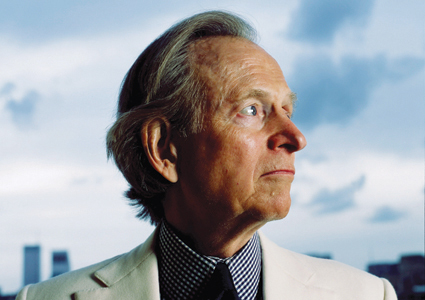
 Tom Wolfe in his trademark white suit, 2004: For five decades, he has been a correspondent on the frontline of American society (photo: David Corio/Getty Images)
In December 1969, Tom Wolfe received an invitation to the Park Avenue apartment of Leonard Bernstein and his wife Felicia. They were holding a party for guests “to meet and hear from leaders of the Black Panther Party and lawyers for the New York Panther 21”.
Wolfe was 38 and becoming famous as the Man in the White Suit. He had published a bestselling and ground-breaking book about the hippie movement, The Electric Kool-Aid Acid Test (1968), as well as two collections of essays, The Kandy-Kolored Tangerine-Flake Streamline Baby (1965) and The Pump House Gang (1968). With his wit, his powers of observation, his application of the novelist’s tools to non-fiction writing, and an unmistakable style, he turned himself in a few short years from a just another newspaper reporter into a journalistic sensation. And it was after this metamorphosis, at the end of 1969, that Wolfe found himself on the guest list for the Bernsteins’ glittering fundraiser.
The “Panther 21” were facing trial for conspiracy to blow up department stores, a police station and the Bronx Botanical Gardens and they need money to post bail and pay for lawyers. But Tom Wolfe left his chequebook at home and instead packed his notebook.
The result of his reporting that night was an article published several months later in New York magazine. “Radical Chic: That Party at Lenny’s” is an evisceration of the Bernsteins and other socialites who had taken to hobnobbing with the leaders of radical movements. It is the trivial concerns of those at the gathering and the shallow motivations for their involvement that Wolfe satirised so savagely:
What does one wear to these parties for the Panthers or the Young Lords or the grape workers? What does a woman wear? Obviously one does not want to wear something frivolously and pompously expensive, such as a Gerard Pipart party dress. On the other hand one does not want to arrive “poor-mouthing it” in some outrageous turtleneck and West Eighth Street bell-jean combination, as if one is “funky” and “of the people” . . . Look at Felicia. She is wearing the simplest little black frock imaginable, with absolutely no ornamentation save for a plain gold necklace. It is perfect. It has dignity without any overt class symbolism.
Not even the canapés were spared:
Mmmmmmmmmmmmmmm. These are very nice. Little Roquefort cheese morsels rolled in crushed nuts. Very tasty. Very subtle. It’s the way the dry sackiness of the nuts tiptoes up against the dour savor of the cheese that is so nice, so subtle. Wonder what the Black Panthers eat here on the hors d’oeuvre trail?
Describing the fallout from the piece, National Review Editor William F. Buckley praised “Radical Chic” as a “very, very controversial” essay “for which [Wolfe] has been publicly excommunicated by the bishops who preside over the New York Review of Books”. Wolfe landed such a clean blow because he hadn’t just taken issue with the Bernsteins’ politics or the aims or tactics of the Black Panthers. Rather, he had laughed at them, and America had laughed along with him. The country is still laughing. Radical Chic & Mau-Mauing the Flak Catchers, a pair of essays in a single volume, is still in print today.
I found the invitation to the Bernsteins’ party in a box in the main branch of the New York Public Library. In another box is the notebook Wolfe took along: “Panther night at Leonard Bernstein’s” reads the title on its cover. There is also a letter from Bernstein’s sister Shirley, sent to Wolfe after “Radical Chic” was published, accusing him of working “as if on order from Messrs Agnew and Hoover” (Nixon’s Vice-President and the FBI chief) and blacklisting him from “all things radical”.
These artefacts are part of the Tom Wolfe papers, which the library acquired two years ago for $2.1 million. For that sum, Wolfe, now 82, has handed over the physical remnants of a lifetime’s work. After several years’ processing they became available to view earlier this year. In 219 boxes are his correspondence, notes, manuscripts, photographs and drawings. From his contributions to The Pine Needle, his high school newspaper in Richmond, Virginia, to the notes for his most recent work, Back to Blood, it is all there.
At the time of the acquisition, in 2013, Wolfe said he “couldn’t be more delighted. I’ve inhabited the New York Public Library so steadily since the very day I came to New York in 1962 to work — all of three blocks away — at the New York Herald Tribune, I feel like my archive is not moving anywhere. It’s going home.”
It is hard to think of a greater stamp of literary respectability the city could bestow on a writer. Ascend the stairs of the library’s imposing Fifth Avenue entrance, passing Patience and Fortitude, the marble lions that guard the doors, and you are entering the cathedral of literary New York. Its reading room, currently closed for restoration, is an inner sanctum long used by writers escaping the noisy distractions of the city outside. My particular pilgrimage takes me to the library’s Manuscripts and Archives division. Among its treasures are some 700 cuneiform tablets, hundreds of medieval illuminated manuscripts and renaissance documents, a copy of the Declaration of Independence annotated by Thomas Jefferson, George Washington’s Farewell Address (as well as his recipe for beer: “a larger sifter full of Bran Hops”, “3 gallons Molasses”). Researchers can read manuscripts and letters by Washington Irving, Herman Melville, James Joyce and Ezra Pound. With the library’s acquisition of his papers, this is the company Tom Wolfe finds himself in. He is now, officially, an Important Writer.
It is odd thrill to sit in the hush of Room 328 and, while researchers next to you scour Civil War records, read a letter to Tom Wolfe from “Gonzo” journalist Hunter S. Thompson about his new motorbike — “a lightweight Spanish bugger, built for dirt-riding” — or to open an envelope and find in it no note but a series of fabric samples in various creams and whites, sent to Wolfe, one assumes, by his tailor. (There is more than one shade of white suit.) There are letters from editors desperate for his work to appear in their pages (“we are always in the market for a piece by you on any topic whatsoever”) and invitations to lunch, including a 1989 request from a then little-known Michael Bloomberg to meet him and a group of bond traders: “Your portrayal of the ‘masters of the universe’ [in his first novel, The Bonfire of the Vanities] is certainly a subject with which they are quite familiar.”
Such pleasures will not be on offer for admirers of younger writers. Trawling through Jonathan Franzen’s Gmail account or downloading the contents of Zadie Smith’s hard drive in 50 years’ time will be a blander experience than rummaging through Wolfe’s papers. Letters are annotated and corrected, letterheads offer a glimpse of the correspondent’s whereabouts. Wolfe’s own sketches, doodles and scribbles in the margins of his notes and proofs put you there, next to him at the writer’s desk, struggling with a difficult sentence.
These artefacts are part of the Tom Wolfe papers, which the library acquired two years ago for $2.1 million. For that sum, Wolfe, now 82, has handed over the physical remnants of a lifetime’s work. After several years’ processing they became available to view earlier this year. In 219 boxes are his correspondence, notes, manuscripts, photographs and drawings. From his contributions to The Pine Needle, his high school newspaper in Richmond, Virginia, to the notes for his most recent work, Back to Blood, it is all there.
At the time of the acquisition, in 2013, Wolfe said he “couldn’t be more delighted. I’ve inhabited the New York Public Library so steadily since the very day I came to New York in 1962 to work — all of three blocks away — at the New York Herald Tribune, I feel like my archive is not moving anywhere. It’s going home.”
It is hard to think of a greater stamp of literary respectability the city could bestow on a writer. Ascend the stairs of the library’s imposing Fifth Avenue entrance, passing Patience and Fortitude, the marble lions that guard the doors, and you are entering the cathedral of literary New York. Its reading room, currently closed for restoration, is an inner sanctum long used by writers escaping the noisy distractions of the city outside. My particular pilgrimage takes me to the library’s Manuscripts and Archives division. Among its treasures are some 700 cuneiform tablets, hundreds of medieval illuminated manuscripts and renaissance documents, a copy of the Declaration of Independence annotated by Thomas Jefferson, George Washington’s Farewell Address (as well as his recipe for beer: “a larger sifter full of Bran Hops”, “3 gallons Molasses”). Researchers can read manuscripts and letters by Washington Irving, Herman Melville, James Joyce and Ezra Pound. With the library’s acquisition of his papers, this is the company Tom Wolfe finds himself in. He is now, officially, an Important Writer.
It is odd thrill to sit in the hush of Room 328 and, while researchers next to you scour Civil War records, read a letter to Tom Wolfe from “Gonzo” journalist Hunter S. Thompson about his new motorbike — “a lightweight Spanish bugger, built for dirt-riding” — or to open an envelope and find in it no note but a series of fabric samples in various creams and whites, sent to Wolfe, one assumes, by his tailor. (There is more than one shade of white suit.) There are letters from editors desperate for his work to appear in their pages (“we are always in the market for a piece by you on any topic whatsoever”) and invitations to lunch, including a 1989 request from a then little-known Michael Bloomberg to meet him and a group of bond traders: “Your portrayal of the ‘masters of the universe’ [in his first novel, The Bonfire of the Vanities] is certainly a subject with which they are quite familiar.”
Such pleasures will not be on offer for admirers of younger writers. Trawling through Jonathan Franzen’s Gmail account or downloading the contents of Zadie Smith’s hard drive in 50 years’ time will be a blander experience than rummaging through Wolfe’s papers. Letters are annotated and corrected, letterheads offer a glimpse of the correspondent’s whereabouts. Wolfe’s own sketches, doodles and scribbles in the margins of his notes and proofs put you there, next to him at the writer’s desk, struggling with a difficult sentence.
Wolfe has not published a memoir or autobiography. In general he leaves himself out of his writing. But the career of Tom Wolfe, as told by Tom Wolfe, is the story of an outsider swimming against the tide, first in non-fiction and then in novels. Things got interesting when a strike knocked out New York’s newspapers in 1963. “You weren’t going to catch me on a picket line,” Wolfe said in an interview several years ago. “So I went to Esquire with a story about custom cars.” That article, his first magazine piece, was originally titled “There Goes (Varoom! Varoom!) That Kandy-Kolored (Thphhhhh!) Tangerine-Flake Streamline Baby (Rahghhh!) Around the Bend! (Brummmmmmmmmmmmmmm) . . .” Tom Wolfe was already Tom Wolfe.
More magazine work followed. The subject matter was diverse — Las Vegas, a Nascar driver, New Yorker editor William Shawn, Californian surfers — but all are an attempt to understand the zeitgeist. Then, in 1968, he published his first book, The Electric Kool-Aid Acid Test, which follows novelist Ken Kesey and his band of Merry Pranksters, who travel across America taking LSD in a brightly-painted school bus. It quickly became the definitive text on the emergence of hippie culture. The invitations to lunch and reminders to be at the Rockefeller Centre for 8.15 a.m. to appear on the Today Show that populate the box of Wolfe’s correspondence from 1968 demonstrate the splash he had made. One of the more unusual compliments The Electric Kool-Aid Acid Test earned came from a correspondent in London who said in a letter to Wolfe that “the book is a magnificent, harrowing experience and it made me really understand why people read pornography — to experience it vicariously. But you do better than good porn, provoking not vicarious experience but actual experience.”
As Wolfe tells it, during this part of the late Sixties, he and a number of writers of his generation — including Joan Didion, Truman Capote, Gay Talese and Hunter S. Thompson — were experimenting with a new approach to their craft. What became known as the New Journalism was the art of writing non-fiction as though it were fiction, with dialogue and scenes resembling the novel rather than the newspaper report. The output of these writers, including Wolfe, was innovative and exciting, but the New Journalism (the title of a 1973 anthology of writing from this genre and published with an introduction from Wolfe) was let down by its misleading name. Really, Wolfe and his contemporaries were part of a renaissance of literary non-fiction, something great writers have been producing for centuries, rather than the creation of something entirely new. But the questionable novelty of the New Journalism need not obscure the exciting, important work these writers were producing.
After The Electric Kool-Aid Acid Test came the “Radical Chic” brouhaha and, in the Seventies, more of Wolfe’s signature magazine writing as well as a foray into cultural criticism with The Painted Word (1975), an attack on abstract and conceptual art and the critics who encourage it, and, later, From Bauhaus to Our House (1981), a critique of much modern architecture in which he asked of America, “Has there ever been another place on earth where so many people of wealth and power have paid for and put up with so much architecture they detested?” In 1979, he published The Right Stuff, his best-selling book to date, which described the early days of the US space programme and was made into a film in 1983. At the end of the Seventies, Wolfe was a writer at the peak of his powers. Every subject he touched with his non-fiction writing turned to gold. And so he decided to write a novel.
More magazine work followed. The subject matter was diverse — Las Vegas, a Nascar driver, New Yorker editor William Shawn, Californian surfers — but all are an attempt to understand the zeitgeist. Then, in 1968, he published his first book, The Electric Kool-Aid Acid Test, which follows novelist Ken Kesey and his band of Merry Pranksters, who travel across America taking LSD in a brightly-painted school bus. It quickly became the definitive text on the emergence of hippie culture. The invitations to lunch and reminders to be at the Rockefeller Centre for 8.15 a.m. to appear on the Today Show that populate the box of Wolfe’s correspondence from 1968 demonstrate the splash he had made. One of the more unusual compliments The Electric Kool-Aid Acid Test earned came from a correspondent in London who said in a letter to Wolfe that “the book is a magnificent, harrowing experience and it made me really understand why people read pornography — to experience it vicariously. But you do better than good porn, provoking not vicarious experience but actual experience.”
As Wolfe tells it, during this part of the late Sixties, he and a number of writers of his generation — including Joan Didion, Truman Capote, Gay Talese and Hunter S. Thompson — were experimenting with a new approach to their craft. What became known as the New Journalism was the art of writing non-fiction as though it were fiction, with dialogue and scenes resembling the novel rather than the newspaper report. The output of these writers, including Wolfe, was innovative and exciting, but the New Journalism (the title of a 1973 anthology of writing from this genre and published with an introduction from Wolfe) was let down by its misleading name. Really, Wolfe and his contemporaries were part of a renaissance of literary non-fiction, something great writers have been producing for centuries, rather than the creation of something entirely new. But the questionable novelty of the New Journalism need not obscure the exciting, important work these writers were producing.
After The Electric Kool-Aid Acid Test came the “Radical Chic” brouhaha and, in the Seventies, more of Wolfe’s signature magazine writing as well as a foray into cultural criticism with The Painted Word (1975), an attack on abstract and conceptual art and the critics who encourage it, and, later, From Bauhaus to Our House (1981), a critique of much modern architecture in which he asked of America, “Has there ever been another place on earth where so many people of wealth and power have paid for and put up with so much architecture they detested?” In 1979, he published The Right Stuff, his best-selling book to date, which described the early days of the US space programme and was made into a film in 1983. At the end of the Seventies, Wolfe was a writer at the peak of his powers. Every subject he touched with his non-fiction writing turned to gold. And so he decided to write a novel.
He did so, he admits, partly to prove to himself and his critics that he had it in him, but also because of his dismay at what he saw as the collective failure of American novelists to tell the stories of their age. Later, explaining his novel in a Harper’s essay “Stalking the Billion-Footed Beast: A literary manifesto for the new social novel” (1989), he wrote:
Here Wolfe is stretching his point somewhat. Vietnam, for example, spawned dozens of novels. But his sense that something was lacking in American writing drove him on. His novel about New York “should be a novel of the city, in the sense that Balzac and Zola had written novels of Paris and Dickens and Thackeray had written novels of London, with the city always in the foreground, exerting its relentless pressure on the souls of its inhabitants”.
Wolfe-the-novelist got things off to a Dickensian start, writing The Bonfire of the Vanities as a serialisation in Rolling Stone magazine, running fortnightly in 27 instalments beginning in 1984. The result, which Wolfe called “a very public first draft”, was reworked and published in a single volume in 1987. The book was a publisher’s dream, pleasing (most) critics and becoming a bestseller. True to Wolfe’s intentions, The Bonfire of the Vanities is a wide-angle look at Eighties New York, in which two sides of the city, rich and white, black and poor, collide when bond trader Sherman McCoy takes a wrong turn on the way back from collecting his mistress from JFK.
One letter in the archives is an unlikely testament to the novel’s success. It is from a real-life resident of 962 Fifth Avenue, the address of self-proclaimed master of the universe McCoy: “As a very private person who wishes to remain that way and who has no taste whatsoever for the kinds of flashy lifestyles which you describe, I am embarrassed and ashamed when friends gleefully inform us that our new address is in your book and has become a rather notorious one.”
Open the Bonfire boxes in the NYPL and it is clear that Wolfe means it when he says:
Half of the publishers along Madison Avenue . . . had their noses pressed against their thermopile glass walls scanning the billion-footed city for the approach of young novelists who, surely, would bring them the big novels of the racial clashes, the hippie movement, the New Left, the Wall Street boom, the sexual revolution, the war in Vietnam. But such creatures it seemed, no longer existed . . . The strange fact of the matter was that young people with serious literary ambitions were no longer interested in the metropolis, or any other big, rich slice of contemporary life.
Here Wolfe is stretching his point somewhat. Vietnam, for example, spawned dozens of novels. But his sense that something was lacking in American writing drove him on. His novel about New York “should be a novel of the city, in the sense that Balzac and Zola had written novels of Paris and Dickens and Thackeray had written novels of London, with the city always in the foreground, exerting its relentless pressure on the souls of its inhabitants”.
Wolfe-the-novelist got things off to a Dickensian start, writing The Bonfire of the Vanities as a serialisation in Rolling Stone magazine, running fortnightly in 27 instalments beginning in 1984. The result, which Wolfe called “a very public first draft”, was reworked and published in a single volume in 1987. The book was a publisher’s dream, pleasing (most) critics and becoming a bestseller. True to Wolfe’s intentions, The Bonfire of the Vanities is a wide-angle look at Eighties New York, in which two sides of the city, rich and white, black and poor, collide when bond trader Sherman McCoy takes a wrong turn on the way back from collecting his mistress from JFK.
One letter in the archives is an unlikely testament to the novel’s success. It is from a real-life resident of 962 Fifth Avenue, the address of self-proclaimed master of the universe McCoy: “As a very private person who wishes to remain that way and who has no taste whatsoever for the kinds of flashy lifestyles which you describe, I am embarrassed and ashamed when friends gleefully inform us that our new address is in your book and has become a rather notorious one.”
Open the Bonfire boxes in the NYPL and it is clear that Wolfe means it when he says:
[The] task, as I see it, inevitably involves reporting, which I regard as the most valuable and least understood resource available to any writer with exalted ambitions, whether the medium is print, film tape or the stage. Young writers are told, “Write about what you know.” There is nothing wrong with that rule as a starting point, but it seems to get quickly magnified into an unspoken maxim: The only valid experience is personal experience.
There are newspaper clippings, notes in shorthand, sketches and plans. For The Bonfire of the Vanities, he spent time in Bronx courts listening to cases, talking to lawyers and defendants and taking books of notes. In one box is a letter from someone who worked at a Bronx court. Francine Garb wrote: “I want to encourage you to take an interest . . . I am very familiar with your work, and this place and the goings-on, believe me, is just your stuff . . . Trying to sort it all out, get to the core, is like walking down a long labyrinth in a Fun House, attempting to focus and just getting those distortions back from the mirrors.”
New York’s justice system was not the last “labyrinth in a Fun House” that Wolfe would navigate. In his three subsequent novels, he has grabbed thorny issues without flinching. In A Man in Full (1998) questions of status, wealth and race boil over in Atlanta. I Am Charlotte Simmons (2004) concerns sex on campus. Back to Blood (2012) is set among Cuban immigrants in Miami.
Wolfe may feel his work is “going home”, but his papers sit uncomfortably alongside their august neighbours in the New York Public Library. The acquisition is a strange mark of respectability for a writer who, from “Radical Chic” onwards, has spent much of his career thumbing his nose at New York’s literary establishment, skewering the rich and famous for their hypocrisies and feuding fearlessly with some of America’s most respected writers.
A Man in Full was met with scathing reviews from three literary giants. Norman Mailer’s takedown of Wolfe’s kinetic style is hard to forget. Reading Wolfe’s weighty novel was, he said, like making love to a 300lb woman: “Once she gets on top it’s all over. Fall in love or be asphyxiated,” he wrote in the New York Review of Books. John Irving (The Cider House Rules) claimed he could open A Man in Full to any page and “read a sentence that would make me gag”. Wolfe’s novels are “yak” and “journalistic hyperbole described as fiction,” he said.
Most temperate and perhaps therefore most damning was John Updike: “A Man in Full still amounts to entertainment, not literature, even literature in a modest aspirant form. Like a movie desperate to recoup its bankers’ investment, the novel tries too hard to please us.”
While their attacks evidently stung — Wolfe hit back in a vituperative essay boldly titled “My Three Stooges” — there was a sort of vindication for him buried in their criticisms. If they would not let Wolfe into the literary club because his work was “journalistic”, then they were proving the point he had been making throughout his career: that “serious” writers no longer saw it as their duty to report on the world around them.
Sift through the Tom Wolfe papers and you get a picture of a writer who, from Sixties hippies to Eighties “masters of the universe”, has been a correspondent on the frontline of American society, reporting on its changes, its absurdities and its hypocrisies — and in doing so, helping a country make sense of itself.
New York’s justice system was not the last “labyrinth in a Fun House” that Wolfe would navigate. In his three subsequent novels, he has grabbed thorny issues without flinching. In A Man in Full (1998) questions of status, wealth and race boil over in Atlanta. I Am Charlotte Simmons (2004) concerns sex on campus. Back to Blood (2012) is set among Cuban immigrants in Miami.
Wolfe may feel his work is “going home”, but his papers sit uncomfortably alongside their august neighbours in the New York Public Library. The acquisition is a strange mark of respectability for a writer who, from “Radical Chic” onwards, has spent much of his career thumbing his nose at New York’s literary establishment, skewering the rich and famous for their hypocrisies and feuding fearlessly with some of America’s most respected writers.
A Man in Full was met with scathing reviews from three literary giants. Norman Mailer’s takedown of Wolfe’s kinetic style is hard to forget. Reading Wolfe’s weighty novel was, he said, like making love to a 300lb woman: “Once she gets on top it’s all over. Fall in love or be asphyxiated,” he wrote in the New York Review of Books. John Irving (The Cider House Rules) claimed he could open A Man in Full to any page and “read a sentence that would make me gag”. Wolfe’s novels are “yak” and “journalistic hyperbole described as fiction,” he said.
Most temperate and perhaps therefore most damning was John Updike: “A Man in Full still amounts to entertainment, not literature, even literature in a modest aspirant form. Like a movie desperate to recoup its bankers’ investment, the novel tries too hard to please us.”
While their attacks evidently stung — Wolfe hit back in a vituperative essay boldly titled “My Three Stooges” — there was a sort of vindication for him buried in their criticisms. If they would not let Wolfe into the literary club because his work was “journalistic”, then they were proving the point he had been making throughout his career: that “serious” writers no longer saw it as their duty to report on the world around them.
Sift through the Tom Wolfe papers and you get a picture of a writer who, from Sixties hippies to Eighties “masters of the universe”, has been a correspondent on the frontline of American society, reporting on its changes, its absurdities and its hypocrisies — and in doing so, helping a country make sense of itself.