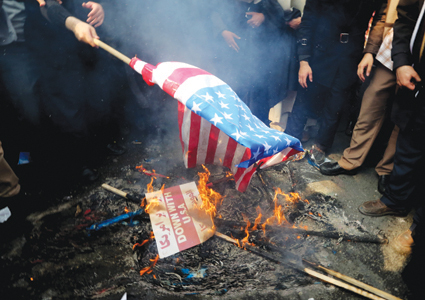
 A prospective ally? Protesters burn the US flag on this year’s annual “Day Against Global Arrogance” in Iran, despite the nuclear deal (© Atta Kenare/AFP/Getty Images)
In his first presidential election campaign in 2008, Barack Obama singled out the Middle East as the top foreign policy priority for his hoped-for administration. He wanted to extricate the United States from both Iraq, which he dubbed “the wrong war”, and Afghanistan, which he labelled “the right war.” He promised “a new beginning with the Muslim world”, and soon after his election made spectacular trips to Turkey and Egypt where he made lengthy speeches crediting Islam with achievements that surprised many Muslims. Believing that most Muslims were unhappy to see their brethren wearing orange jumpsuits in Guantanamo Bay, he also promised to abolish the notorious prison camp with a stroke of the presidential pen. Recalling the sympathy he had nurtured for the “Palestinian cause” in his youth, he promised to make the two-state slogan, a Bush administration diplomatic concoction, a reality.
His most ardent desire, however, was to make a deal with the Islamic Republic in Iran, stretching the hand of friendship to adversaries who had waved a clenched fist at the world for three decades. No sooner had Obama entered the White House than he started an epistolary courting of Tehran’s Khomeinist leaders, writing first to President Mahmoud Ahmadinejad and, when he was ignored, to the “Supreme Guide”, Ayatollah Ali Khamenei.
Since then, the story of Obama and the Middle East has been a Dutch auction of lowering aims and failure to meet them. The flatter-Islam exercise in Istanbul and Cairo, where Obama even almost credited Islam for having invented the cinema, boosted the Islamist groups that instantly boasted about having “humbled the last superpower”, in the words of one of Egypt’s Muslim Brotherhood leaders, Kamal Halbawi. Soon, the Brotherhood was invited to a “dialogue” with the new US administration, thus securing a degree of legitimacy it had never previously enjoyed.
In Turkey, Obama’s flatter-Islam policy encouraged factions within the Justice and Development Party (AKP), built on the debris of several Islamist parties that had always been unhappy about hiding their movement’s religious aspirations. Obama’s stance weakened the position of moderates such as the then president, Abdullah Gul, and the finance minister, Ali Babacan, strengthening the position of then prime minister Recep Tayyip Erdogan with his more in-your-face Islamist attitude. Erdogan would make a full comeback this past October by winning a fourth term in power for the AKP, albeit without obtaining the two-thirds majority he had hoped for and needed to change the constitution.
In Egypt, Obama’s flirting with Islam and Islamism was interpreted as a sign that the United States was prepared to ditch its long-time ally President Hosni Mubarak just as the first clouds of the Arab Spring were beginning to appear above Cairo’s Tahrir (Liberation) Square.
Obama’s Islamist tilt was to lead to an objective, though not officially sanctioned, alliance with the Muslim Brotherhood and, when Egypt was plunged into crisis, Washington sent senior diplomat Frank Wisner to “advise” the Egyptian military to force Mubarak out. However, when the Muslim Brotherhood did come to power and plunged Egypt into an even deeper crisis, Obama had become nothing but an embarrassed spectator of events he did not even understand. By the time the Egyptian military had returned to power with a coup, the US had lost credibility with both the army and the Brotherhood not to mention the pro-democracy groups of Tahrir Square and the urban middle class.
Obama launched his “peace in Palestine” number just two days after his inauguration in January 2009 and appointed former Senator George Mitchell, a highly respected Democrat and one-time Senate majority leader, as special envoy with the promise that “when we meet next year” there would be two states, one Israeli, the other Palestinian. However, the whole thing was soon forgotten as Obama, in his butterfly style, simply flew to another flower to make another speech. A frustrated Mitchell resigned two years later, telling friends that he never gained the impression that Obama was serious about the “peace mission”.
Throughout 2009 and 2010, Obama did all he could to sabotage the Status of Forces Agreement (Sofa) that President George W. Bush’s administration had negotiated with Baghdad, providing for the continued presence of 11,000 American troops in Iraq. Obama’s campaign succeeded and, by 2013, the number of US military in Iraq was cut to fewer than 1,000. Obama’s policy drove Iraq’s new Shia-dominated leadership to move closer to Iran as the only power capable of helping it face the growing challenge of Sunni Islam to the new sectarian balance of power in Baghdad. Two years later, however, Obama was forced almost to beg Iraq to let in more American troops. At the time of writing, the American military build-up in Iraq was heading towards the same numbers envisaged in the accord negotiated under Bush. Meanwhile, the premature US troop draw-down opened a space for Sunni-based terror groups to recover from the defeat inflicted on them during the US-led surge of 2007-2008 and to reorganise, eventually coalescing to form the Islamic State (IS), or Daesh.
Playing catch-up as usual, Obama tried to rewind the film of his mistakes by announcing air-strikes against Daesh. But even then he made it clear that air-strikes would target Daesh positions only in Iraq, not the terrorist group’s core-support base and capital in the neighbouring Syrian province of Raqqah. The aim was “to degrade and contain” Daesh, not to defeat and destroy it. In Libya, Obama saw an opportunity to test his doctrine of “leading from behind”, encouraging France’s then president, Nicolas Sarkozy, and British prime minister David Cameron to take the lead in managing the crisis triggered by Colonel Muammar Gaddafi’s plan to wipe out his long-time opponents in the eastern and southern provinces of the country. Sarkozy and Cameron succeeded in preventing the massacres that Gaddafi had planned but, in the absence of American leadership, proved unable to stop the spiral that led to the collapse of Libyan state structures, triggering a cluster of crises with no end in sight.
The Syrian crisis, a popular uprising that morphed into a civil war and a humanitarian disaster, was another challenge that Obama faced, played with and danced around. Having solemnly declared that “President [Bashar] Al-Assad must step down,” Obama drew a number of “red lines” which the Syrian despot quickly crossed when his forces used chemical weapons against the civilian population in at least 18 cities. Adopting martial tones, Obama at one point wrote to Congress asking for authorisation to use military force to evict Assad. Even then he insisted that he was not proposing an “endurable” (sic) military intervention, meaning he was thinking of a quick operation delivering a swift victory. He even insisted that there would be no American “boots on the ground”, sending a signal to everyone that he was thinking of nothing but a weak symbolic gesture.
However, even before US legislators had considered the issue, Obama shelved the military option in favor of “a peace plan” proposed by “our Russian partners”. The move signalled the start of a new process that would end with Russian military intervention in Syria this year to prevent the fall of Assad’s neo-fascist Ba’athist regime. Syrians continue to die every day. Many of those who have survived have been driven out of their homes, producing a tsunami of refugees that threatens the stability of neighbouring nations and, beyond them, the European Union.
One result of Obama’s tergiversations on Syria was to leave the people of that broken land defenseless between a brutal regime and a pseudo-state founded on plunder and terror. The Syrian fiasco also encouraged the Islamic State to try and expand its reign of terror to Lebanon, Jordan, Egypt, Libya and Tunisia and to mount deadly operations that claimed the lives of 220 Russian tourists on a flight back from Sharm al-Sheikh and 129 people in Paris in a series of terror attacks and suicide operations.
Even before he was elected president, Obama had made it clear that he regarded the “Iran problem” as the biggest foreign policy challenge he would face. Convinced of his own superiority, Obama deluded himself into believing that with Iran he could succeed where six previous US presidents had lamentably failed. He hoped to do so with a combination of the “stretched hand of friendship” and “everything is on the table” toughness. The priority, however, was to “block all paths to Iran acquiring a nuclear weapon.”
This is what he said during the presidential debate of October 7, 2008:
Seven years later, and after two years of secret contacts followed by two more years of formal negotiations, Obama had all but accepted Iran as a nation capable of building a nuclear arsenal.
In his Dutch-auction style of diplomacy he was no longer hoping to “block all paths” to an Iranian bomb but was instead happy to slow the mullahs’ progress in that direction. Having worked out the outline of a deal in secret talks with Iran in Oman, Obama tried to muddy the waters regarding his U-turn by involving the four other veto-holding members of the United Nations Security Council plus Germany, Iran’s biggest Western trading partner, in the form of a group called the P5+1, which was charged with working out the language of his surrender. The EU’s foreign policy chief was also involved in a capacity that was never clearly defined and varied between mere observer and chairmanship of some of the sessions. By last July, the P5+1 and the Islamic Republic were able to declare that an accord had been reached, although the accounts given by various participants, notably Iran and the US, regarding what had been agreed differed sharply.
In a Reuters interview last March, Obama broadly outlined the deal. Iran, he said, was already at the “threshold” point, needing just a year to build its first nuclear warhead. Under the deal negotiated between Tehran and the P5+1, Iran would freeze its programme at the current point for 10 years, subject to review in five years’ time, but could continue enriching uranium up to 5 per cent. In other words, Washington would acknowledge Iran’s right to build a nuclear arsenal in ten years (perhaps five) if it so wished. Meanwhile, Iran could enrich uranium and build up low-grade stocks. In exchange for accepting international “probation”, the form of which remained unclear, Iran would see US, UN and EU sanctions lifted. The text of a protocol that Iran subsequently signed with the International Atomic Energy Agency (IAEA) on the modalities of inspections remains confidential.
Even before he was elected president, Obama had made it clear that he regarded the “Iran problem” as the biggest foreign policy challenge he would face. Convinced of his own superiority, Obama deluded himself into believing that with Iran he could succeed where six previous US presidents had lamentably failed. He hoped to do so with a combination of the “stretched hand of friendship” and “everything is on the table” toughness. The priority, however, was to “block all paths to Iran acquiring a nuclear weapon.”
This is what he said during the presidential debate of October 7, 2008:
We cannot allow Iran to get a nuclear weapon. It would be a game-changer in the region. Not only would it threaten Israel, our strongest ally in the region and one of our strongest allies in the world, but it would also create a possibility of nuclear weapons falling into the hands of terrorists. And so it’s unacceptable. And I will do everything that’s required to prevent it. And we will never take military options off the table.
Seven years later, and after two years of secret contacts followed by two more years of formal negotiations, Obama had all but accepted Iran as a nation capable of building a nuclear arsenal.
In his Dutch-auction style of diplomacy he was no longer hoping to “block all paths” to an Iranian bomb but was instead happy to slow the mullahs’ progress in that direction. Having worked out the outline of a deal in secret talks with Iran in Oman, Obama tried to muddy the waters regarding his U-turn by involving the four other veto-holding members of the United Nations Security Council plus Germany, Iran’s biggest Western trading partner, in the form of a group called the P5+1, which was charged with working out the language of his surrender. The EU’s foreign policy chief was also involved in a capacity that was never clearly defined and varied between mere observer and chairmanship of some of the sessions. By last July, the P5+1 and the Islamic Republic were able to declare that an accord had been reached, although the accounts given by various participants, notably Iran and the US, regarding what had been agreed differed sharply.
In a Reuters interview last March, Obama broadly outlined the deal. Iran, he said, was already at the “threshold” point, needing just a year to build its first nuclear warhead. Under the deal negotiated between Tehran and the P5+1, Iran would freeze its programme at the current point for 10 years, subject to review in five years’ time, but could continue enriching uranium up to 5 per cent. In other words, Washington would acknowledge Iran’s right to build a nuclear arsenal in ten years (perhaps five) if it so wished. Meanwhile, Iran could enrich uranium and build up low-grade stocks. In exchange for accepting international “probation”, the form of which remained unclear, Iran would see US, UN and EU sanctions lifted. The text of a protocol that Iran subsequently signed with the International Atomic Energy Agency (IAEA) on the modalities of inspections remains confidential.
The “deal” was presented as a 159-page document under the title of Comprehensive Joint Plan of Action (CJPOA) which, thanks to its Orwellian grammar and vocabulary, is likely to enter history as a model of diplomatic obfuscation. The text makes it clear that the deal is tailor-made for Iran and will not apply to any other nation that, like Iran, might violate the Nuclear Nonproliferation Treaty (NPT). As far as the Islamic Republic was concerned, however, the deal left Iran’s nuclear programme intact while “signalling the collapse of the structure of sanctions”, as President Hassan Rouhani remarked. To Rouhani and his team what mattered was that Iran would gain access to billions of dollars in Iran’s frozen assets plus the possibility of raising investment funds and loans on global capital markets to inject life into a moribund economy. Many wondered about the point of more than a decade of tensions, sanctions and threats of war, half of it on Obama’s watch, if America was to end up effectively accepting Tehran’s right to build a bomb. The Obama deal threatens other harm too.
First, it further discredits the word of America’s president. Five presidents from both parties, including Obama himself, are on record pledging not to allow Iran to build a nuclear arsenal. Ironically, and as noted above, the toughest pledge came from Obama himself, who, waving his finger and repeating his catchphrase, “make no mistake”, has said he would never let Iran go nuclear.
Second, the deal signals to all nations that building nuclear arms is OK, even for those (like Iran) that promised not to do so by signing the NPT. That could trigger a stampede that Obama’s successors will find hard to contain. Turkey has already said it intends to build a nuclear “industry”. Egypt promises to expand its embryonic Nuclear Commission. Nuclear cooperation featured in last summer’s talks between Saudi Arabia’s new king, Salman bin Abdulaziz, and Pakistani prime minister Nawaz Sharif. The United Arab Emirates is in talks with France to start its own nuclear programme. Even Iraq is toying with the idea. Last March, Iraqi foreign minister Ibrahim al-Jaafari said Obama’s recognition of “Iran’s nuclear rights” was a signal to “other developing nations” to build programmes of their own.
Third, the Obama “deal” undermines the UN. Obama has long accused President George W. Bush of “unilateralism” and ignoring the UN. Yet Bush ordered intervention in Iraq on the basis of 14 Security Council resolutions passed between 1990 and 2003. Obama, by contrast, ignored six UN Security Council resolutions that demanded Iran stop all uranium enrichment. He then proceeded to push through a seventh resolution to endorse the CJPOA, albeit with important differences from the Vienna text, in effect drawing whatever teeth there were in the six previous resolutions. The seventh resolution set a new record by being passed in a single day under intense lobbying by the Obama administration.
Worse, by putting the talks under the umbrella of the P5+1 group, an ad-hoc body with no clear mission statement, no legal legitimacy and certainly no authority to negotiate on behalf of the UN, Obama created a rival to the Security Council. Obama had mocked Bush’s concept of “the coalition of the willing” to deal with major international problems. Here he was copying that very concept with the difference that he was double-crossing his P5+1 partners by conducting secret parallel talks with the Iranians. At one point during the talks in Switzerland, French foreign minister Laurent Fabius protested, only half in jest, that the US secretary of state John Kerry and his Iranian counterpart Muhammad Javad Zarif often found themselves on the same side against other P5+1 ministers.
First, it further discredits the word of America’s president. Five presidents from both parties, including Obama himself, are on record pledging not to allow Iran to build a nuclear arsenal. Ironically, and as noted above, the toughest pledge came from Obama himself, who, waving his finger and repeating his catchphrase, “make no mistake”, has said he would never let Iran go nuclear.
Second, the deal signals to all nations that building nuclear arms is OK, even for those (like Iran) that promised not to do so by signing the NPT. That could trigger a stampede that Obama’s successors will find hard to contain. Turkey has already said it intends to build a nuclear “industry”. Egypt promises to expand its embryonic Nuclear Commission. Nuclear cooperation featured in last summer’s talks between Saudi Arabia’s new king, Salman bin Abdulaziz, and Pakistani prime minister Nawaz Sharif. The United Arab Emirates is in talks with France to start its own nuclear programme. Even Iraq is toying with the idea. Last March, Iraqi foreign minister Ibrahim al-Jaafari said Obama’s recognition of “Iran’s nuclear rights” was a signal to “other developing nations” to build programmes of their own.
Third, the Obama “deal” undermines the UN. Obama has long accused President George W. Bush of “unilateralism” and ignoring the UN. Yet Bush ordered intervention in Iraq on the basis of 14 Security Council resolutions passed between 1990 and 2003. Obama, by contrast, ignored six UN Security Council resolutions that demanded Iran stop all uranium enrichment. He then proceeded to push through a seventh resolution to endorse the CJPOA, albeit with important differences from the Vienna text, in effect drawing whatever teeth there were in the six previous resolutions. The seventh resolution set a new record by being passed in a single day under intense lobbying by the Obama administration.
Worse, by putting the talks under the umbrella of the P5+1 group, an ad-hoc body with no clear mission statement, no legal legitimacy and certainly no authority to negotiate on behalf of the UN, Obama created a rival to the Security Council. Obama had mocked Bush’s concept of “the coalition of the willing” to deal with major international problems. Here he was copying that very concept with the difference that he was double-crossing his P5+1 partners by conducting secret parallel talks with the Iranians. At one point during the talks in Switzerland, French foreign minister Laurent Fabius protested, only half in jest, that the US secretary of state John Kerry and his Iranian counterpart Muhammad Javad Zarif often found themselves on the same side against other P5+1 ministers.
Compared to Obama, Bush was a paragon of multilateralism. Indeed, Obama’s approach recalls the actions of the appeasement-struck governments of Britain and France in the face of Fascist Italy’s and Nazi Germany’s aggressive behaviour; it was their separate negotiations that sidelined, and eventually doomed, the League of Nations.
Obama also succeeded in writing the US Congress out of the whole Iran nuclear script by concocting a hybrid document that commits the US to a course of action on a major issue of national security and international affairs, but isn’t a treaty and thus not subject to Senate approval. Obama has never stopped castigating Bush as an egomaniacal lone rider. Yet Bush sought congressional approval for his major decisions on Afghanistan and Iraq, including the “surge”, while Obama refused to do the same on this deal.
In 2008, Obama was secretly pressing the Iraqi government not to negotiate a status-of-forces agreement with the Bush team but instead to wait for him to enter the White House. At the same time, he was calling for Congress to have a say on that issue. On the Iran nuclear issue, however, he claimed he could do as he deemed fit without consulting anyone in Congress.
The Obama deal is bad for regional and world peace, bad for international cooperation, bad for US democracy and bad for the Iranian people, because it has given the obnoxious Khomeinist regime another opportunity to claim victory over the “Great Satan”. It has also sent a signal to America’s traditional allies in the region that Washington has embarked on a change of alliances, with Iran, as leader of the Shia camp of Islam, the principal partner in reshaping the Middle East.
Since last summer the White House has approached some critics of the Iran deal to explain the rationale behind the Obama policy through informal, non-attributable briefings. In these conversations, Obama aides readily admit the shortcomings of the Vienna deal but try to justify it as an attempt at persuading Iran to change the worst aspects of its behaviour.
One argument is that the deal would “empower the moderate faction in Tehran”, led by former President Ali-Akbar Hashemi Rafsanjani and with President Rouhani as its current spokesman, to consolidate its power base and, hopefully, capture other levers of power in next year’s crucial elections for the Islamic Majlis, Iran’s ersatz parliament, and the Assembly of Experts, a body of mullahs that chooses the Supreme Guide. The hope is that once the Rafsanjani-Rouhani faction is in effective control it would introduce reforms that would benefit the Iranian people while helping to normalise Iran’s relations with the outside world, including the US and other Western democracies. The analysis based on the supposed “war of the factions” as the key determinant of Iranian policy is a caricature of the “hawks and doves” dualism developed by Kremlin watchers during the Cold War. That analysis was wrong then and it is even more wrong now. The reason is that systems such as the one in place in the old Soviet Union and that which is now operating in Iran lack effective mechanisms for reform. If they had had such a mechanism they would have had ample time to use it over the decades.
Obama also succeeded in writing the US Congress out of the whole Iran nuclear script by concocting a hybrid document that commits the US to a course of action on a major issue of national security and international affairs, but isn’t a treaty and thus not subject to Senate approval. Obama has never stopped castigating Bush as an egomaniacal lone rider. Yet Bush sought congressional approval for his major decisions on Afghanistan and Iraq, including the “surge”, while Obama refused to do the same on this deal.
In 2008, Obama was secretly pressing the Iraqi government not to negotiate a status-of-forces agreement with the Bush team but instead to wait for him to enter the White House. At the same time, he was calling for Congress to have a say on that issue. On the Iran nuclear issue, however, he claimed he could do as he deemed fit without consulting anyone in Congress.
The Obama deal is bad for regional and world peace, bad for international cooperation, bad for US democracy and bad for the Iranian people, because it has given the obnoxious Khomeinist regime another opportunity to claim victory over the “Great Satan”. It has also sent a signal to America’s traditional allies in the region that Washington has embarked on a change of alliances, with Iran, as leader of the Shia camp of Islam, the principal partner in reshaping the Middle East.
Since last summer the White House has approached some critics of the Iran deal to explain the rationale behind the Obama policy through informal, non-attributable briefings. In these conversations, Obama aides readily admit the shortcomings of the Vienna deal but try to justify it as an attempt at persuading Iran to change the worst aspects of its behaviour.
One argument is that the deal would “empower the moderate faction in Tehran”, led by former President Ali-Akbar Hashemi Rafsanjani and with President Rouhani as its current spokesman, to consolidate its power base and, hopefully, capture other levers of power in next year’s crucial elections for the Islamic Majlis, Iran’s ersatz parliament, and the Assembly of Experts, a body of mullahs that chooses the Supreme Guide. The hope is that once the Rafsanjani-Rouhani faction is in effective control it would introduce reforms that would benefit the Iranian people while helping to normalise Iran’s relations with the outside world, including the US and other Western democracies. The analysis based on the supposed “war of the factions” as the key determinant of Iranian policy is a caricature of the “hawks and doves” dualism developed by Kremlin watchers during the Cold War. That analysis was wrong then and it is even more wrong now. The reason is that systems such as the one in place in the old Soviet Union and that which is now operating in Iran lack effective mechanisms for reform. If they had had such a mechanism they would have had ample time to use it over the decades.
In the case of Iran, empirical evidence proves Obama’s analysis wrong. Obama’s willingness to bend backwards to “meet their concerns” has not empowered the imaginary “moderate” faction. In Rouhani’s first two years as president the number of people executed in Iran reached figures not seen since the darkest days of 1988. This year Iran was the world’s number one nation for number of executions relative to its population, and second only to the People’s Republic of China overall. Under Rouhani, four times as many people have become political prisoners than under the supposedly hardline Ahmadinejad. Rouhani has presided over a nationwide crackdown on civil society: independent trade unions, human rights organisations, NGOs, and media and cultural associations representing religious and ethnic minorities.
As far as foreign policy is concerned, far from moderating its stance on a number of key issues, the Islamic Republic has adopted a more hardline attitude. Despite its own cash-flow problems, at times forcing the government to postpone payment of salaries of its own employees, Iran has increased its support for Assad in Syria to the tune of $6 billion a year. In Iraq, Tehran is investing in building a parallel army, known as Hashad al-Shaabi (Popular Mobilisation), modelled on its own Islamic Revolutionary Guard, with the clear aim of supplanting the regular Iraqi army. In Yemen, Iran is pursuing a similar policy by recruiting, arming and leading the paramilitary Ansar-Allah (Helpers of God) to replace the regular armed forces. The Islamic Republic has also stepped up its efforts to incite anti-regime elements in Bahrain through openly sectarian propaganda.
As far as relations with the US are concerned, Obama’s bending backwards to please the mullahs has produced little positive change in Iranian attitudes. From its very inception, not a day has passed without the Islamic Republic holding a number of American hostages. When Rouhani took over as president the number of American hostages had fallen to two, a record low. At the time of writing, it has increased to six: a former FBI officer, a Christian pastor, a former Marine, a Washington Post reporter, a businessman and an IT scientist.
Anti-Americanism remains the central theme of the Khomeinist discourse, reaching its crescendo in a week of “End of America” marches, seminars, special TV programmes and exhibitions marking the anniversary of the seizure of US diplomats as hostages in 1979. The week-long exercise, from November 1-7, was held with greater vigour this year. All schools opened on November 1 with bells ringing followed by cries of “Death to America”. A group of black American “guests”, advertised as “victims of American police brutality”, was given top billing and a number of individuals described as “philosophers” or “religious leaders of black Americans” were feted and invited to interviews with state-owned media networks. The “Supreme Guide”, the President and other senior officials, issued special messages accusing the US of almost every crime under the sun. One ayatollah, Hussein Panahian, even unveiled what he claimed was research that traced the slogan “Death to America” to a number of verses in the Koran. Far from moderating Iranian behaviour towards the US, the deal marketed by Obama as a prelude to peace with the Khomeinist regime seems to have strengthened its worst tendencies.
Obama has claimed his deal with Iran as “a chance of a lifetime” and an “historic achievement”. Kerry has pushed hyperbole further by referring to the deal as “the crown jewel” of Obama’s new style of diplomacy. But what is this “historic achievement” made of? The answer is: a fatwa that doesn’t exist, a wish list that no one has signed, a resolution that contradicts the wish list, and a protocol that no one has seen.
As far as foreign policy is concerned, far from moderating its stance on a number of key issues, the Islamic Republic has adopted a more hardline attitude. Despite its own cash-flow problems, at times forcing the government to postpone payment of salaries of its own employees, Iran has increased its support for Assad in Syria to the tune of $6 billion a year. In Iraq, Tehran is investing in building a parallel army, known as Hashad al-Shaabi (Popular Mobilisation), modelled on its own Islamic Revolutionary Guard, with the clear aim of supplanting the regular Iraqi army. In Yemen, Iran is pursuing a similar policy by recruiting, arming and leading the paramilitary Ansar-Allah (Helpers of God) to replace the regular armed forces. The Islamic Republic has also stepped up its efforts to incite anti-regime elements in Bahrain through openly sectarian propaganda.
As far as relations with the US are concerned, Obama’s bending backwards to please the mullahs has produced little positive change in Iranian attitudes. From its very inception, not a day has passed without the Islamic Republic holding a number of American hostages. When Rouhani took over as president the number of American hostages had fallen to two, a record low. At the time of writing, it has increased to six: a former FBI officer, a Christian pastor, a former Marine, a Washington Post reporter, a businessman and an IT scientist.
Anti-Americanism remains the central theme of the Khomeinist discourse, reaching its crescendo in a week of “End of America” marches, seminars, special TV programmes and exhibitions marking the anniversary of the seizure of US diplomats as hostages in 1979. The week-long exercise, from November 1-7, was held with greater vigour this year. All schools opened on November 1 with bells ringing followed by cries of “Death to America”. A group of black American “guests”, advertised as “victims of American police brutality”, was given top billing and a number of individuals described as “philosophers” or “religious leaders of black Americans” were feted and invited to interviews with state-owned media networks. The “Supreme Guide”, the President and other senior officials, issued special messages accusing the US of almost every crime under the sun. One ayatollah, Hussein Panahian, even unveiled what he claimed was research that traced the slogan “Death to America” to a number of verses in the Koran. Far from moderating Iranian behaviour towards the US, the deal marketed by Obama as a prelude to peace with the Khomeinist regime seems to have strengthened its worst tendencies.
Obama has claimed his deal with Iran as “a chance of a lifetime” and an “historic achievement”. Kerry has pushed hyperbole further by referring to the deal as “the crown jewel” of Obama’s new style of diplomacy. But what is this “historic achievement” made of? The answer is: a fatwa that doesn’t exist, a wish list that no one has signed, a resolution that contradicts the wish list, and a protocol that no one has seen.
Supposedly issued by Iran’s Supreme Guide Ali Khamenei, the fatwa declares nuclear weapons haram in Islam. Obama cites it as proof that Iran does not intend to build a bomb. The president has never said he has actually seen the fatwa, which, in any case, would have no legal force, since the Islamic Republic’s constitution does not include the issuing of fatwas as a means of enacting laws binding on the Iranian state. In religious terms, a fatwa is nothing but a theological opinion that a believer could accept or ignore. In any case, Khamenei is not senior enough in the Shia clerical hierarchy to issue authoritative fatwas. In political terms, and under the Islamic Republic’s constitution, he could issue edicts known as hukm hukumati (state orders) that are binding in the same way as executive orders issued by the US president. However, Khamenei has not done that with regard to the nuclear issue.
The fatwa that Obama keeps referring to has not been seen by anyone. This is why those inside and outside Iran who refer to it, including regime-controlled mullahs, always credit Obama as the source of their information. In the 18th century, Mullah Sadra liked to say that “you will see only if you believe”. He has a disciple in Obama. As a former law professor, Obama should know the risks involved in elevating a fatwa, which is at most a private clerical opinion within one of the world’s many hundreds of religions, and cannot be given authority in the secular context of international law. The decision by the leader of a major power, in this case the world’s only superpower, to accept a fatwa as an element in sustaining an international agreement could set a dangerous precedent, encouraging others to use the subterfuge to weaken or even circumvent international law.
The deal’s wish list takes the form of the CJPOA. I call it a wish list because none of those involved has found a better term for it, studiously avoiding terms such as treaty, accord, agreement or even memorandum of understanding. Iran’s deputy foreign minister Abbas Araqchi, the point man in negotiations with P5+1, has described CJPOA as “a list of voluntary measures” or even “a press release”.
“This is neither an agreement nor a treaty,” writes Dr Saberi Ansari, Iran’s legal adviser during the Vienna talks. “An agreement or a treaty is distinguished by the fact that its contents are binding on contracting parties. This is not the case with CJPOA. For example, CJPOA envisages moves that ought to be made by the United Nations or the International Atomic Energy Agency. However, it is not in Iran’s or the P5+1’s gift to decide for the UN and the IAEA.” In other words, what we have instead is a list of things that participants in the talks wish would happen.
However, the Iranian side does not feel bound by the wish list. It has not even been presented at the Council of Ministers headed by President Rouhani. Ministers have only read about it in the press. More interestingly, there is no official Persian translation of the text. In September, a rough translation was presented by the foreign ministry to the Islamic Majlis for “information and discussion”. However, the text was withdrawn after it was revealed that it contained more than 70 cases of “deliberately misleading translation to massage the facts”. A new text was then presented, this time containing 13 “misleading translations”. In any case, Rouhani publicly advised the Majlis not to try to turn the CJPOA into an act of parliament because its full implementation would then become binding on the government. As long as CJPOA was nothing but a list of “voluntary measures” one could pick and choose which parts to implement and which to ignore. Zarif and his key aides have made much of the fact that Iran has signed “nothing”. They have also declared publicly that they reject the Security Council’s seventh resolution as Iran has done in the case of the six previous ones.
The fatwa that Obama keeps referring to has not been seen by anyone. This is why those inside and outside Iran who refer to it, including regime-controlled mullahs, always credit Obama as the source of their information. In the 18th century, Mullah Sadra liked to say that “you will see only if you believe”. He has a disciple in Obama. As a former law professor, Obama should know the risks involved in elevating a fatwa, which is at most a private clerical opinion within one of the world’s many hundreds of religions, and cannot be given authority in the secular context of international law. The decision by the leader of a major power, in this case the world’s only superpower, to accept a fatwa as an element in sustaining an international agreement could set a dangerous precedent, encouraging others to use the subterfuge to weaken or even circumvent international law.
The deal’s wish list takes the form of the CJPOA. I call it a wish list because none of those involved has found a better term for it, studiously avoiding terms such as treaty, accord, agreement or even memorandum of understanding. Iran’s deputy foreign minister Abbas Araqchi, the point man in negotiations with P5+1, has described CJPOA as “a list of voluntary measures” or even “a press release”.
“This is neither an agreement nor a treaty,” writes Dr Saberi Ansari, Iran’s legal adviser during the Vienna talks. “An agreement or a treaty is distinguished by the fact that its contents are binding on contracting parties. This is not the case with CJPOA. For example, CJPOA envisages moves that ought to be made by the United Nations or the International Atomic Energy Agency. However, it is not in Iran’s or the P5+1’s gift to decide for the UN and the IAEA.” In other words, what we have instead is a list of things that participants in the talks wish would happen.
However, the Iranian side does not feel bound by the wish list. It has not even been presented at the Council of Ministers headed by President Rouhani. Ministers have only read about it in the press. More interestingly, there is no official Persian translation of the text. In September, a rough translation was presented by the foreign ministry to the Islamic Majlis for “information and discussion”. However, the text was withdrawn after it was revealed that it contained more than 70 cases of “deliberately misleading translation to massage the facts”. A new text was then presented, this time containing 13 “misleading translations”. In any case, Rouhani publicly advised the Majlis not to try to turn the CJPOA into an act of parliament because its full implementation would then become binding on the government. As long as CJPOA was nothing but a list of “voluntary measures” one could pick and choose which parts to implement and which to ignore. Zarif and his key aides have made much of the fact that Iran has signed “nothing”. They have also declared publicly that they reject the Security Council’s seventh resolution as Iran has done in the case of the six previous ones.
Thus Iran, having made a non-binding deal with an ad hoc body that has no legal existence, has no intention of accepting any formula that might bestow on CJPOA a semblance of legality. Seen from Tehran, CJPOA is nothing but an excuse for the lifting of sanctions on Iran, something that, for economic, commercial and political reasons, many nations — notably Russia, China, Germany, India and Japan — are equally keen to see happen as quickly as possible.
To relativise the importance of the CJPOA even as a “wish list”, the Majlis passed a nine-point resolution instructing the Rouhani administration to pursue a number of goals that are not mentioned in Obama’s “chance of a lifetime” deal. Point number one on the Majlis’ “instructions” is the dismantling of Israel’s nuclear arsenal as a precondition for Iran’s compliance with the CJPOA.
The Majlis has not been alone in trying to shoot holes in the CJPOA. The High Council of National Security has issued its own ten-point “observations and recommendations”, virtually rewriting Obama’s “historic achievement” into something of a farce. To cap it all off, Khamenei has also issued a nine-point “edict” of his own. Unlike Obama, he does not refer to the fatwa he is supposed to have issued. Instead, he is in effect demanding that Iran retain its full freedom to develop a nuclear arsenal while sanctions imposed by the UN, the EU and the US are lifted “on the day that CJPOA comes into effect”, that is to say December 15. The argument is that reducing the level of uranium enrichment, cutting down the number of centrifuges and redesigning the heavy water plutonium plant at Arak might take years to implement, whereas sanctions could be lifted with a stroke of a pen.
Khamenei has been proven right, as many sanctions have already been either lifted or suspended thanks to an executive order signed by Obama and a series of official decisions by the EU. In fact, in the entire process that led to CJPOA, Obama has ended up as the only person who has signed something, while also committing his nation to the Vienna text, thanks to the Security Council’s seventh resolution which the US sponsored. Iran’s atomic energy chief, Ali-Akbar Salehi, put it nicely when he said: “The only thing that Iran gave Obama was a promise not to do things we were not doing anyway, or did not wish to do or could not even do at present.”
On Novemer 8, opening the Press Expo in Tehran, Rouhani described the CJPOA as “a plan for the lifting of sanctions and the modernisation of Iran’s nuclear programme”.
He went on: “From the very first day of implementation, we shall start operating more modern centrifuges. As for [the plutonium plant] in Arak, we are not only going to modernise it but modernise with the latest technology given to us by the P5+1 nations. Thus, not only have we offered no concessions but are guaranteed advantages that, in some cases such as the recognition of the right to enrich uranium, have not been granted to any other nation by the Security Council. [With the CJPOA,] we enter the full nuclear cycle, including the nuclear market, while the cruel sanctions are lifted.”
To relativise the importance of the CJPOA even as a “wish list”, the Majlis passed a nine-point resolution instructing the Rouhani administration to pursue a number of goals that are not mentioned in Obama’s “chance of a lifetime” deal. Point number one on the Majlis’ “instructions” is the dismantling of Israel’s nuclear arsenal as a precondition for Iran’s compliance with the CJPOA.
The Majlis has not been alone in trying to shoot holes in the CJPOA. The High Council of National Security has issued its own ten-point “observations and recommendations”, virtually rewriting Obama’s “historic achievement” into something of a farce. To cap it all off, Khamenei has also issued a nine-point “edict” of his own. Unlike Obama, he does not refer to the fatwa he is supposed to have issued. Instead, he is in effect demanding that Iran retain its full freedom to develop a nuclear arsenal while sanctions imposed by the UN, the EU and the US are lifted “on the day that CJPOA comes into effect”, that is to say December 15. The argument is that reducing the level of uranium enrichment, cutting down the number of centrifuges and redesigning the heavy water plutonium plant at Arak might take years to implement, whereas sanctions could be lifted with a stroke of a pen.
Khamenei has been proven right, as many sanctions have already been either lifted or suspended thanks to an executive order signed by Obama and a series of official decisions by the EU. In fact, in the entire process that led to CJPOA, Obama has ended up as the only person who has signed something, while also committing his nation to the Vienna text, thanks to the Security Council’s seventh resolution which the US sponsored. Iran’s atomic energy chief, Ali-Akbar Salehi, put it nicely when he said: “The only thing that Iran gave Obama was a promise not to do things we were not doing anyway, or did not wish to do or could not even do at present.”
On Novemer 8, opening the Press Expo in Tehran, Rouhani described the CJPOA as “a plan for the lifting of sanctions and the modernisation of Iran’s nuclear programme”.
He went on: “From the very first day of implementation, we shall start operating more modern centrifuges. As for [the plutonium plant] in Arak, we are not only going to modernise it but modernise with the latest technology given to us by the P5+1 nations. Thus, not only have we offered no concessions but are guaranteed advantages that, in some cases such as the recognition of the right to enrich uranium, have not been granted to any other nation by the Security Council. [With the CJPOA,] we enter the full nuclear cycle, including the nuclear market, while the cruel sanctions are lifted.”
According to various statements by the US and the EU, the CJPOA is scheduled to enter an “implementation phase” before the end of 2015 after the IAEA decides that Iran has dealt with “the remaining areas of doubt and confusion” regarding its nuclear programme. If the IAEA does come out with such a statement we would be back to 2003, when the Islamic Republic agreed voluntarily to suspend uranium enrichment for an indefinite period. Subsequently, of course, it was shown that Tehran never honoured that pledge and continued its programme unabated in locations hidden from the IAEA. In 2005, Tehran announced the formal end of the “voluntary” measure.
Under CJPOA, Iran’s performance would be assessed every two years by a committee consisting of the foreign ministers of the P5+1 plus the EU foreign policy chief and Iran. A decision regarding Iran’s violation of the “deal” would need at least five out of the eight votes, something not as easy to achieve as it might sound. It is unlikely that Iran, Russia and China would vote to find Iran guilty of cheating. Germany, which attaches an almost sentimental importance to its “historic relations” with Iran, might find it more expedient to cast a blank vote. Depending on who represents the EU at the time, that vote, too, might go one way or the other. If Federica Mogherini, with decades of “anti-imperialist” militancy behind her, remains the EU’s foreign policy tsarina, Iran is sure to get a sympathetic hearing. To restore sanctions, or “snap-back” as Obama likes to call it, might not be as easy as the US president seems to believe. The first session of the projected ministerial assessment committee is likely to be held in January 2018, long after Obama has left the White House.
Meanwhile, remember you read it here first: beyond a number of cosmetic measures, the Islamic Republic has no intention of implementing the CJPOA. The mullahs gave Obama a piece of candy to keep him happy for the remaining part of his presidency. But the Iranian nuclear issue, though kicked down the road, remains dangerously alive.
Under CJPOA, Iran’s performance would be assessed every two years by a committee consisting of the foreign ministers of the P5+1 plus the EU foreign policy chief and Iran. A decision regarding Iran’s violation of the “deal” would need at least five out of the eight votes, something not as easy to achieve as it might sound. It is unlikely that Iran, Russia and China would vote to find Iran guilty of cheating. Germany, which attaches an almost sentimental importance to its “historic relations” with Iran, might find it more expedient to cast a blank vote. Depending on who represents the EU at the time, that vote, too, might go one way or the other. If Federica Mogherini, with decades of “anti-imperialist” militancy behind her, remains the EU’s foreign policy tsarina, Iran is sure to get a sympathetic hearing. To restore sanctions, or “snap-back” as Obama likes to call it, might not be as easy as the US president seems to believe. The first session of the projected ministerial assessment committee is likely to be held in January 2018, long after Obama has left the White House.
Meanwhile, remember you read it here first: beyond a number of cosmetic measures, the Islamic Republic has no intention of implementing the CJPOA. The mullahs gave Obama a piece of candy to keep him happy for the remaining part of his presidency. But the Iranian nuclear issue, though kicked down the road, remains dangerously alive.