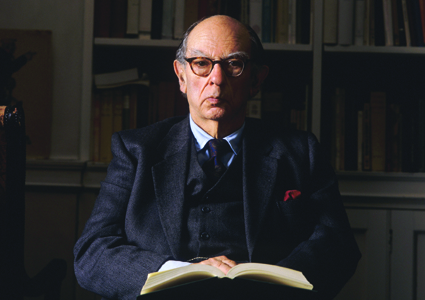
 Isaiah Berlin: He believed that all major thinkers were inspired by one, quite often simple, vision (©JOE PARTRIDGE/REX SHUTTERSTOCK)
With the publication of Affirming: Letters, 1975-1997 (Chatto & Windus, £40), Henry Hardy and Mark Pottle bring to a triumphant conclusion one of the most remarkable literary projects of our time. Isaiah Berlin’s selected correspondence runs to four volumes, covers nearly 3,000 pages and amounts to more than one million words. Even its recipients number well into the hundreds. These include men and women of all ages, many nationalities and a surprising range of occupations. There may be no dustmen amongst them, but nor are they confined to the conventionally respectable. Perhaps as a result, Berlin’s Letters also constitute an epistolary oeuvre alternatively deadly serious and playfully frivolous, often nobly inspired, occasionally just a little bit disreputable.
The cumulative effect is amusing, compelling and illuminating. By his own evaluation, Berlin’s natural medium was “chatting — plauderei”. Writing letters was a simple extension of that pleasure. Yet he eventually found both the time and energy to express profoundly significant observations about the Russian Revolution and its undoing, the Nazi nightmare and the Holocaust, the foundation of Israel and the creation of the modern Middle East, even the Cold War and the dynamics of decolonisation through this otherwise informal medium. Students of 20th-century politics, scarcely less than scholars in intellectual history and of political philosophy, will find much of lasting value to ponder in these pages for years to come.
The appearance of Affirming also marks the culmination of an extraordinary feat of intellectual discipleship. It is easy to pass over the impressive list of Berlin’s published works in its prefatory pages. (Seventeen volumes are listed on page ii.) It is even easier to forget that when he retired as President of Wolfson College, Oxford in 1975, having previously served for ten years as Chichele Professor of Social and Political Theory at Oxford, Berlin had just four books to his credit. Of these only two, Four Essays on Liberty and Vico and Herder, had much claim to enduring intellectual significance. Much more had been promised, both in the fields of political philosophy and the history of ideas. But little had materialised, in print anyway. Maurice Bowra famously made light of his old friend’s lack of obvious output: “Though, like Our Lord and Socrates, he does not publish very much, he thinks and says a great deal and has had an enormous influence on our times.” Others were less charitable. Some suggested that he had been awarded his knighthood largely “for services to conversation”.
Henry Hardy insisted that both Berlin’s apologists and detractors were mistaken in this matter. There was a considerable body of work. Much of it had already appeared, albeit often through obscure outlets. Still more remained in typescript or (as it turned out) on various tape recorders. Forty years ago, he set himself the task of bringing together the best of this material in book form. Initially, this involved little more than the convenient organisation of previously dispersed essays. That yielded two volumes of lasting consequence: Russian Thinkers and Against the Current. Still unsatisfied, Hardy set about recasting previous publications into more substantial editions. This produced Three Critics of the Enlightenment and Liberty. More heroically still, he then transposed previously un-available writings, even talks, into permanent form. Political Ideas of the Romantic Age was only the most striking of these later efforts.
Sometimes Hardy’s enthusiasm got the better of his judgment. Those legendary 1965 Mellon Lectures turned out to be a dated book on The Roots of Romanticism. Even an otherwise co-operative author occasionally baulked at the resuscitation of some of his lesser efforts. In the case of The Soviet Mind, he was probably right. But that Berlin has so significant a posthumous intellectual reputation is in no small part owed to the indefatigable labours of one who rarely claimed much credit for himself. Family, friends and admirers should be eternally grateful.
Then something strange happened. Having exhausted all other possibilities, Hardy proposed to Berlin, sometime in the late 1980s, that they might round off their joint venture with “a selective . . . volume of letters . . . intended for the general reader”. It is easy to envisage what the superficial attraction of such an enterprise might have been. Enthusiasts for this sort of intellectual bowdlerisation might wish to consult — and compare — Andrew and Stephen Schlesinger (eds.), The Letters of Arthur Schlesinger, Jr., a fine example of that insipid art. For now, let Hardy continue the story:
His orders were faithfully executed. Indeed, three volumes were initially planned.
Why did Berlin wish it this way? We do not know. Even with all the evidence now in front of us, the answer to that question remains elusive. It has been suggested that he hoped to bequeath to the world a body of papers comparable to those of his hero, Chaim Weizmann. This seems unconvincing. Berlin never was, nor ever claimed to be, a “man of action”. Perhaps he believed that this massive repository of intellect, learning and wit might stand in lieu of the great work he never wrote. Yet the best information we have suggests that he was often unaware of much of the content of many of these letters. He had either forgotten that he had written them, or no longer remembered what they said. Perhaps we can only conclude that his otherwise disarming observation, expressed late in life to Dr Elizabeth Chang — “How would I like to be remembered? I could not care less. I do not mind in the least if I am completely forgotten” — is not to be taken at face value.
This point is worth labouring since it would be idle to pretend that the initial reaction to Berlin’s correspondence was entirely favourable. Sycophants and stargazers aside, many thoughtful critics expressed dismay at much of what it revealed. Here was a “mother’s boy”, distastefully deriding his estimable father. Here too, was a young man on the make, eager to please in public but willing to wound in private. Above all, there was a certain underlying triviality about both the tone and content of the first two volumes. The coming of the National Government in 1931 passed unnoticed, similarly Hitler’s accession to power. The Spanish Civil War merited one letter, the Munich Agreement much the same. There was nothing on Kristallnacht. Berlin’s donnish backbiting quickly became tiresome, his social mountaineering little short of embarrassing. There is too little about what he and others were actually thinking at the time. This was no modern Clarke-Leibniz correspondence — nor, indeed, anything like it.
Then something strange happened. Having exhausted all other possibilities, Hardy proposed to Berlin, sometime in the late 1980s, that they might round off their joint venture with “a selective . . . volume of letters . . . intended for the general reader”. It is easy to envisage what the superficial attraction of such an enterprise might have been. Enthusiasts for this sort of intellectual bowdlerisation might wish to consult — and compare — Andrew and Stephen Schlesinger (eds.), The Letters of Arthur Schlesinger, Jr., a fine example of that insipid art. For now, let Hardy continue the story:
His response, which came without any noticeable pause for reflection, surprised me, since it was so unlike his reliably self-deprecating reaction to suggestions about publishing his academic writing. He brushed aside any instinct for selectivity and said that, if the job was to be done, it should be done thoroughly. The edition should be full-bottomed, free of half measures.
His orders were faithfully executed. Indeed, three volumes were initially planned.
Why did Berlin wish it this way? We do not know. Even with all the evidence now in front of us, the answer to that question remains elusive. It has been suggested that he hoped to bequeath to the world a body of papers comparable to those of his hero, Chaim Weizmann. This seems unconvincing. Berlin never was, nor ever claimed to be, a “man of action”. Perhaps he believed that this massive repository of intellect, learning and wit might stand in lieu of the great work he never wrote. Yet the best information we have suggests that he was often unaware of much of the content of many of these letters. He had either forgotten that he had written them, or no longer remembered what they said. Perhaps we can only conclude that his otherwise disarming observation, expressed late in life to Dr Elizabeth Chang — “How would I like to be remembered? I could not care less. I do not mind in the least if I am completely forgotten” — is not to be taken at face value.
This point is worth labouring since it would be idle to pretend that the initial reaction to Berlin’s correspondence was entirely favourable. Sycophants and stargazers aside, many thoughtful critics expressed dismay at much of what it revealed. Here was a “mother’s boy”, distastefully deriding his estimable father. Here too, was a young man on the make, eager to please in public but willing to wound in private. Above all, there was a certain underlying triviality about both the tone and content of the first two volumes. The coming of the National Government in 1931 passed unnoticed, similarly Hitler’s accession to power. The Spanish Civil War merited one letter, the Munich Agreement much the same. There was nothing on Kristallnacht. Berlin’s donnish backbiting quickly became tiresome, his social mountaineering little short of embarrassing. There is too little about what he and others were actually thinking at the time. This was no modern Clarke-Leibniz correspondence — nor, indeed, anything like it.
Part of the problem lay with the nature of Berlin’s early existence. Despite the undoubted significance of the Washington interlude (that said, remember everyone else was at war), his was a don’s life. Quintin Hogg remembered the young Berlin as “a terribly typical don”. That cannot have been true. His principal preoccupations until the mid-1950s — doing and teaching philosophy — enabled him to live and work in a world where the world of mouth largely still largely prevailed over the realm of writing, both formally and informally. This is not to criticise. Far from it. Still, it is worth observing just how few letters there are in these early volumes to his fellow Oxford philosophers J.L. Austin, A.J. Ayer and even Gilbert Ryle. Indeed, it is significant that there are not many references to them, whether about their thoughts, or even their writings, in these pages at all.
That, circumstantial, self-censorship receded considerably in later life. Success brought broader engagement with Berlin’s ideas. The growth of attendant interest finally stimulated him, if not to write more books, then at least to write to many of his intellectual peers and contemporaries about what he was doing and why he was doing it. It also enabled — perhaps it also compelled — him to express himself more formally about worlds beyond the Oxford cloister. The rest of us are the long-term beneficiaries of this, subtle but significant, alteration in his way of life. The intellectual qualities of volumes three and four, especially, are very much higher. So too is their intellectual generosity. Indeed, much the most attractive aspect of the whole correspondence, much more noticeable in Affirming than in any preceding volume, is the repeated demonstration of Berlin’s willingness to explain himself, often at considerable length to young and obscure scholars who sought his instruction and, one suspects, also his encouragement. Both were invariably forthcoming, and often quite touchingly expressed.
To be sure, both this quality, and indeed that generosity, were often double-edged. The inadvertent great man sometimes slipped rather too easily into a grand authority. Read his letter to Edward Adeane on who should (or should not) be considered for the next Order of Merit, c.1993, and gasp. Even the occasional “to the extent that I can judge” might have helped. The much-fêted professor more seldom doubted his own importance, indeed originality. He usually made these points modestly, but he meant them all the same. The idea of a so-called “incommensurability of values” was, he insisted, “not to be found in most of the political philosophers of whatever age”. Much rests on the meaning of the word “most” in that context.
True, Berlin often described himself as “overrated”. However, he no less frequently depicted others — usually his intellectual peers — in considerably less flattering a light. His judgment on Michael Oakeshott (“a feeble heir to Montaigne . . . with not one idea, or even formulation to call his own”) was uttered in the very year of the publication of On Human Conduct. His attitude to Hannah Arendt was little short of demented, and rooted in more of a personal grudge than he was ever prepared to admit. Leo Strauss was alternatively ignored or dismissed. Compare Berlin with Raymond Aron in this respect. Then observe how rarely — how astonishingly rarely — the name of Aron appears throughout the whole of this correspondence. Perhaps Berlin implicitly understood that any serious comparison between the two of them might not turn out to his advantage.
That, circumstantial, self-censorship receded considerably in later life. Success brought broader engagement with Berlin’s ideas. The growth of attendant interest finally stimulated him, if not to write more books, then at least to write to many of his intellectual peers and contemporaries about what he was doing and why he was doing it. It also enabled — perhaps it also compelled — him to express himself more formally about worlds beyond the Oxford cloister. The rest of us are the long-term beneficiaries of this, subtle but significant, alteration in his way of life. The intellectual qualities of volumes three and four, especially, are very much higher. So too is their intellectual generosity. Indeed, much the most attractive aspect of the whole correspondence, much more noticeable in Affirming than in any preceding volume, is the repeated demonstration of Berlin’s willingness to explain himself, often at considerable length to young and obscure scholars who sought his instruction and, one suspects, also his encouragement. Both were invariably forthcoming, and often quite touchingly expressed.
To be sure, both this quality, and indeed that generosity, were often double-edged. The inadvertent great man sometimes slipped rather too easily into a grand authority. Read his letter to Edward Adeane on who should (or should not) be considered for the next Order of Merit, c.1993, and gasp. Even the occasional “to the extent that I can judge” might have helped. The much-fêted professor more seldom doubted his own importance, indeed originality. He usually made these points modestly, but he meant them all the same. The idea of a so-called “incommensurability of values” was, he insisted, “not to be found in most of the political philosophers of whatever age”. Much rests on the meaning of the word “most” in that context.
True, Berlin often described himself as “overrated”. However, he no less frequently depicted others — usually his intellectual peers — in considerably less flattering a light. His judgment on Michael Oakeshott (“a feeble heir to Montaigne . . . with not one idea, or even formulation to call his own”) was uttered in the very year of the publication of On Human Conduct. His attitude to Hannah Arendt was little short of demented, and rooted in more of a personal grudge than he was ever prepared to admit. Leo Strauss was alternatively ignored or dismissed. Compare Berlin with Raymond Aron in this respect. Then observe how rarely — how astonishingly rarely — the name of Aron appears throughout the whole of this correspondence. Perhaps Berlin implicitly understood that any serious comparison between the two of them might not turn out to his advantage.
If Berlin too often disparaged his principal rivals in the field of political philosophy, he persisted in conceiving himself as the sole significant practitioner of intellectual history in this country long after that self-characterisation had ceased to be credible. Writing to Jean Floud in January 1996, he insisted that: “In Germany there are chairs in Geistesgeschichte, Ideengeschichte etc. In Italy also, in America too. In England — two minor posts, occupied by pretty inferior people.” At the time, Quentin Skinner was still Professor of the History of Political Thought in Cambridge. John Burrow had just been appointed Professor of European Thought at Oxford: some “minor posts”, some “inferior people”. One might go on.
But that would be to miss the point. For what finally emerges from these pages is not so much the man as a thinker. Several thousand pages later, Berlin himself remains a shadowy figure. Of the ordinary stuff of his life — his loves and travels, of places and peoples seen, of reactions to landscape and scenery — we learn conspicuously little. Perhaps he preferred it that way. Perhaps too there are parallels to be drawn between the curiously underdeveloped subject of these letters and the disturbingly two-dimensional eloges to friends recently passed that litter its later volumes.
Of Berlin’s profounder thoughts, more precisely of the genesis of his political ideas, there is altogether more to be savoured here. That is possibly as it should be. Berlin believed that all major thinkers were inspired by one, often quite simple, vision: their way of looking at things. However complex its subsequent expression, this insight remained, in principle, accessible. The primary purpose of interpretation was to expose it. Berlin has not been without able readers since his death. But no one essayed that task more thoroughly than himself. This is where he made that attempt.
The basis of Berlin’s thought, the root of all his reactions to the world, and the foundation of all his political prognostications for the world, lay in his sense of Jewishness. This point cannot be emphasised too strongly since, when pushed, he denied it. These Letters furnish chapter and verse to prove that he protested too strongly on that occasion. There neither was, nor is, anything in the least discreditable about this. The fact remains — it is impossible to read these letters through without concluding — Berlin defined himself as a Jew before everything else, before being a “Russian”, before being an Englishman, before being a philosopher too.
There was nothing specifically religious about this attachment. Berlin declined to describe himself either as an atheist or an agnostic. But this was only because the concept of God held “no meaning” for him. That said, he acknowledged the possibility of “religious feelings” and regarded those of his friends, notably Freddie Ayer and (more subtly) Hugh Trevor-Roper, who did not, as in some sense deficient — anyway, as thereby “incapable . . . of understanding what men live by”. It is difficult to disagree.
Brought up Conservative (“not, strictly speaking, Orthodox”), he remained an occasionally observant Jew all his life. This was, in part, owed to his distinguished lineage and, in part out of deference to his parents. It was more because he naturally “identified . . . with the Jewish community”. He “liked . . . to feel a member of a community that (had) existed for three thousand years”. This involved a certain complicité — that invariably irrational, possibly even unjustified but nonetheless ineradicable sense of similarity, comparable to the affinity that Tocqueville always acknowledged among fellow French aristocrats. It also involved something else. This was the sense, beyond mere affinity, of real and exacting loyalty: in other words, the proper demands of irreducible commitment.
But that would be to miss the point. For what finally emerges from these pages is not so much the man as a thinker. Several thousand pages later, Berlin himself remains a shadowy figure. Of the ordinary stuff of his life — his loves and travels, of places and peoples seen, of reactions to landscape and scenery — we learn conspicuously little. Perhaps he preferred it that way. Perhaps too there are parallels to be drawn between the curiously underdeveloped subject of these letters and the disturbingly two-dimensional eloges to friends recently passed that litter its later volumes.
Of Berlin’s profounder thoughts, more precisely of the genesis of his political ideas, there is altogether more to be savoured here. That is possibly as it should be. Berlin believed that all major thinkers were inspired by one, often quite simple, vision: their way of looking at things. However complex its subsequent expression, this insight remained, in principle, accessible. The primary purpose of interpretation was to expose it. Berlin has not been without able readers since his death. But no one essayed that task more thoroughly than himself. This is where he made that attempt.
The basis of Berlin’s thought, the root of all his reactions to the world, and the foundation of all his political prognostications for the world, lay in his sense of Jewishness. This point cannot be emphasised too strongly since, when pushed, he denied it. These Letters furnish chapter and verse to prove that he protested too strongly on that occasion. There neither was, nor is, anything in the least discreditable about this. The fact remains — it is impossible to read these letters through without concluding — Berlin defined himself as a Jew before everything else, before being a “Russian”, before being an Englishman, before being a philosopher too.
There was nothing specifically religious about this attachment. Berlin declined to describe himself either as an atheist or an agnostic. But this was only because the concept of God held “no meaning” for him. That said, he acknowledged the possibility of “religious feelings” and regarded those of his friends, notably Freddie Ayer and (more subtly) Hugh Trevor-Roper, who did not, as in some sense deficient — anyway, as thereby “incapable . . . of understanding what men live by”. It is difficult to disagree.
Brought up Conservative (“not, strictly speaking, Orthodox”), he remained an occasionally observant Jew all his life. This was, in part, owed to his distinguished lineage and, in part out of deference to his parents. It was more because he naturally “identified . . . with the Jewish community”. He “liked . . . to feel a member of a community that (had) existed for three thousand years”. This involved a certain complicité — that invariably irrational, possibly even unjustified but nonetheless ineradicable sense of similarity, comparable to the affinity that Tocqueville always acknowledged among fellow French aristocrats. It also involved something else. This was the sense, beyond mere affinity, of real and exacting loyalty: in other words, the proper demands of irreducible commitment.
That held true for Berlin’s response to all those Jews he came across. He was perfectly happy to divide their number into “good Jews” and “bad Jews”. He was equally content — the example of Meyer Schapiro springs to mind — to delight in someone “as a Jew”. This ineradicable sense, both of attachment and difference, was similarly if oppositely true of his lifelong reaction to exile among the gentiles. Expelled from his first homeland, Berlin was a dedicated Anglophile. He never came to think of himself as an ordinary Englishman. By the same token, he took it as axiomatic that “even the most friendly, unbiased, unprejudiced Englishman today [1985] does not think of Jews as English”. This was not because he regarded England as an anti-Semitic country. These he identified as “Russia, Germany, Poland, France and the United States”.
This was important in and of itself. It also pointed to one of the reasons why Berlin accepted, from the very first, Herzl’s insistence that the great 19th-century European project for Jewish assimilation, that is, emancipation as assimilation, had failed. Perhaps it was bound to.In these circumstances, self-respect as much as self-preservation demanded a positive response. There lay the basis for Berlin’s one, lifelong, unwavering, concrete political commitment. This was to Zionism. Berlin was rarely accused of reckless moral courage during the course of his life. Yet he was unerring in his dedication to the cause of Israel, even in the face of so many developments in that country which subsequently disturbed him. This stance stands as critical testimony against those who suggest that in all substantial things he was never more than a “trimmer”.
It is surely anything but fanciful to see in that, essential, definition and in those, particular, commitments, the grounds of his broader political teachings. Berlin devoted the greater part of his scholarly life to exploring Romanticism’s critique of the Enlightenment. He was often — wrongly — reckoned to subscribe to that criticism himself. When so challenged, he justly pointed to what he had said long before: “The intellectual power, honesty, lucidity, courage and disinterested love of the truth of those most gifted thinkers of the eighteenth century remains to this day without parallel. Their age was one of the best and most hopeful episodes in the history of mankind.”
However, Berlin also instinctively understood the limits of Enlightenment. To the extent that the Enlightenment project criticised—better still, exposed—pretentious theocracy, unproblematised tradition and simply superstition, it was both true and liberating. Herzen taught him that. But to the degree that it also demanded a cosmopolitan politics, nothing short of a universal reordering of regimes, it failed to comprehend, and in that way also failed to assuage, the most basic and unyielding demands of mankind. Herder furnished this insight.
History taught something more. This was that there was much to be said for a certain, limited but real, “oscillation” between these two traditions. Failure to sustain that balance led to the temptation of monism — the assertion of a universally applicable and harmonious rule and from there to the real nightmares of “totalitarianism” — the application of precisely that intellectual fantasy on all too messy a reality. For Berlin, the history of the 20th century was plagued by examples of this characteristically modern mistake. The Soviet Union was no more (nor less) than the most terrifying case of this error.
This was important in and of itself. It also pointed to one of the reasons why Berlin accepted, from the very first, Herzl’s insistence that the great 19th-century European project for Jewish assimilation, that is, emancipation as assimilation, had failed. Perhaps it was bound to.In these circumstances, self-respect as much as self-preservation demanded a positive response. There lay the basis for Berlin’s one, lifelong, unwavering, concrete political commitment. This was to Zionism. Berlin was rarely accused of reckless moral courage during the course of his life. Yet he was unerring in his dedication to the cause of Israel, even in the face of so many developments in that country which subsequently disturbed him. This stance stands as critical testimony against those who suggest that in all substantial things he was never more than a “trimmer”.
It is surely anything but fanciful to see in that, essential, definition and in those, particular, commitments, the grounds of his broader political teachings. Berlin devoted the greater part of his scholarly life to exploring Romanticism’s critique of the Enlightenment. He was often — wrongly — reckoned to subscribe to that criticism himself. When so challenged, he justly pointed to what he had said long before: “The intellectual power, honesty, lucidity, courage and disinterested love of the truth of those most gifted thinkers of the eighteenth century remains to this day without parallel. Their age was one of the best and most hopeful episodes in the history of mankind.”
However, Berlin also instinctively understood the limits of Enlightenment. To the extent that the Enlightenment project criticised—better still, exposed—pretentious theocracy, unproblematised tradition and simply superstition, it was both true and liberating. Herzen taught him that. But to the degree that it also demanded a cosmopolitan politics, nothing short of a universal reordering of regimes, it failed to comprehend, and in that way also failed to assuage, the most basic and unyielding demands of mankind. Herder furnished this insight.
History taught something more. This was that there was much to be said for a certain, limited but real, “oscillation” between these two traditions. Failure to sustain that balance led to the temptation of monism — the assertion of a universally applicable and harmonious rule and from there to the real nightmares of “totalitarianism” — the application of precisely that intellectual fantasy on all too messy a reality. For Berlin, the history of the 20th century was plagued by examples of this characteristically modern mistake. The Soviet Union was no more (nor less) than the most terrifying case of this error.
It cannot be stated too strongly that for Berlin the origins of these errors were fundamentally intellectual. Few can have believed more profoundly in the sovereignty of ideas: “It is ideas — Marxism, Fascism, National Socialism — that have done it all — not as some historians would like to believe, social conditions or the relationship of economic classes, the effect of technology on culture”. If this was idealism with a vengeance, it was entirely free of utopian silliness. Berlin was sometimes presumed to lack a tragic sense of life. This seems to me mistaken. Few can have conceived both the liberating possibilities and the terrible dangers of political thought so intimately. Berlin was never an epistemological pluralist. Moreover, his moral pluralism was strictly limited, cast as the best way of countering, rather than of yielding, to the temptations of relativism. But he was a cultural pluralist because he believed that anything else must ultimately prove not simply unsatisfying but also coercive. It is by no means clear that he was wrong in this last respect.
Put another way, Berlin’s pluralism defined his liberalism, not the other way around. He was, in many ways, a rather strange liberal. He believed in the natural freedom (and, to that extent, equality) of man. Yet he did not subscribe to any doctrine of natural rights. He saw in liberalism more of a method to secure the varieties of life, similarly toleration between communities, than to establish justice between all men and women. This was closer to a “liberalism of fear” than a “liberalism of hope”. It also put a strict limit to his commitment on the proper sway of democracy. He was a democrat. But wisely, he loved it best by loving it moderately.
Writing to Geert Van Cleemput, a Belgian classicist and parliamentary aide, Berlin defined a “true democracy” as “one where the government does not feel too safe”. This may not be a very accurate characterisation. It is not a bad idea all the same. He conceived of “liberal democracy”, the best regime of which mankind was capable, as being characterised “first . . . by toleration [for] a certain degree of multiplicity of cultures” (i.e. not individual rights). He never doubted that stable societies must possess a “central culture”, to which “the minority must adapt . . . itself”. But he took the latter requirement to be reciprocal in nature and properly grounded in mutual respect rather than legal limitation. Unsurprisingly, he cited English Jewry as the best example of what he had in mind.
For all his upbeat manner, Berlin was not an optimist. He believed that he had lived through a terrible century and also that he was witness to cultural decline. It was not just that the world of his dotage was less exciting than that of his youth. It was also inferior. These late, melancholic, reflections were grounded in a general understanding. It is difficult to believe that they were not also rooted in a very particular view of things. Reading these Letters to the end, it is almost impossible not to be reminded of the Diaries of Count Harry Kessler. Of course, the similarities are far from exact. Kessler was a German aristocrat, a self-conscious aesthete and a homosexual. Berlin, to the best of my knowledge, was none of these things, though he was very musical. That said, Kessler wrote as an heroic, self-conscious, witness to the suicide of German, liberal, civilisation. He died in 1937. Whatever else they do, Berlin’s Letters stand as a monument to European, Jewish, liberal civilisation in what may prove to be the last century of its recognisable flourishing.
Put another way, Berlin’s pluralism defined his liberalism, not the other way around. He was, in many ways, a rather strange liberal. He believed in the natural freedom (and, to that extent, equality) of man. Yet he did not subscribe to any doctrine of natural rights. He saw in liberalism more of a method to secure the varieties of life, similarly toleration between communities, than to establish justice between all men and women. This was closer to a “liberalism of fear” than a “liberalism of hope”. It also put a strict limit to his commitment on the proper sway of democracy. He was a democrat. But wisely, he loved it best by loving it moderately.
Writing to Geert Van Cleemput, a Belgian classicist and parliamentary aide, Berlin defined a “true democracy” as “one where the government does not feel too safe”. This may not be a very accurate characterisation. It is not a bad idea all the same. He conceived of “liberal democracy”, the best regime of which mankind was capable, as being characterised “first . . . by toleration [for] a certain degree of multiplicity of cultures” (i.e. not individual rights). He never doubted that stable societies must possess a “central culture”, to which “the minority must adapt . . . itself”. But he took the latter requirement to be reciprocal in nature and properly grounded in mutual respect rather than legal limitation. Unsurprisingly, he cited English Jewry as the best example of what he had in mind.
For all his upbeat manner, Berlin was not an optimist. He believed that he had lived through a terrible century and also that he was witness to cultural decline. It was not just that the world of his dotage was less exciting than that of his youth. It was also inferior. These late, melancholic, reflections were grounded in a general understanding. It is difficult to believe that they were not also rooted in a very particular view of things. Reading these Letters to the end, it is almost impossible not to be reminded of the Diaries of Count Harry Kessler. Of course, the similarities are far from exact. Kessler was a German aristocrat, a self-conscious aesthete and a homosexual. Berlin, to the best of my knowledge, was none of these things, though he was very musical. That said, Kessler wrote as an heroic, self-conscious, witness to the suicide of German, liberal, civilisation. He died in 1937. Whatever else they do, Berlin’s Letters stand as a monument to European, Jewish, liberal civilisation in what may prove to be the last century of its recognisable flourishing.