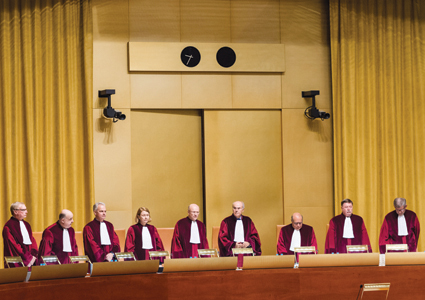
 A supra-national institution: The European Court of Justice in Luxembourg provides a “sledgehammer” to litigants, say legal academics (©Geert Vanden Wijngaert/AP/PA Images)
It goes without saying that we all believe in democracy. And that’s the problem. We take it for granted. When there are complaints, we seek refuge in the popular Churchillian quotation, “Democracy is the worst form of government except for all the other forms that have been tried from time to time.”
In the early 1990s, the triumph of democracy seemed complete with the fall of the Soviet empire and the transition to multi-party elections in many parts of Africa and Latin America. Yet democracy has always been more fragile than it is presumed to be. Far from being triumphant today, it continues to be subject to serious challenge. We forget to our peril that this applies also to the United Kingdom.
Some of the threats to democracy are dramatic and obvious, particularly that of international terrorism and the ideologies that motivate it. Violence, war, foreign occupation and struggles over territory have meant that there are few countries which have not been torn apart and have enjoyed prolonged periods of stability. Turmoil is the unfortunate norm. Nor has the United Kingdom been exempt. For much of the 19th and early 20th centuries, conflict about Ireland was a prime factor in British party politics. In the 1960s, terrorism in Northern Ireland erupted again. The difficulty of defeating it, the loss of more than 3,500 lives between 1969 and 2001, the bombing of the hotel where Prime Minister Margaret Thatcher and her senior colleagues were gathered for the Conservative party’s annual conference in Brighton in 1984, and other outrages on the British mainland have led to an uneasy, unsatisfactory peace. The territorial integrity of the UK is far from assured, as demonstrated by the sweep of SNP victories in last May’s general election. Without an agreed and settled boundary, the basis of democracy within that disputed territory is potentially weakened.
There are a number of other threats to British democracy. They are all the more insidious because they are less obvious. Three of them will be highlighted here: inadequate electoral administration; constitutional confusion resulting from a loss of national sovereignty to supra-national institutions; and the additional assault on sovereignty from a growing body of “soft law” promulgated by international organisations. The last of these is perhaps the least noted and, for that reason, especially worthy of attention.
Inadequate electoral administration — a dry and technical topic, which for that reason receives far too little attention — is an essential problem I have already raised in recent issues of Standpoint. Since elections are the basis of democracy, it follows that the quality of electoral rules and the efficient management of those rules are vital. Who is legally qualified to vote and whether the electoral roll accurately lists those entitled to cast a ballot is the essential foundation of free and fair elections. It is equally important to ensure that the names of the dead, the unqualified and those who have moved to a different address are not listed.
As far as the qualification to vote is concerned, the legacy of Britain’s imperial past has left an anomaly. Citizens of the Republic of Ireland who are resident in the UK and citizens of Commonwealth nations resident in the UK are entitled to vote in British elections. UK citizens do not possess the same privilege when they reside in most of those countries. It surely is reasonable to expect that those entitled to vote in national elections should be the citizens. It is to be hoped that the anomaly will disappear when the revision of election law now being prepared by the Law Commission is implemented.
The franchise for Irish and Commonwealth residents also creates administrative problems. A considerable proportion of them do not know that they may cast a ballot in UK elections or, if they do realise it, are not interested in doing so. The consequence is that a high proportion of them fail to register (as they are legally obliged to do).
This is by no means the only difficulty concerning the electoral roll. There is no official estimate of the number of errors on the electoral registers at the time of the 2015 general election. The neglect of assessing this is itself an indication of administrative shortcoming. If the situation remained unchanged from 2014, there were as many as 15 million errors with more than 8 million qualified electors (including Irish and Commonwealth citizens) omitted and more than 6 million names of persons not resident at the addresses shown on the registers included. This staggering degree of error means that 12 per cent of registered names were incorrect; approximately 14 per cent of qualified electors were unregistered either at their current address or at a former address. The error rate was the same as in the US and lower than in Canada. Moreover, there has been a huge decline both in the accuracy and completeness of the UK voter rolls over recent decades. The British public and, more importantly and deplorably, British officialdom has been far too complacent about these statistics.
Contributing to this lack of attention and commitment to electoral process and a lack of pride in the Westminster model may well be the instinctive feeling that elections no longer matter all that much except to professional members of the political class. Though an exaggeration, there is much truth in this. The UK has stumbled into a position of semi-sovereignty. Successive governments have been careful to conceal this from the public. There is a danger that campaigning before the promised referendum on British membership of the European Union will focus unduly on economics, disguising the basic question about sovereignty.
It was during the premiership of Sir John Major that a curious set of events made this clear to me. There had been a bus crash in Kent resulting in a high death toll. This raised the issue of why there was then no legal requirement for passengers to wear seat belts. It turned out that this was an EU responsibility and that the UK could not take action on its own. What other questions of transport policy (and, indeed, policies within areas covered by other government departments) fell under EU rather than UK jurisdiction? The Times asked me to investigate, and I published a piece on the long reach of the EU in transport matters before proceeding to look into the position concerning other departments. There followed an invitation to meet with a senior member of the Cabinet Secretariat who would help me. When I arrived, he took little time to let me know that instructions had been given throughout Whitehall that only departmental press officers were to speak to me. There were to be no direct contacts with civil servants on the lines I had enjoyed with the Department of Transport.
The franchise for Irish and Commonwealth residents also creates administrative problems. A considerable proportion of them do not know that they may cast a ballot in UK elections or, if they do realise it, are not interested in doing so. The consequence is that a high proportion of them fail to register (as they are legally obliged to do).
This is by no means the only difficulty concerning the electoral roll. There is no official estimate of the number of errors on the electoral registers at the time of the 2015 general election. The neglect of assessing this is itself an indication of administrative shortcoming. If the situation remained unchanged from 2014, there were as many as 15 million errors with more than 8 million qualified electors (including Irish and Commonwealth citizens) omitted and more than 6 million names of persons not resident at the addresses shown on the registers included. This staggering degree of error means that 12 per cent of registered names were incorrect; approximately 14 per cent of qualified electors were unregistered either at their current address or at a former address. The error rate was the same as in the US and lower than in Canada. Moreover, there has been a huge decline both in the accuracy and completeness of the UK voter rolls over recent decades. The British public and, more importantly and deplorably, British officialdom has been far too complacent about these statistics.
Contributing to this lack of attention and commitment to electoral process and a lack of pride in the Westminster model may well be the instinctive feeling that elections no longer matter all that much except to professional members of the political class. Though an exaggeration, there is much truth in this. The UK has stumbled into a position of semi-sovereignty. Successive governments have been careful to conceal this from the public. There is a danger that campaigning before the promised referendum on British membership of the European Union will focus unduly on economics, disguising the basic question about sovereignty.
It was during the premiership of Sir John Major that a curious set of events made this clear to me. There had been a bus crash in Kent resulting in a high death toll. This raised the issue of why there was then no legal requirement for passengers to wear seat belts. It turned out that this was an EU responsibility and that the UK could not take action on its own. What other questions of transport policy (and, indeed, policies within areas covered by other government departments) fell under EU rather than UK jurisdiction? The Times asked me to investigate, and I published a piece on the long reach of the EU in transport matters before proceeding to look into the position concerning other departments. There followed an invitation to meet with a senior member of the Cabinet Secretariat who would help me. When I arrived, he took little time to let me know that instructions had been given throughout Whitehall that only departmental press officers were to speak to me. There were to be no direct contacts with civil servants on the lines I had enjoyed with the Department of Transport.
What makes this episode all the more eerie is that it occurred in the 1990s, before the Nice Treaty and the Lisbon Treaty had extended EU powers much further still. Not only was the UK public to be deterred from knowing the extent of the transfer of power from the House of Commons to Brussels, but members of the Conservative Cabinet professed ignorance themselves. When I spoke to an academic colleague in Germany, who was a senior adviser to the then Chancellor Helmut Kohl, he said he would very much like to see any results I could obtain, since he thought that the German Chancellor was just as much in the dark as the British Prime Minister.
More recently, the coalition government carried out a lengthy exercise led by the Foreign & Commonwealth Office to survey, department by department, the so-called “balance of competences” between the UK and the EU. The title itself embodied the assumption that there can be such a “balance” and that the existing situation is satisfactory. This indeed was the predictable conclusion of a survey dominated by the avidly pro-EU Liberal Democrat academic Lord Wallace of Saltaire and consisting in part of consultation with mandarins and an undisclosed set of academics. Moreover, the complex of nearly three dozen separate reports omitted to present the crucial list of things which, under the existing EU treaties, now fall within the remit of the EU.
The only feature of the UK’s relationship with authoritative supra-national institutions which is the subject of serious public debate has been the power of the European Court of Human Rights in Strasbourg vis-à-vis that of the House of Commons. The current Conservative government is committed to recoup power from the court to the UK parliament. The issue is so complex and fraught that it has delayed presenting proposals which reportedly had been ready before the 2015 general election.
But senior lawyers such as the former Attorney General Dominic Grieve consider that the challenge to national sovereignty from the Court of Justice of the European Union — the court in Luxembourg — is actually far greater under the terms of the Lisbon Treaty of 2009. Like so much else concerning the strategy of EU expansionism, the precise implications of this treaty are murky and subject to disagreement among experts.
The issue is the incorporation of the EU Charter of Fundamental Rights into EU law in the Lisbon Treaty and the meaning of the opt-out obtained by the UK. The Charter of Fundamental Rights goes far wider than the European Convention on Human Rights of the Council of Europe. It includes wide-ranging social, educational, health, constitutional and economic rights phrased in terms so general that, as pointed out by Chris Grayling, the then Lord Chancellor, on November 13, 2013, the Lisbon Treaty puts “huge power” in the hands of the EU court in Luxembourg: “We cannot go on seeing crucial decisions about our society and our system of justice and government being taken by unaccountable international courts.” The power of the Luxembourg court, he suggested, would be part of the renegotiation with the EU prior to the EU referendum.
More recently, the coalition government carried out a lengthy exercise led by the Foreign & Commonwealth Office to survey, department by department, the so-called “balance of competences” between the UK and the EU. The title itself embodied the assumption that there can be such a “balance” and that the existing situation is satisfactory. This indeed was the predictable conclusion of a survey dominated by the avidly pro-EU Liberal Democrat academic Lord Wallace of Saltaire and consisting in part of consultation with mandarins and an undisclosed set of academics. Moreover, the complex of nearly three dozen separate reports omitted to present the crucial list of things which, under the existing EU treaties, now fall within the remit of the EU.
The only feature of the UK’s relationship with authoritative supra-national institutions which is the subject of serious public debate has been the power of the European Court of Human Rights in Strasbourg vis-à-vis that of the House of Commons. The current Conservative government is committed to recoup power from the court to the UK parliament. The issue is so complex and fraught that it has delayed presenting proposals which reportedly had been ready before the 2015 general election.
But senior lawyers such as the former Attorney General Dominic Grieve consider that the challenge to national sovereignty from the Court of Justice of the European Union — the court in Luxembourg — is actually far greater under the terms of the Lisbon Treaty of 2009. Like so much else concerning the strategy of EU expansionism, the precise implications of this treaty are murky and subject to disagreement among experts.
The issue is the incorporation of the EU Charter of Fundamental Rights into EU law in the Lisbon Treaty and the meaning of the opt-out obtained by the UK. The Charter of Fundamental Rights goes far wider than the European Convention on Human Rights of the Council of Europe. It includes wide-ranging social, educational, health, constitutional and economic rights phrased in terms so general that, as pointed out by Chris Grayling, the then Lord Chancellor, on November 13, 2013, the Lisbon Treaty puts “huge power” in the hands of the EU court in Luxembourg: “We cannot go on seeing crucial decisions about our society and our system of justice and government being taken by unaccountable international courts.” The power of the Luxembourg court, he suggested, would be part of the renegotiation with the EU prior to the EU referendum.
During the negotiations over the Lisbon Treaty, the Labour Foreign Secretary David Miliband gave the European Scrutiny Committee of the House of Commons the soothing assurance on February 16, 2007, that acceptance of the Charter of Fundamental Rights would not “extend the reach of European courts into British law”, and that it “only records existing rights under domestic and international law and does not create new ones”. Over the past eight years, this assurance appears to have crumbled.
Kieron Beal QC and Tom Hickman, a prominent legal academic, co-authored in 2011 a study pointing out that the Luxembourg court provided a “sledgehammer” to litigants far more powerful than the Strasbourg court: “The supremacy of EU law means that primary and subordinate national legislation which is declared incompatible with a directly effective EU law right, and therefore invalid, must be disapplied by national courts. Fundamental rights are directly effective. Primary or subordinate domestic legislation that contravenes those rights protected by EU law must therefore be disapplied by national courts in respect of the person relying upon them.”
It is easier to bring a case to the Luxembourg Court than to the European Court of Human Rights in Strasbourg and the damages awarded by Luxembourg are far larger than by Strasbourg. The former EU Commissioner for Justice, Vivian Reding, warned in 2012 that the Charter of Fundamental Rights would become a “powerful tool”: “To all those who are not satisfied with the current state of Union law as regards fundamental rights, I say: Be patient. It has only been two years since the charter came into force. We should give it time to develop.”
These points may be viewed as Eurosceptic. This is not necessarily the case. They may equally be used by supporters of a United States of Europe (such as Commissioner Reding) to suggest that, having gone this far, the logical course of action is to accept the disappearance of national sovereignty and to pursue democracy through fully-fledged federal institutions. All I wish to do here is to state two things. First, it is vital that discussion about the character of UK democracy (and thus about sovereignty) should play a far larger part in pre-referendum discussions than has been the case so far. It would be tragic were fundamental questions about the future of the nation to be decided by elite prejudices, by economic considerations, by whether Nigel Farage’s bonhomie is appealing, or even by views on immigration and counter-terrorism. The debate about the nature of democracy in the modern world should be the key.
Second, there needs to be especially careful examination of rhetoric about “shared sovereignty” as a halfway house between national independence and federal integration. There are some things which cannot, in practice, be shared. If democracy is about giving the final say to the citizens of a country at the ballot box, it follows that the national legislatures they elect must be able to reflect their will — in other words, they must be fully sovereign. Obviously, there are practical limitations to the power of any single nation, but these are different from legal restrictions. By way of example, the ending of legal segregation in the southern states of the US did not bring de facto segregation based on economic, educational or cultural inequalities to an end. Such informal divisions are quite different to segregation by law. Similarly, increasingly complex and powerful legal restrictions on the elected UK legislature by the EU treaties have effects on democratic governance, which are not the same as de facto economic and security pressures.
Kieron Beal QC and Tom Hickman, a prominent legal academic, co-authored in 2011 a study pointing out that the Luxembourg court provided a “sledgehammer” to litigants far more powerful than the Strasbourg court: “The supremacy of EU law means that primary and subordinate national legislation which is declared incompatible with a directly effective EU law right, and therefore invalid, must be disapplied by national courts. Fundamental rights are directly effective. Primary or subordinate domestic legislation that contravenes those rights protected by EU law must therefore be disapplied by national courts in respect of the person relying upon them.”
It is easier to bring a case to the Luxembourg Court than to the European Court of Human Rights in Strasbourg and the damages awarded by Luxembourg are far larger than by Strasbourg. The former EU Commissioner for Justice, Vivian Reding, warned in 2012 that the Charter of Fundamental Rights would become a “powerful tool”: “To all those who are not satisfied with the current state of Union law as regards fundamental rights, I say: Be patient. It has only been two years since the charter came into force. We should give it time to develop.”
These points may be viewed as Eurosceptic. This is not necessarily the case. They may equally be used by supporters of a United States of Europe (such as Commissioner Reding) to suggest that, having gone this far, the logical course of action is to accept the disappearance of national sovereignty and to pursue democracy through fully-fledged federal institutions. All I wish to do here is to state two things. First, it is vital that discussion about the character of UK democracy (and thus about sovereignty) should play a far larger part in pre-referendum discussions than has been the case so far. It would be tragic were fundamental questions about the future of the nation to be decided by elite prejudices, by economic considerations, by whether Nigel Farage’s bonhomie is appealing, or even by views on immigration and counter-terrorism. The debate about the nature of democracy in the modern world should be the key.
Second, there needs to be especially careful examination of rhetoric about “shared sovereignty” as a halfway house between national independence and federal integration. There are some things which cannot, in practice, be shared. If democracy is about giving the final say to the citizens of a country at the ballot box, it follows that the national legislatures they elect must be able to reflect their will — in other words, they must be fully sovereign. Obviously, there are practical limitations to the power of any single nation, but these are different from legal restrictions. By way of example, the ending of legal segregation in the southern states of the US did not bring de facto segregation based on economic, educational or cultural inequalities to an end. Such informal divisions are quite different to segregation by law. Similarly, increasingly complex and powerful legal restrictions on the elected UK legislature by the EU treaties have effects on democratic governance, which are not the same as de facto economic and security pressures.
There has been some discussion among scholars and public intellectuals on both sides of the Atlantic about whether there can be a global democracy and whether or not sovereignty can be shared. Richard Bellamy, Sir Robert Cooper, John Fonte, David Held and Jeremy Rabkin have all published work on the subject. Yet this crucial topic needs to be aired far more prominently. I remain sceptical about “shared sovereignty”. Treaties between sovereign states are one matter. Forms of partial political union are something else altogether and have normally proved to be unstable and temporary.
The final form of assault on democracy is less concrete and far less appreciated. Nevertheless, it is all the more significant for coming under the informed public’s radar. At least since the 1990s, there have been concerted efforts by international organisations such as the UN and by the NGOs and academic camp followers which feed off them to establish what have been variously designated as recommendations, guidelines, best practices, norms, rules, standards, codes and conventions. These documents are far more detailed than the highly general wording of Article 21(3) of the Universal Declaration of Human Rights, adopted by the UN General Assembly in 1948, which merely set out that “the will of the people shall be the basis of the authority of government; this will shall be expressed in periodic and genuine elections which shall be by universal and equal suffrage and shall be held by secret vote or by equivalent free voting procedures.” Such a formulation allowed the signatory governments to decide for themselves what constituted “genuine” and “free” voting procedures.
Matters have moved on. There is a race between different national and international organisations to establish ever more detailed formulations. Often, these bodies have themselves been colonised by pressure groups. Some of them are heavily funded by governments, others by billionaires.
At their best, bodies such as the United Nations, the World Bank, the Council of Europe, and the Organisation of American States perform invaluable functions. They sometimes attract staff with exceptionally fine minds. They provide expert assistance when elections are held in the aftermath of civil war. They are able to identify controversial practices by means such as election observation missions, technical assistance to election management bodies and special investigations. These may be as valuable for countries with long-established systems of democratic elections as for emerging democracies. Nevertheless, the pitfalls of institutions of actual or would-be global governance cannot safely be ignored.
Alongside activities of international organisations, there has been a surge in academic attention to the topic of electoral malpractice and corruption. An extensive programme on the subject is currently in progress under the leadership of Pippa Norris of Harvard and Sydney University. The highly ambitious Electoral Integrity Project appears to engage in advocacy as well as research. In broad terms, it seems to favour the continental European critique of traditional Anglo-American models.
The final form of assault on democracy is less concrete and far less appreciated. Nevertheless, it is all the more significant for coming under the informed public’s radar. At least since the 1990s, there have been concerted efforts by international organisations such as the UN and by the NGOs and academic camp followers which feed off them to establish what have been variously designated as recommendations, guidelines, best practices, norms, rules, standards, codes and conventions. These documents are far more detailed than the highly general wording of Article 21(3) of the Universal Declaration of Human Rights, adopted by the UN General Assembly in 1948, which merely set out that “the will of the people shall be the basis of the authority of government; this will shall be expressed in periodic and genuine elections which shall be by universal and equal suffrage and shall be held by secret vote or by equivalent free voting procedures.” Such a formulation allowed the signatory governments to decide for themselves what constituted “genuine” and “free” voting procedures.
Matters have moved on. There is a race between different national and international organisations to establish ever more detailed formulations. Often, these bodies have themselves been colonised by pressure groups. Some of them are heavily funded by governments, others by billionaires.
At their best, bodies such as the United Nations, the World Bank, the Council of Europe, and the Organisation of American States perform invaluable functions. They sometimes attract staff with exceptionally fine minds. They provide expert assistance when elections are held in the aftermath of civil war. They are able to identify controversial practices by means such as election observation missions, technical assistance to election management bodies and special investigations. These may be as valuable for countries with long-established systems of democratic elections as for emerging democracies. Nevertheless, the pitfalls of institutions of actual or would-be global governance cannot safely be ignored.
Alongside activities of international organisations, there has been a surge in academic attention to the topic of electoral malpractice and corruption. An extensive programme on the subject is currently in progress under the leadership of Pippa Norris of Harvard and Sydney University. The highly ambitious Electoral Integrity Project appears to engage in advocacy as well as research. In broad terms, it seems to favour the continental European critique of traditional Anglo-American models.
When I was first asked to participate in a code-making exercise, it was stimulating and enjoyable, but hard to take seriously. In 1995, the Council of Europe convened a group of politicians, largely from countries which had recently freed themselves from the Soviet empire, and an assortment of academics and public officials. We were to formulate within four days rules for “genuine democracy” and for political finance. Given the wide political and cultural differences between the politicians and the seeming vested interests of some of the representatives of national bureaucracies, it was hard to see how much this motley crew could achieve.
It was a mistake to underestimate the importance of the meeting. It was to lead to the Council of Europe’s “Recommendation Rec (2003)4 of the Committee of Ministers to member states on common rules against corruption in the funding of political parties and electoral campaigns”. And why was this of any significance? Simply because the recommendations in these “common rules” stand to influence the European Court of Human Rights in any future litigation about whether UK laws conform to the European Convention on Human Rights. This Convention is vague but the “common rules” are more specific.
Projects aiming to set out international standards have typically started as exercises in advocacy with purely informal influence. However, they all too often have come to possess a degree of binding authority.
One contentious but potentially influential report was issued in 2012 by the Global Commission on Elections, Democracy and Security of the Kofi Annan Foundation and the Stockholm-based International Institute for Democracy and Electoral Assistance (International IDEA). The latter is a body created in 1995 with an aim of countering American notions of democracy with Swedish-inspired models.
International IDEA has subsequently invested heavily in persuading bodies such as the Council of Europe, the Organisation for Security and Cooperation in Europe, the Organisation of American States and the OECD to adopt as a norm the public funding of political parties. Though increasingly common across the globe, popular among professional politicians and disliked by voters, public funding of parties and election campaigns remains controversial and cannot reasonably be regarded as an essential aspect of democratic elections. Indeed, it is strongly resisted by the current UK government. The flow of recommendations by international bodies on the matter may well leave the UK exposed in the future to litigation either in the Strasbourg or Luxembourg courts. In 1998, in the Bowman case, the Strasbourg Court invalidated the longstanding UK ban on independent spending (i.e. not authorised by one of the candidates) in parliamentary elections.
In the international arena, the longstanding English-speaking democracies are outnumbered. There are growing pressures to accept continental European forms of democracy as a legally enforceable standard.
It was a mistake to underestimate the importance of the meeting. It was to lead to the Council of Europe’s “Recommendation Rec (2003)4 of the Committee of Ministers to member states on common rules against corruption in the funding of political parties and electoral campaigns”. And why was this of any significance? Simply because the recommendations in these “common rules” stand to influence the European Court of Human Rights in any future litigation about whether UK laws conform to the European Convention on Human Rights. This Convention is vague but the “common rules” are more specific.
Projects aiming to set out international standards have typically started as exercises in advocacy with purely informal influence. However, they all too often have come to possess a degree of binding authority.
One contentious but potentially influential report was issued in 2012 by the Global Commission on Elections, Democracy and Security of the Kofi Annan Foundation and the Stockholm-based International Institute for Democracy and Electoral Assistance (International IDEA). The latter is a body created in 1995 with an aim of countering American notions of democracy with Swedish-inspired models.
International IDEA has subsequently invested heavily in persuading bodies such as the Council of Europe, the Organisation for Security and Cooperation in Europe, the Organisation of American States and the OECD to adopt as a norm the public funding of political parties. Though increasingly common across the globe, popular among professional politicians and disliked by voters, public funding of parties and election campaigns remains controversial and cannot reasonably be regarded as an essential aspect of democratic elections. Indeed, it is strongly resisted by the current UK government. The flow of recommendations by international bodies on the matter may well leave the UK exposed in the future to litigation either in the Strasbourg or Luxembourg courts. In 1998, in the Bowman case, the Strasbourg Court invalidated the longstanding UK ban on independent spending (i.e. not authorised by one of the candidates) in parliamentary elections.
In the international arena, the longstanding English-speaking democracies are outnumbered. There are growing pressures to accept continental European forms of democracy as a legally enforceable standard.
Several recommendations emerge. The preservation of the Westminster model of democracy cannot be taken for granted. Discussions about parliamentary sovereignty, including limits on the jurisdiction of the Court of Justice of the European Union, should be a prime component of negotiation and of public debate before the UK’s EU referendum. The UK should examine whether it wishes to continue to subscribe by “soft law” to agreements reached under previous governments, such as Council of Europe Recommendation Rec 2003(4). British agreement to international conventions with constitutional implications (such as the UN Convention Against Corruption) should always be subject to debate in the House of Commons. The Committee on Standards in Public Life should conduct a thorough review of electoral administration with a view to improving the completeness and accuracy of the electoral register through a national civilian register. Finally, the UK should invest more of its development budget in promoting the Westminster model of democracy abroad.
Yet detailed policy proposals do not grasp the fundamental problem, which is the neglect and trivialisation of democracy as a subject of fundamental concern. I was recently struck and saddened by the reactions of two academics who have devoted their lives to the most distinguished research into politics when I discussed the problems set out in this article with them. Both answered to the effect that democracy was, after all, of secondary importance. This too was the implication of the fine debate organised by the Europaeum at the Oxford Union last November in which José Manuel Barroso and Nick Clegg emerged triumphant in their advocacy of European union. Their case was legitimate but their grounds were jarring. On its own, the UK would have little international influence, and its economy would suffer (an Oxford economics professor sitting next to me quietly muttered his disagreement). Above all, urged Barroso, it is “pragmatic” for the UK to remain within the EU because it faces “unknown unknowns”. Where in this debate was consciousness of the need to maintain and foster democracy?
Regardless of the case for or against Britain’s EU membership, the decision must surely be based above all on how best to assure government of the people, by the people, for the people. When it comes to the actual mechanics of elections, tolerance of the disgraceful tally of errors on the UK voting register shows a fundamental disrespect for the machinery on which our freedoms are based. Who will take democracy seriously?
Yet detailed policy proposals do not grasp the fundamental problem, which is the neglect and trivialisation of democracy as a subject of fundamental concern. I was recently struck and saddened by the reactions of two academics who have devoted their lives to the most distinguished research into politics when I discussed the problems set out in this article with them. Both answered to the effect that democracy was, after all, of secondary importance. This too was the implication of the fine debate organised by the Europaeum at the Oxford Union last November in which José Manuel Barroso and Nick Clegg emerged triumphant in their advocacy of European union. Their case was legitimate but their grounds were jarring. On its own, the UK would have little international influence, and its economy would suffer (an Oxford economics professor sitting next to me quietly muttered his disagreement). Above all, urged Barroso, it is “pragmatic” for the UK to remain within the EU because it faces “unknown unknowns”. Where in this debate was consciousness of the need to maintain and foster democracy?
Regardless of the case for or against Britain’s EU membership, the decision must surely be based above all on how best to assure government of the people, by the people, for the people. When it comes to the actual mechanics of elections, tolerance of the disgraceful tally of errors on the UK voting register shows a fundamental disrespect for the machinery on which our freedoms are based. Who will take democracy seriously?