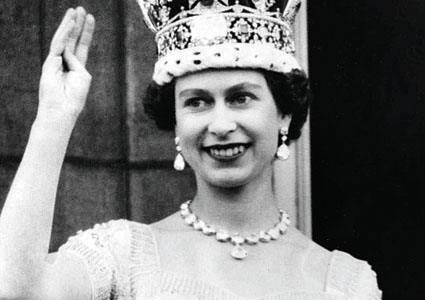
 Long to reign over us: Queen Elizabeth II waves from the palace balcony after her coronation in 1953 (National Media Museum/ The Commons)
From our earliest years, we delight in hearing about kings and queens, princes and princesses, without needing to know why we are drawn to these stories. The first reason to tell our children the history of our kings and queens is for pleasure. As J.H. Plumb remarks in his book on the first four Georges, “It is almost impossible for a monarch to be dull, no matter how stupid.” Here human passions, admirable and disgraceful, are played out for the highest stakes. No wonder Shakespeare wrote play after play about royalty and rebellion, ranging from ancient times to the still quite recent convulsions on the English throne.
From 1307 to 1485, England had nine kings, of whom four were murdered and one died in battle, while the other four died of illness, but fought battles in which they too might have perished. Even today, Henry V expresses English patriotism in its most cheerful form, as a perfect mixture of elitism and egalitarianism: “We few, we happy few, we band of brothers.”
These things are uppermost in my mind because I have just attempted, in a volume of brief lives of all 40 monarchs from William the Conqueror to the present Queen (Gimson’s Kings and Queens, Square Peg, £10.99), to tell the story for enjoyment rather than edification. I like knowing which monarch was known as “Dismal Jimmy”; which was probably the first to eat ice cream; which one locked up his wife for 32 years after hearing she was about to elope with a Swede; who told his valet, as the royal yacht approached the coast of Scotland, “Un costume un peu plus écossais demain”; and which heir to the throne inquired, when conversation flagged during lunch with a famous novelist: “Now you can settle this, Mr Hardy. I was having an argument with my Mama the other day. She said you had once written a book called Tess of the d’Urbervilles, and I said I was sure it was by somebody else.”*
But while drawing a picture of each of our monarchs, I couldn’t help wondering why they still have such a hold on our imagination. This is not a narrowly British point, or one which applies only to children. Go to some distant part of the globe, and you are far more likely to be asked about our Queen (who will be 90 in May) than our Prime Minister.
Yet with the exception of Bagehot (usefully derided by Ferdinand Mount in The British Constitution Now) not much has been written in the last 200 years which casts light on the attraction of kingship. Among political writers, the rise of democracy has tended to eclipse everything else. In a way this is right and proper, for here is the great new force which lends legitimacy to government. Our political system is acceptable because at a general election we can sack whichever set of rogues has been running the show, and can put in the other lot. Here is the most popular and indispensable check on the abuse of power, and I would not wish anything in the rest of this article to be taken as implying any kind of opposition to it.
Nor do I yield to anyone in my admiration of the greatest writers on democracy, notably Alexis de Tocqueville. But in lesser hands, incessant repetition of the word “democracy” can become a hindrance to understanding how things actually work. Our vocabulary has become too narrow to express whatever thoughts and feelings we may have about other parts of our constitution, including the monarchy. A kind of self-censorship prevails. We suppose ourselves to be more free than any previous generation, but are in fact just as inhibited. Our sense of what we ought to believe obscures our true sentiments even from ourselves.
This leaves the monarchy as an almost incomprehensible anachronism. How, one wonders, has the House of Windsor survived so long? The Bourbons, the Braganzas, the Romanovs, the Habsburgs, the Wittelsbachs and the Hohenzollerns have been swept from the stage. One may feel driven to assume it is by some kind of accident that our royal house has survived, assisted by an astute rebranding exercise in 1917, when it changed its name from Saxe-Coburg and Gotha to Windsor.
Some writers imagine, on observing the dutifulness with which Elizabeth II has conducted herself, that the monarchy has survived because of the virtues of individual monarchs. Their attitude is that of courtiers: they wish to see the best in their sovereign, and in the case of the present queen, they do not find themselves short of material. She has upheld for more than 63 years the conscientious monarchy which her father, George VI, restored after the Abdication crisis.
Other writers go to the opposite extreme. They are determined to mock the monarchy. They wish to indicate that they are too clever and modern to be taken in by this undemocratic anomaly. They are surprised such an absurd mummery has not yet been abolished. Such attitudes are often held by intellectuals and by writers of comedy programmes for the BBC.
Both approaches are wrong, or at best inadequate. Neither the loyal courtier nor the contemptuous intellectual sees to the heart of the matter. The main reason the monarchy survives is that we the people want it to survive. We have a popular monarchy, created, maintained and modified by popular demand. In that sense, it is our most democratic institution. As Eric Hobsbawm, a Communist rather than a monarchist, observed in his essay on the mass production of traditions in Europe from 1870 to 1914: “Glory and greatness, wealth and power, could be symbolically shared by the poor through royalty and its rituals.” By magnifying the monarch, we magnify ourselves. In Obscure Kingdoms by Edward Fox, published in 1993, which is one of the most thoughtful accounts of the subject I have come across, the author observes, during an account of an audience with Sultan Qaboos of Oman:
This leaves the monarchy as an almost incomprehensible anachronism. How, one wonders, has the House of Windsor survived so long? The Bourbons, the Braganzas, the Romanovs, the Habsburgs, the Wittelsbachs and the Hohenzollerns have been swept from the stage. One may feel driven to assume it is by some kind of accident that our royal house has survived, assisted by an astute rebranding exercise in 1917, when it changed its name from Saxe-Coburg and Gotha to Windsor.
Some writers imagine, on observing the dutifulness with which Elizabeth II has conducted herself, that the monarchy has survived because of the virtues of individual monarchs. Their attitude is that of courtiers: they wish to see the best in their sovereign, and in the case of the present queen, they do not find themselves short of material. She has upheld for more than 63 years the conscientious monarchy which her father, George VI, restored after the Abdication crisis.
Other writers go to the opposite extreme. They are determined to mock the monarchy. They wish to indicate that they are too clever and modern to be taken in by this undemocratic anomaly. They are surprised such an absurd mummery has not yet been abolished. Such attitudes are often held by intellectuals and by writers of comedy programmes for the BBC.
Both approaches are wrong, or at best inadequate. Neither the loyal courtier nor the contemptuous intellectual sees to the heart of the matter. The main reason the monarchy survives is that we the people want it to survive. We have a popular monarchy, created, maintained and modified by popular demand. In that sense, it is our most democratic institution. As Eric Hobsbawm, a Communist rather than a monarchist, observed in his essay on the mass production of traditions in Europe from 1870 to 1914: “Glory and greatness, wealth and power, could be symbolically shared by the poor through royalty and its rituals.” By magnifying the monarch, we magnify ourselves. In Obscure Kingdoms by Edward Fox, published in 1993, which is one of the most thoughtful accounts of the subject I have come across, the author observes, during an account of an audience with Sultan Qaboos of Oman:
Rule through splendid display is one of the basic techniques of kingship, for to be impressed is to obey. It arouses an aesthetic appetite in us that can be satisfied only by the continued reign of the king. It turns the king into a cultural force we come to identify with the culture of the nation itself, making him indispensable to it.
Among our other appetites, there is a hunger to be impressed, and a disposition to feast our eyes on splendour. This is why republics, even great and successful ones such as the United States, so often find themselves aping monarchical forms: a point made with patrician irony by Henry Adams in Democracy: An American Novel, published in 1880. The President of the United States is an elective monarch, who at times also acquires hereditary characteristics. Presidents George Bush I and George Bush II are among the most recent successors of King George III, who managed to lose the American colonies.
The most penetrating recent book on this subject is The Royalist Revolution: Monarchy and the American Founding, by Eric Nelson of Harvard, published in 2014 and reviewed in this magazine’s January/February 2015 issue. I am grateful to Noel Malcolm for pointing me towards this work when I asked him what to read about kingship. Nelson shows that many of the American colonists considered themselves to be rebelling against parliament rather than against the king. As James Wilson of Pennsylvania put it at the constitutional convention in Philadelphia in the summer of 1787, “The people of America did not oppose the British king but the parliament — the opposition was not against an unity but a corrupt multitude.”
Pregnant words! For many people today — I mean ordinary people, such as one might meet in a downmarket pub, an exercise in which I engaged for several years for various publications — consider our parliament to be irretrievably corrupt. When the expenses scandal occurred, it occasioned no surprise in the public bar, where the assumption has long been that politicians are “only in it for the money”. I do not say this popular prejudice is correct (in my view it is exaggerated). But it is a prejudice which is difficult to make sense of if you are the kind of columnist who uses the word “democratic” as a multi-purpose term of approval. All you can do, when elected representatives turn out to be corrupt, is express pious rage, inform them that they ought not to be corrupt, and call for regulators who will make it impossible for them to be corrupt. Blind faith in “democracy” makes it very difficult to work out how to guard against the tyranny of the majority, or even to perceive that danger.
In the American colonies which fell out with Westminster in the 1760s and 1770s, a more sophisticated constitutional debate was possible. Those who thought parliament was the problem turned to Charles I as the solution. In 1642, when parliament tried to take control of military appointments, despite not having submitted the militia ordinance to the king for the royal assent, Charles responded with a tremendous defence of his prerogatives, drafted for him by Lord Falkland and Sir John Culpepper:
The most penetrating recent book on this subject is The Royalist Revolution: Monarchy and the American Founding, by Eric Nelson of Harvard, published in 2014 and reviewed in this magazine’s January/February 2015 issue. I am grateful to Noel Malcolm for pointing me towards this work when I asked him what to read about kingship. Nelson shows that many of the American colonists considered themselves to be rebelling against parliament rather than against the king. As James Wilson of Pennsylvania put it at the constitutional convention in Philadelphia in the summer of 1787, “The people of America did not oppose the British king but the parliament — the opposition was not against an unity but a corrupt multitude.”
Pregnant words! For many people today — I mean ordinary people, such as one might meet in a downmarket pub, an exercise in which I engaged for several years for various publications — consider our parliament to be irretrievably corrupt. When the expenses scandal occurred, it occasioned no surprise in the public bar, where the assumption has long been that politicians are “only in it for the money”. I do not say this popular prejudice is correct (in my view it is exaggerated). But it is a prejudice which is difficult to make sense of if you are the kind of columnist who uses the word “democratic” as a multi-purpose term of approval. All you can do, when elected representatives turn out to be corrupt, is express pious rage, inform them that they ought not to be corrupt, and call for regulators who will make it impossible for them to be corrupt. Blind faith in “democracy” makes it very difficult to work out how to guard against the tyranny of the majority, or even to perceive that danger.
In the American colonies which fell out with Westminster in the 1760s and 1770s, a more sophisticated constitutional debate was possible. Those who thought parliament was the problem turned to Charles I as the solution. In 1642, when parliament tried to take control of military appointments, despite not having submitted the militia ordinance to the king for the royal assent, Charles responded with a tremendous defence of his prerogatives, drafted for him by Lord Falkland and Sir John Culpepper:
We call God to witnesse, that as for Our Subjects’ sake these Rights are vested in Us, so for their sakes, as well as for Our Own, We are resolved not to quit them, nor to subvert (though in a Parliamentary way) the ancient, equall, happy, well-poised, and never-enough commended Constitution of the Government of this Kingdom.
A king could be the guardian rather than the subverter of his subjects’ liberties. He was above faction, and could stand up for those who would otherwise be at the mercy of the rich, ambitious and often corrupt men who dominated parliament. This was how Charles I saw himself, and was why he declared, in his speech from the scaffold on January 30, 1649: “I am the Martyr of the People.”
But George III declined American pleas to behave like Charles I and defend them against acts of parliamentary oppression, by withholding royal assent to those acts. The Americans nevertheless decided to confer this power of veto on their president. Opponents who complained that “the foetus of monarchy” was being insinuated into the American Constitution were overruled. The elected monarch in the White House can reject acts of Congress. In Washington, legislative deadlock threatens to lead to the “constitutional death spiral” that in the 1640s produced the English Civil War.
It is not my purpose here to attempt a full account of what Nelson says. That would be impossible. Because his account is so contrary to the received wisdom that the American rebels were out and out democrats, it has to be fully buttressed by quotations from contemporary sources. But he sums up the new situation after the founding of the American republic with an epigram: “On one side of the Atlantic, there would be kings without monarchy; on the other, monarchy without kings.”
On this reading of history, the Americans preserve a more faithful version of “the ancient, equall, happy, well-poised and never-enough commended Constitution” of England than we do ourselves. At Westminster the monarch’s ability to avert legislative tyranny by refusing the royal assent had already been surrendered: Queen Anne was the last to use it, in 1707. Whig magnates had captured the Commons, made it the dominant institution and enriched themselves at public expense. So impressed are we by these grandees that we accept their claim to be on the side of freedom, and think this means they must have been democrats, or at least the glorious prophets of democracy. Their character as a corrupt and greedy oligarchy is treated as a minor and picturesque flaw. They can be forgiven almost anything because they stood, with the Tories, as a bulwark of liberty against the absolute Catholic monarchy of Louis XIV, towards which James II had attempted, from 1685-88, to steer us.
With the Act of Settlement of 1701, parliament ensured that we would have a Protestant monarchy. The main merit of George I, the Hanoverian princeling who ascended the throne in 1714, was that he was a Protestant, and could therefore be presumed to be a defender of our ancient liberties.
We have grown used to the idea that a representative has to be elected. A moment’s thought should be enough to correct this error. The monarch has a representative function which does not, usually, depend on election, but which does require widespread approval. As Jonathan Sumption pointed out, in a recent address on Magna Carta to the Friends of the British Library, medieval kings “could not govern without the tacit support of their subjects, and the active support of at least the most powerful of them . . . kings could not afford to act in a way that defied the contemporary consensus about how a king should behave.”
But George III declined American pleas to behave like Charles I and defend them against acts of parliamentary oppression, by withholding royal assent to those acts. The Americans nevertheless decided to confer this power of veto on their president. Opponents who complained that “the foetus of monarchy” was being insinuated into the American Constitution were overruled. The elected monarch in the White House can reject acts of Congress. In Washington, legislative deadlock threatens to lead to the “constitutional death spiral” that in the 1640s produced the English Civil War.
It is not my purpose here to attempt a full account of what Nelson says. That would be impossible. Because his account is so contrary to the received wisdom that the American rebels were out and out democrats, it has to be fully buttressed by quotations from contemporary sources. But he sums up the new situation after the founding of the American republic with an epigram: “On one side of the Atlantic, there would be kings without monarchy; on the other, monarchy without kings.”
On this reading of history, the Americans preserve a more faithful version of “the ancient, equall, happy, well-poised and never-enough commended Constitution” of England than we do ourselves. At Westminster the monarch’s ability to avert legislative tyranny by refusing the royal assent had already been surrendered: Queen Anne was the last to use it, in 1707. Whig magnates had captured the Commons, made it the dominant institution and enriched themselves at public expense. So impressed are we by these grandees that we accept their claim to be on the side of freedom, and think this means they must have been democrats, or at least the glorious prophets of democracy. Their character as a corrupt and greedy oligarchy is treated as a minor and picturesque flaw. They can be forgiven almost anything because they stood, with the Tories, as a bulwark of liberty against the absolute Catholic monarchy of Louis XIV, towards which James II had attempted, from 1685-88, to steer us.
With the Act of Settlement of 1701, parliament ensured that we would have a Protestant monarchy. The main merit of George I, the Hanoverian princeling who ascended the throne in 1714, was that he was a Protestant, and could therefore be presumed to be a defender of our ancient liberties.
We have grown used to the idea that a representative has to be elected. A moment’s thought should be enough to correct this error. The monarch has a representative function which does not, usually, depend on election, but which does require widespread approval. As Jonathan Sumption pointed out, in a recent address on Magna Carta to the Friends of the British Library, medieval kings “could not govern without the tacit support of their subjects, and the active support of at least the most powerful of them . . . kings could not afford to act in a way that defied the contemporary consensus about how a king should behave.”
Or as Thomas à Becket put it, with subtle intransigence, once he had become Archbishop of Canterbury: “Although the king must be obeyed in many things, he must not be obeyed in those things which cause him not to be a king.” In 973, Dunstan had become the first Archbishop of Canterbury to anoint an English monarch, King Edgar, in a coronation service including the text “Zadok the priest . . . anointed Solomon”, which is used to this day. Becket was reminding Henry II that the Church’s approval is not unconditional.
Successful rulers ally themselves with the zeitgeist. Max Weber observes that “the king is everywhere primarily a warlord”, and throughout the Middle Ages, that remained the great test. In 1066, at the head of 5,000 knights, a brave, clever, brutal, illiterate Norman warlord made himself the master of a kingdom with perhaps 1.5 million inhabitants. At the end of the middle ages, Richard III lost his throne, and his life, because too few of his subjects were prepared to fight for him.
The Tudors were a new dynasty who allied themselves with new men. Henry VIII exploited widespread anti-clericalism. His younger daughter, Elizabeth I, played at Tilbury the warlord role to perfection, becoming the embodiment of English resistance to the Spanish Armada. She worked without ceasing at the mystique of monarchy, and to carry people and parliament with her, but an important element in her policy was vagueness: rather than define royalty, she projected it.
Her Stuart successors made the error of becoming too definite. Perhaps from some inner sense of insecurity or inferiority (for he cut a pretty feeble figure compared to Elizabeth), James I expounded the doctrine of the divine right of kings, which by the end of the seventeenth century had been replaced by the parliamentary right of kings. We enter the familiar story of prime ministers acting in the name of the crown, but in fact on their own and their parties’ account. Not that this process took place without a certain amount of royal resistance. Here is Queen Victoria, writing to W.E. Forster, the Chief Secretary for Ireland, at a time of tremendous ructions over Gladstone’s Irish policy:
Despite these animadversions, Victoria was, in her impulsive and contradictory way, a profoundly democratic monarch, who expressed her people’s middle-class desire for self-improvement accompanied by imperial grandeur. The royal family adapted itself well to democratic times. Edward VII provided any amount of copy for the Daily Mail, founded in 1896, and saw to it that slipshod standards of royal ceremonial were raised to the almost perfect level needed in an age of photography. In the 1920s, George V extended the hand of friendship to Labour Cabinet ministers, and enabled them to show how respectable they were: an opportunity they embraced with enthusiasm. He also mastered the new medium of radio.
Successful rulers ally themselves with the zeitgeist. Max Weber observes that “the king is everywhere primarily a warlord”, and throughout the Middle Ages, that remained the great test. In 1066, at the head of 5,000 knights, a brave, clever, brutal, illiterate Norman warlord made himself the master of a kingdom with perhaps 1.5 million inhabitants. At the end of the middle ages, Richard III lost his throne, and his life, because too few of his subjects were prepared to fight for him.
The Tudors were a new dynasty who allied themselves with new men. Henry VIII exploited widespread anti-clericalism. His younger daughter, Elizabeth I, played at Tilbury the warlord role to perfection, becoming the embodiment of English resistance to the Spanish Armada. She worked without ceasing at the mystique of monarchy, and to carry people and parliament with her, but an important element in her policy was vagueness: rather than define royalty, she projected it.
Her Stuart successors made the error of becoming too definite. Perhaps from some inner sense of insecurity or inferiority (for he cut a pretty feeble figure compared to Elizabeth), James I expounded the doctrine of the divine right of kings, which by the end of the seventeenth century had been replaced by the parliamentary right of kings. We enter the familiar story of prime ministers acting in the name of the crown, but in fact on their own and their parties’ account. Not that this process took place without a certain amount of royal resistance. Here is Queen Victoria, writing to W.E. Forster, the Chief Secretary for Ireland, at a time of tremendous ructions over Gladstone’s Irish policy:
She cannot and will not be the Queen of a democratic monarchy; and those who have spoken and agitated . . . in a very radical sense must look for another monarch; and she doubts if they will find one.
Despite these animadversions, Victoria was, in her impulsive and contradictory way, a profoundly democratic monarch, who expressed her people’s middle-class desire for self-improvement accompanied by imperial grandeur. The royal family adapted itself well to democratic times. Edward VII provided any amount of copy for the Daily Mail, founded in 1896, and saw to it that slipshod standards of royal ceremonial were raised to the almost perfect level needed in an age of photography. In the 1920s, George V extended the hand of friendship to Labour Cabinet ministers, and enabled them to show how respectable they were: an opportunity they embraced with enthusiasm. He also mastered the new medium of radio.
On the death of George V in 1936, grave difficulties arose. Edward VIII showed he was unwilling to make the sacrifices of personal inclination which are required of a constitutional monarch. His insistence on marrying Wallis Simpson, a twice-divorced American, led to the Abdication crisis. Had he wished merely to retain her as a mistress, matters would not have come to a head so quickly. But Baldwin, as Prime Minister, mobilised the Establishment and insisted that “in the choice of a queen the voice of the people must be heard”.
Here, one may note, was a chance to get rid of the monarchy altogether. James Maxton, an Independent Labour MP, duly proposed in Parliament that Britain should become a republic. His motion was defeated by 403 votes to 5. Neither the ruling classes nor the people wanted a republic. What they wanted was a dutiful monarch, and in George III that is what they got.
Baldwin described the monarchy as “the guarantee against many evils”. It remains one of the greatest, though least observed, checks on arbitrary power, for the king or queen occupies the space a dictator would need to occupy. Because it is unthinkable in Britain to push the monarchy aside, tyranny itself becomes unthinkable. In countries where the monarchy was overthrown — France in 1789, Russia in 1917, Germany in 1918 — tyranny was not unthinkable. Our hereditary umpire is not just decorative: she stops the players from getting out of hand. When Jeremy Corbyn declined to sing “God Save the Queen”, he did himself great harm, and her no harm at all.
It is true that the Queen has no power to run the government which is carried on in her name. Her ministers do that, and take the blame when things go wrong. The prime minister exercises an impressive range of royal prerogatives. Tony Benn used to complain about that, and I confess I thought he was wrong-headed. But it now occurs to me that he was on to something. George III tried, by the exercise of patronage, to control Parliament. So does David Cameron. I wonder if Eric Nelson could be prevailed on to write another book, in which he examines whether Cameron has become, in reality though not in name, an elected monarch.
Here, one may note, was a chance to get rid of the monarchy altogether. James Maxton, an Independent Labour MP, duly proposed in Parliament that Britain should become a republic. His motion was defeated by 403 votes to 5. Neither the ruling classes nor the people wanted a republic. What they wanted was a dutiful monarch, and in George III that is what they got.
Baldwin described the monarchy as “the guarantee against many evils”. It remains one of the greatest, though least observed, checks on arbitrary power, for the king or queen occupies the space a dictator would need to occupy. Because it is unthinkable in Britain to push the monarchy aside, tyranny itself becomes unthinkable. In countries where the monarchy was overthrown — France in 1789, Russia in 1917, Germany in 1918 — tyranny was not unthinkable. Our hereditary umpire is not just decorative: she stops the players from getting out of hand. When Jeremy Corbyn declined to sing “God Save the Queen”, he did himself great harm, and her no harm at all.
It is true that the Queen has no power to run the government which is carried on in her name. Her ministers do that, and take the blame when things go wrong. The prime minister exercises an impressive range of royal prerogatives. Tony Benn used to complain about that, and I confess I thought he was wrong-headed. But it now occurs to me that he was on to something. George III tried, by the exercise of patronage, to control Parliament. So does David Cameron. I wonder if Eric Nelson could be prevailed on to write another book, in which he examines whether Cameron has become, in reality though not in name, an elected monarch.