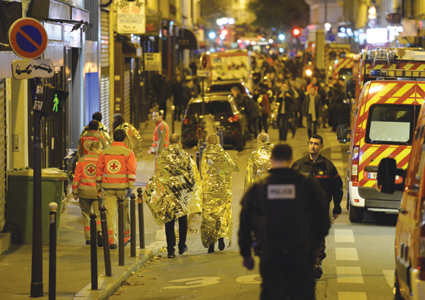
 An avoidable catastrophe? The Bataclan concert hall is evacuated after the terrorist attack which killed 89 (©Miguel Medina/AFP/Getty Images)
On Friday November 13, we were watching our favourite TV series when my father-in-law called, in a panic. It was 11pm. Was I in Paris? No. Great — because something terrible was happening. An attack? Again? Le Monde’s website was down. I turned to the BBC, where I learned about the whole thing, then to a French news channel. It was devastating.
My best friend lives 15 minutes away from the Bataclan, the theatre where 90 people were shot. I called her — fortunately, she was at home, safe. Then I called all my other friends in Paris. Everyone was safe. I was relieved, but felt also guilty, because other people were not as lucky.
Before moving to London a year ago, I lived in the 19th arrondissement, a few Metro stations away from the place of the attacks. The Bataclan is located between the pretty Canal-Saint-Martin and Le Marais, the beautiful part-Jewish, part-gay area. My friends and I used to go out there often. To me, the attacks seemed all the more real and terrifying as they happened in the very place where I had lived for years.
I spent the rest of the weekend in front of the news. My first feeling was a deep sadness. For most of the following days, I was stunned, weak, unable to undertake any consistent task. I constantly looked at the pictures and films showing hundreds of flowers and candles left by people in front of the Bataclan and the targeted restaurants. I read dozens of stories told by victims and witnesses. I felt nothing but empathy.
However, within days, I felt something different. I felt anger. I got fed-up with the sight of flowers and candles piling up in the streets. The impression was growing that the only reaction we French were able to show was shock and grief, and that we favoured “kitsch” over reserve. This was perfectly demonstrated by the commemoration of the attacks on November 27, where President François Hollande sat ridiculously alone on a chair, aloof from the crowd, while songs by Jacques Brel and Barbara were badly sung. Barbara’s song, “Perlimpinpin”, was possibly a good choice, but I didn’t really see the point of singing “Quand on n’a que l’amour”, or John Lennon’s “Imagine”, which was played by a pianist in the street after the attacks, and dozens of times everywhere afterwards. Peace and love against hatred? Is that really going to impress IS? To be clear: I have the utmost respect for the huge pain and despair of the families who have lost loved ones, and they are free to play and sing anything they want for the rest of their lives. What I don’t get is why the French government is deploying emotion instead of reason. You cannot pretend to be “merciless” against your enemy, and at the same time gather to sing songs like “Imagine”.
But that is not the main cause of my anger. Its main cause is the political leaders of my country, and not only the current ones but all of them, because they have ignored the threats looming over us for a long time.
Each time that a catastrophe happens it is customary to say that it could have been avoided. This is not always true. But in the case of the latest Paris attacks, it is. After the January attacks against Charlie Hebdo and the Hypercacher supermarket, we knew that France was a prominent target for terrorists. There were other attacks which we merely talked about, and which would have appeared as horrendous in other times. Remember the Thalys attack in August? The beheading of the poor boss of an IS supporter in June?
Of course, the government was able to prevent a lot of them. But it was not enough. How is it possible that some of the terrorists involved in the attacks were able to come back so easily from Syria and travel round Europe? Why implement the state of emergency only now, and not last January? It is easy to play the tough guys now, when everyone in France agrees — we have no other choice — but the crucial decisions should have been made months ago. Of course, they would have provoked controversy. But the function of politicians is not primarily to deal with catastrophes — it is to avoid them, usually through unpopular decisions.
The long-term conditions that have given rise to the attacks are even more worrying. We don’t know precisely yet where the terrorists got their arms, but certainly in Belgium or France. For years we have known that vast numbers of illegal arms circulate freely in France, and that this trade is linked to drug trafficking. What has been done?
The sad truth is that for political, ideological as well as financial reasons, the French state has given up controlling certain areas, included what we call the banlieues, the peripheral areas of big towns known for their architectural ugliness, their economic distress and their culture of violence. Especially, this is where ethnic minorities concentrate. This is also where some of the November 13 terrorists grew up. For the Left, poverty and discrimination are the main causes for the problems of the banlieues. For the Right, people themselves and a lack of authority are to blame. But whichever interpretation prevails, everyone agrees today that some parts of those areas are out of control.
According to a parliamentary report, President Nicolas Sarkozy reduced the number of police employees by 10,000 between 2007 and 2012, in order to make savings. François Hollande will hire 5,000 more. Is it enough? There are banlieues where the police don’t go any more. They are no-go zones. The phrase has been poisoned by its use by Fox News after the January attacks, when the channel deliberately mixed truths with lies — for example when they declared that sharia prevails in some parts of the banlieues, which is absolutely false. But there is a grain of truth in the idea of “no-go zones”: there are places in French towns where the police can’t go, because they are too dangerous. They are also places, and some in the very centre of Paris, where you would never walk alone, even during the day, especially as a woman, because people aggressively stare at you as if you didn’t belong. The violent places and the unfriendly ones are not necessarily the same ones, but closure, insecurity and violence are potential nests for more extreme activities. Then, while past and present governments have known for a long time where to find arms caches and drug dealers, they deliberately decided not to intervene too much, out of fear of provoking a riot.
Why a riot? Because the riots of 2005 are still vivid in our memory. This was the first time we fully realised how the intégration à la française was not completely working. It was working very well, as it still does, most of the time, but when it failed, the consequences were dramatic. The fact that most of the terrorists of the November attack were French or Belgians just confirmed this sad reality. Much has been said about French integration, and I know that people in the Anglosphere have a tendency to see French assimilation and laïcité as intolerant creeds. They are not.
The long-term conditions that have given rise to the attacks are even more worrying. We don’t know precisely yet where the terrorists got their arms, but certainly in Belgium or France. For years we have known that vast numbers of illegal arms circulate freely in France, and that this trade is linked to drug trafficking. What has been done?
The sad truth is that for political, ideological as well as financial reasons, the French state has given up controlling certain areas, included what we call the banlieues, the peripheral areas of big towns known for their architectural ugliness, their economic distress and their culture of violence. Especially, this is where ethnic minorities concentrate. This is also where some of the November 13 terrorists grew up. For the Left, poverty and discrimination are the main causes for the problems of the banlieues. For the Right, people themselves and a lack of authority are to blame. But whichever interpretation prevails, everyone agrees today that some parts of those areas are out of control.
According to a parliamentary report, President Nicolas Sarkozy reduced the number of police employees by 10,000 between 2007 and 2012, in order to make savings. François Hollande will hire 5,000 more. Is it enough? There are banlieues where the police don’t go any more. They are no-go zones. The phrase has been poisoned by its use by Fox News after the January attacks, when the channel deliberately mixed truths with lies — for example when they declared that sharia prevails in some parts of the banlieues, which is absolutely false. But there is a grain of truth in the idea of “no-go zones”: there are places in French towns where the police can’t go, because they are too dangerous. They are also places, and some in the very centre of Paris, where you would never walk alone, even during the day, especially as a woman, because people aggressively stare at you as if you didn’t belong. The violent places and the unfriendly ones are not necessarily the same ones, but closure, insecurity and violence are potential nests for more extreme activities. Then, while past and present governments have known for a long time where to find arms caches and drug dealers, they deliberately decided not to intervene too much, out of fear of provoking a riot.
Why a riot? Because the riots of 2005 are still vivid in our memory. This was the first time we fully realised how the intégration à la française was not completely working. It was working very well, as it still does, most of the time, but when it failed, the consequences were dramatic. The fact that most of the terrorists of the November attack were French or Belgians just confirmed this sad reality. Much has been said about French integration, and I know that people in the Anglosphere have a tendency to see French assimilation and laïcité as intolerant creeds. They are not.
Assimilation was conceived at first both as a constraining and empowering device. In the first decades after the Second World War, it seemed to work very well. Immigrants from North Africa, for example, integrated well. But their children and grandchildren started experiencing integration very differently from their parents, revealing a wound that had been ignored but was obvious — the painful memory of colonialism. As Andrew Hussey brilliantly demonstrated in his book The French Intifada, France has avoided looking back at its colonial past, especially in Algeria. Engaging in a proper exercise of memory and reconciliation would be necessary to appease us. It wouldn’t be, as the French Right likes to say, tantamount to a work of “repentance”; it would be repentance if we did so without involving everyone, France, North Africa and the descendants of immigrants. For that reason, it is not so much assimilation that doesn’t work, but the way France has dealt with it.
Laïcité seems very severe seen from outside; inside, it is not, because every French person is educated in the spirit that the best way to treat people equally in the public sphere is to be blind towards their religious beliefs — namely, to ask them to keep them private. I am well aware of the flaws of this concept, and how laïcité has been sometimes related to sectarian and anti-religious attitudes, from the Revolution onwards. But that debate is now over, and most Christians fully accept it — and when they don’t, they don’t show it, which is the only thing we ask. What is new today is that those who don’t accept it are mainly Muslims — not all of them, of course, only a minority, but a noisy one none the less. Some, like Emmanuel Todd in his recent book Who is Charlie?, make the argument that Catholics never really accepted laïcité, whereas Muslims are being forced to do so. This is particularly confusing and paranoid: from 1905, Catholics have made tremendous effort to accept the separation of church and state. Today, it is much easier to ridicule the Pope than the Prophet, as we all know. If Christians remain an influential authority in France, it is because France has Christian roots. You cannot avoid it: it is called history and culture.
Laïcité is not an exceptional concept. It may be so in its purist approach to the separation between state and religion. It is not when put in the context of Western liberalism, because all liberal democracies have operated the same separation between church and state, but each of them in a specific way. For that reason, it is wrong to say that laïcité has failed because it is too tough. When it has failed, it is because authorities have given up enforcing it in some places, beginning with schools. Sarkozy was so good at speaking that he forgot to do anything. Others on the Left and the Right have been praising “diversity” for electoral purposes and preferred to violently condemn anyone who dared to notice that some problems had arisen. The main problem posed by laïcité is that we have had a tendency to interpret the concept of “separation” as “indifference” towards religion, and that has prevented us from understanding what was happening in some religious circles. The consequences, today, are numerous and have expanded well beyond the religious question, to become a question of identity. In some places, people who are French don’t even consider themselves to be so; anti-Semitism is growing; and boys and girls live in different worlds.
Laïcité seems very severe seen from outside; inside, it is not, because every French person is educated in the spirit that the best way to treat people equally in the public sphere is to be blind towards their religious beliefs — namely, to ask them to keep them private. I am well aware of the flaws of this concept, and how laïcité has been sometimes related to sectarian and anti-religious attitudes, from the Revolution onwards. But that debate is now over, and most Christians fully accept it — and when they don’t, they don’t show it, which is the only thing we ask. What is new today is that those who don’t accept it are mainly Muslims — not all of them, of course, only a minority, but a noisy one none the less. Some, like Emmanuel Todd in his recent book Who is Charlie?, make the argument that Catholics never really accepted laïcité, whereas Muslims are being forced to do so. This is particularly confusing and paranoid: from 1905, Catholics have made tremendous effort to accept the separation of church and state. Today, it is much easier to ridicule the Pope than the Prophet, as we all know. If Christians remain an influential authority in France, it is because France has Christian roots. You cannot avoid it: it is called history and culture.
Laïcité is not an exceptional concept. It may be so in its purist approach to the separation between state and religion. It is not when put in the context of Western liberalism, because all liberal democracies have operated the same separation between church and state, but each of them in a specific way. For that reason, it is wrong to say that laïcité has failed because it is too tough. When it has failed, it is because authorities have given up enforcing it in some places, beginning with schools. Sarkozy was so good at speaking that he forgot to do anything. Others on the Left and the Right have been praising “diversity” for electoral purposes and preferred to violently condemn anyone who dared to notice that some problems had arisen. The main problem posed by laïcité is that we have had a tendency to interpret the concept of “separation” as “indifference” towards religion, and that has prevented us from understanding what was happening in some religious circles. The consequences, today, are numerous and have expanded well beyond the religious question, to become a question of identity. In some places, people who are French don’t even consider themselves to be so; anti-Semitism is growing; and boys and girls live in different worlds.
Now, 2005 seems a long way away. The riots were not ideological, and there was no such thing as radical Islamism in France at the time. They were a mixture of anger, provocation, and gratuitous violence carried out by bored youths. As nature abhors a vacuum, and there was a huge vacuum of identity among these young men, radical Islamism filled the void in their hearts. In 2015, young men born and educated in France or Belgium turned against their country.
There too, the state has failed to deal with radical Islam. The government started far too late, expelling radical imams as well as blocking indoctrination through the internet. They refused to even question — never mind answer — the nature of the link between Islam and Islamism, because it is the new taboo. When Hollande spoke on November 13 and 14, he didn’t even mention the word “Islamism”. Never forget that Newspeak isn’t just the invention of new words, but the concealing of reality.
Very strikingly, after November 13, government and opposition pretended to be “united” — unity is a French obsession, probably commensurate with our inner inability to reach consensus. In a time of grief, it is understandable that politicians want to appear as peacemakers, at least out of respect for the families of the victims. But it made them appear as they truly are: all the same, fearful and talentless. For that reason, we shouldn’t expect anything from the people currently in power. We should expect something, instead, from the institutions.
Most of the conditions for the attacks — illegal arms, lack of control, integration, radicalism — boil down to a central plank of liberal democracy: the rule of law, and its enforcement. If you have watched the excellent French series Spiral, you may know what I am talking about. Just the fact that the procureur, a representative of the Ministry of Justice, can interfere in any investigation being conducted by the police and the juge d’instruction, and even block prosecutions, conflicts with the appearance of impartiality. This is just one example among thousands. The most striking ones are the slowness of the judiciary and the tendency to reduce sentences after only part of them has been served — for many reasons, including the fact that there are not enough places in prisons, and also because a lot of people, mainly on the Left, have always taken a soft line on sentencing.
This goes beyond that: the rule of law is not only the power to punish, it is the power to protect. Today in France, ordinary citizens don’t feel that they are protected by the law, but that those who have money and power receive better treatment. This may be a very exaggerated view of our society; unfortunately, in some cases, it is true. Every New Year’s Eve, cars are set alight on the streets of the banlieues, and no one even tries to prevent it any more. I am not sure that could happen on the Boulevard Saint-Germain. Most French people, obviously, complain about laws being ignored, but only when they are penalised. Otherwise, they are happy to benefit. Don’t they see the contradiction?
There too, the state has failed to deal with radical Islam. The government started far too late, expelling radical imams as well as blocking indoctrination through the internet. They refused to even question — never mind answer — the nature of the link between Islam and Islamism, because it is the new taboo. When Hollande spoke on November 13 and 14, he didn’t even mention the word “Islamism”. Never forget that Newspeak isn’t just the invention of new words, but the concealing of reality.
Very strikingly, after November 13, government and opposition pretended to be “united” — unity is a French obsession, probably commensurate with our inner inability to reach consensus. In a time of grief, it is understandable that politicians want to appear as peacemakers, at least out of respect for the families of the victims. But it made them appear as they truly are: all the same, fearful and talentless. For that reason, we shouldn’t expect anything from the people currently in power. We should expect something, instead, from the institutions.
Most of the conditions for the attacks — illegal arms, lack of control, integration, radicalism — boil down to a central plank of liberal democracy: the rule of law, and its enforcement. If you have watched the excellent French series Spiral, you may know what I am talking about. Just the fact that the procureur, a representative of the Ministry of Justice, can interfere in any investigation being conducted by the police and the juge d’instruction, and even block prosecutions, conflicts with the appearance of impartiality. This is just one example among thousands. The most striking ones are the slowness of the judiciary and the tendency to reduce sentences after only part of them has been served — for many reasons, including the fact that there are not enough places in prisons, and also because a lot of people, mainly on the Left, have always taken a soft line on sentencing.
This goes beyond that: the rule of law is not only the power to punish, it is the power to protect. Today in France, ordinary citizens don’t feel that they are protected by the law, but that those who have money and power receive better treatment. This may be a very exaggerated view of our society; unfortunately, in some cases, it is true. Every New Year’s Eve, cars are set alight on the streets of the banlieues, and no one even tries to prevent it any more. I am not sure that could happen on the Boulevard Saint-Germain. Most French people, obviously, complain about laws being ignored, but only when they are penalised. Otherwise, they are happy to benefit. Don’t they see the contradiction?
When invoking the rule of law, I am not only invoking the state. I have talked a lot about the state here, because in all the issues I have described, civil society is often powerless. You cannot control a lawless area and fight Islamist-friendly mosques with little platoons. I would love to, but we can’t. What civil society can do though, is work on the ideological front, because the rule of law cannot exist without a concomitant mindset — that is, we must accept that we have to abide by the law, not because it is mandatory, but because it is good.
The French think of themselves as very unconventional, and enjoy disregarding the law, especially for minor things. They see the British as too obedient and describe their tendency to care about their neighbourhoods as “denunciation”. I find this view despicable, because it is the opinion of a selfish mind which thinks that incidents only happen to others. The truth is, it is better to abide by the law and be protected by it when needed than to boast about one’s lack of conventionality and be targeted because one is weak. Let’s begin by enforcing the law everywhere, and be happy about it, and maybe we will find it easier to enforce it in the most difficult places.
Today, we French have plenty on our plate. We are now bombing Syria and contemplating changing the rules of free movement in Europe. Both are very serious questions. But the real war will be fought at home. I may seem too severe to you, but if I am so severe with my beloved country, it is because it is my beloved country.
The French think of themselves as very unconventional, and enjoy disregarding the law, especially for minor things. They see the British as too obedient and describe their tendency to care about their neighbourhoods as “denunciation”. I find this view despicable, because it is the opinion of a selfish mind which thinks that incidents only happen to others. The truth is, it is better to abide by the law and be protected by it when needed than to boast about one’s lack of conventionality and be targeted because one is weak. Let’s begin by enforcing the law everywhere, and be happy about it, and maybe we will find it easier to enforce it in the most difficult places.
Today, we French have plenty on our plate. We are now bombing Syria and contemplating changing the rules of free movement in Europe. Both are very serious questions. But the real war will be fought at home. I may seem too severe to you, but if I am so severe with my beloved country, it is because it is my beloved country.