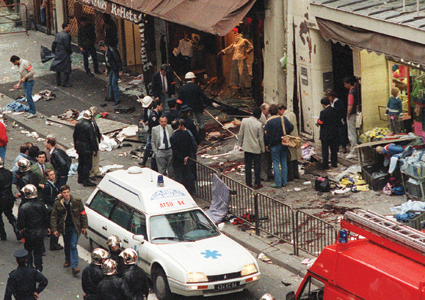
 The aftermath of the bombing in Rue de Rennes, Paris, in 1986, attributed to Hezbollah: Seven were killed and 55 injured (© Staff/AFP/Getty Images)
After the latest wave of Islamist terror in Paris, many in France have begun to wonder how to deal with a threat that most agree is unlikely to fade away any time soon. This is not the first time that Paris has been hit by terrorism in one form or another. Walking the streets of the City of Light, one can draw a mental map of Paris arrondissements that have experienced terror. There is hardly a neighbourhood in the French capital that has not been hit by terrorism. In the past six or seven decades almost all the terror attacks on the city have been committed by members of Islamist groups, or at least have been related to real or imagined grievances in various parts of the so-called “Muslim world”.
Starting in the 1950s, Algerian terrorism kept Paris on tenterhooks for a decade. The Algerian terror campaign was part of a larger plan drawn up by the Soviet Union and its regional client, the Egyptian despot Gamal Abdel Nasser.
Moscow wanted to pin down the French army, at the time the second largest in Nato. Its Algerian allies, many of them former NCOs from the French army, wished to seize control of the North African country for themselves, taking the place of moderate Algerians, led by Ferhat Abbas, who wished to negotiate a peaceful and phased independence from France, modelled on the ways in which Morocco and Tunisia had gained independence.
Trained and equipped by the Soviets and Egyptians, the National Liberation Army (ALN) and its political wing, the National Liberation Front (FLN), never managed to defeat the French. But they performed the task set for them by the Soviet bloc by keeping the French army busy for years. France under General Charles de Gaulle fulfilled Russian desires by withdrawing from Nato’s military section, closing all US bases in French territory and adopting a semi-nonaligned foreign policy.
The 1960s were marked by the first wave of Palestinian terror. Groups such as Al-Fatah and Al-Saiqah, created by Egypt or Syria with Soviet blessing, muscled onto the international stage by hijacking passenger aircraft and, occasionally, with bomb attacks.
The 1970s saw a fusion of Palestine-related terrorism and radical leftist terrorism of the Leninist, Maoist and Trotskyite variety, with France as a prime target. Again, successive French governments tried to calm things down with measures such as the payment of regular cash tributes to the terrorist groups involved in exchange for protection for French airlines.
Subsequently, the French went even further in appeasing the terrorists by cutting all arms sales to Israel, pushing the Jewish state closer to the US. In the 1950s, the French government under prime minister Guy Mollet had helped Israel start its nuclear programme. By the 1970s another French government, under prime minister Jacques Chirac, was helping a Saddam Hussein-led Iraq to create a nuclear capability aimed, at least in part, at Israel.
The 1980s were dominated by Tehran-sponsored terrorism as the mullahs ruling Iran tried to force France to submit to their demands through violence in Paris. With a series of terrorist attacks, mostly carried out by Lebanese Hezbollah elements recruited and trained by Iran, the mullahs succeeded in obtaining what they wanted. President François Mitterrand agreed to release $1 billion of frozen Iranian assets, enabling Tehran to return to the arms bazaar with well-lined pockets.
France also toned down its support for Iraq, then at war with Iran, and, more importantly from Tehran’s point of view, expelled the key figures of anti-mullah opposition in exile in Paris. French police also adopted a tolerant attitude as agents sent by Tehran murdered 17 Iranian opposition figures, including a former prime minister, a former deputy minister of education, a former chief of the general staff, and half a dozen intellectuals.
By the 1990s the idea that terrorism pays, at least in France, was taken as a given by many observers. By then, the torch had been passed to a new generation of home-grown terrorists, young men and women born and raised in France but brain-washed into a deep hatred of everything to do with France and the West by years of propaganda from radical Islamist groups and mosques financed by oil-rich Arab states and led by imams recruited in the Maghreb and West Africa.
Again, the French government responded with appeasement. The number of permits for building mosques and setting up Islamic schools jumped dramatically and French foreign policy was granted an even greater pro-Islamic profile in the context of the notorious “politique Arabe de la France”. Paris ended up violating the French Republic’s secular credentials by setting up a National Council of Muslims of France, mostly composed of radical Islamist groups but financed by the ministry of the interior. The group’s very title indicated that the state was prepared to recognise being a Muslim as an identity quite distinct from being French. One was not dealing with Frenchmen who happened to be Muslims but with Muslims who just happened to be in France and owed the French nation no loyalty, even if their family had been there for generations.
More than a decade later, the present prime minister Manuel Valls recognised the bizarre arrangement as a form of apartheid based on one version of a religion, divided into scores of “narratives”.
The terrorism that hit France in 2015, in January against Charlie Hebdo and a kosher supermarket and in November against a number of targets in Paris, is of a new kind for a number of reasons.
To start with, all previous Islamist terrorist attacks were inspired if not actually organised by foreign powers, including the USSR, Egypt, Syria, Libya and Iran. Even the attacks carried out by various Palestinian groups ultimately came under the umbrella of their respective patrons in Arab capitals. The 2015 attacks were ideologically sponsored by Islamic State (IS), a non-state entity regardless of its lofty name and pretention to the status of caliphate.
France also toned down its support for Iraq, then at war with Iran, and, more importantly from Tehran’s point of view, expelled the key figures of anti-mullah opposition in exile in Paris. French police also adopted a tolerant attitude as agents sent by Tehran murdered 17 Iranian opposition figures, including a former prime minister, a former deputy minister of education, a former chief of the general staff, and half a dozen intellectuals.
By the 1990s the idea that terrorism pays, at least in France, was taken as a given by many observers. By then, the torch had been passed to a new generation of home-grown terrorists, young men and women born and raised in France but brain-washed into a deep hatred of everything to do with France and the West by years of propaganda from radical Islamist groups and mosques financed by oil-rich Arab states and led by imams recruited in the Maghreb and West Africa.
Again, the French government responded with appeasement. The number of permits for building mosques and setting up Islamic schools jumped dramatically and French foreign policy was granted an even greater pro-Islamic profile in the context of the notorious “politique Arabe de la France”. Paris ended up violating the French Republic’s secular credentials by setting up a National Council of Muslims of France, mostly composed of radical Islamist groups but financed by the ministry of the interior. The group’s very title indicated that the state was prepared to recognise being a Muslim as an identity quite distinct from being French. One was not dealing with Frenchmen who happened to be Muslims but with Muslims who just happened to be in France and owed the French nation no loyalty, even if their family had been there for generations.
More than a decade later, the present prime minister Manuel Valls recognised the bizarre arrangement as a form of apartheid based on one version of a religion, divided into scores of “narratives”.
The terrorism that hit France in 2015, in January against Charlie Hebdo and a kosher supermarket and in November against a number of targets in Paris, is of a new kind for a number of reasons.
To start with, all previous Islamist terrorist attacks were inspired if not actually organised by foreign powers, including the USSR, Egypt, Syria, Libya and Iran. Even the attacks carried out by various Palestinian groups ultimately came under the umbrella of their respective patrons in Arab capitals. The 2015 attacks were ideologically sponsored by Islamic State (IS), a non-state entity regardless of its lofty name and pretention to the status of caliphate.
Second, previous terror attacks had precise political aims and were done to force changes to French foreign policy. The 2015 attacks, however, were not designed to obtain any concessions from the French state. The terrorists’ intention was simply to kill as many people as possible. Parisians had to die not because of what their government did or didn’t do but simply because of who they were.
That important point was spelt out by Ayatollah Ali Khamenei, the “Supreme Guide” of the Islamic Republic of Iran, in an “Open Letter to the Youth of the West” published on November 30, 2015. Khamenei wrote: “In the modern era the West, using advanced instruments [sic] has insisted on global cultural uniformalisation of the world. I regard the imposition of Western culture on [other] nations and the humiliation of independent cultures [by the West] as devastating and silent violence. Humiliating other cultures and insulting the most sacred of their content [i.e. religion] is the work of a culture that has absolutely no capability for replacing them. Even in the West itself the emergence of aggressiveness and loose-living as the principal ingredients of the dominant culture is leading to its rejection. We ask: is it a sin to reject your aggressive, cheap and nihilistic culture?” Khamenei went on to claim that IS represents a violent reaction based on “a Bedouin desert ideology” to colonialism, Zionism and American hegemony.
In other words, while the politically correct elites in the West pooh-pooh the theory of a clash of civilisations, Iran’s spiritual leader puts it at the centre of his analysis.
President François Hollande has extended the state of emergency imposed immediately after the November attacks by three months, increased the budget of the security services, brought 10,000 troops to Paris and given the green light to a series of arrests that would have enraged the politically correct before the latest attacks. He is also claims to have a strategy to deal with the threat posed by IS, one he has tried to sell to his Russian, American and British counterparts.
However, before one can talk of what to do, it is important to decide what not to do. The first item on the not-to-do list is precisely what Hollande and Valls have done, albeit in a number of asides rather than full statements — to assert that this is not Islam. Since many Muslims think otherwise, it would be more prudent for French leaders not to pose as arbiters of what is and what is not Islam.
The attacks in Paris were designed to massacre as many people as possible. If we use Russian matryoshka dolls, in which dolls nest within each other, as a metaphor, the smallest of the dolls represents the Paris killers. The next biggest doll, within which the first nests, is the network of radical Islamist groups that have taken root throughout France and, indeed, in all the Western democracies. The third doll is the Muslim community in non-Muslim societies. It may not even know what is nesting inside it but, perhaps without wanting to, it provides the society needed for radical groups to flourish. In Maoist terms, it amounts to the water in which the militant “fish” thrive.
That important point was spelt out by Ayatollah Ali Khamenei, the “Supreme Guide” of the Islamic Republic of Iran, in an “Open Letter to the Youth of the West” published on November 30, 2015. Khamenei wrote: “In the modern era the West, using advanced instruments [sic] has insisted on global cultural uniformalisation of the world. I regard the imposition of Western culture on [other] nations and the humiliation of independent cultures [by the West] as devastating and silent violence. Humiliating other cultures and insulting the most sacred of their content [i.e. religion] is the work of a culture that has absolutely no capability for replacing them. Even in the West itself the emergence of aggressiveness and loose-living as the principal ingredients of the dominant culture is leading to its rejection. We ask: is it a sin to reject your aggressive, cheap and nihilistic culture?” Khamenei went on to claim that IS represents a violent reaction based on “a Bedouin desert ideology” to colonialism, Zionism and American hegemony.
In other words, while the politically correct elites in the West pooh-pooh the theory of a clash of civilisations, Iran’s spiritual leader puts it at the centre of his analysis.
President François Hollande has extended the state of emergency imposed immediately after the November attacks by three months, increased the budget of the security services, brought 10,000 troops to Paris and given the green light to a series of arrests that would have enraged the politically correct before the latest attacks. He is also claims to have a strategy to deal with the threat posed by IS, one he has tried to sell to his Russian, American and British counterparts.
However, before one can talk of what to do, it is important to decide what not to do. The first item on the not-to-do list is precisely what Hollande and Valls have done, albeit in a number of asides rather than full statements — to assert that this is not Islam. Since many Muslims think otherwise, it would be more prudent for French leaders not to pose as arbiters of what is and what is not Islam.
The attacks in Paris were designed to massacre as many people as possible. If we use Russian matryoshka dolls, in which dolls nest within each other, as a metaphor, the smallest of the dolls represents the Paris killers. The next biggest doll, within which the first nests, is the network of radical Islamist groups that have taken root throughout France and, indeed, in all the Western democracies. The third doll is the Muslim community in non-Muslim societies. It may not even know what is nesting inside it but, perhaps without wanting to, it provides the society needed for radical groups to flourish. In Maoist terms, it amounts to the water in which the militant “fish” thrive.
Finally, we have the largest doll in which all others are nested: Islam itself, which, having started simply as a religion, has atrophied into a matrix of diverse, and often conflicting political ideologies. Lacking a hierarchical structure, it has become a generic brand, unable to propose coherent ethical and moral discipline for its followers, who could become mystic Sufis or cold-blooded mass-murderers. Because it has had no living theology for at least 200 years, contemporary Islam is incapable of offering a religious approach to, let alone an analysis of, the key issues facing the modern world. Khamenei’s “Letter to Western Youth” illustrates that point. Although he is writing as a religious personality, the entire style and substance of his epistolary venture is strictly political, without a hint of spirituality.
Neither Hollande nor any other outsider can tackle the problems of the biggest doll. That is something that Muslim themselves must do, if they so wish. So there is no sense in appointing a committee of scholars to study how to reform Islam. In any case, Islam has been reformed many times, often for the worse. The word reform has been given a positive connotation by all those ostriches looking for a pile of sand to bury their heads in. However, reform means what it means — re-forming something, for better or worse.
Hollande and leaders of other major powers he has canvassed, including the United States, Russia and Britain, can deal with the two smaller dolls. Through new legislation as well as more serious educational efforts, the Muslim communities can be made aware of the danger the violent Islamists it provides a home pose to the nation and ultimately also to the community itself.
The Muslim world could also use the traditional Islamic technique of tabarra (self-exoneration) to assert its separateness from IS and its ideological brethren. Islam has no mechanism for excommunication, but it is incumbent on every Muslim to make it clear he does not share the beliefs and deeds of any other Muslims if those are in conflict with his. There are numerous examples of tabarra in Islamic history. In the days of the “Well Guided Caliphs” (the first four caliphs after the death of Muhammad), a whole chunk of the still small Muslim ummah decided to break away because of the dish that the Caliph Ali and his rival Muawiyah were trying to serve. They became the Kharijites, those who had departed from Islam. Under the Abbasid caliphs, the idea of tabarra reappeared in a theological-philosophical context with the Mutazilah school, which rejected the dominant narrative of Islam and asserted that the Koran was not co-eternal with God. (Mutazilah means “those who have withdrawn to their own corner”.) In the 19th and the early years of the 20th century, tabarra was practised by a number of movements, among them the Jadidis (Renovators), Islah (Reform), the Salafis (Return to Ancestors) and the Nahda (Resurgence).
Muslim communities in the West have the unique chance to live in free societies where they are able to live their faith the way they like and to express their beliefs without fear. The versions of Islam represented by Khomeinism, Talibanism and now IS resent that freedom and should be shunned and combated by all those who claim to be followers of a different version of Islam. One could practise tabarra by writing, preaching, and marching, and by rejecting the kind of analyses that people like Khamenei or Abu-Bakr al-Baghdadi, the self-styled caliph of IS, try to market.
Neither Hollande nor any other outsider can tackle the problems of the biggest doll. That is something that Muslim themselves must do, if they so wish. So there is no sense in appointing a committee of scholars to study how to reform Islam. In any case, Islam has been reformed many times, often for the worse. The word reform has been given a positive connotation by all those ostriches looking for a pile of sand to bury their heads in. However, reform means what it means — re-forming something, for better or worse.
Hollande and leaders of other major powers he has canvassed, including the United States, Russia and Britain, can deal with the two smaller dolls. Through new legislation as well as more serious educational efforts, the Muslim communities can be made aware of the danger the violent Islamists it provides a home pose to the nation and ultimately also to the community itself.
The Muslim world could also use the traditional Islamic technique of tabarra (self-exoneration) to assert its separateness from IS and its ideological brethren. Islam has no mechanism for excommunication, but it is incumbent on every Muslim to make it clear he does not share the beliefs and deeds of any other Muslims if those are in conflict with his. There are numerous examples of tabarra in Islamic history. In the days of the “Well Guided Caliphs” (the first four caliphs after the death of Muhammad), a whole chunk of the still small Muslim ummah decided to break away because of the dish that the Caliph Ali and his rival Muawiyah were trying to serve. They became the Kharijites, those who had departed from Islam. Under the Abbasid caliphs, the idea of tabarra reappeared in a theological-philosophical context with the Mutazilah school, which rejected the dominant narrative of Islam and asserted that the Koran was not co-eternal with God. (Mutazilah means “those who have withdrawn to their own corner”.) In the 19th and the early years of the 20th century, tabarra was practised by a number of movements, among them the Jadidis (Renovators), Islah (Reform), the Salafis (Return to Ancestors) and the Nahda (Resurgence).
Muslim communities in the West have the unique chance to live in free societies where they are able to live their faith the way they like and to express their beliefs without fear. The versions of Islam represented by Khomeinism, Talibanism and now IS resent that freedom and should be shunned and combated by all those who claim to be followers of a different version of Islam. One could practise tabarra by writing, preaching, and marching, and by rejecting the kind of analyses that people like Khamenei or Abu-Bakr al-Baghdadi, the self-styled caliph of IS, try to market.
The average Muslim citizen of Western democracies could practice tabarra in simple, visually effective ways by discarding the type and colour of hijab now associated with Khomeinists, Taliban and IS, and rejecting beards of the style imposed by those movements. Last October IS published details of the size and shape of the beards it regards as perfectly Islamic. In Raqqa, IS’s de facto capital, agents from the Hasba (religious police) actually measure men’s beards in the streets and punish those who fail the test by caning them in public.
In Tehran, the Islamic chastity police declared in October that women must not infringe hijab rules even in their cars. In the first week of the new order being imposed more than 40,000 vehicles were confiscated because of such infringements. Television stations in Tehran and Raqqa ran footage of hijabs and beards on the streets of Washington, Paris, London and other Western capitals, as a sign of Islam’s triumph in the land of the infidel. (Communist China did something similar by showing films of Western youth wearing Mao-style clothes in the 1960s.) As the medieval Iranian poet Mahyar Dailami put it: “If you don’t think like them, don’t look like them!”
The next doll, the radical sleeper cells in Western cities, could be detected and uprooted by proper police work within the law. It may come as a surprise to some, but France does not have a special unit to combat terrorism; it has units to deal with “grand banditry” and organised crime. Terrorism is a particular kind of threat, especially terrorism built on a religious matrix, and so needs a specialised unit to deal with it.
In 1996, the G7 summit in Lyon, presided over by France’s then president Jacques Chirac, approved 45 measures to combat terrorism. None of them were put into effect. In the 1990s too, France spearheaded a global debate on how to fight terrorism, mainly by seeking joint action through the United Nations. However, the whole process got bogged down in a debate about how to define terrorism with the sick cliché that “one man’s terrorist is another man’s freedom-fighter.” Twenty years and so many atrocities later in more than 30 countries in every continent, it is perhaps time for France and the European Union to persuade the UN to provide the international framework needed to combat terrorism based on the principle that one man’s terrorist is every man’s terrorist.
Finally, we come to the doll that represents IS. It is the easiest to face and defeat — provided its victims, among them almost all the Western democracies, really want to do so. Initially, IS appeared to be a spectacular success because it managed swiftly to conquer territory the size of the United Kingdom. But it did so largely because it faced no opposition. It moved into Raqqa after Syrian President Bashar al-Assad’s troops had fled. Many people think Assad wanted them to leave. IS then moved into Mosul and Ramadi in Iraq, again because local units of the Iraqi army, feeling no loyalty to a Shia-dominated government in Baghdad that discriminated against Arab Sunnis, didn’t see why they should fight. In fact, IS has fought two major battles, over Kobane in Syria and Sinjar in Iraq, and lost both to a coalition of Kurdish fighters.
In Tehran, the Islamic chastity police declared in October that women must not infringe hijab rules even in their cars. In the first week of the new order being imposed more than 40,000 vehicles were confiscated because of such infringements. Television stations in Tehran and Raqqa ran footage of hijabs and beards on the streets of Washington, Paris, London and other Western capitals, as a sign of Islam’s triumph in the land of the infidel. (Communist China did something similar by showing films of Western youth wearing Mao-style clothes in the 1960s.) As the medieval Iranian poet Mahyar Dailami put it: “If you don’t think like them, don’t look like them!”
The next doll, the radical sleeper cells in Western cities, could be detected and uprooted by proper police work within the law. It may come as a surprise to some, but France does not have a special unit to combat terrorism; it has units to deal with “grand banditry” and organised crime. Terrorism is a particular kind of threat, especially terrorism built on a religious matrix, and so needs a specialised unit to deal with it.
In 1996, the G7 summit in Lyon, presided over by France’s then president Jacques Chirac, approved 45 measures to combat terrorism. None of them were put into effect. In the 1990s too, France spearheaded a global debate on how to fight terrorism, mainly by seeking joint action through the United Nations. However, the whole process got bogged down in a debate about how to define terrorism with the sick cliché that “one man’s terrorist is another man’s freedom-fighter.” Twenty years and so many atrocities later in more than 30 countries in every continent, it is perhaps time for France and the European Union to persuade the UN to provide the international framework needed to combat terrorism based on the principle that one man’s terrorist is every man’s terrorist.
Finally, we come to the doll that represents IS. It is the easiest to face and defeat — provided its victims, among them almost all the Western democracies, really want to do so. Initially, IS appeared to be a spectacular success because it managed swiftly to conquer territory the size of the United Kingdom. But it did so largely because it faced no opposition. It moved into Raqqa after Syrian President Bashar al-Assad’s troops had fled. Many people think Assad wanted them to leave. IS then moved into Mosul and Ramadi in Iraq, again because local units of the Iraqi army, feeling no loyalty to a Shia-dominated government in Baghdad that discriminated against Arab Sunnis, didn’t see why they should fight. In fact, IS has fought two major battles, over Kobane in Syria and Sinjar in Iraq, and lost both to a coalition of Kurdish fighters.
This is not surprising. IS patterns its military strategy on that of the Prophet Muhammad, which is to say it organises ghazwa (raids) against soft targets. The Muslim warrior has always been known as the ghazi, a man who takes part in a ghazwa. However, a ghazwa is regarded as religiously permissible only if the ghazis are more than 50 per cent sure of victory. Otherwise, they should return and wait for a better day. That is what the Prophet himself did in his only attempt at ghazwa against the Byzantines.
Waging at least one annual ghazwa became an almost religious obligation for Islamic caliphs and rulers from the eighth century onwards. And for a long while the ghazis enjoyed a number of advantages. They could decide the time and place for launching their raids as well as which target to choose, thus always retaining the initiative. Their enemies, the Persians still fighting in the uplands and the Byzantines resisting in Anatolia, were forced merely to react, often long after the event.
It took the Persians and the Byzantines almost two centuries to learn the trick. They understood that, facing no resistance, the ghazi moves rapidly ahead, like a knife through butter, but would come to a halt if he encounters something hard on his way. In Persia the Buyid tribes of the uplands bordering the Caspian Sea decided to use the tactic against the Arabs, by becoming counter-ghazis. The ghazwa knife was blunted and several Iranian provinces along the Caspian Sea never fell to “holy warriors”. The Byzantine Emperor Basil I (867-886) also learned the trick and, organising his own ghazwas, stopped the Arab advance in Anatolia. It was not until 1071 that the ghazis, this time Turks not Arabs, managed to defeat the Byzantines at the second Battle of Manzikert.
Continuing the tradition, IS goes where it is easy to go and flees from where it is difficult to resist. Last year its forces moved into Palmyra because nobody tried to stop them. Next, they tried to enter Suwaida in south-west Syria and amassed a large number of fighters and weapons for the ghazwa. The city had the advantage of being home to the Druze minority, providing IS with a tempting target. (Islamists regard the Druze as heretics who must be slaughtered.)
IS carried out two probing attacks on two Druze villages in Al-Huqf close to the Jordanian border in May and June 2015, decapitating five “miscreants”. Druze fighters then came in from Suwaida and engaged IS in a battle, killing 11 of them. IS quietly withdrew.
IS understood that the Druze would not quietly go to slaughter as the peace-loving Yazidis in Iraq had done. As Druze fighters from everywhere, including Lebanon and Jordan, poured into Suwaida for the showdown, IS realised that the cost-benefit of the projected ghazwa was not worth the effort. The caravan of ghazis had to make a U-turn back to Palmyra and Raqqa.
Waging at least one annual ghazwa became an almost religious obligation for Islamic caliphs and rulers from the eighth century onwards. And for a long while the ghazis enjoyed a number of advantages. They could decide the time and place for launching their raids as well as which target to choose, thus always retaining the initiative. Their enemies, the Persians still fighting in the uplands and the Byzantines resisting in Anatolia, were forced merely to react, often long after the event.
It took the Persians and the Byzantines almost two centuries to learn the trick. They understood that, facing no resistance, the ghazi moves rapidly ahead, like a knife through butter, but would come to a halt if he encounters something hard on his way. In Persia the Buyid tribes of the uplands bordering the Caspian Sea decided to use the tactic against the Arabs, by becoming counter-ghazis. The ghazwa knife was blunted and several Iranian provinces along the Caspian Sea never fell to “holy warriors”. The Byzantine Emperor Basil I (867-886) also learned the trick and, organising his own ghazwas, stopped the Arab advance in Anatolia. It was not until 1071 that the ghazis, this time Turks not Arabs, managed to defeat the Byzantines at the second Battle of Manzikert.
Continuing the tradition, IS goes where it is easy to go and flees from where it is difficult to resist. Last year its forces moved into Palmyra because nobody tried to stop them. Next, they tried to enter Suwaida in south-west Syria and amassed a large number of fighters and weapons for the ghazwa. The city had the advantage of being home to the Druze minority, providing IS with a tempting target. (Islamists regard the Druze as heretics who must be slaughtered.)
IS carried out two probing attacks on two Druze villages in Al-Huqf close to the Jordanian border in May and June 2015, decapitating five “miscreants”. Druze fighters then came in from Suwaida and engaged IS in a battle, killing 11 of them. IS quietly withdrew.
IS understood that the Druze would not quietly go to slaughter as the peace-loving Yazidis in Iraq had done. As Druze fighters from everywhere, including Lebanon and Jordan, poured into Suwaida for the showdown, IS realised that the cost-benefit of the projected ghazwa was not worth the effort. The caravan of ghazis had to make a U-turn back to Palmyra and Raqqa.
IS also decided to run away with its tail between its legs after planning a ghazwa against Jordan, where Zarqa, the birthplace of Abu-Misaab al-Zarqawi, the patron saint of the caliphate, is located. However, that ghazwa, too, had to be shelved for another day when it became clear that, unlike the Iraqi and Syrian armies, the Jordanians were determined to give the caliph a run for his money.
IS is not a classical terrorist organisation. It is an enemy of humanity, what Roman law classified as hostis humani generis. Thus, despite what President Obama says about merely “containing and degrading” it, it must be defeated and destroyed.
So far, IS has been relatively successful because it has not hit anything hard on its way. The homeopathic air strikes reluctantly ordered by Obama have boosted IS’s narrative of Islamic victimhood without doing much real damage. The last report of the strikes I saw from Secretary of State John Kerry in November put the figure at more than 3,700 over 15 months, a third of them against IS targets in Raqqa. IS has simply factored in the attacks as part of daily hazards, especially because its agents can warn about the approach of bombers over their mobile phones. (Yes, the cellular network operates perfectly in Syria because the company providing it belongs to a cousin of President Assad.) IS has been in control of the rhythm and tempo of this war, even choosing the cadence of the occasional battles it fights.
If Hollande manages to create a new coalition, something still uncertain at the time of this writing, the aim should be to wrest the initiative away from IS. That means turning what is a low-intensity war into one of medium intensity with wider and more frequent air strikes and raids by Special Forces to destroy IS’s logistics and fragment its territorial control. This could be done only if local militias, many of them temporarily allied to IS because of fear or in exchange for arms and money, are confident that the major powers seek IS’s defeat and destruction, regardless of how long that might take. If IS begins to lose its aura of easy winning, it would face numerous hostile armed groups nominally allied with it, because, in the Middle East at least, everyone prefers to be on the side of the winner.
In his message to Congress, Obama asked for permission to take action in Syria but insisted that he was not looking for something “unendurable”, by which he presumably meant a short campaign. In November, Kerry corrected that by inventing a word of his own: “multi-year”. That is how long he thinks fighting IS will take.
There are plenty of people who want to fight IS in Syria and Iraq: the Kurds, the Turkmens, the Druze and the less obnoxious Islamist groups such as Ahrar al-Shaam (Free Men of the Levant), not to mention Sunni Arab tribes on both sides of the border.
In many areas IS is in overall, largely nominal control of territories held by countless emirs who could be persuaded to switch sides. With their help IS territory could be turned into a patchwork of conflicting authorities vulnerable on all sides. IS’s decision to masquerade as a state, a caliphate, may be its chief attraction for Western “volunteers for martyrdom” in search of an Islamic dream. But in military terms this could be IS’s Achilles heel because it offers a range of easy targets for air strikes.
It was precisely by raising the intensity of a low-intensity war that US General David Petraeus managed to destroy al-Qaeda in Iraq. An adapted version of that strategy — the “surge” — could help to get rid of IS. But that requires leadership — US leadership.
IS is not a classical terrorist organisation. It is an enemy of humanity, what Roman law classified as hostis humani generis. Thus, despite what President Obama says about merely “containing and degrading” it, it must be defeated and destroyed.
So far, IS has been relatively successful because it has not hit anything hard on its way. The homeopathic air strikes reluctantly ordered by Obama have boosted IS’s narrative of Islamic victimhood without doing much real damage. The last report of the strikes I saw from Secretary of State John Kerry in November put the figure at more than 3,700 over 15 months, a third of them against IS targets in Raqqa. IS has simply factored in the attacks as part of daily hazards, especially because its agents can warn about the approach of bombers over their mobile phones. (Yes, the cellular network operates perfectly in Syria because the company providing it belongs to a cousin of President Assad.) IS has been in control of the rhythm and tempo of this war, even choosing the cadence of the occasional battles it fights.
If Hollande manages to create a new coalition, something still uncertain at the time of this writing, the aim should be to wrest the initiative away from IS. That means turning what is a low-intensity war into one of medium intensity with wider and more frequent air strikes and raids by Special Forces to destroy IS’s logistics and fragment its territorial control. This could be done only if local militias, many of them temporarily allied to IS because of fear or in exchange for arms and money, are confident that the major powers seek IS’s defeat and destruction, regardless of how long that might take. If IS begins to lose its aura of easy winning, it would face numerous hostile armed groups nominally allied with it, because, in the Middle East at least, everyone prefers to be on the side of the winner.
In his message to Congress, Obama asked for permission to take action in Syria but insisted that he was not looking for something “unendurable”, by which he presumably meant a short campaign. In November, Kerry corrected that by inventing a word of his own: “multi-year”. That is how long he thinks fighting IS will take.
There are plenty of people who want to fight IS in Syria and Iraq: the Kurds, the Turkmens, the Druze and the less obnoxious Islamist groups such as Ahrar al-Shaam (Free Men of the Levant), not to mention Sunni Arab tribes on both sides of the border.
In many areas IS is in overall, largely nominal control of territories held by countless emirs who could be persuaded to switch sides. With their help IS territory could be turned into a patchwork of conflicting authorities vulnerable on all sides. IS’s decision to masquerade as a state, a caliphate, may be its chief attraction for Western “volunteers for martyrdom” in search of an Islamic dream. But in military terms this could be IS’s Achilles heel because it offers a range of easy targets for air strikes.
It was precisely by raising the intensity of a low-intensity war that US General David Petraeus managed to destroy al-Qaeda in Iraq. An adapted version of that strategy — the “surge” — could help to get rid of IS. But that requires leadership — US leadership.