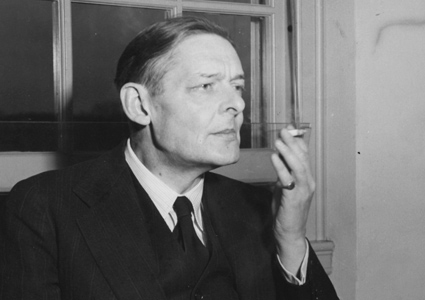
T.S. Eliot in 1950: “I have never succeeded in getting a first edition of one of my own books printed without some errors in it” (©Al Gretz/Keystone Features/Getty Images)
For my generation — that is, those born in the late Fifties and early Sixties — T. S. Eliot provided their first encounter with “difficult” poetry. Nursery anthologies largely made up of 19th-century narrative and nature poetry — Southey, Longfellow, the apparently easier bits of Tennyson and Browning and Keats and Wordsworth — had done little to prepare us for what lay in store. Of course, the poetry we had read as children was not really simple. But its difficulties were concealed, and as a child it was easy to fall into the error that you had understood a poem when in fact all you had done was to take from it some kind of prosaic paraphrase of its meaning. In fact “Childe Roland to the Dark Tower Came” is a much more truly difficult poem than, say, “Sordello”.
So we entered a completely different poetic universe when, on our first day in the sixth form, we came into class, opened the fresh copy of Eliot’s Collected Poems laid out on the desk, and read:
Let us go then, you and I,
When the evening is spread out against the sky
Like a patient etherised upon a table; . . .
Clearly, we had a lot to learn. We weren’t much helped by the Collected Poems. As well as printing in some respects an inaccurate or maimed text (of which more below), it contained no notes, apart from Eliot’s own Delphic notes to The Waste Land (one of the many facts I learned with gratitude from this edition was that Eliot himself in 1957 expressed a wish to “abolish” these notes). The more dutiful among us went off and read The Golden Bough (or at least the abridgement of that almost endless book) and Jessie Weston’s From Ritual to Romance. No doubt this was in a general way good for us. But on coming back to Eliot’s poems one felt no further forward. For the principal difficulty here was not one of explanatory context for the ideas behind the poems. It was rather, as we slowly realised, the difficulty posed by an unfamiliar poetic language and unfamiliar ideas about what a poem was and how it possessed meaning.
The various student guides to Eliot’s poetry that were passed between us like contraband were useless. The shortcomings of poor teachers were also pitilessly exposed. I remember a supply teacher trying to take us through the complexities of “The Love Song of J. Alfred Prufrock”, and pausing over the extended metaphor comparing the evening fog to a cat:
The yellow fog that rubs its back upon the window-panes,
The yellow smoke that rubs its muzzle on the window-panes,
Licked its tongue into the corners of the evening,
Lingered upon the pools that stand in drains,
Let fall upon its back the soot that falls from chimneys,
Slipped by the terrace, made a sudden leap,
And seeing that it was a soft October night,
Curled once about the house, and fell asleep.
“Now, what animal has a muzzle?” It was a few weeks into term, and we were already feeling a bit relaxed. “A horse, sir,” some wag suggested. “Right!” the desperate teacher exclaimed, clearly thinking that a broken straw was better to clutch at than no straw at all. “Fog equals horse!”
Or, perhaps, poetry equals fog. But even when Eliot’s poetry was a puzzle it was also a litmus test. It separated those who could recognise and respond to verbal beauty, even when its meaning was elusive, from those more utilitarian characters who were irritated by poetic difficulty rather than intrigued and drawn in by it, and who were deaf to Eliot’s strange and hypnotic music:
In his “Note of Introduction” to In Parenthesis (1961) Eliot observed that the condition in which I suspect most of my generation still find themselves — that is, the condition of loving Eliot’s poetry, having much of it by heart, and being saturated in its language and rhythms, but without claiming to have even remotely fathomed it — is in fact perfect preparation for this magnificent new edition of his poems:
Everyone who cares either about Eliot’s poetry in particular or about poetry in general will be surprised, delighted, and informed by what Christopher Ricks and Jim McCue have achieved in these volumes.
The first duty of an editor is to establish and print a correct text. Eliot himself was vigilant on this score. Consider, for example, his insistence — polite, but properly inflexible — about the title of The Waste Land. To Ezra Pound, he wrote in 1922: “Not ‘Waste Land’, please, but ‘The Waste Land’”. We find the same measured firmness courteously expressed in a letter to his Spanish translator, Angel Flores, six years later: “The title, by the way, is not ‘The Wasteland’ but ‘The Waste Land’.” As these quotations show, there are so many ways in which a text can become inaccurate, but only one way in which it can be faithful. Eliot occasionally sighed over the fecundity of textual error: “I have never succeeded in getting a first edition of one of my own books printed without some errors in it, and I sometimes find that when those are corrected new errors appear.”
Or, perhaps, poetry equals fog. But even when Eliot’s poetry was a puzzle it was also a litmus test. It separated those who could recognise and respond to verbal beauty, even when its meaning was elusive, from those more utilitarian characters who were irritated by poetic difficulty rather than intrigued and drawn in by it, and who were deaf to Eliot’s strange and hypnotic music:
The river sweats
Oil and tar
The barges drift
With the turning tide
Red sails
Wide
To leeward, swing on the heavy spar.
The barges wash
Drifting logs
Down Greenwich reach
Past the Isle of Dogs.
In his “Note of Introduction” to In Parenthesis (1961) Eliot observed that the condition in which I suspect most of my generation still find themselves — that is, the condition of loving Eliot’s poetry, having much of it by heart, and being saturated in its language and rhythms, but without claiming to have even remotely fathomed it — is in fact perfect preparation for this magnificent new edition of his poems:
Good commentaries can be very helpful but to study even the best commentary on a work of literary art is likely to be a waste of time unless we have first read and been excited by the text commented upon even without understanding it.
Everyone who cares either about Eliot’s poetry in particular or about poetry in general will be surprised, delighted, and informed by what Christopher Ricks and Jim McCue have achieved in these volumes.
The first duty of an editor is to establish and print a correct text. Eliot himself was vigilant on this score. Consider, for example, his insistence — polite, but properly inflexible — about the title of The Waste Land. To Ezra Pound, he wrote in 1922: “Not ‘Waste Land’, please, but ‘The Waste Land’”. We find the same measured firmness courteously expressed in a letter to his Spanish translator, Angel Flores, six years later: “The title, by the way, is not ‘The Wasteland’ but ‘The Waste Land’.” As these quotations show, there are so many ways in which a text can become inaccurate, but only one way in which it can be faithful. Eliot occasionally sighed over the fecundity of textual error: “I have never succeeded in getting a first edition of one of my own books printed without some errors in it, and I sometimes find that when those are corrected new errors appear.”
Sometimes poems were maimed by simple accident — for instance, the omission of the final line of part II of The Hollow Men, which persisted through many reprintings of the Collected Poems, but which in this edition is now restored, so that the section ends not with the puzzling and unpunctuated lines:
But rather with the (still difficult, but at least grammatical) three lines which return us to the opening line of the section:
At other times the poet himself might deface the text of his poem. We are all familiar with the evocation of lovelessness and listlessness from “A Game of Chess” in The Waste Land:
So it is startling to learn that Eliot deleted a parenthetic line at the request of his first wife, Vivien. The poem originally read, and now reads again in this edition:
To “make company” is a euphemism for coition. The ambiguity of the line (do the ivory men themselves make love, or do they encourage the players to do so?) may have pressed too hard on a neuralgic point in a marriage already frail.
Eliot said some fierce things about elucidatory notes, for instance telling the Master of Magdalene College, Cambridge in 1962 that “I will not allow any academic critic (and there are plenty of these in America only too willing) to provide notes of explanation to be published with any of my poems.” And he went on to explain the reason for this stance: “My objection . . . [is] that I should be allowing interpretation of the poem to be interposed between me and my readers . . . the commentator is providing information which stands between the reader and any immediate response . . . I want my readers to get their impressions from the words alone and from nothing else.” This stern warning has guided Ricks and McCue in their annotation, which is lavish in extent but austere in nature.
Not that final meeting
In the twilight kingdom
But rather with the (still difficult, but at least grammatical) three lines which return us to the opening line of the section:
Not that final meeting
In the twilight kingdom
With eyes I dare not meet in dreams.
At other times the poet himself might deface the text of his poem. We are all familiar with the evocation of lovelessness and listlessness from “A Game of Chess” in The Waste Land:
The hot water at ten.
And if it rains, a closed car at four.
And we shall play a game of chess,
Pressing lidless eyes and waiting for a knock upon the door.
So it is startling to learn that Eliot deleted a parenthetic line at the request of his first wife, Vivien. The poem originally read, and now reads again in this edition:
The hot water at ten.
And if it rains, a closed car at four.
And we shall play a game of chess,
(The ivory men make company between us)
Pressing lidless eyes and waiting for a knock upon the door.
To “make company” is a euphemism for coition. The ambiguity of the line (do the ivory men themselves make love, or do they encourage the players to do so?) may have pressed too hard on a neuralgic point in a marriage already frail.
Eliot said some fierce things about elucidatory notes, for instance telling the Master of Magdalene College, Cambridge in 1962 that “I will not allow any academic critic (and there are plenty of these in America only too willing) to provide notes of explanation to be published with any of my poems.” And he went on to explain the reason for this stance: “My objection . . . [is] that I should be allowing interpretation of the poem to be interposed between me and my readers . . . the commentator is providing information which stands between the reader and any immediate response . . . I want my readers to get their impressions from the words alone and from nothing else.” This stern warning has guided Ricks and McCue in their annotation, which is lavish in extent but austere in nature.
One of the most interesting points of principle in scholarly editing is the pitch and angle of annotation. To what should the editor append a note, what should the note contain, and — more importantly, perhaps — what should it not contain? If the point of editorial annotation is to serve, assist, and guide (but never to determine) the understanding of the reader, then any trace of interpretative tendentiousness in annotation will be a poisonous contamination. Editors must be able to step aside from the interpretations they personally favour when they are approaching the text as critics, and must supply relevant information with even-handed impartiality. Ricks and McCue put the matter well:
Inseparable from interpretation; but not therefore identical with it. The frontier between interpretation and annotation will always be policed by judgment and tact, never by theory (whatever the theoreticians may claim); and in this edition Ricks and McCue have shown exemplary tact and judgment times out of mind. The critic must be banished from the editorial workshop. But the critic’s passions and energy still inform, albeit mutely, the apparently dispassionate notations of the editor. Only a critic as engaged and passionate as Ricks could have written annotations as tense and chaste as these.
In a review of this length, one can do no more than point to particularly successful examples. It is difficult to imagine that anyone would not be impelled to useful thought by, for instance, the annotations to the lines “Smells of chestnuts in the streets/And female smells in shuttered rooms” from Rhapsody on a Windy Night. Similarly impressive is the lengthy but also compressed headnote to Hysteria, which assembles a series of Eliot’s thoughts about the relations between prose and poetry, and (a different but related subject) the prospects for and problems of prose poems. These thoughts culminate in 1942 with the rueful verdict that “this form of writing always seems to me a mistake. Years ago I did a little of the sort myself but was never able to persuade myself that the result was more than just a note for a poem to be written.” The earlier part of the note hints at just how extensive and repeated those attempts at self-persuasion were. In a lesser edition, we would have been given just the adverse final judgment. Ricks and McCue, by contrast, have displayed the development of Eliot’s thought concerning a whole realm of literature.
An effort has been made not to use the Commentary for critical elucidation. The frontiers are uncertain, but the principle has been to provide only notes which constitute or proceed from a point of information. Parallels with other writers will sometimes not only suggest a source but amount to an allusion. Conversely, it may not be a source but an analogue that brings back what was in the air. Notes of this kind try to put down only the parallels themselves (though in the awareness that annotation is inseparable from interpretation, selection and judgement), leaving the reader to decide what to make of what the poet may have made of this.
Inseparable from interpretation; but not therefore identical with it. The frontier between interpretation and annotation will always be policed by judgment and tact, never by theory (whatever the theoreticians may claim); and in this edition Ricks and McCue have shown exemplary tact and judgment times out of mind. The critic must be banished from the editorial workshop. But the critic’s passions and energy still inform, albeit mutely, the apparently dispassionate notations of the editor. Only a critic as engaged and passionate as Ricks could have written annotations as tense and chaste as these.
In a review of this length, one can do no more than point to particularly successful examples. It is difficult to imagine that anyone would not be impelled to useful thought by, for instance, the annotations to the lines “Smells of chestnuts in the streets/And female smells in shuttered rooms” from Rhapsody on a Windy Night. Similarly impressive is the lengthy but also compressed headnote to Hysteria, which assembles a series of Eliot’s thoughts about the relations between prose and poetry, and (a different but related subject) the prospects for and problems of prose poems. These thoughts culminate in 1942 with the rueful verdict that “this form of writing always seems to me a mistake. Years ago I did a little of the sort myself but was never able to persuade myself that the result was more than just a note for a poem to be written.” The earlier part of the note hints at just how extensive and repeated those attempts at self-persuasion were. In a lesser edition, we would have been given just the adverse final judgment. Ricks and McCue, by contrast, have displayed the development of Eliot’s thought concerning a whole realm of literature.
As a last example, consider the commentary to the opening lines of section II of Burnt Norton, lines over which in the sixth form we chewed many pencils and shed bitter tears:
How we would have been helped had we realised, in the first place, that when writing these lines Eliot was thinking of Mallarmé’s “Tonnerre et rubis aux moyeux”; but secondly, that these words formed a poetic image of a particular sort. Eliot had commented on just this point in one of his Turnbull lectures on metaphysical poetry, where he had quoted the relevant lines from Mallarmé in the course of mounting a larger argument about poetic metaphor: “It is a mistake to suppose that a simile or a metaphor is always something meant to be visible to the imagination; and even when it is meant to be visible, that all its parts are meant to be visible at once . . . The poet’s business is to know what effect he intends to produce, and then to get it by fair means or foul. There is the element of rationality, the element of precision, and there is also the element of vagueness which may be used; and we must remember that one distinction between poetry and prose is this, that in poetry the word, each word by itself, though only being fully itself in context, has absolute value. Poetry is incantation, as well as imagery. ‘Thunder and rubies’ cannot be seen, heard or thought together, but their collocation here brings out the connotation of each word.” Local explication widens into a larger reflection on poetry more generally. Examples of such generous, exactly-pitched, and stimulating annotation abound throughout this edition.
A scholarly edition must give us a correct text, and it must help us to understand that text for ourselves, rather than foisting an interpretation on us. Both accuracy and understanding are helped by the composition of a history of the text. In many editions the textual history is printed at the back in a smaller font, and is seldom read. And yet this section of a scholarly edition often contains some of the most thought-provoking material. Here scholars become detectives, and it is helpful when thinking about scholarly detective work to recall Eliot’s own discrimination of the English detective story from its American cousin in his essay on Wilkie Collins and Dickens: “The best English detective fiction has relied less on the beauty of the mathematical problem and much more on the intangible human element.” Scholarly detection, too, may turn on and reveal the “human element”.
In this edition an example occurs in relation to one of the typescripts of The Waste Land, “an amateurish fair copy typescript on foolscap . . . from the library of John Hayward” and now kept with the Hayward papers at King’s College, Cambridge. Much later Eliot endorsed the first leaf of this typescript and said that he had typed it. In fact, Ricks and McCue show that the typescript was made after the publication of The Waste Land, and it was copied from an unreliable source, the collection of Prize Poems from The Dial printed in 1930 by Albert Boni. But this raises a curious question: why would anyone type out an inaccurate text of the poem after it had been published?
Ricks’s and McCue’s solution to this riddle is ingenious, persuasive, and ultimately quite moving. They suggest that the typist was Vivien Eliot, and that the preparation of the typescript was part of the régime of care Eliot constructed around his fragile wife: “It appears, both from his interventions and from her descriptions of her own boredom and anxiety, that he was finding things to distract her when she was often not well enough to leave their flat. Asking her to type for him may have been another such activity.” The resulting manuscript thus has no textual authority. But it has a profound interest. Anyone who, following the vulgar error, believes that textual editing is a bloodless, dry-as-dust activity, and that the more technically accomplished it is, the more arid it becomes, should read and ponder these pages, where the application of meticulous scholarly art draws the curtain, however speculatively, on an intensely human scene of suffering and compassion. As with all great editions of poetry, these books will change your ideas of what poems are and of what they can do.
Garlic and sapphires in the mud
Clot the bedded axle-tree.
How we would have been helped had we realised, in the first place, that when writing these lines Eliot was thinking of Mallarmé’s “Tonnerre et rubis aux moyeux”; but secondly, that these words formed a poetic image of a particular sort. Eliot had commented on just this point in one of his Turnbull lectures on metaphysical poetry, where he had quoted the relevant lines from Mallarmé in the course of mounting a larger argument about poetic metaphor: “It is a mistake to suppose that a simile or a metaphor is always something meant to be visible to the imagination; and even when it is meant to be visible, that all its parts are meant to be visible at once . . . The poet’s business is to know what effect he intends to produce, and then to get it by fair means or foul. There is the element of rationality, the element of precision, and there is also the element of vagueness which may be used; and we must remember that one distinction between poetry and prose is this, that in poetry the word, each word by itself, though only being fully itself in context, has absolute value. Poetry is incantation, as well as imagery. ‘Thunder and rubies’ cannot be seen, heard or thought together, but their collocation here brings out the connotation of each word.” Local explication widens into a larger reflection on poetry more generally. Examples of such generous, exactly-pitched, and stimulating annotation abound throughout this edition.
A scholarly edition must give us a correct text, and it must help us to understand that text for ourselves, rather than foisting an interpretation on us. Both accuracy and understanding are helped by the composition of a history of the text. In many editions the textual history is printed at the back in a smaller font, and is seldom read. And yet this section of a scholarly edition often contains some of the most thought-provoking material. Here scholars become detectives, and it is helpful when thinking about scholarly detective work to recall Eliot’s own discrimination of the English detective story from its American cousin in his essay on Wilkie Collins and Dickens: “The best English detective fiction has relied less on the beauty of the mathematical problem and much more on the intangible human element.” Scholarly detection, too, may turn on and reveal the “human element”.
In this edition an example occurs in relation to one of the typescripts of The Waste Land, “an amateurish fair copy typescript on foolscap . . . from the library of John Hayward” and now kept with the Hayward papers at King’s College, Cambridge. Much later Eliot endorsed the first leaf of this typescript and said that he had typed it. In fact, Ricks and McCue show that the typescript was made after the publication of The Waste Land, and it was copied from an unreliable source, the collection of Prize Poems from The Dial printed in 1930 by Albert Boni. But this raises a curious question: why would anyone type out an inaccurate text of the poem after it had been published?
Ricks’s and McCue’s solution to this riddle is ingenious, persuasive, and ultimately quite moving. They suggest that the typist was Vivien Eliot, and that the preparation of the typescript was part of the régime of care Eliot constructed around his fragile wife: “It appears, both from his interventions and from her descriptions of her own boredom and anxiety, that he was finding things to distract her when she was often not well enough to leave their flat. Asking her to type for him may have been another such activity.” The resulting manuscript thus has no textual authority. But it has a profound interest. Anyone who, following the vulgar error, believes that textual editing is a bloodless, dry-as-dust activity, and that the more technically accomplished it is, the more arid it becomes, should read and ponder these pages, where the application of meticulous scholarly art draws the curtain, however speculatively, on an intensely human scene of suffering and compassion. As with all great editions of poetry, these books will change your ideas of what poems are and of what they can do.