On a crisp, sunlit morning in March, I ceased to feel at home in London. It dawned on me that the city where I had been born 58 years ago was no longer safe.
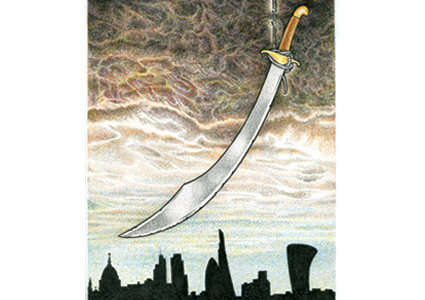
(Illustration by Michael Daley)
I was walking past two men at a stall outside my local Underground station. Their beards and dress revealed them as Salafists; they were proselytising for their fundamentalist form of Islam. My face must have betrayed my anxiety, because they started pointing and talking while I entered the station. As I looked round, both men were grinning at me.
Why did I find their presence disquieting? A couple of hours earlier in Brussels, three suicide bombers had detonated nail bombs in the airport and on the Metro, killing 32 passengers outright and inflicting horrific wounds on another 312 people, of whom 62 were critically injured — all in the name of the Islamic State. It was hard to believe that the two jovial gentlemen outside the station could have been unaware of what had just taken place less than 200 miles away. That was presumably why they were there.
As I descended into the Tube, my thoughts went back to a similar morning, July 7, 2005, when four suicide bombers struck the London transport system. I was going to work on one of the Tube lines that was attacked, having just delivered my two youngest children to their school. Like thousands of others, I was lucky to be on a different train and to have escaped injury, but 52 died and 700 were maimed in the name of al-Qaeda. At the time, Londoners assumed that this terrorist threat would eventually pass, just as the IRA threat with which we had grown up had passed. Though Madrid had already been attacked, killing 192 and injuring more than 2,000, nothing on the scale of the 9/11 attacks on New York and Washington had then seemed likely. But over the past decade the threat has grown steadily worse. Above all, last year there had been the attacks on Paris, since which the French capital had yet to return to normality. After Paris and Brussels, I looked back on the horror of London 11 years ago with a sickening feeling of dread. Was there any reason to suppose that such attacks would not be repeated, now that jihadis loyal to IS had multiplied across Europe and notably in London? We now know that Mohamed Abrini, the “man in the hat” bomber who survived the Brussels airport attacks, was not only also involved in the Paris massacre, but visited Britain last July and allegedly met more than a dozen Islamists here. At the time of writing, five Britons have been arrested.
As if on cue, on the day after the Brussels bombs, two West London students were convicted of plotting a “drive-by” attack on the police station that I had passed every day on my journey to school or work for the past 21 years. A gun and silencer had been supplied by two others, plans had been made to shoot police and army recruits, links with IS had emerged in court. The ringleader, a medic called Tarik Hassane, had attended the same West London mosque as Mohammed Emwazi, known as “Jihadi John”, the notorious IS executioner. His fellow jihadi, King’s College physicist Suhaib Majeed, had invited a notorious extremist preacher to address the Islamic Society there in March 2014. Uthman Lateef urged students at King’s to go to Syria. At least 800 have fought for jihadist groups, including IS, and hundreds of these — including about 100 “high-risk” terrorists — have returned to London to join about 2,000 IS supporters who have been prevented from going to Syria, plus thousands of other extremists monitored by police and MI5.
(Illustration by Michael Daley)
I was walking past two men at a stall outside my local Underground station. Their beards and dress revealed them as Salafists; they were proselytising for their fundamentalist form of Islam. My face must have betrayed my anxiety, because they started pointing and talking while I entered the station. As I looked round, both men were grinning at me.
Why did I find their presence disquieting? A couple of hours earlier in Brussels, three suicide bombers had detonated nail bombs in the airport and on the Metro, killing 32 passengers outright and inflicting horrific wounds on another 312 people, of whom 62 were critically injured — all in the name of the Islamic State. It was hard to believe that the two jovial gentlemen outside the station could have been unaware of what had just taken place less than 200 miles away. That was presumably why they were there.
As I descended into the Tube, my thoughts went back to a similar morning, July 7, 2005, when four suicide bombers struck the London transport system. I was going to work on one of the Tube lines that was attacked, having just delivered my two youngest children to their school. Like thousands of others, I was lucky to be on a different train and to have escaped injury, but 52 died and 700 were maimed in the name of al-Qaeda. At the time, Londoners assumed that this terrorist threat would eventually pass, just as the IRA threat with which we had grown up had passed. Though Madrid had already been attacked, killing 192 and injuring more than 2,000, nothing on the scale of the 9/11 attacks on New York and Washington had then seemed likely. But over the past decade the threat has grown steadily worse. Above all, last year there had been the attacks on Paris, since which the French capital had yet to return to normality. After Paris and Brussels, I looked back on the horror of London 11 years ago with a sickening feeling of dread. Was there any reason to suppose that such attacks would not be repeated, now that jihadis loyal to IS had multiplied across Europe and notably in London? We now know that Mohamed Abrini, the “man in the hat” bomber who survived the Brussels airport attacks, was not only also involved in the Paris massacre, but visited Britain last July and allegedly met more than a dozen Islamists here. At the time of writing, five Britons have been arrested.
As if on cue, on the day after the Brussels bombs, two West London students were convicted of plotting a “drive-by” attack on the police station that I had passed every day on my journey to school or work for the past 21 years. A gun and silencer had been supplied by two others, plans had been made to shoot police and army recruits, links with IS had emerged in court. The ringleader, a medic called Tarik Hassane, had attended the same West London mosque as Mohammed Emwazi, known as “Jihadi John”, the notorious IS executioner. His fellow jihadi, King’s College physicist Suhaib Majeed, had invited a notorious extremist preacher to address the Islamic Society there in March 2014. Uthman Lateef urged students at King’s to go to Syria. At least 800 have fought for jihadist groups, including IS, and hundreds of these — including about 100 “high-risk” terrorists — have returned to London to join about 2,000 IS supporters who have been prevented from going to Syria, plus thousands of other extremists monitored by police and MI5.
That day, I again saw Salafists outside the Tube station. This time they thrust a pamphlet into my hand. It was headed: “A warning against terror groups ISIS & al-Qaedah [sic] and the correct Islamic position regarding them!” My daughter chided me for my suspicions about our proselytising Islamists. The pamphlet came larded with quotations from the Koran and the Prophet Muhammad and his Companions, as well as Islamic scholars, past and present, including the Grand Mufti of Saudi Arabia (the same one who had just condemned chess as un-Islamic). It claimed that modern movements such as the Muslim Brotherhood, al-Qaeda and IS were all ideological descendants of the Kharijite sect, whom the Prophet himself had threatened to exterminate. The Salafists alone, it went on, had spoken out against these extremists.
This is, of course, propaganda. In reality, IS, al-Qaeda and the Muslim Brotherhood are Sunnis, not Kharijites. The premise of the polemic is false, like much else in this pamphlet. For example, it also claims that “severing the heads of the enemy in war is not a practice condoned by Islam and was not a practice of the Prophet or his companions”. Yet Muhammad’s first biographer, Ibn Ishaq, describes in detail how the Prophet himself personally beheaded between 600 and 900 Jewish prisoners of the Banu Qurayza tribe in 627. The denial of such facts is not only a problem for Islam.
Salafists — who dominate many of the mosques in London and elsewhere in Britain — differ from IS about means rather than ends. They wish to live under sharia law in Britain, they define jihad as “a just conventional war to prevent or repel oppression”, and their ultimate goal is the restoration of the caliphate — though they reject “the imposter caliph” Abu Bakr al-Baghdadi. The pamphlet indicated that this Salafist group had a mosque less than a mile from where I live, of which I was quite unaware. Are the authorities aware of it? They are struggling to keep pace with the number of mosques, which is rising just as rapidly as mainstream churches are closing.
Indeed, what has emerged before our eyes in Britain is a kind of Islamist state within a state. Alongside the Salafist movement, which originates in the Middle East, the Deobandi tradition, which predominates among Muslims of Pakistani, Bangladeshi and Kashmiri background, also has links to the Taliban. A new survey by ICM with the former head of the Equality and Human Rights Commission, Trevor Phillips, for Channel Four and the Sunday Times confirms that Salafists are fast becoming the dominant influence on British Islam. Nearly a quarter (23 per cent) of a sample of 1,081 adult Muslims want to see “areas of Britain in which sharia law is introduced instead of British law”. Nearly a third (31 per cent) of them think “it is acceptable for a British Muslim to keep more than one wife”, even though polygamy is in theory punishable by up to five years imprisonment. Wives should “always obey their husbands”, according to 39 per cent; the survey did not ask about the Koran’s injunction to husbands to “chastise” their wives, but Trevor Phillips sees it as “a clear invitation to legitimise domestic violence”. About 5 per cent of British Muslims sympathise with stoning adulterers. That may seem a small percentage, but only 66 per cent completely condemn such executions. This suggests that about a third would go along with such punishments under certain circumstances.
This is, of course, propaganda. In reality, IS, al-Qaeda and the Muslim Brotherhood are Sunnis, not Kharijites. The premise of the polemic is false, like much else in this pamphlet. For example, it also claims that “severing the heads of the enemy in war is not a practice condoned by Islam and was not a practice of the Prophet or his companions”. Yet Muhammad’s first biographer, Ibn Ishaq, describes in detail how the Prophet himself personally beheaded between 600 and 900 Jewish prisoners of the Banu Qurayza tribe in 627. The denial of such facts is not only a problem for Islam.
Salafists — who dominate many of the mosques in London and elsewhere in Britain — differ from IS about means rather than ends. They wish to live under sharia law in Britain, they define jihad as “a just conventional war to prevent or repel oppression”, and their ultimate goal is the restoration of the caliphate — though they reject “the imposter caliph” Abu Bakr al-Baghdadi. The pamphlet indicated that this Salafist group had a mosque less than a mile from where I live, of which I was quite unaware. Are the authorities aware of it? They are struggling to keep pace with the number of mosques, which is rising just as rapidly as mainstream churches are closing.
Indeed, what has emerged before our eyes in Britain is a kind of Islamist state within a state. Alongside the Salafist movement, which originates in the Middle East, the Deobandi tradition, which predominates among Muslims of Pakistani, Bangladeshi and Kashmiri background, also has links to the Taliban. A new survey by ICM with the former head of the Equality and Human Rights Commission, Trevor Phillips, for Channel Four and the Sunday Times confirms that Salafists are fast becoming the dominant influence on British Islam. Nearly a quarter (23 per cent) of a sample of 1,081 adult Muslims want to see “areas of Britain in which sharia law is introduced instead of British law”. Nearly a third (31 per cent) of them think “it is acceptable for a British Muslim to keep more than one wife”, even though polygamy is in theory punishable by up to five years imprisonment. Wives should “always obey their husbands”, according to 39 per cent; the survey did not ask about the Koran’s injunction to husbands to “chastise” their wives, but Trevor Phillips sees it as “a clear invitation to legitimise domestic violence”. About 5 per cent of British Muslims sympathise with stoning adulterers. That may seem a small percentage, but only 66 per cent completely condemn such executions. This suggests that about a third would go along with such punishments under certain circumstances.
The most striking of all the ICM statistics concern homosexuality. Only 18 per cent of Muslims think it should be legal in Britain, while more than half (52 per cent) would ban it. Up to half of the latter group, it is fair to assume, also support sharia law, which prescribes the death penalty for homosexuality. If most British Muslims hold such hostile attitudes towards same-sex attraction, it is not surprising that — to take one example — a recent gay participant on the TV reality show First Dates explained how he had been beaten up by other Muslims so badly that he was in hospital for months. This brave young man explained that he no longer considered himself Muslim — making his public appearance doubly risky as he could now also be targeted as an apostate.
I have always had great admiration for those British Muslims who reject Salafist or Deobandi ideology and the bigotry that comes with them. I was deeply impressed by the late Zaki Badawi, the founder of Muslim College and for many years the leading spokesman for Islam in Britain. He had a vision of a tolerant, open community and wanted Muslims to become as integrated as Jews or Catholics. Like many other Londoners, I have Muslim friends and neighbours who have embraced Western values. Often, they have married non-Muslims. But that makes them untypical: fewer than 10 per cent of Muslims live in mixed relationships and just 3 per cent of Muslim children grow up in mixed households. While more than half of Muslims do mix with non-Muslims at work or in college, friendships do not always result: a fifth of them never enter a non-Muslim home. Many have hostile attitudes to non-Muslims. A Pew survey in 2006, for example, found that 47 per cent of British Muslims held unfavourable views of Jews; unfortunately, the ICM poll shows that up to 44 per cent are still anti-Semitic.
There are, of course, plenty of well-integrated Muslims who are repelled by anti-Semitism and other forms of bigotry. In my own neighbourhood, my dry cleaner, who is an Afghan Muslim, wished me “Happy Easter” and there are countless others like him who reach out to their non-Muslim customers. We have, too, popular role models, such as the athlete Mo Farah and the headscarf-wearing TV cook Nadiya Hussain, who positively embrace their British identity. The ICM poll shows that eight out of 10 Muslims here do feel British. But with mass immigration from more illiberal Muslim cultures, higher birthrates in more segregated communities and a growing number of non-Muslims who are converted to Salafism, liberal Muslims are a shrinking minority.
Segregation and intolerance are by-products of the disastrous policy of multiculturalism (or cultural relativism), which for many years was championed by, among others, Trevor Phillips. When the then Anglican Bishop of Rochester, Michael Nazir-Ali, criticised multiculturalism a decade ago, warning that we were creating “no-go areas” in our cities, he was denounced by Labour ministers and Muslim leaders. The effects of that policy are, as Bishop Nazir-Ali now says, “irreversible”. Phillips does at least admit that he got it wrong as chairman of the Equalities Commission in the l990s, when he saw Islamophobia as the biggest problem facing Muslims. A far greater danger is presented by the voluntary segregation of the Muslim community, which has facilitated its radicalisation.
I have always had great admiration for those British Muslims who reject Salafist or Deobandi ideology and the bigotry that comes with them. I was deeply impressed by the late Zaki Badawi, the founder of Muslim College and for many years the leading spokesman for Islam in Britain. He had a vision of a tolerant, open community and wanted Muslims to become as integrated as Jews or Catholics. Like many other Londoners, I have Muslim friends and neighbours who have embraced Western values. Often, they have married non-Muslims. But that makes them untypical: fewer than 10 per cent of Muslims live in mixed relationships and just 3 per cent of Muslim children grow up in mixed households. While more than half of Muslims do mix with non-Muslims at work or in college, friendships do not always result: a fifth of them never enter a non-Muslim home. Many have hostile attitudes to non-Muslims. A Pew survey in 2006, for example, found that 47 per cent of British Muslims held unfavourable views of Jews; unfortunately, the ICM poll shows that up to 44 per cent are still anti-Semitic.
There are, of course, plenty of well-integrated Muslims who are repelled by anti-Semitism and other forms of bigotry. In my own neighbourhood, my dry cleaner, who is an Afghan Muslim, wished me “Happy Easter” and there are countless others like him who reach out to their non-Muslim customers. We have, too, popular role models, such as the athlete Mo Farah and the headscarf-wearing TV cook Nadiya Hussain, who positively embrace their British identity. The ICM poll shows that eight out of 10 Muslims here do feel British. But with mass immigration from more illiberal Muslim cultures, higher birthrates in more segregated communities and a growing number of non-Muslims who are converted to Salafism, liberal Muslims are a shrinking minority.
Segregation and intolerance are by-products of the disastrous policy of multiculturalism (or cultural relativism), which for many years was championed by, among others, Trevor Phillips. When the then Anglican Bishop of Rochester, Michael Nazir-Ali, criticised multiculturalism a decade ago, warning that we were creating “no-go areas” in our cities, he was denounced by Labour ministers and Muslim leaders. The effects of that policy are, as Bishop Nazir-Ali now says, “irreversible”. Phillips does at least admit that he got it wrong as chairman of the Equalities Commission in the l990s, when he saw Islamophobia as the biggest problem facing Muslims. A far greater danger is presented by the voluntary segregation of the Muslim community, which has facilitated its radicalisation.
Instead of the cultural relativism he promoted while in office, Phillips now advocates “muscular integration”. As examples of this, he suggests regulating sharia courts and obliging them to sit in public; preventing Islamic control of school governing bodies, as in the Birmingham “Trojan Horse” scandal; exposing “silence-for-votes” deals between local politicians and Muslim leaders, as in Rotherham and Rochdale; and stopping the Salafist takeover of mosques, funded by Saudi Arabia and the Gulf states.
Such moves would indeed be welcome, but they do not go far enough. What is missing is a deeper understanding of the threat posed by radical Islam to the values that underpin British society. In an important new book, Faith, Freedom and the Future (Wilberforce, £12.99), Michael Nazir-Ali draws on his articles in Standpoint since 2008 to explain how “radical Islamism cannot be effectively opposed without reaffirming the Christian foundations and values of this nation which gave us Magna Carta and the liberties that flowed from it”. Bishop Nazir-Ali, himself born in Pakistan, knows Islam, its theology and its politics extremely well. He asks: “Does the logic of Islam lead ineluctably to Islamism with closed, regressive and monolithic societies as the radicals desire, or can it also lead to open, free and plural societies?” This has become an urgent question, not only for Muslim countries, where minorities struggle to survive, but also for Western ones which, like Britain, are now confronted by the rise of political Islam in their midst. Will we allow our cities to become miniature Islamic states?
Here in London, which is home to about a third of British Muslims (including thousands of migrants who live below the radar of the authorities), we have already seen the assertion of power by political Islam. The takeover of Tower Hamlets by a corrupt Islamist politician, Lutfur Rahman, may be a harbinger of things to come. Last year he was removed from office by special commissioners, but for five years Rahman and his cronies ran a borough of nearly 300,000 people, distributing a budget of more than £1 billion. It is worth noting that after being ousted from the Labour Party, he was able to replace it with a notionally “independent” but in practice sectarian group, even though Muslims officially make up only a third of the population. The Muslim “block vote” is such a formidable electoral force that for Islamists to dominate a city it does not need to have a Muslim majority.
The greatest prize, of course, is London itself. By the time you read this, the capital may already have elected the first Muslim Mayor of London: Sadiq Khan. At the time of writing, polls predict that Khan, who is also Labour MP for Tooting, will win by a larger majority than either of his predecessors, Ken Livingstone and Boris Johnson.
Khan has worked hard at projecting a moderate image as a modern, liberal Muslim with no sectarian baggage. He no longer protests, as he did in 2004, that Sheikh Yusuf al-Qaradawi perhaps the most influential preacher in the whole Islamic world — is “not an extremist”. (The Sheikh says that Hitler “put Jews in their place”.) He has carefully distanced himself from Babar Ahmad, who was later convicted of terrorist offences, and other extremists with whom he was once associated. But he knows very well how important the Muslim vote is for Labour. At least ten London boroughs have large, mainly conservative Muslim communities, where children grow up in an Islamic monoculture and women are covered or veiled. Khan is not likely to challenge the self-appointed leaders of these communities. At all costs, he must maintain Labour’s near-monopoly of Muslim politics and prevent the emergence of an explicitly Islamist party.
Such moves would indeed be welcome, but they do not go far enough. What is missing is a deeper understanding of the threat posed by radical Islam to the values that underpin British society. In an important new book, Faith, Freedom and the Future (Wilberforce, £12.99), Michael Nazir-Ali draws on his articles in Standpoint since 2008 to explain how “radical Islamism cannot be effectively opposed without reaffirming the Christian foundations and values of this nation which gave us Magna Carta and the liberties that flowed from it”. Bishop Nazir-Ali, himself born in Pakistan, knows Islam, its theology and its politics extremely well. He asks: “Does the logic of Islam lead ineluctably to Islamism with closed, regressive and monolithic societies as the radicals desire, or can it also lead to open, free and plural societies?” This has become an urgent question, not only for Muslim countries, where minorities struggle to survive, but also for Western ones which, like Britain, are now confronted by the rise of political Islam in their midst. Will we allow our cities to become miniature Islamic states?
Here in London, which is home to about a third of British Muslims (including thousands of migrants who live below the radar of the authorities), we have already seen the assertion of power by political Islam. The takeover of Tower Hamlets by a corrupt Islamist politician, Lutfur Rahman, may be a harbinger of things to come. Last year he was removed from office by special commissioners, but for five years Rahman and his cronies ran a borough of nearly 300,000 people, distributing a budget of more than £1 billion. It is worth noting that after being ousted from the Labour Party, he was able to replace it with a notionally “independent” but in practice sectarian group, even though Muslims officially make up only a third of the population. The Muslim “block vote” is such a formidable electoral force that for Islamists to dominate a city it does not need to have a Muslim majority.
The greatest prize, of course, is London itself. By the time you read this, the capital may already have elected the first Muslim Mayor of London: Sadiq Khan. At the time of writing, polls predict that Khan, who is also Labour MP for Tooting, will win by a larger majority than either of his predecessors, Ken Livingstone and Boris Johnson.
Khan has worked hard at projecting a moderate image as a modern, liberal Muslim with no sectarian baggage. He no longer protests, as he did in 2004, that Sheikh Yusuf al-Qaradawi perhaps the most influential preacher in the whole Islamic world — is “not an extremist”. (The Sheikh says that Hitler “put Jews in their place”.) He has carefully distanced himself from Babar Ahmad, who was later convicted of terrorist offences, and other extremists with whom he was once associated. But he knows very well how important the Muslim vote is for Labour. At least ten London boroughs have large, mainly conservative Muslim communities, where children grow up in an Islamic monoculture and women are covered or veiled. Khan is not likely to challenge the self-appointed leaders of these communities. At all costs, he must maintain Labour’s near-monopoly of Muslim politics and prevent the emergence of an explicitly Islamist party.
We now know that in the past Sadiq Khan, who as a left-wing human rights solicitor represented Muslim extremists, was happy to make compromises with the Salafist attitudes that prevail in many London mosques. In 2004, he supported incorporating sharia law into the British legal system: “There are some . . . uncontroversial areas of Islamic law which could easily be applied to the legal system . . . in the UK.” What Khan had in mind by “uncontroversial” was the legitimisation of polygamy, by altering inheritance tax law to allow husbands to divide their estates between several wives while enjoying the tax exemption normally applicable to a single spouse. He called this “applying common sense”, but it was yet another step towards de facto recognition of polygamy by the law. Muslims have long been claiming welfare benefits for multiple wives; the only condition is that they must have married them abroad.
In 2007, Khan questioned the need for the criminal law to be used to stop forced marriages, claiming that such “ghetto” legislation would stereotype Muslims. Of course, he glossed over the fact that forced marriage was almost exclusively a Muslim problem in Britain. It is hard to avoid the conclusion that Khan is a typical left-wing cultural relativist — and they are a big part of London’s problem. Despite having made his career as a human rights lawyer, Khan has never challenged the conspiracy of silence about certain offences — such as forced marriage and abduction, female gentile mutilation and “honour crimes” — that are committed mainly by Salafist and other fundamentalist Muslims on a huge scale, yet are rarely or never prosecuted in Britain. Nor did he expose grooming by Muslim gangs.
Under Mayor Khan, London will undoubtedly deserve more than ever the ironical nickname it earned a decade ago among European intelligence services: “Londonistan”. It is hard to imagine Khan taking the tough measures to root out Isis cells hidden inside Muslim ghettos that have been forced on French and Belgian police forces since the attacks on Paris and Brussels. Even in the aftermath of a similar attack on London, it is inconceivable that Khan would risk the accusation that he had turned his back on his Muslim heritage. His opinions change according to need; his allegiance doesn’t.
In policing, Khan is far more likely to attach weight to the “sensitivities” of Muslim community leaders than to put pressure on those communities to eradicate radicalisation. According to ICM, only a third of Muslims say they would inform police if they thought someone was involved with terrorist groups in Syria. The Metropolitan Police have searched London mosques on very few occasions. They would be more proactive if they felt that the mayor would back them in upholding the law. Fear of causing offence explains the failure to protect minorities who are unpopular with the Sunni majority. After an Ahmadi newsagent was killed in Glasgow in March, it emerged that a Pakistani group urging Muslims to murder members of the Ahmadiyya sect has close links with a Deobandi mosque at Stockwell in South London where their leaflets were found, though a mosque trustee denied any knowledge of such links. The same concerns apply to London’s 40-odd universities. It is rare for police to intervene to preserve free speech on campus, or for a university to clamp down on intimidation by an Islamic society. Yet terrorists and IS recruits include a high proportion of students and graduates, including doctors and engineers. I cannot imagine Mayor Khan standing up to such powerful lobbies as London’s universities and mosques, even after a major attack.
In 2007, Khan questioned the need for the criminal law to be used to stop forced marriages, claiming that such “ghetto” legislation would stereotype Muslims. Of course, he glossed over the fact that forced marriage was almost exclusively a Muslim problem in Britain. It is hard to avoid the conclusion that Khan is a typical left-wing cultural relativist — and they are a big part of London’s problem. Despite having made his career as a human rights lawyer, Khan has never challenged the conspiracy of silence about certain offences — such as forced marriage and abduction, female gentile mutilation and “honour crimes” — that are committed mainly by Salafist and other fundamentalist Muslims on a huge scale, yet are rarely or never prosecuted in Britain. Nor did he expose grooming by Muslim gangs.
Under Mayor Khan, London will undoubtedly deserve more than ever the ironical nickname it earned a decade ago among European intelligence services: “Londonistan”. It is hard to imagine Khan taking the tough measures to root out Isis cells hidden inside Muslim ghettos that have been forced on French and Belgian police forces since the attacks on Paris and Brussels. Even in the aftermath of a similar attack on London, it is inconceivable that Khan would risk the accusation that he had turned his back on his Muslim heritage. His opinions change according to need; his allegiance doesn’t.
In policing, Khan is far more likely to attach weight to the “sensitivities” of Muslim community leaders than to put pressure on those communities to eradicate radicalisation. According to ICM, only a third of Muslims say they would inform police if they thought someone was involved with terrorist groups in Syria. The Metropolitan Police have searched London mosques on very few occasions. They would be more proactive if they felt that the mayor would back them in upholding the law. Fear of causing offence explains the failure to protect minorities who are unpopular with the Sunni majority. After an Ahmadi newsagent was killed in Glasgow in March, it emerged that a Pakistani group urging Muslims to murder members of the Ahmadiyya sect has close links with a Deobandi mosque at Stockwell in South London where their leaflets were found, though a mosque trustee denied any knowledge of such links. The same concerns apply to London’s 40-odd universities. It is rare for police to intervene to preserve free speech on campus, or for a university to clamp down on intimidation by an Islamic society. Yet terrorists and IS recruits include a high proportion of students and graduates, including doctors and engineers. I cannot imagine Mayor Khan standing up to such powerful lobbies as London’s universities and mosques, even after a major attack.
And yet, regardless of the illiberal views he has held or condoned and the vicious company he has kept, London seems bent on electing Khan as its first Muslim Mayor. The symbolism of his election will be understood differently around the world; but for me, as a Londoner who is proud to live here, there is a sense of impending doom. London has a claim to be the greatest city on earth, because we have given the world the cosmopolitan Western values by which London has always lived. But as the ICM survey shows, a substantial proportion of the Muslim community rejects those values.
Increasingly, British Islam will now redefine London, rather than London redefining British Islam. I shall be astonished if Mayor Khan is strong enough to resist Salafist pressure to transform London into a city as segregated as Paris, Brussels — or Birmingham. One reason why Paris and Brussels have already succumbed to such terrible attacks is that the sheer weight of numbers makes it impossible for the authorities to know what is going on inside Muslim communities. After decades of denial, French demographers now agree that about 25 per cent of school-age children are Muslim. So France faces a cultural and political revolution within a generation. Paris, including its suburbs, is a microcosm of this new France. London, which is home to more than a million Muslims, is heading in the same direction.
Not all European cities are going quietly. In some, liberal Muslims are resisting the relentless radicalisation by the Salafists. The Moroccan-born mayor of Rotterdam, where up to a quarter of the population is Muslim, had a blunt message for Islamists who reject freedom. “If you don’t like freedom, pack your bags and leave,” Ahmed Aboutaleb told them last year after the Charlie Hebdo massacre. If Dutch Muslims didn’t like newspapers or magazines that satirised Islam, he added, they could “just fuck off”.
It would be nice to think that Mayor Khan might send a similarly clear signal to Muslims who reject the spirit of liberty that has always characterised London. But wishful thinking is what has landed us in our present predicament. Unless we — and that includes liberal Muslim Londoners — can face up to and fight what is happening in Islam, here and abroad, I fear for the future of London. Above all I fear that I, and millions like me, may have no place in that future.
Increasingly, British Islam will now redefine London, rather than London redefining British Islam. I shall be astonished if Mayor Khan is strong enough to resist Salafist pressure to transform London into a city as segregated as Paris, Brussels — or Birmingham. One reason why Paris and Brussels have already succumbed to such terrible attacks is that the sheer weight of numbers makes it impossible for the authorities to know what is going on inside Muslim communities. After decades of denial, French demographers now agree that about 25 per cent of school-age children are Muslim. So France faces a cultural and political revolution within a generation. Paris, including its suburbs, is a microcosm of this new France. London, which is home to more than a million Muslims, is heading in the same direction.
Not all European cities are going quietly. In some, liberal Muslims are resisting the relentless radicalisation by the Salafists. The Moroccan-born mayor of Rotterdam, where up to a quarter of the population is Muslim, had a blunt message for Islamists who reject freedom. “If you don’t like freedom, pack your bags and leave,” Ahmed Aboutaleb told them last year after the Charlie Hebdo massacre. If Dutch Muslims didn’t like newspapers or magazines that satirised Islam, he added, they could “just fuck off”.
It would be nice to think that Mayor Khan might send a similarly clear signal to Muslims who reject the spirit of liberty that has always characterised London. But wishful thinking is what has landed us in our present predicament. Unless we — and that includes liberal Muslim Londoners — can face up to and fight what is happening in Islam, here and abroad, I fear for the future of London. Above all I fear that I, and millions like me, may have no place in that future.