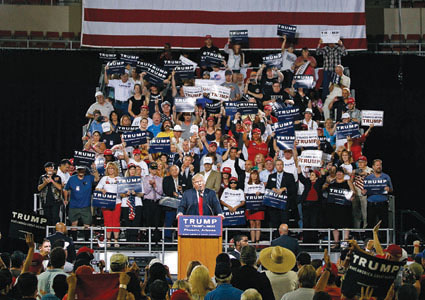
 Performative populism: Donald Trump addresses supporters at a campaign rally in June (©Ralph Freso/Getty Images)
Western civilisation is threatened by an unprecedented array of external adversaries and dangers, ranging from Islamist terror and Russian or Chinese aggression to the fall-out from failed states. It also faces internal threats — above all the collapse of confidence in Judaeo-Christian values and democratic capitalism. What solutions do liberals and conservatives have to offer in answer to this predicament? Can either the Left or the Right rise to the challenge of the present crisis? Or are both political traditions mired in self-destructive mind-sets that prevent them from grasping the scale of the task, let alone reversing the decline of the West? I shall sketch a diagnosis and propose a cure for these pathologies of Left and Right, but I can only hazard a guess as to whether our political class is ready to take its medicine in time to save the day. The future of Western civilisation will depend on how well the present can mobilise the intellectual resources of the past.
I want to begin with the Right, because the crisis of conservatism on both sides of the Atlantic seems too deep to be explained by the vagaries of individual personalities or parties. The example that most obviously illustrates this comes from America, where the fiasco of the Republican nomination process is fresh in our minds. How could one of the oldest political parties in the world, drawing on the vast pool of talent provided by a great nation of more than 300 million souls, end up with Donald Trump? I will suggest three reasons, which I have discussed at greater length in an article in the April issue of Standpoint.
First, the revolt of the masses, a phenomenon first analysed by Ortega y Gasset in 1930, made it possible for a demagogue to appeal over the heads of the elites to the most plebeian and philistine instincts, the lowest moral denominators. On the American Right, we see the mastery of mediocrity, the apotheosis of the average, the triumph of Trumpery — a word that ever since Shakespeare has denoted something showy but worthless, empty or ridiculous talk, and deception.
Second, the backlash against political correctness — a pathology that has spread from the universities via the social media to permeate every nook and cranny of society — has found its champion in Donald Trump. He is certainly not the sophisticated critic of illiberal liberalism that conservatives should wish for; indeed, he is quite illiberal himself. But he has captured the field by shooting from the hip, indiscriminately targeting feminists, Hispanics, Muslims and just about anybody else who gets in his way. Indeed, Trump may even have given political correctness a new lease of life by reminding people why it originally emerged.
Third, Trump may appeal to the masses by denouncing the liberal elites who have failed America, but he belongs to those elites in a particular way: he is the embodiment of that “culture of narcissism” diagnosed by Christopher Lasch in the 1970s, when Trump’s mindset was formed. In an America where narcissists flourish, a reality TV host is a plausible president. The French Revolution ended by crowning a war hero as emperor. The American mutiny may end by inaugurating a paranoid, narcissistic megalomaniac as commander-in-chief.
The strange case of Donald Trump illustrates the neglect of conservative thought. Such a thing has never entered his head. From Edmund Burke to William Buckley, from Samuel Johnson to Paul Johnson, from Irving Kristol to Bill Kristol, the confluence of dispositions and ideas we call conservatism has cumulatively inundated the politics of the English-speaking peoples, leaving traces and sediments in the theory and practice of almost every leading statesman. Yet the mind of Donald Trump is, as far as anybody can ascertain, an idea-free zone. He has a slogan — “America First” — but it is a tainted one. Either he is unaware of Charles Lindbergh’s vile, anti-Semitic campaign under that banner to stop the United States fighting Nazi Germany, in which case his ignorance of history is shocking, or he does not care, which is actually sinister. The Trump campaign has cooked up the most unpalatably putrid stew of nativism, protectionism and paleoconservatism, served up as a patriotic dish for the populace, since Huey Long tried to use Louisiana as a springboard for the White House in 1935. His public works projects such as the Mexican wall are an echo, perhaps a conscious one, of Roosevelt’s New Deal — but Trump’s New Deal would, for all his vaunted skill in constructing towers, be built on sand: a ballooning debt that would be a bad investment for future generations. His would clearly be an activist, interventionist administration — except in foreign policy, where he advocates a crude form of Realpolitik, the opposite of the Bush doctrine of defending freedom and democracy. He despises Nato members and America’s far-Eastern allies as parasites. Instead, he promises “deals” with the least enlightened of despots. He has an unhealthy admiration for Putin and Xi Jinping, unaware of the usually disastrous denouement of dalliances between democracies and dictators. On the Middle East, he veers between professions of loyalty to the Jewish people and ominous intimations that he will force Israel to submit to one of his “deals” with the Palestinians. Nothing he has said on the subject suggests that he has the faintest notion of the complexities of the region. The best that can be hoped for is that he will make good on his promise to crush IS, but his pathological aversion to intervention rules that out. Despite having consulted Henry Kissinger, he is anything but a “realist”: he simply wants the rest of the world to leave America alone. It won’t.
Republicans rarely win without a unifying candidate, but even the most extreme cult of the personality cannot resurrect a defunct ideology from the graveyard of history. Both living Republican presidents, Bush pére et fils, have declined to endorse Trump. House Speaker Paul Ryan commented: “We hope that our nominee aspires to be Lincoln- and Reaganesque.” Not only does Trump fall dismally short of that standard of statesmanship — he does not obviously belong in the same party as the best Republican presidents. But instead of rising to Ryan’s challenge, he has allowed his supporters to blackmail the Speaker. Trump’s promise to exclude Muslims from entering the US — a process that implies imposing a religious test — was prima facie unconstitutional; indeed, he has backed away from what he now says was “just a suggestion”. But such a lack of gravitas in matters so grave is a serious disqualification for a commander- in-chief. Islam’s challenge to the values of the West is grave, but it does not require us to jettison those values in the name of national security. Trump is not so much Reaganesque as Kafkaesque.
Republicans rarely win without a unifying candidate, but even the most extreme cult of the personality cannot resurrect a defunct ideology from the graveyard of history. Both living Republican presidents, Bush pére et fils, have declined to endorse Trump. House Speaker Paul Ryan commented: “We hope that our nominee aspires to be Lincoln- and Reaganesque.” Not only does Trump fall dismally short of that standard of statesmanship — he does not obviously belong in the same party as the best Republican presidents. But instead of rising to Ryan’s challenge, he has allowed his supporters to blackmail the Speaker. Trump’s promise to exclude Muslims from entering the US — a process that implies imposing a religious test — was prima facie unconstitutional; indeed, he has backed away from what he now says was “just a suggestion”. But such a lack of gravitas in matters so grave is a serious disqualification for a commander- in-chief. Islam’s challenge to the values of the West is grave, but it does not require us to jettison those values in the name of national security. Trump is not so much Reaganesque as Kafkaesque.
Whatever now happens to the Trump campaign, forces have been unleashed that cannot easily be laid to rest again. It does not help that he has been consistently underestimated. A year ago, I recall being told by an old friend of his that “Donald does not seriously want the presidency.” Then the mantra was that his campaign would implode. When that did not happen, the line was that even if he won the nomination, his unpopularity among key demographics meant that he stood no chance against Hillary Clinton. Now the polls show that she is even more unpopular than he is. The pollsters, the commentariat and, yes, the editors of conservative magazines are dumbfounded. One Washington insider, John Hulsman, must stand for countless others who keep getting it wrong. Mr Hulsman, who is an admirer of Lawrence of Arabia, evidently has plenty of time for charlatans, but still thinks that Trump will lose and his ideology will die with him: “So Trumpism, while rightfully smashing the feckless neoconservative elite that ran the GOP into the ground, is not the answer to what ails the Republican Party.” As a corresponding member of that feckless elite, I am struck by the way in which neocons are always blamed for whatever goes wrong on the American Right. The last time the GOP took neocons’ advice seriously, George W. Bush won — twice. Conservatives have a choice: between measured restraint and outright repudiation. Those who hope to restrain the candidate are banking on his need to make peace with the Republican establishment. Yet voters have already rejected the latter, whom they suspect of betraying and looting the republic; Trump is their champion. Repudiation is not attractive either: it risks a permanent schism that might spread from the party to the people. In the absence of a deus ex machina, the Republicans are now stuck with Donald Trump. So, quite possibly, will be America and the West. It may be time for European leaders to come to terms with this phenomenon. There is very little to be gained by treating Trump as a pariah, as David Cameron has done — a short-sighted tactic which plays into the hands of isolationist sentiment. Far better to reach out to his supporters and reassure them of Britain’s loyalty as an ally.
If the Right is struggling to appeal to voters who doubt the good faith of its conventional politicians, the Left has the opposite problem. The same electorate that doubts whether slick conservatives mean what they say, also fears that bearded socialists might indeed say what they mean. My example here comes from Britain: Jeremy Corbyn, the Che Guevara of North London, Leader of Her Majesty’s Loyal Opposition pro tem. In comparison with his Brooklyn-born counterpart Bernie Sanders, Corbyn comes off emphatically second-best. Almost as badly educated and inarticulate as Trump, Corbyn lacks the natural eloquence of Sanders that has enabled the Vermont senator to run Hillary Clinton so close in this race. But Corbyn is no less popular than Sanders with a privileged and vociferous section of the young, by promoting their interests, such as free tuition, combined with much talk of inequality and injustice, at home and abroad. The basic repertoire has not changed in nearly half a century, but the old tunes have found new audiences on both sides of the Atlantic — not large enough to win elections, but quite enough to recommence the long march through the institutions that has carried the Corbyns and Sanderses further than Gramsci ever imagined. The anti-Western ideology that New Left academics such as Noam Chomsky were peddling in the 1960s is still being peddled by . . . Noam Chomsky. The Cold War may have ended more than quarter of a century ago, but a war of ideas against the West is still being waged by the Marxists and their fellow travellers with undiminished ferocity. Corbyn, whose public utterances are scripted for him by the former Guardian columnist Seumas Milne (an unrepentant Stalinist), appears to be untroubled by the genocidal role of the ideology he espouses during the last century. Like the Bourbons, he has learnt nothing and forgotten nothing; like Robespierre, the “sea-green incorruptible”, he believes that he himself is the people. Anyone who doubts that is a traitor.
If the Right is struggling to appeal to voters who doubt the good faith of its conventional politicians, the Left has the opposite problem. The same electorate that doubts whether slick conservatives mean what they say, also fears that bearded socialists might indeed say what they mean. My example here comes from Britain: Jeremy Corbyn, the Che Guevara of North London, Leader of Her Majesty’s Loyal Opposition pro tem. In comparison with his Brooklyn-born counterpart Bernie Sanders, Corbyn comes off emphatically second-best. Almost as badly educated and inarticulate as Trump, Corbyn lacks the natural eloquence of Sanders that has enabled the Vermont senator to run Hillary Clinton so close in this race. But Corbyn is no less popular than Sanders with a privileged and vociferous section of the young, by promoting their interests, such as free tuition, combined with much talk of inequality and injustice, at home and abroad. The basic repertoire has not changed in nearly half a century, but the old tunes have found new audiences on both sides of the Atlantic — not large enough to win elections, but quite enough to recommence the long march through the institutions that has carried the Corbyns and Sanderses further than Gramsci ever imagined. The anti-Western ideology that New Left academics such as Noam Chomsky were peddling in the 1960s is still being peddled by . . . Noam Chomsky. The Cold War may have ended more than quarter of a century ago, but a war of ideas against the West is still being waged by the Marxists and their fellow travellers with undiminished ferocity. Corbyn, whose public utterances are scripted for him by the former Guardian columnist Seumas Milne (an unrepentant Stalinist), appears to be untroubled by the genocidal role of the ideology he espouses during the last century. Like the Bourbons, he has learnt nothing and forgotten nothing; like Robespierre, the “sea-green incorruptible”, he believes that he himself is the people. Anyone who doubts that is a traitor.
But the cadaverous Corbyn is already being eclipsed by the new Mayor of London, Sadiq Khan, who also hails from the far Left, but is well aware of what is needed to woo middle-class voters who have much to lose by penal taxation and are deterred by socialist slogans. The fact that Khan has associated himself with 57 varieties of Islamist extremist does not preclude him from following Tony Blair’s electoral playbook. It may be hard to imagine Jeremy Corbyn entering Downing Street as Britain’s first Marxist Prime Minister; it is not at all hard to imagine Sadiq Khan there as our first Muslim one. He has successfully rewritten the narrative of how he won the mayoralty: by a broad appeal to Londoners of all ethnic and religious stripes, defeating a vicious Islamophobic campaign by the Conservative candidate Zac Goldsmith, who highlighted Khan’s Islamist links. The truth is rather different. The Conservative vote held up well, falling by only 60,000 compared to Boris Johnson’s winning total of 970,000 in 2012. But Sadiq Khan hugely increased the Labour vote by more than quarter of a million to 1,150,000. Given the high turnout in certain districts, it is reasonable to conclude that Khan won mainly because London’s Muslims voted en bloc to elect their first mayor in any Western capital. Evidently Muslim voters were not deterred from supporting Khan by the fact that he had shared platforms with radical Islamists, represented them in court, or otherwise associated himself with them and their views. Once elected, Khan reassured his core supporters by picking a fight over Islam with Donald Trump, who hasn’t even held office yet. One may well agree with Khan’s view of Trump, probably the most hated man in the Muslim world, but should alienating a US presidential candidate really be the top priority for a new mayor of London?
More worrying still, the mayoral election coincided with the anti-Semitism scandal in the Labour Party. It was set off by the former London mayor and Labour national executive member Ken Livingstone who, by claiming that Hitler had colluded with Zionists and shared their goal of a Jewish state, deliberately stoked up hatred of Israel and smeared Jews by extension. The resulting outcry put pressure on Corbyn, whose views on Zionism are indistinguishable from Livingstone’s and who has shared platforms with Hamas and Hezbollah. The Labour Party announced an “independent” inquiry into anti-Semitism within its ranks, but Corbyn made sure that it was chaired by a human rights activist, Shami Chakrabarti, who is not only a party member but has no expertise in anti-Semitism and appears to want the scope of the inquiry to be broadened to include Islamophobia. The only Jew involved is an anti-Zionist academic. Sadiq Khan distanced himself from Livingstone’s incendiary remarks, but given that polls suggest that up to half the Muslim community holds anti-Semitic views, the row may well have helped get him elected. Once Khan was home and dry, he had himself photographed with the Chief Rabbi and attended a Holocaust memorial ceremony. The truth is that Corbyn, Livingstone and Khan — like the rest of the Left — are all implacably hostile to Israel. Given that for the overwhelming majority of Jews, Zionism is part of their identity, the denial of Israel’s legitimacy as a Jewish state inevitably puts the Left on a collision course not only with Israelis but also with the diaspora.
More worrying still, the mayoral election coincided with the anti-Semitism scandal in the Labour Party. It was set off by the former London mayor and Labour national executive member Ken Livingstone who, by claiming that Hitler had colluded with Zionists and shared their goal of a Jewish state, deliberately stoked up hatred of Israel and smeared Jews by extension. The resulting outcry put pressure on Corbyn, whose views on Zionism are indistinguishable from Livingstone’s and who has shared platforms with Hamas and Hezbollah. The Labour Party announced an “independent” inquiry into anti-Semitism within its ranks, but Corbyn made sure that it was chaired by a human rights activist, Shami Chakrabarti, who is not only a party member but has no expertise in anti-Semitism and appears to want the scope of the inquiry to be broadened to include Islamophobia. The only Jew involved is an anti-Zionist academic. Sadiq Khan distanced himself from Livingstone’s incendiary remarks, but given that polls suggest that up to half the Muslim community holds anti-Semitic views, the row may well have helped get him elected. Once Khan was home and dry, he had himself photographed with the Chief Rabbi and attended a Holocaust memorial ceremony. The truth is that Corbyn, Livingstone and Khan — like the rest of the Left — are all implacably hostile to Israel. Given that for the overwhelming majority of Jews, Zionism is part of their identity, the denial of Israel’s legitimacy as a Jewish state inevitably puts the Left on a collision course not only with Israelis but also with the diaspora.
This brings me to the main point about the Left and the West. If the moral basis of the democratic Right since 1945 was to preserve the free world from Communism, that of the democratic Left was to preserve it from a revival of Nazism. Anti-Semitism was the common factor in both forms of totalitarianism, in practice if not in theory, and so both Right and Left have a particular duty to expose and defeat it whenever and wherever it emerges. The postwar Right, both in America and Europe, has not always been staunch in its support of the Jewish people in general and the Jewish state in particular, but at least since the era of Reagan and Thatcher support for Israel and opposition to anti-Semitism in all its manifestations have been articles of faith for the majority of conservatives in the Anglosphere. Not so on the Left: there the demonisation of Israel — and, by extension, of the “Israel lobby” — has tempted the liberal conscience into adopting the vocabulary and agenda of anti-Semitism, from the Stop the War Coalition after 9/11 to the Occupy and BDS movements more recently. Above all, the Left has — thanks to its long-standing aversion to such slippery notions as imperialism, orientalism and, of course, capitalism — made common cause with radical Islam, which often presents itself in a revolutionary guise, as it did during the Arab Spring. The proposition that the West is responsible for most, if not all, of the misfortunes of the world, has a perennial appeal to the liberal imagination. Once, it meant turning a blind eye to crimes committed by Communist regimes and their proxies; now it has translated itself into an uncannily similar attitude to oppression in the Islamic world. This betrayal of the West — not unlike the flirtation with fascism of French intellectuals between the wars that Julien Benda dubbed the trahison des clercs — goes far beyond a fringe phenomenon.
Take, for example, the cult of Malcolm X, a racist and Islamist demagogue who has exercised a toxic influence on black communities ever since his assassination in 1965, yet is now canonised by white intellectuals. In a “Thought for the Day” talk given last month on BBC Radio 4’s flagship Today programme, which has up to ten million listeners, Robert Beckford informed the British public that they should “continue Malcom’s quest for race, class and gender justice”. Professor Beckford holds a chair of theology and culture at Canterbury — the place where, 1,420 years ago, an Italian monk called Augustine arrived on a mission from Pope Gregory the Great, converted Aethelbert, the Saxon King of Kent, to Christianity, and founded a monastery there. Thus we have the irony that a Christian theologian in the birthplace of what would become the ecclesia anglicana uses the BBC’s bully pulpit to promote the ideas of the founder of Black Power extremism, who taught that Christianity was the religion of white slave owners and is responsible for the spread of Islam among African Americans.
Take, for example, the cult of Malcolm X, a racist and Islamist demagogue who has exercised a toxic influence on black communities ever since his assassination in 1965, yet is now canonised by white intellectuals. In a “Thought for the Day” talk given last month on BBC Radio 4’s flagship Today programme, which has up to ten million listeners, Robert Beckford informed the British public that they should “continue Malcom’s quest for race, class and gender justice”. Professor Beckford holds a chair of theology and culture at Canterbury — the place where, 1,420 years ago, an Italian monk called Augustine arrived on a mission from Pope Gregory the Great, converted Aethelbert, the Saxon King of Kent, to Christianity, and founded a monastery there. Thus we have the irony that a Christian theologian in the birthplace of what would become the ecclesia anglicana uses the BBC’s bully pulpit to promote the ideas of the founder of Black Power extremism, who taught that Christianity was the religion of white slave owners and is responsible for the spread of Islam among African Americans.
A day later, St Augustine’s successor, the Archbishop of Canterbury Justin Welby, denounced anti-Semitism as “absolutely intolerable” and “a deep shame” before a multi-faith audience that included the Chief Rabbi. A long overdue gesture, to be sure, even if he refused to single out the Labour Party or the Left more generally. It is certainly far preferable to his immediate predecessor, Rowan Williams, who embraced the inevitability of Sharia law in Britain. But in the same breath as he anathematised anti-Semitism, Dr Welby denied its uniquely evil influence by aligning it with Islamophobia. He dismissed fellow Christians who warn against the dangers posed by radical Islam and the fact that British Muslims lead “parallel lives”. What motivated the Archbishop was, we may assume, the fear of offending Muslims, who are responsible for much of the rise in anti-Semitism, and the very Anglican preference for a “middle way”, an aversion to upsetting consensus. This is not quite the spirit of another Archbishop of Canterbury, St Thomas Becket, whose defiance of King Henry II cost him his life in 1170, when he was martyred in his own cathedral. Until the Reformation, Becket’s shrine was one of the greatest places of pilgrimage in Christendom. It might be said to have given birth to modern English literature, by providing the occasion for Chaucer’s Canterbury Tales. When some of Becket’s relics were brought back to Canterbury last month from Esztergom in Hungary, did it occur to the present Archbishop that one of the great sources of the Western political tradition has been the separation of church and state? Or that Becket died to preserve what he saw as the libertas ecclesiae, the freedom of the church from secular authority? Such a separation of mosque and state is alien to Islam; even in Turkey, which has sought to imitate the West, political Islam has returned with a vengeance under Recep Tayyip Erdogan. Only in the West have liberty, democracy and the rule of law been able to emerge, limiting the powers of both ecclesiastical and secular authorities. Modern Western political theory and practice were only forged in the furnace of the Enlightenment, the greatest legacy of which is the United States. But these freedoms have their origin in biblical ideas, without which our political tradition would be cut off from its tap root. Clerics such as Archbishop Welby would do better to attend to the precipitous collapse of Christianity: in the last five years, the proportion in England describing themselves as having “no religion” has doubled from 25 per cent to nearly 50 per cent. What has changed is that those brought up as Christians are abandoning their given identity. London, as so often, is untypical: “nones” there number only 40 per cent. The reason is the high percentage of Muslims in the capital. The rapid hollowing out of English Christianity is mirrored elsewhere on the Continent. But the self-immolation of the Judaeo-Christian tradition in Europe would sound the death knell for the whole of Western civilisation.
As we have seen, neither the Right nor the Left is doing a good job of defending, representing or embodying the values of our civilisation. Those values come into play if, for example, the state treats human beings merely as a means rather than an end, or if executive authority is elevated above the law, or if the rights of conscience are subordinated to the sensibilities of groups or the imperatives of society. Conservatives are on guard against big government, while being alert to any abdication of its proper responsibilities to individuals and families; liberals have an overriding duty to protect the most vulnerable, at home and abroad, without allowing the entitlements of the living to burden generations as yet unborn. Our politics would still be recognizable to citizens of the Graeco-Roman polis; we have not improved on the Enlightenment’s injunction to be ready to make the supreme sacrifice for the sake of life, liberty and the pursuit of happiness, just as we still divine the moral law encoded in our hearts and enshrined in the Hebrew Bible. The story of the West is the exegesis of this incomparable, inexhaustible diamond mine of the intellect. The disjunction between Left and Right only enters this story during the French Revolution, when the seating arrangements of the Estates General proved more memorable than the deputies to be seated. Yet the party antagonisms of liberals and conservatives, populists and elitists, progressives and traditionalists, seems to have usurped the political stage to the detriment of the defence of civilisation itself. This has historically been less true in time of war or other emergencies. During the Second World War, the bitter and destructive hostilities between Communist and “bourgeois” parties were temporarily suspended, at least in some of the Allies, in order to defeat Germany and Japan. Similarly, during the Cold War, adversarial politics between anti-Communists of Left and Right was kept within bounds because of the common enemy in Moscow. That came to an end after 1989, since when the polarisation of politics in America and Europe has only intensified. It has become commonplace not only for Democrat and Republican or Labour and Conservative activists, but even for ordinary voters, to exclude anybody of the opposite persuasion from their circle of acquaintance.
How very different, how utterly dismaying is such an uncharitable partisanship from the magnanimous spirit which once animated our great democracies! One example must suffice: that of Benjamin Disraeli. In his Life of Lord George Bentinck, Britain’s first and thus far only Jewish Prime Minister wrote a personal manifesto in the guise of “a political biography”. Disraeli defined his own Conservatism as an expression of what he called “the Semitic principle”: religion, property and “natural aristocracy”. His interpretation of Judaism was the antithesis of the Orthodoxy that his father had already rejected when choosing to have the young Benjamin baptised. Indeed, Disraeli’s “Jewish religion” was unique to him and he devotes an entire chapter of his book to it. But the paradox that made Disraeli’s extraordinary career possible was his leadership of the High Tory backwoodsmen in the House of Commons, after the early death of Bentinck. And the single fact that inspired Disraeli to throw in his lot with these dyed-in-the-wool reactionaries, was Bentinck’s decision to defy his faction of the Tories so that a Jewish MP for the City of London could take his seat without swearing a Christian oath. Disraeli concedes that Bentinck’s motives had nothing to do with his own, but were “in accordance with that general principle of religious liberty to which he was an uncompromising adherent”. The point is that this principle, applied specifically to Jewish civil liberties, was capable of breaking up party or factional loyalties — Bentinck was rebelling against the rebels he had led against Sir Robert Peel over free trade and protection. That sacrifice of career on a matter of principle was also capable of inspiring Disraeli, a man of profoundly liberal sensibilities, to join the most illiberal of the Tories. As a Conservative Prime Minister of a minority government, he would later persuade the Commons to give the vote to working men, though he failed to persuade them to support John Stuart Mill’s efforts to extend the franchise to women. The Victorians invented modern party politics, but they elevated principle above party.
How very different, how utterly dismaying is such an uncharitable partisanship from the magnanimous spirit which once animated our great democracies! One example must suffice: that of Benjamin Disraeli. In his Life of Lord George Bentinck, Britain’s first and thus far only Jewish Prime Minister wrote a personal manifesto in the guise of “a political biography”. Disraeli defined his own Conservatism as an expression of what he called “the Semitic principle”: religion, property and “natural aristocracy”. His interpretation of Judaism was the antithesis of the Orthodoxy that his father had already rejected when choosing to have the young Benjamin baptised. Indeed, Disraeli’s “Jewish religion” was unique to him and he devotes an entire chapter of his book to it. But the paradox that made Disraeli’s extraordinary career possible was his leadership of the High Tory backwoodsmen in the House of Commons, after the early death of Bentinck. And the single fact that inspired Disraeli to throw in his lot with these dyed-in-the-wool reactionaries, was Bentinck’s decision to defy his faction of the Tories so that a Jewish MP for the City of London could take his seat without swearing a Christian oath. Disraeli concedes that Bentinck’s motives had nothing to do with his own, but were “in accordance with that general principle of religious liberty to which he was an uncompromising adherent”. The point is that this principle, applied specifically to Jewish civil liberties, was capable of breaking up party or factional loyalties — Bentinck was rebelling against the rebels he had led against Sir Robert Peel over free trade and protection. That sacrifice of career on a matter of principle was also capable of inspiring Disraeli, a man of profoundly liberal sensibilities, to join the most illiberal of the Tories. As a Conservative Prime Minister of a minority government, he would later persuade the Commons to give the vote to working men, though he failed to persuade them to support John Stuart Mill’s efforts to extend the franchise to women. The Victorians invented modern party politics, but they elevated principle above party.
Today we find an almost total absence of solidarity across the democratic political spectrum against the threats that confront the West. Such magazines as Standpoint in London, the Weekly Standard in Washington, or Commentary in New York, can do something to rebuild the alliance against anti-Western ideologies that the Cold Warrior generation sustained from the 1950s to the 1980s. Yet the enemies of the open society are far more subversive now than in those days. They invade our space, physical and virtual, with ease. They saturate us with propaganda, deploying traditional media such as broadcasting stations, social media and every conceivable form of cyber-warfare directed at the West. With terrifying rapidity, hostile foreign powers are buying into our institutions and corporations, our universities and cities, literally and metaphorically; they are thereby buying influence on our policies and our silence about their atrocities. Let there be no illusions about the malign intentions of our antagonists, external and internal. China, Russia, Iran, Saudi Arabia and other authoritarian regimes are out to undermine the intellectual pillars of democratic capitalism. Meanwhile, our public opinion is seduced by the dream of a world without enemies, by the pathologies of relativism — cultural, moral and epistemological — and by the need to fill the void created by ignorance of or hostility to the Judaeo-Christian core of our civilisation. I hesitate to adopt Disraeli’s implicitly racial idiom, but he was not entirely mistaken when, speaking of the early 19th century, he observed that “the decline and disasters of modern communities have generally been relative to their degree of sedition against the Semitic principle.” France had been in “a state of collapse or convulsion”; Germany “has never at any time been thoroughly converted”; Spain had been in decline ever since the expulsion of the Jews and Muslims. By contrast, “England, notwithstanding her deficient and meagre theology, has always remembered Sion. The great transatlantic republic is intensely Semitic and has prospered accordingly.”
Disraeli may be one of the most peculiar paragons of philosemitism to feature in The People of the Book, Gertrude Himmelfarb’s superb history. But he was astonishingly prescient, anticipating by nearly two centuries today’s crisis of Judaeo-Christian culture. Almost a century after Disraeli’s dream of a Zionist return to Palestine became a reality with the Declaration by his successor Arthur Balfour, we might expect knowledge and appreciation of the Jewish contribution to civilisation to be greater than ever before. Yet what Europe endorses, tacitly or overtly, is the BDS campaign: not content to boycott, divest and sanction Israel, it seeks to blacken, delegitimise and slander the Jewish state. When Palestinians stab and terrorise Israeli civilians, the criticism is all of IDF soldiers; spurious comparisons with the Nazis are reserved not for Abbas, who never condemns and always rewards the killers, but for Netanyahu. In the Spectator, the Scottish composer Sir James MacMillan asks some cogent questions about Europe: “After 1989, why have the European elites failed to denounce the immorality of Communism? Why have the same elites supported the likes of Yasser Arafat and the Iranian governments? Why are extremist parties well supported and why is anti-Americanism on the rise in Europe? . . . Why do the European elites hate Christianity? Why is anti-Semitism on the rise on the European Left? Why is Europe committing demographic suicide . . . ? Why does Europe look like it has given up hope in its future?” But if continental Europe is overrun by those whom Disraeli called “the modern Attilas”, what of the English-speaking peoples, by whose fidelity to biblical principles he set such store? How “Semitic” is Obama’s America? And does Sadiq Khan’s England remember Zion?
Disraeli may be one of the most peculiar paragons of philosemitism to feature in The People of the Book, Gertrude Himmelfarb’s superb history. But he was astonishingly prescient, anticipating by nearly two centuries today’s crisis of Judaeo-Christian culture. Almost a century after Disraeli’s dream of a Zionist return to Palestine became a reality with the Declaration by his successor Arthur Balfour, we might expect knowledge and appreciation of the Jewish contribution to civilisation to be greater than ever before. Yet what Europe endorses, tacitly or overtly, is the BDS campaign: not content to boycott, divest and sanction Israel, it seeks to blacken, delegitimise and slander the Jewish state. When Palestinians stab and terrorise Israeli civilians, the criticism is all of IDF soldiers; spurious comparisons with the Nazis are reserved not for Abbas, who never condemns and always rewards the killers, but for Netanyahu. In the Spectator, the Scottish composer Sir James MacMillan asks some cogent questions about Europe: “After 1989, why have the European elites failed to denounce the immorality of Communism? Why have the same elites supported the likes of Yasser Arafat and the Iranian governments? Why are extremist parties well supported and why is anti-Americanism on the rise in Europe? . . . Why do the European elites hate Christianity? Why is anti-Semitism on the rise on the European Left? Why is Europe committing demographic suicide . . . ? Why does Europe look like it has given up hope in its future?” But if continental Europe is overrun by those whom Disraeli called “the modern Attilas”, what of the English-speaking peoples, by whose fidelity to biblical principles he set such store? How “Semitic” is Obama’s America? And does Sadiq Khan’s England remember Zion?
The diagnosis, surprisingly, is more complex than the cure. There are numerous viruses attacking the Western body politic, but only one medicine. To face the future unflinchingly, we must return to the past: listen to the patriarchs and prophets, the ancestral voices of our literature, break open the arsenal of our intellectual history, and mobilise the resources of righteous indignation against the dominions, principalities and powers of darkness that threaten to overwhelm us. The great books, from Homer to Shakespeare, from Plato to Pascal, from Dante to Bellow, must once again not only be assigned to every student, but learned where possible by heart. The music of the masters, from Gregorian chant to George Gershwin, from Sebastian Bach to James MacMillan, from Palestrina to Arvo Pärt, must not only float across the courts and quads of our colleges, but fill our airwaves and headsets. The art and architecture of the West must not only fill our galleries and screens, but be protected from the vandals who threaten antiquities from Leptis Magna to Palmyra.
In short, we must celebrate Western civilisation as the living, breathing, flourishing organism that it is. Unless the coming generations embrace its treasures and make them their own, we will forfeit all that the children of Abraham have created to give glory to God, all that has ennobled the West and enabled the rest of humanity to be more humane. But a robust, self-confident culture alone is not enough: there must also be foreign and defence policies muscular enough, not only to support the democratic, liberating and civilising mission of Western civilisation, but also to keep that civilisation safe from predators. Just as the Chinese Communists and others have embraced the market, not to dismantle their totalitarian power structures, but only to reinforce them, so they are now adopting the cultural habits and artistic tastes of the West, while ignoring the religious roots of the laws and liberties that made such a civilisation possible. And while the Islamists in general fear and abominate Western culture, or even wish to extirpate it, because they sense its power, there is always a danger that our political will may be insufficient to resist the demographic pressures now being brought to bear in Europe. I am speaking of France, in which a quarter of teenagers are already Muslims, or England, which within a generation may have followed the example of its capital. Europe’s “migration crisis” is not a crisis; it is, as Lionel Shriver aptly puts it, the new normal. One does not need to have an iota of sympathy for Donald Trump’s crude discrimination against Muslims, or even advocate the mass repatriation of illegal migrants — by the time he leaves office Barack Obama will have deported nearly three million of them, more than all other presidents since 1892 combined — to see that the numbers now entering Europe and America are impossible to integrate. If Western civilisation is to survive the mobilisation of mankind in pursuit of prosperity on a scale that dwarfs anything seen before, we shall have to restore the borders we have been striving to abolish for decades. It is not illiberal to make secure borders the quid pro quo for generous treatment of refugees. Israel, which has no choice but to keep its borders secure, is a nation of immigrants. Maybe in this respect, as in others, Jews can be a light for the Gentiles.
In short, we must celebrate Western civilisation as the living, breathing, flourishing organism that it is. Unless the coming generations embrace its treasures and make them their own, we will forfeit all that the children of Abraham have created to give glory to God, all that has ennobled the West and enabled the rest of humanity to be more humane. But a robust, self-confident culture alone is not enough: there must also be foreign and defence policies muscular enough, not only to support the democratic, liberating and civilising mission of Western civilisation, but also to keep that civilisation safe from predators. Just as the Chinese Communists and others have embraced the market, not to dismantle their totalitarian power structures, but only to reinforce them, so they are now adopting the cultural habits and artistic tastes of the West, while ignoring the religious roots of the laws and liberties that made such a civilisation possible. And while the Islamists in general fear and abominate Western culture, or even wish to extirpate it, because they sense its power, there is always a danger that our political will may be insufficient to resist the demographic pressures now being brought to bear in Europe. I am speaking of France, in which a quarter of teenagers are already Muslims, or England, which within a generation may have followed the example of its capital. Europe’s “migration crisis” is not a crisis; it is, as Lionel Shriver aptly puts it, the new normal. One does not need to have an iota of sympathy for Donald Trump’s crude discrimination against Muslims, or even advocate the mass repatriation of illegal migrants — by the time he leaves office Barack Obama will have deported nearly three million of them, more than all other presidents since 1892 combined — to see that the numbers now entering Europe and America are impossible to integrate. If Western civilisation is to survive the mobilisation of mankind in pursuit of prosperity on a scale that dwarfs anything seen before, we shall have to restore the borders we have been striving to abolish for decades. It is not illiberal to make secure borders the quid pro quo for generous treatment of refugees. Israel, which has no choice but to keep its borders secure, is a nation of immigrants. Maybe in this respect, as in others, Jews can be a light for the Gentiles.
Will Western civilisation, which has endured the vicissitudes of millennia, survive this century? If those of us who care enough resolve to make that civilisational survival our highest goal, dedicating the best efforts of our free peoples to renewing that sense of moral purpose and intellectual curiosity we have lost over the past generation, then the inner strength that enabled us to win the Cold War will carry us through again. There is a bright future for us: given peace and security, a new golden age of science, philosophy and the arts could dawn, combining a renaissance of the West with a global enlightenment. A generation from now, it is possible to envisage a world in which, thanks to the spread of Western ideas and technology, not only tens of millions but billions of people are able to enjoy with Matthew Arnold and the rest of the West “the best that is known and thought in the world” — without the interference of their politburos and potentates, their warlords and guardians.
Is there, though, that awakening consciousness of the precarious nature of civilisation which Churchill conjured up so vividly in the speeches with which he roused the free world against the Nazi menace in 1940? Without such a spur to action, the restoration of Western morale may remain a mere desideratum rather than a fact. Only those who know what it is to live in exile, under the yoke of servitude, can teach others what tyranny is and what is needed to overcome it. May the leaders of the West, whether they hail from Right or Left, reach deep into our collective memory, resurrecting and drawing on the bitter experience of an exiled nation. In Psalm 137, perhaps the most memorable of all, the Psalmist sings: “By the waters of Babylon we sat down and wept: when we remembered thee, O Sion. As for our harps, we hanged them up: upon the trees that are therein. For they that led us away captive, required of us then a song, and melody in our heaviness: Sing us one of the songs of Sion. How shall we sing the Lord’s song: in a strange land? If I forget thee, O Jerusalem: let my right hand forget her cunning.” If we were to forget the origins of the West here, in this great city of God, our right hands too would forget their cunning — the conservative cause would be lost and the machinery of capitalism would grind to a halt. Our harps too would fall silent, as the cultural achievements of the centuries lost their meaning. If the Bible is the testament of the human race, the Jewish people are the living embodiment of that collective memory. The West’s commitment to Israel’s existence is, or should be, a matter of self-interested survival: we stand or fall together.
Is there, though, that awakening consciousness of the precarious nature of civilisation which Churchill conjured up so vividly in the speeches with which he roused the free world against the Nazi menace in 1940? Without such a spur to action, the restoration of Western morale may remain a mere desideratum rather than a fact. Only those who know what it is to live in exile, under the yoke of servitude, can teach others what tyranny is and what is needed to overcome it. May the leaders of the West, whether they hail from Right or Left, reach deep into our collective memory, resurrecting and drawing on the bitter experience of an exiled nation. In Psalm 137, perhaps the most memorable of all, the Psalmist sings: “By the waters of Babylon we sat down and wept: when we remembered thee, O Sion. As for our harps, we hanged them up: upon the trees that are therein. For they that led us away captive, required of us then a song, and melody in our heaviness: Sing us one of the songs of Sion. How shall we sing the Lord’s song: in a strange land? If I forget thee, O Jerusalem: let my right hand forget her cunning.” If we were to forget the origins of the West here, in this great city of God, our right hands too would forget their cunning — the conservative cause would be lost and the machinery of capitalism would grind to a halt. Our harps too would fall silent, as the cultural achievements of the centuries lost their meaning. If the Bible is the testament of the human race, the Jewish people are the living embodiment of that collective memory. The West’s commitment to Israel’s existence is, or should be, a matter of self-interested survival: we stand or fall together.