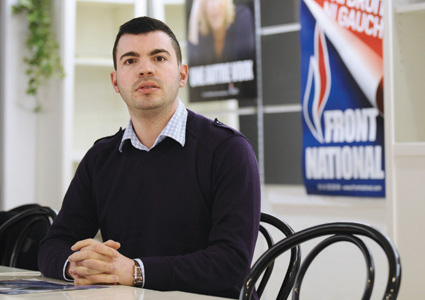
 Fabien Engelmann, Mayor of Hayange: A gay leftist, he switched to the FN in 2010 (© JEAN-CHRISTOPHE VERHAEGEN/AFP/Getty Images)
You only really know Paris when you know the Métro. When you recognise the Roma rapping on La Ligne 13, when you know without needing to look which stations let the sleeping bags in at night, when you get that instinctive feel for the hour the homeless beggars do their rounds up and down the carriages — “Mesdames, Messieurs.”
You only really know Paris when you know the spots where women look behind themselves at night. Get out quickly from the tunnels at Stalingrad — watch out for your bag, they say, that’s where the Eritreans are sleeping. Don’t get yourself a commute on La Ligne 13, they joke, it may be light blue but it goes from Romania to the banlieue end of hell. And with this ticket this is where I am going. I have to see the new France for myself to ask: is this country in danger? This is not just any old question to me. This is about my family.
My aunt lives on La Ligne 13. She, like most of my family is French. French and Jewish. She lives in the Paris that the tourists think can never change. But this is not the France we knew. Outside her apartment on the pavement someone has spray-painted in black “Too Many Arabs”, while inside our family has been arguing. Le Bataclan, les banlieues, Marine Le Pen, burnt police cars, jihadi assassinations, the HyperCacher — do we smell smoke?
If we get one more failed president then Marine Le Pen will win the presidency, says my uncle. My aunt wants a British passport. This is hysteria! Let’s be calm, tuts my cousin. But the killings have already started, says his wife. Round and round it goes. Optimists, turning into pessimists, and back again. Are we paranoid? I am on the Métro to find out.
A swirl of purple and blue light glows out of the rose windows of the cathedral of Saint-Denis and spills mystery over the silence of the nave. I am standing in a sacred necropolis: the burial place of the kings of France. Tombs surround me. Carved out of limestone, their faces calm, they look as ifthey are sleeping. The crypt holds their bones, from Dagobert I all the way to Louis XIII. This is the line of the Sun King. A man lies here who was not a king: Charles Martel, the Frankish warrior who Gibbon believed had saved Christendom by defeating the Arab invasion of France on the battlefield near Poitiers in 732.
Two hundred metres away, it is time for Friday prayers. The mosque is overflowing. Every week 3,000 believers come to pray here on Rue de la Boulangerie, in a dingy space that cannot hold more than 1,800. In tracksuits, jubbah, and the white tunics of Islamists it overflows. The road is crowded, blocked, as around a hundred fall to their knees towards Mecca. These hardline mosques are building a parallel Paris: segregated by faith.
I am only 20 minutes from my aunt’s flat on Ligne 13. This is Sunday morning. At the cathedral I count scarcely 500 faithful at Mass. They are almost all black. “This is a black church,” says the old white priest as I leave. Imagine Westminster Abbey in Tower Hamlets, a Tower Hamlets without jobs, which makes it more of a Bradford. This is the banlieue of Seine-Saint-Denis. In a country where ethno-religious statistics are illegal, this is seen as a Muslim-majority territory. To mention Saint-Denis is to start arguing about France’s greatest tension: Islam and the Republic.
Bradford upsets the British less than Saint-Denis does the French. France has a far more virulent rejection of Muslim multiculturalism. The majority even find Islam itself incompatible with the values of French society. The word communitaire is only used with sharply negative connotations. This is because Saint-Denis clashes with the underlying French ideology — La République, the enlightenment scheme whereby there should be nothing between the will of a uniform, secular state and its citizens. No priests, no imams, no community elders.
Last week one of the cathedral’s priests was savagely beaten here, thugs mistaking a long thin book for an iPad. Then they bolted, leaving him with a bleeding nose on the square. My notebook fills with stories like this: of thieves, hoodlums and pickpockets. This is nothing like poor London.
The streets of Saint-Denis talk as if the authorities have lost their grip. Jihadists are waging a dirty war on the Republic, recruiting intensively in these banlieues. Since 2012, stabbings, shootings and car rammings have taken place every few months, punctuated by slaughters such as Charlie Hebdo and the Bataclan.
It was here after the Bataclan massacre that the police stormed the hideout of the terrorist mastermind, firing 5,000 rounds. Three jihadis were shot dead, minutes from the cathedral. Their stated ambition was to start a civil war.
The odd woman circumvents France’s ban on complete face coverings, by wearing a little anti-bacterial facemask under tight-fitting hijab. The Catholic faithful drifting out of the cathedral are uncomfortable. “Everything has changed,” says Maria, a 62-year-old cleaner. “Immigration changed everything. The people changed. You can just see it for yourself. The French have all left Saint-Denis. Look around you.” She has lived here for 37 years. “The real French have left. I’m a Portuguese immigrant, and I want to leave too. It’s their own fault they let themselves get screwed like this. But now France is no longer France.”
The square is full of drug pushers, hustling in broad light. They are brazen in a way unthinkable in London. Dishevelled Arab men hawk parsley and fennel out of cardboard boxes where the escalators grind out from the Métro. A Roma beggar without one arm but instead three deformed fingers sprouting from her shoulder stump, chimes “Salaam Aleikum” at the hijabis outside a poky Islamic clothes shop.
Bradford upsets the British less than Saint-Denis does the French. France has a far more virulent rejection of Muslim multiculturalism. The majority even find Islam itself incompatible with the values of French society. The word communitaire is only used with sharply negative connotations. This is because Saint-Denis clashes with the underlying French ideology — La République, the enlightenment scheme whereby there should be nothing between the will of a uniform, secular state and its citizens. No priests, no imams, no community elders.
Last week one of the cathedral’s priests was savagely beaten here, thugs mistaking a long thin book for an iPad. Then they bolted, leaving him with a bleeding nose on the square. My notebook fills with stories like this: of thieves, hoodlums and pickpockets. This is nothing like poor London.
The streets of Saint-Denis talk as if the authorities have lost their grip. Jihadists are waging a dirty war on the Republic, recruiting intensively in these banlieues. Since 2012, stabbings, shootings and car rammings have taken place every few months, punctuated by slaughters such as Charlie Hebdo and the Bataclan.
It was here after the Bataclan massacre that the police stormed the hideout of the terrorist mastermind, firing 5,000 rounds. Three jihadis were shot dead, minutes from the cathedral. Their stated ambition was to start a civil war.
The odd woman circumvents France’s ban on complete face coverings, by wearing a little anti-bacterial facemask under tight-fitting hijab. The Catholic faithful drifting out of the cathedral are uncomfortable. “Everything has changed,” says Maria, a 62-year-old cleaner. “Immigration changed everything. The people changed. You can just see it for yourself. The French have all left Saint-Denis. Look around you.” She has lived here for 37 years. “The real French have left. I’m a Portuguese immigrant, and I want to leave too. It’s their own fault they let themselves get screwed like this. But now France is no longer France.”
The square is full of drug pushers, hustling in broad light. They are brazen in a way unthinkable in London. Dishevelled Arab men hawk parsley and fennel out of cardboard boxes where the escalators grind out from the Métro. A Roma beggar without one arm but instead three deformed fingers sprouting from her shoulder stump, chimes “Salaam Aleikum” at the hijabis outside a poky Islamic clothes shop.
In swirls of black cloth, veiled women drift towards the market. Bartering at stalls, almost all the women are in headscarves, penny-pinching for Made In Bangladesh clothes. You hear more Arabic than French, and shaking jangling plasticated sacks, shouting the Arabic for charity — zakat, zakat, zakat — are the Islamists, dominating it, raising coins for the mosque.
“People have gone back to religion,” smiles Idir Mazad over his euro-filled sack. He is a Salafist foot soldier. “And they have gone back hard. The French mistreated them. That’s why.” I flick a German euro into Idir’s sack and he begins to tell his story. Born in Tunisia, he is a 34-year-old security guard. Sometimes he moonlights as an Arabic teacher. “It all really started ten years ago.” As he talks I pick up his aura: one of calm, softness and distance. “Back in the 1990s people in Saint-Denis didn’t live and dress like true Muslims.” Everyone I speak to in the market keeps repeating this.
I wander down Rue de la République. The bourgeois France of boulangeries, épiceries, boucheries and charcuteries is all but gone, replaced by Chinese bargain shops, gloomy halal butchers and cut-price urban fashion shops stuffed with glitzy trainers, most of them obvious fakes. I find Ahlam shy under a hijab, behind the till at GoldFoot Urban Clothing. She smiles: “The French are very rare here now.” She blinks, hesitating, over three boxes of Nikes. “And lot of them are converts to Islam.”
Saint-Denis feels stigmatised, disorientated and vulnerable. Muslim men talk as if they are all suspects. “They call us all terrorists,” says Mbraki, a 34-year-old halal butcher. “We’re not!” But they nearly all also lament the loss of authority. Mbraki leans on his metallic counter, dripping red mutton behind him. “The French are too scared to come and shop in Saint-Denis since the attacks. There’s fear. There’s less order — less police, more druggies, more dealers and more thieves. It’s getting worse. I tell you — ten years ago it was not this bad.”
How does the French state explain all this? I take the butcher’s accusation to the prefect. Grey-haired Philippe Galli is Saint-Denis’s most powerful official and the president’s envoy to the department of Seine-Saint-Denis. His throaty, gravelly voice is accustomed to power.
“Those same people who say there is a lack of authority,” snaps the 60-year-old prefect, “are the same ones who refuse the police access when they try and enter. Those from the Maghreb, by origin, permit themselves to behave in ways that would be unthinkable where they came from.”
He tells me that the secret services are currently monitoring 700 people at risk of radicalisation in Saint-Denis, and the police are too frightened to enter alone most areas under his control. So what, on the outskirts of Paris, has gone so wrong?
“People have gone back to religion,” smiles Idir Mazad over his euro-filled sack. He is a Salafist foot soldier. “And they have gone back hard. The French mistreated them. That’s why.” I flick a German euro into Idir’s sack and he begins to tell his story. Born in Tunisia, he is a 34-year-old security guard. Sometimes he moonlights as an Arabic teacher. “It all really started ten years ago.” As he talks I pick up his aura: one of calm, softness and distance. “Back in the 1990s people in Saint-Denis didn’t live and dress like true Muslims.” Everyone I speak to in the market keeps repeating this.
I wander down Rue de la République. The bourgeois France of boulangeries, épiceries, boucheries and charcuteries is all but gone, replaced by Chinese bargain shops, gloomy halal butchers and cut-price urban fashion shops stuffed with glitzy trainers, most of them obvious fakes. I find Ahlam shy under a hijab, behind the till at GoldFoot Urban Clothing. She smiles: “The French are very rare here now.” She blinks, hesitating, over three boxes of Nikes. “And lot of them are converts to Islam.”
Saint-Denis feels stigmatised, disorientated and vulnerable. Muslim men talk as if they are all suspects. “They call us all terrorists,” says Mbraki, a 34-year-old halal butcher. “We’re not!” But they nearly all also lament the loss of authority. Mbraki leans on his metallic counter, dripping red mutton behind him. “The French are too scared to come and shop in Saint-Denis since the attacks. There’s fear. There’s less order — less police, more druggies, more dealers and more thieves. It’s getting worse. I tell you — ten years ago it was not this bad.”
How does the French state explain all this? I take the butcher’s accusation to the prefect. Grey-haired Philippe Galli is Saint-Denis’s most powerful official and the president’s envoy to the department of Seine-Saint-Denis. His throaty, gravelly voice is accustomed to power.
“Those same people who say there is a lack of authority,” snaps the 60-year-old prefect, “are the same ones who refuse the police access when they try and enter. Those from the Maghreb, by origin, permit themselves to behave in ways that would be unthinkable where they came from.”
He tells me that the secret services are currently monitoring 700 people at risk of radicalisation in Saint-Denis, and the police are too frightened to enter alone most areas under his control. So what, on the outskirts of Paris, has gone so wrong?
“The children of this great wave of immigration are living in failure,” he says. “The failure of integration, the failure of schooling, the failure of employment.” Every day, Islamists are gaining ground in Saint-Denis. Militant Salafist and fundamentalist groups are active around the mosques, says the prefect, who finds the imams worryingly reluctant to speak to his officials. “The children of immigrants don’t recognise as their values those values that attracted their parents to France.” He remembers the first wave of North African immigrants: no veils, no beards, no Salafists. They came, he says, not just for French jobs but also for French liberty. “They were proud of those values. But I don’t think their children share the same pride.” Under his administration the prefect sees a generation in thrall to football, rap and Allah. And the old values? “They just don’t attach any value to them.”
Are the French people, those loyal to the Fifth Republic, falling apart? The only place to test this is a lycée. I take La Ligne 13 south of Saint-Denis and get off at Saint-Ouen, a banlieue best known for its flea market, to find one.
The French people were built by these lycées. This was how Paris colonised la France profonde which in the late 19th century mostly spoke dialects closer to Catalan and Italian. Has this system now broken down?
All lycées look alike: the textbooks the same; the lessons the same; the aquamarine frame chairs the same, everything making one Republic.
I sit at the back of a normal banlieue classroom. Bits of plastic and dust balls fleck the floor. Fifteen-year-olds yell and shriek. There are 28 of them: eight of them white, the rest black or Arab, and only one without an immigrant background. They don’t know it, but they are about to experience Coexist, a volunteer anti-racist project.
The class is divided into four groups and handed blank sheets of paper marked with black headings: French, Blacks, Arabs, Jews, Muslims, Men and Women. The children are then told to fill in whatever words come into their heads. A group of eight fill in what comes into their heads for French. This is what they wrote: whites, whites, France, whites, whites, French blood, whites, born in France.
“The French, it’s them,” says a black boy pointing at a white one. “The French, they’re not us,” says an Arab girl. “To be French,” says an Arab boy, “you have to have all your family French, all of them back to . . . the start of humanity.” Almost all of them were born in this banlieue.
Mohammed, a cheeky boy with a brutal undercut, is asked to come to the blackboard to read out what his group wrote for Jew. He also presents a picture they drew for it.
“Jews ✡ = Sons of Bitches = $”
Why did you draw a dollar sign, asks the instructor?
Painstakingly, the programme begins breaking down the stereotypes. But there is one issue where some pupils reject the message.
“Who here feels French?” asks the instructor.
“I’m not French because I’m not seen as French,” says Usama, a dark-skinned boy in a number-eight football shirt. “People don’t want to see me as French, because I’m not white, because I’m from a banlieue. They go: oh you’re an Arab, you’re not French. I was born here but I’m an immigrant to them.”
Other kids nod, one yells: “Yeah, me too.”
“The French, that’s not us, I’m an Arab.”
The instructor carries on as they shout over each other.
“No. We are all French. The law says that being French . . .”
The instructor tries something else.
“I’m not asking you if others think you’re French, but do you feel French? How do you feel? French?”
They, all but three, raise their hands.
I ask myself what I’d have put at their age for Les Français. I don’t need to think for long. I’d have put whites too.
I finger my passport. On the front is an axe, wrapped in a wood bundle, stamped with “RF: La République Française.” It makes me French, a graduate of a (London) French lycée, or does it?
My great-grandfather was a German. This may seem an odd thing to recall at the back of a banlieue lycée, but let me explain. In the muddy winters of 1914-1918 he fought in the trenches, for his country, Germany. I learnt at my lycée, what his army did to France. Every day at the battle of the Marne and the Somme, thousands of men — morts pour la France.
Are the French people, those loyal to the Fifth Republic, falling apart? The only place to test this is a lycée. I take La Ligne 13 south of Saint-Denis and get off at Saint-Ouen, a banlieue best known for its flea market, to find one.
The French people were built by these lycées. This was how Paris colonised la France profonde which in the late 19th century mostly spoke dialects closer to Catalan and Italian. Has this system now broken down?
All lycées look alike: the textbooks the same; the lessons the same; the aquamarine frame chairs the same, everything making one Republic.
I sit at the back of a normal banlieue classroom. Bits of plastic and dust balls fleck the floor. Fifteen-year-olds yell and shriek. There are 28 of them: eight of them white, the rest black or Arab, and only one without an immigrant background. They don’t know it, but they are about to experience Coexist, a volunteer anti-racist project.
The class is divided into four groups and handed blank sheets of paper marked with black headings: French, Blacks, Arabs, Jews, Muslims, Men and Women. The children are then told to fill in whatever words come into their heads. A group of eight fill in what comes into their heads for French. This is what they wrote: whites, whites, France, whites, whites, French blood, whites, born in France.
“The French, it’s them,” says a black boy pointing at a white one. “The French, they’re not us,” says an Arab girl. “To be French,” says an Arab boy, “you have to have all your family French, all of them back to . . . the start of humanity.” Almost all of them were born in this banlieue.
Mohammed, a cheeky boy with a brutal undercut, is asked to come to the blackboard to read out what his group wrote for Jew. He also presents a picture they drew for it.
“Jews ✡ = Sons of Bitches = $”
Why did you draw a dollar sign, asks the instructor?
“Because they are all rich, they all used to be bankers, in the Middle Ages or something. So they have an inheritance. And they stick together.”
One girl laughs. “So we can take it from them.”
“What is the Shoah?” says a confused black girl. “Is it a drug?”
One girl laughs. “So we can take it from them.”
“What is the Shoah?” says a confused black girl. “Is it a drug?”
Painstakingly, the programme begins breaking down the stereotypes. But there is one issue where some pupils reject the message.
“Who here feels French?” asks the instructor.
“I’m not French because I’m not seen as French,” says Usama, a dark-skinned boy in a number-eight football shirt. “People don’t want to see me as French, because I’m not white, because I’m from a banlieue. They go: oh you’re an Arab, you’re not French. I was born here but I’m an immigrant to them.”
Other kids nod, one yells: “Yeah, me too.”
“The French, that’s not us, I’m an Arab.”
The instructor carries on as they shout over each other.
“No. We are all French. The law says that being French . . .”
The instructor tries something else.
“I’m not asking you if others think you’re French, but do you feel French? How do you feel? French?”
They, all but three, raise their hands.
I ask myself what I’d have put at their age for Les Français. I don’t need to think for long. I’d have put whites too.
I finger my passport. On the front is an axe, wrapped in a wood bundle, stamped with “RF: La République Française.” It makes me French, a graduate of a (London) French lycée, or does it?
My great-grandfather was a German. This may seem an odd thing to recall at the back of a banlieue lycée, but let me explain. In the muddy winters of 1914-1918 he fought in the trenches, for his country, Germany. I learnt at my lycée, what his army did to France. Every day at the battle of the Marne and the Somme, thousands of men — morts pour la France.
Then something changed. This man, Johannes-Paul, honoured to hold an Iron Cross, who celebrated Christmas, was told he was not German: he was a Jew. In 1933, after my 13-year-old grandmother started to be singled out by schoolteachers as a Jew, he emigrated to France.
My great-grandfather was naturalised French. The more I think about it, the more remarkable this is. This man, who had killed Frenchmen, who had killed either so many or killed them so well he was awarded the Iron Cross, suddenly becomes French, with the amazing magnanimity of the Republic, the creator of les Droits de l’Homme. Some time after arriving, he threw his Iron Cross into the Seine and decided his name was now Jean-Paul.
France’s greatness just as suddenly turns to France’s disgrace in my family history. Nine years later my great-grandmother was arrested by the French police and deported by the French railways. Her crime was being Jewish, the destination Auschwitz, where she died in the gas chambers. My grandmother and my great-aunt went into hiding. They both narrowly survived the France — travail, famille, patrie — of Marshal Pétain. Does that history make me French, to the Republic? I don’t know.
The noise of children — 150, laughing, shouting, shrieking, sulking, spinning children — somehow it always reaches a single pitch. This is the sound of the basement of a synagogue in suburban Charenton as they line up for lunch. Somebody misbehaves, big boys promise extra helpings to the ones who eat their greens, and Madame Martine Saada fills up their little plates with a ladle. She is the co-president of the community.
I have driven round Le Périphérique, the orbital motorway that divides Paris from the banlieues, to ask her a Jewish question. Can a Jew still live safely in a banlieue?
“A Jew can’t live where he wants anymore,” says Mme Saada. “Bit by bit, everyone is moving from the banlieues. As soon as there are ethnic populations, and as soon as it gets, shall we say, problematic, the Jews move. The visible ones — they get constantly attacked.”
My great-grandfather was naturalised French. The more I think about it, the more remarkable this is. This man, who had killed Frenchmen, who had killed either so many or killed them so well he was awarded the Iron Cross, suddenly becomes French, with the amazing magnanimity of the Republic, the creator of les Droits de l’Homme. Some time after arriving, he threw his Iron Cross into the Seine and decided his name was now Jean-Paul.
France’s greatness just as suddenly turns to France’s disgrace in my family history. Nine years later my great-grandmother was arrested by the French police and deported by the French railways. Her crime was being Jewish, the destination Auschwitz, where she died in the gas chambers. My grandmother and my great-aunt went into hiding. They both narrowly survived the France — travail, famille, patrie — of Marshal Pétain. Does that history make me French, to the Republic? I don’t know.
The noise of children — 150, laughing, shouting, shrieking, sulking, spinning children — somehow it always reaches a single pitch. This is the sound of the basement of a synagogue in suburban Charenton as they line up for lunch. Somebody misbehaves, big boys promise extra helpings to the ones who eat their greens, and Madame Martine Saada fills up their little plates with a ladle. She is the co-president of the community.
I have driven round Le Périphérique, the orbital motorway that divides Paris from the banlieues, to ask her a Jewish question. Can a Jew still live safely in a banlieue?
“A Jew can’t live where he wants anymore,” says Mme Saada. “Bit by bit, everyone is moving from the banlieues. As soon as there are ethnic populations, and as soon as it gets, shall we say, problematic, the Jews move. The visible ones — they get constantly attacked.”
The rise of Saint-Denis France means the flight of the Jews. Since 2000, when banlieue anti-Semitism began to flare alongside the Palestinian intifada, the number of Jewish families in Aulnay-sous-Bois fell from 600 to 100, in Le Blanc-Mesnil from 300 to 100, in Clichy-Sous-Bois from 400 to 80, and in La Courneuve from 300 to 80. French Jews call this flight internal aliyah.
This is why they move: in 2014, 51 per cent of reported racist incidents in France targeted Jews. On average a Jew is assaulted in France every day. And this means it touches most families. A recent poll found that 74 per cent of Jews who wore traditional skullcaps and 20 per cent who didn’t reported being attacked.
Madame Saada’s community is a refuge: in 2000 it was 800 families strong, now internal aliyah has enlarged it to 1,500. This crush makes the synagogue feel more like a home than a place of worship. And, like so many things Jewish, it is a cacophonic mess: someone is looking for a tennis racket, a flotilla of pastry boxes seems to be arriving, and the rabbi is nowhere to be seen. It seems so similar to Jewish life in London — but then 20 soldiers arrive. “I’m the next guard,” booms a tall white trooper with a buzz cut.
Since the jihadi slaughter at the HyperCacher after the Charlie Hebdo attack last year, 10,000 troops and 5,000 police have guarded all Jewish sites in France. The military has been brought in because there are now so many potential jihadist cells and lone wolves in the banlieue that there is simply no other way to protect them.
Mme Saada looks at the troops. Every day she sees the uniforms and feels amazingly thankful and amazingly sad. It has come to this: that the Jews are, once again, so hated that they need the army patrolling their every building to keep them safe. It feels, almost, like a return to the Middle Ages, when the Jews were protected by the prince and would avoid those areas where the writ of their sovereign was weakest. French Jews with a sense of humour joke about their protector as le Prince Valls, Prime Minister Manuel Valls, and how they avoid banlieues where his rule is weak.
“It’s traumatic, claustrophobic, to live every day,” she says, “with soldiers, seeing we are so hated we can’t be here without them. It’s particularly awful at the school gates, thinking that without the army our children would come home dead.” Many pious ones, who, praying daily, almost live in the synagogue, really struggle. At least in Israel the soldiers are not at the door.
She turns round and calls to a veiled cleaner in Arabic — help me tidy up. This is typically French Jewish. Mme Saada was born in Tunis. France’s Jews are some 70 per cent Sephardic: they were once the Jews of French Algeria, Morocco and Tunisia. Theirs is a newer, bigger, poorer community than Britain’s. “We arrived speaking Arabic,” she says, “in the same banlieues as the Arabs. We used to wish each other happy holidays. But things turned violent.” Moving away from this is bankrupting many families.
Mme Saada is growing old, but her eyes are wide brown. “This future frightens us. We’re being marginalised.” Three children have moved to Israel, two to New York. Only one is left in Paris. “We didn’t even get one full generation in France.”
At the edge of Seine-Saint-Denis, I am sitting in the functional, plastic-grey office of Jérôme Fourquet. This slight, dark-haired man is one of France’s most famous pollsters. Given that the state forbids ethno-religious statistics, he laughs that his work is skirting the edge of the law.
“Statistics show,” he says, “perceptions of anti-Semitic insecurity exploded in France in the early 2000s. This reconfigured where French Jews live.” They are not moving far. Half of France’s roughly 500,000 Jews live in the Paris conurbation. This aliyah is from one banlieue to another. “We found that the number of Jews in districts of Seine-Saint-Denis has plummeted in ten to 15 years.”
This is why they move: in 2014, 51 per cent of reported racist incidents in France targeted Jews. On average a Jew is assaulted in France every day. And this means it touches most families. A recent poll found that 74 per cent of Jews who wore traditional skullcaps and 20 per cent who didn’t reported being attacked.
Madame Saada’s community is a refuge: in 2000 it was 800 families strong, now internal aliyah has enlarged it to 1,500. This crush makes the synagogue feel more like a home than a place of worship. And, like so many things Jewish, it is a cacophonic mess: someone is looking for a tennis racket, a flotilla of pastry boxes seems to be arriving, and the rabbi is nowhere to be seen. It seems so similar to Jewish life in London — but then 20 soldiers arrive. “I’m the next guard,” booms a tall white trooper with a buzz cut.
Since the jihadi slaughter at the HyperCacher after the Charlie Hebdo attack last year, 10,000 troops and 5,000 police have guarded all Jewish sites in France. The military has been brought in because there are now so many potential jihadist cells and lone wolves in the banlieue that there is simply no other way to protect them.
Mme Saada looks at the troops. Every day she sees the uniforms and feels amazingly thankful and amazingly sad. It has come to this: that the Jews are, once again, so hated that they need the army patrolling their every building to keep them safe. It feels, almost, like a return to the Middle Ages, when the Jews were protected by the prince and would avoid those areas where the writ of their sovereign was weakest. French Jews with a sense of humour joke about their protector as le Prince Valls, Prime Minister Manuel Valls, and how they avoid banlieues where his rule is weak.
“It’s traumatic, claustrophobic, to live every day,” she says, “with soldiers, seeing we are so hated we can’t be here without them. It’s particularly awful at the school gates, thinking that without the army our children would come home dead.” Many pious ones, who, praying daily, almost live in the synagogue, really struggle. At least in Israel the soldiers are not at the door.
She turns round and calls to a veiled cleaner in Arabic — help me tidy up. This is typically French Jewish. Mme Saada was born in Tunis. France’s Jews are some 70 per cent Sephardic: they were once the Jews of French Algeria, Morocco and Tunisia. Theirs is a newer, bigger, poorer community than Britain’s. “We arrived speaking Arabic,” she says, “in the same banlieues as the Arabs. We used to wish each other happy holidays. But things turned violent.” Moving away from this is bankrupting many families.
Mme Saada is growing old, but her eyes are wide brown. “This future frightens us. We’re being marginalised.” Three children have moved to Israel, two to New York. Only one is left in Paris. “We didn’t even get one full generation in France.”
At the edge of Seine-Saint-Denis, I am sitting in the functional, plastic-grey office of Jérôme Fourquet. This slight, dark-haired man is one of France’s most famous pollsters. Given that the state forbids ethno-religious statistics, he laughs that his work is skirting the edge of the law.
“Statistics show,” he says, “perceptions of anti-Semitic insecurity exploded in France in the early 2000s. This reconfigured where French Jews live.” They are not moving far. Half of France’s roughly 500,000 Jews live in the Paris conurbation. This aliyah is from one banlieue to another. “We found that the number of Jews in districts of Seine-Saint-Denis has plummeted in ten to 15 years.”
Fourquet’s research shows that French Jews are moving from areas run by Communist mayors — twinned with Palestinian camps, where Palestinian war heroes hold honorary citizenship, and regular exhibitions are held on the Nakba — to areas where there are right-wing mayors, and twinned with Israel. Internal aliyah — not to Israel, or English-speaking countries — is the largest movement of French Jews. “Are they trying to flee Muslim areas?” I ask. “Yes, clearly, very clearly,” says Fourquet. “What we found was that when the Jews moved, this was the canary in the coal mine. There is now massive flight of the non-immigrant population from these areas.Things that were previously felt by the Jewish community are now felt by the population at large.”
What do regular French families fear? Fourquet’s study found the answer was insecurité, a term that has a much wider meaning in French. His studies pick up the following examples: they range from anger that 15 types of veil are sold in the market but no pork, to reports of physical assault.
The rise of Saint-Denis France is also the rise of Le Pen Land. “But this has changed the Front National,” says Fourquet. Back in the 1990s many Front National voters used to live in immigrant areas. “The Front’s vote in Seine-Saint-Denis,” he says, “which was very high in the 1990s, has now collapsed to near- non-existent levels due to massive white flight.” This has changed Le Pen’s slogans. “France for the French” has been ditched for “This Is Our Home.”
“What does the slogan mean?” grins Fourquet. “It means we make the law here, and we say how you live. And if you have to go — ‘This Is Our Home’ — it means you have to remind people of it, because it’s no longer so clear.”
The pollster feels France is obsessed with Islam. “It may not sounds like it,” he says, “but areas like Saint-Denis are only small.” This obsession is paranoid. The French believe Muslims make up 31 per cent of their population. In reality, Fourquet estimates Muslims comprise only 7-8 per cent. The internet is filled with viral zombie demography, he explains. Predictions of a Muslim majority by 2050 are baseless. Only 13 per cent of French teenagers are Muslims, and Muslims are expected to reach only 10 per cent of the French population by 2030.
“Yet what we found in our interviews in the Jewish community,” says Fourquet, “was more and more Jews say, there is us, them and you — the ethnic French. Yet again, in our interviews with them, they talk as if they are canaries in the coalmine. This comes up a lot: you’ll see it when were gone and you’ll be left with them — les Arabes. This is dramatic. The sense of a common French destiny is vanishing in our surveys.”
This new France is Marine Le Pen’s good fortune. Her rank and file call her Joan of Arc, France’s saintly heroine come to lance the Muslim peril and slay the Brussels Hydra. Marine is the leader of what she calls “the first party of France”. This claim is serious. Her Front now has more members than the governing Socialist party and came first in the first round of 2015’s regional elections with nearly a third of the vote. (In the second round, tactical voting kept them out.) Marine is becoming a serious contender for the presidency.
What do regular French families fear? Fourquet’s study found the answer was insecurité, a term that has a much wider meaning in French. His studies pick up the following examples: they range from anger that 15 types of veil are sold in the market but no pork, to reports of physical assault.
The rise of Saint-Denis France is also the rise of Le Pen Land. “But this has changed the Front National,” says Fourquet. Back in the 1990s many Front National voters used to live in immigrant areas. “The Front’s vote in Seine-Saint-Denis,” he says, “which was very high in the 1990s, has now collapsed to near- non-existent levels due to massive white flight.” This has changed Le Pen’s slogans. “France for the French” has been ditched for “This Is Our Home.”
“What does the slogan mean?” grins Fourquet. “It means we make the law here, and we say how you live. And if you have to go — ‘This Is Our Home’ — it means you have to remind people of it, because it’s no longer so clear.”
The pollster feels France is obsessed with Islam. “It may not sounds like it,” he says, “but areas like Saint-Denis are only small.” This obsession is paranoid. The French believe Muslims make up 31 per cent of their population. In reality, Fourquet estimates Muslims comprise only 7-8 per cent. The internet is filled with viral zombie demography, he explains. Predictions of a Muslim majority by 2050 are baseless. Only 13 per cent of French teenagers are Muslims, and Muslims are expected to reach only 10 per cent of the French population by 2030.
“Yet what we found in our interviews in the Jewish community,” says Fourquet, “was more and more Jews say, there is us, them and you — the ethnic French. Yet again, in our interviews with them, they talk as if they are canaries in the coalmine. This comes up a lot: you’ll see it when were gone and you’ll be left with them — les Arabes. This is dramatic. The sense of a common French destiny is vanishing in our surveys.”
This new France is Marine Le Pen’s good fortune. Her rank and file call her Joan of Arc, France’s saintly heroine come to lance the Muslim peril and slay the Brussels Hydra. Marine is the leader of what she calls “the first party of France”. This claim is serious. Her Front now has more members than the governing Socialist party and came first in the first round of 2015’s regional elections with nearly a third of the vote. (In the second round, tactical voting kept them out.) Marine is becoming a serious contender for the presidency.
These are my first memories of the Front National. I was 14 in 2002 when Jean-Marie Le Pen, Marine’s father, got 17 per cent of the vote. There were millions of people in the street. I was in Nice with my mother, brother and sisters. We were visiting the tomb of my great-grandmother. Well, since she was gassed and burnt at Auschwitz, she doesn’t have a tomb — only her name carved onto a memorial on a hill overlooking Nice. This is where she was rounded up by the French police. I remember the heat and the barbed wire around our little monument. There was a fat, miserable guardian sitting there, with two huge dogs — without them the Jews’ stone would keep on being defaced.
Now I am 28, and in 2017 it is near-certain that Marine Le Pen will be in the second round of next year’s presidential election. She is polling around 40 per cent in the run-off — and anything under 35 per cent will be seen as a disappointment. There are no marches, no protests — just smiles and selfies.
I am watching a humdrum, 50-strong French protest. The protesters want tougher sentences for the bad drivers who killed their children. Holding portraits and wearing T-shirts printed with pictures of their dead sons and daughters, they gather under four plane trees in a small square just next to L’Assemblée Nationale, France’s parliament.
This is the France that the Front National claims as hers: the France that feels victimised, abandoned, ignored and simply unheard because, isolated, it can’t shout as loudly as a community of Muslims or Jews — the France that feels nobody gives a hoot about it. As they blare into the megaphone Gilbert Collard slinks out of the Assemblée Nationale and joins the crowd. Leftists label him one of the most dangerous men in France. Collard is one of only two FN members of parliament.
It is clear just watching this pink and puffy man how far Le Pen politics has entered the mainstream. Protesters hug him, then they take selfies with him, listen intently and implore him to help. Collard, a brilliant lawyer, smiles. He smells of cigars and in his trench coat radiates a manipulative intelligence. “The first to start our decontamination,” he says. “C’est moi.”
Marine’s MP thinks it was inevitable that France would start voting Le Pen: “For years you can see that we were correct in all our all judgments.” History, he says, has proved them right. Collard smokes with his right hand, and waves his left with dramatic effect. “Our whole diagnosis on immigration, sovereignty, the borders, the problems created by the euro, insecurité and the zones of lawlessness in the banlieues. Alas — it’s all come true. So maybe after all these years the people just want to pick the doctor that gave them the best diagnosis — ten years before the rest.”
The France of Saint-Denis and that of Le Pen are feeding off each other.
How much larger can Le Pen Land grow?
Camus says that since Marine took over the party from her father the Front has made spectacular progress, increasing its electorate from some 20 per cent to about 30 per cent of the population. How could the FN achieve this, he asks, when the BNP never had a chance in the UK? The first answer Camus says is technology: the FN has conquered the internet. In Britain, trolling, Twitter and alternative news sites are a leftist thing; in France the FN has built and been echoed by its own alt-media. Websites like www.fdesouche.com — a play on Français de souche, or real, pure, Frenchmen with roots — pump out an alternative news agenda, with stories every day of migrant rapes and Arab knifings. It is among the most popular sites in France.
The second answer, Camus says, is cadres: Jean-Marie had a talent for picking managers and organisers. Marine, he says, has married this to a new talent — strategy. The Front has officially moved away from homophobia, Holocaust denial and anti-Semitism, while abandoning Jean-Marie’s free-market economics. Marine calls this la dédiabolisation — decontamination — and it has been spearheaded by her own new cadres, such as the FN’s new gay vice-president Florian Philipot. “Marine wants to rule,” says Camus. “Jean-Marie preferred to be a spoiler.”
Decontamination is about making the Le Pen name Marine’s and not Jean-Marie’s. At the heart of this is a new umbrella party — Le Rassemblement Bleu Marine — that lets hard rightists sign up to a party unassociated with Jean-Marie. Camus sees the strategy as half-working. Decontamination has brought establishment names to the Front. These include Robert Ménard, the former head of Reporters Without Borders, who is now the Mayor of Beziers, and Gilbert Collard.
“But decontamination is blocked,” says Camus. “Because the Front is still a party alone. It is only an extremely well- performing first-round party.” France’s two-stage electoral system means that a party can’t win an election on only 30 per cent of the vote. Camus thinks that the Front’s attempt to be simultaneously an anti-austerity, anti-Islam and anti-EU protest party has won it a large support base but one that cannot grow. “Swing any more to the centre and it will start to lose votes from the extremes. Swing any more to the protectionist Left it will start to lose votes from the Right.” The Front is also blocked by France’s professionals. For them, quite unlike for France’s poor, a vote for Marine is still largely seen as vulgar and delusional, if no longer totally inexcusable. “This is why Left and Right are still ready to vote for each other to stop the Front passing the threshold. This is the glass ceiling.”
Now I am 28, and in 2017 it is near-certain that Marine Le Pen will be in the second round of next year’s presidential election. She is polling around 40 per cent in the run-off — and anything under 35 per cent will be seen as a disappointment. There are no marches, no protests — just smiles and selfies.
I am watching a humdrum, 50-strong French protest. The protesters want tougher sentences for the bad drivers who killed their children. Holding portraits and wearing T-shirts printed with pictures of their dead sons and daughters, they gather under four plane trees in a small square just next to L’Assemblée Nationale, France’s parliament.
This is the France that the Front National claims as hers: the France that feels victimised, abandoned, ignored and simply unheard because, isolated, it can’t shout as loudly as a community of Muslims or Jews — the France that feels nobody gives a hoot about it. As they blare into the megaphone Gilbert Collard slinks out of the Assemblée Nationale and joins the crowd. Leftists label him one of the most dangerous men in France. Collard is one of only two FN members of parliament.
It is clear just watching this pink and puffy man how far Le Pen politics has entered the mainstream. Protesters hug him, then they take selfies with him, listen intently and implore him to help. Collard, a brilliant lawyer, smiles. He smells of cigars and in his trench coat radiates a manipulative intelligence. “The first to start our decontamination,” he says. “C’est moi.”
Marine’s MP thinks it was inevitable that France would start voting Le Pen: “For years you can see that we were correct in all our all judgments.” History, he says, has proved them right. Collard smokes with his right hand, and waves his left with dramatic effect. “Our whole diagnosis on immigration, sovereignty, the borders, the problems created by the euro, insecurité and the zones of lawlessness in the banlieues. Alas — it’s all come true. So maybe after all these years the people just want to pick the doctor that gave them the best diagnosis — ten years before the rest.”
The France of Saint-Denis and that of Le Pen are feeding off each other.
How much larger can Le Pen Land grow?
At the edge of Le Marais, in the back of a sticky, gloomy, as-traditional-as-they-come Parisian café I meet Jean-Yves Camus, the leading expert on the Front National. “Look out of the window,” says Camus. “See all those people passing there? Statistically you now must be looking at voters for the Front National. Maybe it’s a man, maybe it’s a woman, maybe it’s a guy with a good job, maybe it’s a guy with a really great job, and maybe it’s a really nice guy.”
Camus says that since Marine took over the party from her father the Front has made spectacular progress, increasing its electorate from some 20 per cent to about 30 per cent of the population. How could the FN achieve this, he asks, when the BNP never had a chance in the UK? The first answer Camus says is technology: the FN has conquered the internet. In Britain, trolling, Twitter and alternative news sites are a leftist thing; in France the FN has built and been echoed by its own alt-media. Websites like www.fdesouche.com — a play on Français de souche, or real, pure, Frenchmen with roots — pump out an alternative news agenda, with stories every day of migrant rapes and Arab knifings. It is among the most popular sites in France.
The second answer, Camus says, is cadres: Jean-Marie had a talent for picking managers and organisers. Marine, he says, has married this to a new talent — strategy. The Front has officially moved away from homophobia, Holocaust denial and anti-Semitism, while abandoning Jean-Marie’s free-market economics. Marine calls this la dédiabolisation — decontamination — and it has been spearheaded by her own new cadres, such as the FN’s new gay vice-president Florian Philipot. “Marine wants to rule,” says Camus. “Jean-Marie preferred to be a spoiler.”
Decontamination is about making the Le Pen name Marine’s and not Jean-Marie’s. At the heart of this is a new umbrella party — Le Rassemblement Bleu Marine — that lets hard rightists sign up to a party unassociated with Jean-Marie. Camus sees the strategy as half-working. Decontamination has brought establishment names to the Front. These include Robert Ménard, the former head of Reporters Without Borders, who is now the Mayor of Beziers, and Gilbert Collard.
“But decontamination is blocked,” says Camus. “Because the Front is still a party alone. It is only an extremely well- performing first-round party.” France’s two-stage electoral system means that a party can’t win an election on only 30 per cent of the vote. Camus thinks that the Front’s attempt to be simultaneously an anti-austerity, anti-Islam and anti-EU protest party has won it a large support base but one that cannot grow. “Swing any more to the centre and it will start to lose votes from the extremes. Swing any more to the protectionist Left it will start to lose votes from the Right.” The Front is also blocked by France’s professionals. For them, quite unlike for France’s poor, a vote for Marine is still largely seen as vulgar and delusional, if no longer totally inexcusable. “This is why Left and Right are still ready to vote for each other to stop the Front passing the threshold. This is the glass ceiling.”
The consensus in Paris is that another terrorist slaughter would shatter it. The radicals of Saint-Denis could tip the radicals of Le Pen Land into power.
How is the old Paris of politicians reacting?
Bruno Le Maire is exactly what French people see when they think of a politician. Blue-eyed, fine-featured, immaculately dressed, Le Maire is a caricature of France’s ruling caste. He is an Énarque, a graduate of l’École Nationale d’Administration — the school that is the French elite, a state-selective political academy of 80-90 students a year that is France’s Eton, Oxford and Cambridge rolled into one. Énarques like Le Maire have a grip on France’s paramount positions from politics to industry.
“Democracy is dead.” I am meeting Le Maire because he is standing for the Right’s nomination for the presidency and he is the third man in the race after Nicolas Sarkozy and Alain Juppé, the Mayor of Bordeaux. “What I mean by democracy is dead is that the system is completely immobile, the system is completely blocked.” He is a former minister, will probably be one again, and if he gets very lucky in the nomination could easily be president.
But is there something deeper at play? “What is happening now has happened several times before.” When France experiences defeat, Le Maire argues, it always comes to believe that its true values are not les droits de l’homme, the values of its confidence — but purity, the countryside, the Church: the values of its fear.
“After the German Empire was declared in the Hall of Mirrors at Versailles, France threw itself into constructing basilicas everywhere. They felt France had sinned.” This is “the perpetual Pétainist temptation.” Singular, exclusive, defensive — an anti-idea of France.
The Right’s optimists think that a strong candidate could break France’s protectionist labour code, make way for Uber-jobs for the banlieues and impose a crackdown on Islamist segregation. The frontrunner Alain Juppé proposes banning sermons in Arabic, shuttering unregistered mosques, and forcing all imams to qualify with French diplomas.
The Right’s pessimists worry that the institutions of the Fifth Republic are breaking down and the elite’s legitimacy so low that France is becoming un-reformable, entrenching unemployment.
“So if the next president doesn’t do what the French people want and reform,” says Le Maire, “and it continues in paralysis like this, we run a very real chance of Marine Le Pen winning — not in 2017 but in 2022 — and opening up a huge danger for the country.”
The left bank of political Paris is a sad sight. Young activists mill about in the drizzle on the Place de la République. Meaningless graffiti covers the square.The longer I spend with the activists, the clearer it is why the Right think 2017 is in the bag. The Left looks and sounds as if it is coming apart.
How is the old Paris of politicians reacting?
Bruno Le Maire is exactly what French people see when they think of a politician. Blue-eyed, fine-featured, immaculately dressed, Le Maire is a caricature of France’s ruling caste. He is an Énarque, a graduate of l’École Nationale d’Administration — the school that is the French elite, a state-selective political academy of 80-90 students a year that is France’s Eton, Oxford and Cambridge rolled into one. Énarques like Le Maire have a grip on France’s paramount positions from politics to industry.
“Democracy is dead.” I am meeting Le Maire because he is standing for the Right’s nomination for the presidency and he is the third man in the race after Nicolas Sarkozy and Alain Juppé, the Mayor of Bordeaux. “What I mean by democracy is dead is that the system is completely immobile, the system is completely blocked.” He is a former minister, will probably be one again, and if he gets very lucky in the nomination could easily be president.
But is there something deeper at play? “What is happening now has happened several times before.” When France experiences defeat, Le Maire argues, it always comes to believe that its true values are not les droits de l’homme, the values of its confidence — but purity, the countryside, the Church: the values of its fear.
“After the German Empire was declared in the Hall of Mirrors at Versailles, France threw itself into constructing basilicas everywhere. They felt France had sinned.” This is “the perpetual Pétainist temptation.” Singular, exclusive, defensive — an anti-idea of France.
The Right’s optimists think that a strong candidate could break France’s protectionist labour code, make way for Uber-jobs for the banlieues and impose a crackdown on Islamist segregation. The frontrunner Alain Juppé proposes banning sermons in Arabic, shuttering unregistered mosques, and forcing all imams to qualify with French diplomas.
The Right’s pessimists worry that the institutions of the Fifth Republic are breaking down and the elite’s legitimacy so low that France is becoming un-reformable, entrenching unemployment.
“So if the next president doesn’t do what the French people want and reform,” says Le Maire, “and it continues in paralysis like this, we run a very real chance of Marine Le Pen winning — not in 2017 but in 2022 — and opening up a huge danger for the country.”
The left bank of political Paris is a sad sight. Young activists mill about in the drizzle on the Place de la République. Meaningless graffiti covers the square.The longer I spend with the activists, the clearer it is why the Right think 2017 is in the bag. The Left looks and sounds as if it is coming apart.
“None of the activists who would campaign for Hollande will this time,” says Baki Youssoufou, one of the protest organisers. “He’s a French Blairite.”
France’s bad luck is in the presidency. De Gaulle created a monarchical presidency. Yet France has had five bad kings in a row. Giscard d’Estaing was wasteful. Mitterrand was scheming. Chirac was immobile. Sarkozy was ineffectual.
Hollande has fared even worse. The president has sunk to an abysmal 13 per cent approval rating. He has failed utterly to rule from the Left; he is now attempting to reform from the Right. Hollande’s failure to reduce unemployment on a statist programme means he now has no option but to attempt Sarkozy’s broken promise of a more British liberal labour code. This volte-face has shattered the Left. Unions are striking to stop him. But even Hollande’s ministers are now moving to the right. Emmanuel Macron is the greatest victory for the Right. The 38-year-old economy minister is now raising funds for a presidential run as a centrist candidate — hoping to implement rightist labour reforms on left-wing votes.
The crumbling of the Left is also the growth of Le Pen. Since 1995 the French working class has shown no electoral preference for the Left above that of its professionals. This allowed the Front National to build up two new heartlands in the rustbelts of France’s post-industrial north and east. These young, uneducated, working-class people, whom the Left once saw as its people, now vote for the FN. This has greatly expanded the party’s punch from its southern heartland, where its loyalists are still the families of former French Algerian pied-noirs, reactionary Catholics, farmers and shopkeepers.
Activists around me are trying to stage an anti-Hollande, Occupy-style movement. Limp Palestinian flags droop in the rain. This Haussmann square shrinks the protesters into insignificance. This is a very middle-class affair. Not only do polls show that a majority of French industrial workers plan to vote Le Pen in 2017, but so do a majority of those without qualifications. The Left has lost its hinterland. The FN is now the party of first choice for France’s first-time voters. “Our only hope,” says Youssoufou, “is to take back from Le Pen what she now has — the monopoly of the protest vote.”
The left’s ideology is muddled, the right’s is vague, but Marine’s is crystal clear. They call it Le Grand Remplacement: the idea that France is ceasing to be France demographically, that slowly this century the old majority is being replaced by a new one, of immigrant ethnicity. The Great Replacing boils down to a simple claim. Immigrants are arriving in large numbers and having more children than natives. Unless this is stopped, the idea that true French will become a minority will constantly be on France’s mind.
My car accelerates down the motorways built by De Gaulle past fields of green under lead skies. The rivers are flooding, and back in Paris precious objects are being removed from the cellars of the Louvre. The road runs straight, over the battlefields of Verdun and past the cemeteries. In the distance rise the rotting hulks of steel plants the General believed France’s independence depended on. “Village for Sale,” shouts a placard. Brown signs announce French history: “The Battle of Valmy.” The GPS bleeps turn off at a signpost for “The Maginot Line.” The Fiat snakes into darkly-forested lanes towards one of the 14 towns with an FN mayor.
France’s bad luck is in the presidency. De Gaulle created a monarchical presidency. Yet France has had five bad kings in a row. Giscard d’Estaing was wasteful. Mitterrand was scheming. Chirac was immobile. Sarkozy was ineffectual.
Hollande has fared even worse. The president has sunk to an abysmal 13 per cent approval rating. He has failed utterly to rule from the Left; he is now attempting to reform from the Right. Hollande’s failure to reduce unemployment on a statist programme means he now has no option but to attempt Sarkozy’s broken promise of a more British liberal labour code. This volte-face has shattered the Left. Unions are striking to stop him. But even Hollande’s ministers are now moving to the right. Emmanuel Macron is the greatest victory for the Right. The 38-year-old economy minister is now raising funds for a presidential run as a centrist candidate — hoping to implement rightist labour reforms on left-wing votes.
The crumbling of the Left is also the growth of Le Pen. Since 1995 the French working class has shown no electoral preference for the Left above that of its professionals. This allowed the Front National to build up two new heartlands in the rustbelts of France’s post-industrial north and east. These young, uneducated, working-class people, whom the Left once saw as its people, now vote for the FN. This has greatly expanded the party’s punch from its southern heartland, where its loyalists are still the families of former French Algerian pied-noirs, reactionary Catholics, farmers and shopkeepers.
Activists around me are trying to stage an anti-Hollande, Occupy-style movement. Limp Palestinian flags droop in the rain. This Haussmann square shrinks the protesters into insignificance. This is a very middle-class affair. Not only do polls show that a majority of French industrial workers plan to vote Le Pen in 2017, but so do a majority of those without qualifications. The Left has lost its hinterland. The FN is now the party of first choice for France’s first-time voters. “Our only hope,” says Youssoufou, “is to take back from Le Pen what she now has — the monopoly of the protest vote.”
The left’s ideology is muddled, the right’s is vague, but Marine’s is crystal clear. They call it Le Grand Remplacement: the idea that France is ceasing to be France demographically, that slowly this century the old majority is being replaced by a new one, of immigrant ethnicity. The Great Replacing boils down to a simple claim. Immigrants are arriving in large numbers and having more children than natives. Unless this is stopped, the idea that true French will become a minority will constantly be on France’s mind.
My car accelerates down the motorways built by De Gaulle past fields of green under lead skies. The rivers are flooding, and back in Paris precious objects are being removed from the cellars of the Louvre. The road runs straight, over the battlefields of Verdun and past the cemeteries. In the distance rise the rotting hulks of steel plants the General believed France’s independence depended on. “Village for Sale,” shouts a placard. Brown signs announce French history: “The Battle of Valmy.” The GPS bleeps turn off at a signpost for “The Maginot Line.” The Fiat snakes into darkly-forested lanes towards one of the 14 towns with an FN mayor.
I have come to Hayange to find out what is turning France’s north and east into Le Pen Land. Is it unemployment or the fear of the great replacing?
Hayange sits under a motorway bridge. This is one of the towns Marine won in 2014 from the crumbling Left. Rusting smelters sit, locked since 2011, like abandoned rocket-launchers from the space age. Signs for Kronenbourg are stamped on some dozen buildings. Jobless people idle in the street. I spot an aged signpost of a line-drawn pole-dancer over a bolted door. Just like anywhere in poor France things give themselves English names to sound cool: American Bar.
Hayange is a town where most of the restaurants have closed down. Families no longer have the cash for such treats.Unemployment is at 13 per cent. “We’ve had enough of Paris politicians,” sighs Anne, a half-Italian café owner. “We’ve voted for all of them and nothing changes. It’s not like the FN are going to turn on the gas in the crematoriums again.”
Hayange is a town where I expected to meet anger at the France of the Élysée and not the France of Saint-Denis. Yet this is not what I hear at all, even from the unemployed. “I’m 700 per cent, no, 800 per cent for the Front National,” says Michel, an overweight man in his sixties sunning himself on a bench. “Those Arabs, they made shit everywhere! Constantly at war. TV should be exclusively Europe and America: those Arabs — we don’t give a shit.”
A hijabi strolls in front of the church. Islam is here, even in remote France. There are now two halal butchers and one prayer room in this town of 18,000 people. At the café opposite everyone is speaking Arabic, and nobody wants to talk. Unemployed, listless men sit everywhere. Outside a shop I meet an enthusiastic supporter of the mayor. “I love him,” said Madame Fers. “There are too many Arabs in France.” She points at a veiled woman. “This is not normal. We are in France. They should stop behaving like this — it’s like we are no longer in France. It’s like: whose country is this now — theirs?”
I stroll towards the mayor’s office: a hulking, stained-concrete building with the Soviet-feel of provincial Russia. The mayor is the new Front National. Fabien Engelmann is a gay vegetarian and for eight years was a far-left activist with Lutte Ouvrière. “I’m an atheist,” he says. “But I defend Christian civilisation. I would not have voted for the Front National of Jean-Marie Le Pen, because of his economic liberalism, obsession with the war and derogatory comments to a certain community.” He worked in clothes shops and a factory. “I realised,” he says, “after a certain amount of time this internationalist utopia, lovely as it would be, is unrealistic.”
The new Front National mayor rejects the “far-right” label. This is a media and elite smear to scare people away. To prove it, Engelmann says he opposes mass deportation of immigrants with French citizenship. He says he supports a small level of immigration that assimilates itself. He even has Italian migrant roots himself. It’s all about religion, he says, not race.
Hayange sits under a motorway bridge. This is one of the towns Marine won in 2014 from the crumbling Left. Rusting smelters sit, locked since 2011, like abandoned rocket-launchers from the space age. Signs for Kronenbourg are stamped on some dozen buildings. Jobless people idle in the street. I spot an aged signpost of a line-drawn pole-dancer over a bolted door. Just like anywhere in poor France things give themselves English names to sound cool: American Bar.
Hayange is a town where most of the restaurants have closed down. Families no longer have the cash for such treats.Unemployment is at 13 per cent. “We’ve had enough of Paris politicians,” sighs Anne, a half-Italian café owner. “We’ve voted for all of them and nothing changes. It’s not like the FN are going to turn on the gas in the crematoriums again.”
Hayange is a town where I expected to meet anger at the France of the Élysée and not the France of Saint-Denis. Yet this is not what I hear at all, even from the unemployed. “I’m 700 per cent, no, 800 per cent for the Front National,” says Michel, an overweight man in his sixties sunning himself on a bench. “Those Arabs, they made shit everywhere! Constantly at war. TV should be exclusively Europe and America: those Arabs — we don’t give a shit.”
A hijabi strolls in front of the church. Islam is here, even in remote France. There are now two halal butchers and one prayer room in this town of 18,000 people. At the café opposite everyone is speaking Arabic, and nobody wants to talk. Unemployed, listless men sit everywhere. Outside a shop I meet an enthusiastic supporter of the mayor. “I love him,” said Madame Fers. “There are too many Arabs in France.” She points at a veiled woman. “This is not normal. We are in France. They should stop behaving like this — it’s like we are no longer in France. It’s like: whose country is this now — theirs?”
I stroll towards the mayor’s office: a hulking, stained-concrete building with the Soviet-feel of provincial Russia. The mayor is the new Front National. Fabien Engelmann is a gay vegetarian and for eight years was a far-left activist with Lutte Ouvrière. “I’m an atheist,” he says. “But I defend Christian civilisation. I would not have voted for the Front National of Jean-Marie Le Pen, because of his economic liberalism, obsession with the war and derogatory comments to a certain community.” He worked in clothes shops and a factory. “I realised,” he says, “after a certain amount of time this internationalist utopia, lovely as it would be, is unrealistic.”
The new Front National mayor rejects the “far-right” label. This is a media and elite smear to scare people away. To prove it, Engelmann says he opposes mass deportation of immigrants with French citizenship. He says he supports a small level of immigration that assimilates itself. He even has Italian migrant roots himself. It’s all about religion, he says, not race.
What made a gay leftist switch from the far Left to the Front? “I realised,” he announces, “my error of interpretation on immigration and Islamisation, which is a danger to liberty.” It was seeing a veiled woman standing for parliament — “that was the click for me.” That and — “all around us this rise of halal, this halalisation of France through its dishes, it’s a conquest of France through its dishes, if you look closely.”
The mayor is no longer fighting class war: he is fighting Saint-Denis. He doesn’t talk about unemployment, austerity or the euro, only France’s ethnic change. “This is the Great Replacing,” he says. “Now go around in Paris, the Gare du Nord . . . you have prayers in the street even when there is a half-empty mosque on Friday morning because it’s really to say this is our territory and we want to impose all that you don’t like.”
The mayor talks like a man utterly convinced, sitting facing a pop-art painting of Tintin and poster of Brigitte Bardot in front of a mini-bust of Mozart. “Go to La Goûte d’Or, the area that was, in the past, one of white wine and the eternal France and the tradition of France — go now and you won’t recognise it at all. This makes me hurt. It makes me hurt to see Paris becoming effectively a land of Islam — little by little a land of Islam.”
Engelmann has a little book on his desk called The Fundamental Principles Of Human Stupidity. He waves it at his political opponents in council.
“France already had a mini civil war,” he says. This is how he sees the banlieue riots of 2005 that saw thousands of cars and even schools set alight. This will never happen again with the Front National he says. “There’s the army, there’s the riot police, there are the forces of order, and then voilà. And listen — if there are a few dead, there are a few dead.”
Not once does the mayor mention Hayange. He only talks about the France of Saint-Denis. His eyes swell up. He talks like a man who sees himself as a French Luke Skywalker in a Star Wars civilisational war against Islam, battling from this obscure planet, Le Grand Remplacement. “Nothing would be as great or as beautiful for us as Brexit. It fills me with excitement and hope to see our allies, our friends marching with happy songs to victory. To destroy the European Union.”
As I drive back to Paris I wonder what I will tell my family. The windscreen is battered with rain. I drive on, over the battlefields of Verdun, past the graves, through the valley of the Marne. The fields are covered in a thin fog, huge, wet — and silent.
Neither Islamists nor nationalists are about to take power. But the hatred between Saint-Denis and Hayange will shape the future of France.
The mayor is no longer fighting class war: he is fighting Saint-Denis. He doesn’t talk about unemployment, austerity or the euro, only France’s ethnic change. “This is the Great Replacing,” he says. “Now go around in Paris, the Gare du Nord . . . you have prayers in the street even when there is a half-empty mosque on Friday morning because it’s really to say this is our territory and we want to impose all that you don’t like.”
The mayor talks like a man utterly convinced, sitting facing a pop-art painting of Tintin and poster of Brigitte Bardot in front of a mini-bust of Mozart. “Go to La Goûte d’Or, the area that was, in the past, one of white wine and the eternal France and the tradition of France — go now and you won’t recognise it at all. This makes me hurt. It makes me hurt to see Paris becoming effectively a land of Islam — little by little a land of Islam.”
Engelmann has a little book on his desk called The Fundamental Principles Of Human Stupidity. He waves it at his political opponents in council.
“France already had a mini civil war,” he says. This is how he sees the banlieue riots of 2005 that saw thousands of cars and even schools set alight. This will never happen again with the Front National he says. “There’s the army, there’s the riot police, there are the forces of order, and then voilà. And listen — if there are a few dead, there are a few dead.”
Not once does the mayor mention Hayange. He only talks about the France of Saint-Denis. His eyes swell up. He talks like a man who sees himself as a French Luke Skywalker in a Star Wars civilisational war against Islam, battling from this obscure planet, Le Grand Remplacement. “Nothing would be as great or as beautiful for us as Brexit. It fills me with excitement and hope to see our allies, our friends marching with happy songs to victory. To destroy the European Union.”
As I drive back to Paris I wonder what I will tell my family. The windscreen is battered with rain. I drive on, over the battlefields of Verdun, past the graves, through the valley of the Marne. The fields are covered in a thin fog, huge, wet — and silent.
Neither Islamists nor nationalists are about to take power. But the hatred between Saint-Denis and Hayange will shape the future of France.