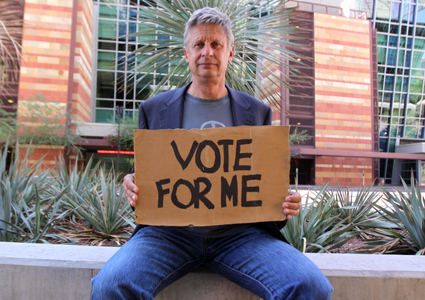
 Laid-back and modest: Gary Johnson, Libertarian Party candidate for President (©GAGE SKIDMORE)
In “Treehouse of Horror VII”, a 1996 episode of The Simpsons, Bob Dole and Bill Clinton, the Republican and Democratic candidates for the presidency that year, are kidnapped by aliens. Two aliens return to earth impeccably disguised as Dole and Clinton. Only Homer — who has also been kidnapped — knows that the supposed candidates are in fact from outer space. He manages to return to earth and, in front of a crowd, reveals the candidate-impersonators’ true identities. The crowd gasps. “It’s true, we are aliens,” says one of them to the crowd. “But what are you going to do about it? It’s a two-party system. You have to vote for one of us.” The crowd look at one another in dismay before someone says: “Well, I believe I’ll vote for a third-party candidate.” “Go ahead, throw your vote away,” says the other alien, laughing.
On Memorial Day weekend, at the end of May, with US television dominated by the news that Donald Trump had secured enough delegates to become the Republican nominee, and with Hillary Clinton on the brink of becoming the Democratic candidate, 997 Libertarian Party delegates meet in Orlando for their national convention, where they elect their presidential and vice-presidential candidates.
For three days, a cavernous space at the back of the Rosen Hotel becomes a place where opening a speech with the line “Are there any Von Mises fans in the house?” prompts a raucous response from the audience. It is a place where a middle-aged woman in a fluorescent pink wig can delay the election of a presidential candidate to ask the chairman for a vote on making Dobby, the house elf from Harry Potter, the official mascot of the Libertarian Party. (“Dobby has no master. Dobby is a free elf.”)
The slogans on delegates’ T-shirts give a flavour of the ideological cocktail on offer: “Marijuana user”, “Enjoy Capitalism” (in the style of the Coca-Cola logo), “I’m already against the next war”, “Free to Marry and Free to Carry”. One features Ayn Rand’s face, torso-sized. Another conveys general exasperation: “Don’t Keep Calm!”
Supporters of this eccentric third party readily admit that the mainstream of American politics usually ignores their zany carnival of democracy, to which delegates arrive with no binding primaries telling them who they must vote for, and in which the vice-presidential candidate is elected, rather than appointed by the presidential candidate as in other parties.
But 2016 is different. While the two main-party candidates are not — as far as we know — alien impostors, many voters are frustrated by the choice between what one attendee described as “Frankenstein and Bride of Frankenstein”. Never before has America had to choose between two major-party candidates for the presidency who provoke so many “strongly unfavourable” responses in the polls. When it comes to revulsion, Hillary Clinton and Donald Trump are record- breakers. Dismayed and discombobulated by plans A and B, many voters are casting around for a plan C.
Libertarians hope they could be that plan C, picking up enough disgruntled Republicans and Democrats to prise open the duopoly that dominates American politics. This is not just the wishful thinking of party activists. As well as an ideology that they insist has broad enough appeal to pick up both Bernie Sanders supporters left with no one to vote for and disgruntled, socially liberal Republicans, the party has a technical claim to being taken seriously in the year of “Never Trump” and “Never Clinton”. There are only three candidates for President on the ballot in all 50 states: the Republican, the Democrat and the Libertarian. If media interest is anything to go by, the Libertarian Party matters as it never has before. Fewer than 20 journalists applied for credentials for the Libertarian Party convention in 2012. This year the number is 250. How will a party whose 45-year history has been defined by a steadfast adherence to an inflexible set of core beliefs survive when it steps out of irrelevance and into the limelight?
Late on Sunday afternoon, James Weeks II, a large man with a thick sandy beard, walks onto the convention stage and into that limelight. He is a candidate for the party’s chairmanship. “Let’s have some fun,” he tells the assembled delegates, journalists and television cameras. He plays a song from his phone, placing the microphone on the lectern next to its speakers to fill the room with tinny country rock. He takes his jacket off, raises his hands above his head and claps along to the beat, urging the crowd to do the same. He removes the lanyard holding his convention credentials. He loosens his tie. And then it dawns on everyone: James Weeks II is going to strip.
With every piece of clothing he peels from his chubby body, every lasso-like swing of his tie above his head and every gyration of his waist, not only does it become clear that his candidacy for the chairmanship may not be entirely serious, it also becomes apparent that the Libertarian Party may not be as prepared, or even willing, to disrupt the duopoly as they say they are.
The crowd is split on the advisability of Weeks’s routine, which he says was the result of a dare made by “an important donor to my Sheriff campaign”. Some are disgusted, or at least think it unhelpful. “I do not want the world to think that is what libertarians are,” one exasperated delegate tells me. “I found that so offensive,” says another, “that it was a violation of the non-aggression pact,” citing what for many is the golden rule of libertarianism. (According to the late economist Murray Rothbard, a leading figure of the movement, the rule dictates that “no violence may be employed against a nonaggressor”; he described it as the “fundamental rule from which can be deduced the entire corpus of libertarian theory”. “NAP” badges are a popular accessory in Orlando.) Others whoop at what they see to be an exhilarating exhibition of the freedom they have come to Florida to celebrate and advance. A few even run on stage to fold a dollar bill under a thong that is perilously close to losing its grip on Weeks’s buttocks. I asked Weeks whether he thought his performance was helpful for the party. “It can’t be worse than Gary Johnson,” he replied as he climbed back into his trousers.
Late on Sunday afternoon, James Weeks II, a large man with a thick sandy beard, walks onto the convention stage and into that limelight. He is a candidate for the party’s chairmanship. “Let’s have some fun,” he tells the assembled delegates, journalists and television cameras. He plays a song from his phone, placing the microphone on the lectern next to its speakers to fill the room with tinny country rock. He takes his jacket off, raises his hands above his head and claps along to the beat, urging the crowd to do the same. He removes the lanyard holding his convention credentials. He loosens his tie. And then it dawns on everyone: James Weeks II is going to strip.
With every piece of clothing he peels from his chubby body, every lasso-like swing of his tie above his head and every gyration of his waist, not only does it become clear that his candidacy for the chairmanship may not be entirely serious, it also becomes apparent that the Libertarian Party may not be as prepared, or even willing, to disrupt the duopoly as they say they are.
The crowd is split on the advisability of Weeks’s routine, which he says was the result of a dare made by “an important donor to my Sheriff campaign”. Some are disgusted, or at least think it unhelpful. “I do not want the world to think that is what libertarians are,” one exasperated delegate tells me. “I found that so offensive,” says another, “that it was a violation of the non-aggression pact,” citing what for many is the golden rule of libertarianism. (According to the late economist Murray Rothbard, a leading figure of the movement, the rule dictates that “no violence may be employed against a nonaggressor”; he described it as the “fundamental rule from which can be deduced the entire corpus of libertarian theory”. “NAP” badges are a popular accessory in Orlando.) Others whoop at what they see to be an exhilarating exhibition of the freedom they have come to Florida to celebrate and advance. A few even run on stage to fold a dollar bill under a thong that is perilously close to losing its grip on Weeks’s buttocks. I asked Weeks whether he thought his performance was helpful for the party. “It can’t be worse than Gary Johnson,” he replied as he climbed back into his trousers.
Most Americans don’t know who Gary Johnson is. Of those that do, most probably have a vague sense of him as “the pot guy” or, at a push, “the libertarian”. As the Republican Governor of New Mexico, a position he held for two terms from 1995 to 2003, he ran a fiscally conservative administration and argued for marijuana legalisation. He is still the highest-ranked elected official to have done so. He also claims to have vetoed more legislation than his 49 contemporary governors combined. He is in Orlando to ask the Libertarians to make him their candidate for the presidency.
In 2011 he dipped his toe into the race for the Republican candidacy. When he didn’t get very far he sought, and won, the Libertarian nomination. As their candidate, he received just under one per cent of the national vote. His own bar for success was five per cent — a level of support which would give the Libertarians “major party” status, an important regulatory distinction — but his 1.27 million votes was still a record number for the party and more than the sum of the votes for all other minor parties.
For a man who wants to be President of the United States, Gary Johnson apologises a lot — often when he doesn’t have anything to apologise for. Apologetic modesty is his default setting. When answering questions, even easy ones, he is prone to raise his shoulders in a shrug, tilt his head, smile and begin his answer with “Look . . .”, “Listen . . .”, “Well . . .” or some other I’m-being-as-reasonable-as-I-can sort of opening. When he complains about not being included in national polls, a regular gripe of his, he does not rail at being shut out of the system; instead, he says calmly, “Hey, why not include this guy?” At one point in the convention he even says, “I constantly apologise for not being the best advocate when it comes to articulating these things.” His style, however, is a mixed blessing. The bumbling means media appearances can fall flat and he often misses opportunities to make a clear case for libertarianism. But by avoiding the kind of declarative statements that go down well with doctrinaire libertarians — “Taxation is theft!” — he has an appeal to voters susceptible to libertarianism of a more common-sense tinge. Added to Johnson’s mild manner is a lack of polish. During one televised press conference in Orlando, a journalist asks how he feels and he releases a loud “Whooooooop!” When asked if he’s a fringe candidate his response is usually “Oh, yeah, totally fringe.” The last time he ran for president he stripped naked and climbed into a hot tub while a reporter profiling him looked on.
Johnson spent his life before politics running Big J Enterprises, a thousand-man construction company that grew out of his work as a door-to-door handyman in college. He is lean and fit, not just by the standards of a 63-year-old but by any measure. In his spare time he runs ultramarathons and takes part in Ironman races (extended triathlons). He has climbed Everest and hasn’t had a drink in 29 years because alcohol was “stopping me being the best rock climber I could be”. He has spent the last few years as CEO of a medical marijuana company and said in March that he uses the drug “occasionally”.
In 2011 he dipped his toe into the race for the Republican candidacy. When he didn’t get very far he sought, and won, the Libertarian nomination. As their candidate, he received just under one per cent of the national vote. His own bar for success was five per cent — a level of support which would give the Libertarians “major party” status, an important regulatory distinction — but his 1.27 million votes was still a record number for the party and more than the sum of the votes for all other minor parties.
For a man who wants to be President of the United States, Gary Johnson apologises a lot — often when he doesn’t have anything to apologise for. Apologetic modesty is his default setting. When answering questions, even easy ones, he is prone to raise his shoulders in a shrug, tilt his head, smile and begin his answer with “Look . . .”, “Listen . . .”, “Well . . .” or some other I’m-being-as-reasonable-as-I-can sort of opening. When he complains about not being included in national polls, a regular gripe of his, he does not rail at being shut out of the system; instead, he says calmly, “Hey, why not include this guy?” At one point in the convention he even says, “I constantly apologise for not being the best advocate when it comes to articulating these things.” His style, however, is a mixed blessing. The bumbling means media appearances can fall flat and he often misses opportunities to make a clear case for libertarianism. But by avoiding the kind of declarative statements that go down well with doctrinaire libertarians — “Taxation is theft!” — he has an appeal to voters susceptible to libertarianism of a more common-sense tinge. Added to Johnson’s mild manner is a lack of polish. During one televised press conference in Orlando, a journalist asks how he feels and he releases a loud “Whooooooop!” When asked if he’s a fringe candidate his response is usually “Oh, yeah, totally fringe.” The last time he ran for president he stripped naked and climbed into a hot tub while a reporter profiling him looked on.
Johnson spent his life before politics running Big J Enterprises, a thousand-man construction company that grew out of his work as a door-to-door handyman in college. He is lean and fit, not just by the standards of a 63-year-old but by any measure. In his spare time he runs ultramarathons and takes part in Ironman races (extended triathlons). He has climbed Everest and hasn’t had a drink in 29 years because alcohol was “stopping me being the best rock climber I could be”. He has spent the last few years as CEO of a medical marijuana company and said in March that he uses the drug “occasionally”.
To the party faithful, Johnson’s name is shorthand for compromise. Many Libertarians are wary — and weary — of self-exiled Republicans using their party as a last-chance saloon. Their 2008 candidate for president, Bob Barr, was once a prominent social conservative whose voting record as a Congressman was given a perfect score by the Christian Coalition, and who, in the 1990s, was a leading figure in the impeachment of Bill Clinton, arguing in Congress that “the flames of hedonism, the flames of narcissism, the flames of self-centred morality are licking at the very foundation of our society.” Barr had gone on something of a political journey to get from there to a sufficiently live-and-let-live approach to feel at home with Libertarians. Yet while “recovering Republicans”, as many describe themselves, make up a significant chunk of Libertarian supporters, there are a good number of members with a left-wing background and, if the Orlando convention is anything to go by, “Republican!” is an insult Libertarians are fond of hurling at each other.
Among delegates I speak to, the spectrum of opinions on Johnson, the Governor turned pot CEO, range from those who just don’t see Johnson as a true Libertarian to those who agree with him when he asks, “If you can’t go straight from A to Z, why not start with B?”
One week before the convention, Johnson burnishes his mainstream credentials by announcing Bill Weld as his preferred running-mate. Weld, 70, was the Republican Governor of Massachusetts from 1991 to 1997. He is about as Yankee-establishment as they come. He is a Harvard man. He sprinkles his speech with sailing metaphors, and the prefix “My old friend” automatically attaches itself to the names of presidents, senators and every other bigwig he mentions. Asked how his family got their money, he once said, “We don’t get money, we have money.”
Both Johnson and Weld were Republican Governors in “blue” (Democrat) states, something that adds to their neither-Trump-nor-Hillary appeal. Weld’s political reputation is built on fiscal conservatism. He may have an orthodox manner and fuddy-duddy instincts (he irritates delegates in Orlando by telling them people think voting Libertarian means that unsavoury types will move into the neighbourhood), but his social liberalism is sincere. As Governor he was an advocate for gay rights and appointed Margaret Marshall, the judge who would go on to rule that same-sex couples in the state had the right to marry. He says of the two main parties, “The Ds are off-base economically and the Rs are off- base on social issues.”
In Orlando, Weld struggles to shake off the impression that at heart he is still a Republican. He tells me, somewhat unconvincingly, that he feels at home at the convention, which “really isn’t that different from a Republican convention, and I’ve been to plenty of those”.
Among delegates I speak to, the spectrum of opinions on Johnson, the Governor turned pot CEO, range from those who just don’t see Johnson as a true Libertarian to those who agree with him when he asks, “If you can’t go straight from A to Z, why not start with B?”
One week before the convention, Johnson burnishes his mainstream credentials by announcing Bill Weld as his preferred running-mate. Weld, 70, was the Republican Governor of Massachusetts from 1991 to 1997. He is about as Yankee-establishment as they come. He is a Harvard man. He sprinkles his speech with sailing metaphors, and the prefix “My old friend” automatically attaches itself to the names of presidents, senators and every other bigwig he mentions. Asked how his family got their money, he once said, “We don’t get money, we have money.”
Both Johnson and Weld were Republican Governors in “blue” (Democrat) states, something that adds to their neither-Trump-nor-Hillary appeal. Weld’s political reputation is built on fiscal conservatism. He may have an orthodox manner and fuddy-duddy instincts (he irritates delegates in Orlando by telling them people think voting Libertarian means that unsavoury types will move into the neighbourhood), but his social liberalism is sincere. As Governor he was an advocate for gay rights and appointed Margaret Marshall, the judge who would go on to rule that same-sex couples in the state had the right to marry. He says of the two main parties, “The Ds are off-base economically and the Rs are off- base on social issues.”
In Orlando, Weld struggles to shake off the impression that at heart he is still a Republican. He tells me, somewhat unconvincingly, that he feels at home at the convention, which “really isn’t that different from a Republican convention, and I’ve been to plenty of those”.
“Isn’t one Republican governor enough?” asks Larry Sharpe, another candidate for the vice presidency, during a debate with Weld. Or as Starchild, an “erotic services provider” and delegate from California who is dressed in tight swimming trunks and a see-through raincoat on which he has written “Demand Transparency”, puts it to me, “If you take on too much water from starboard, you keel over further and further, until eventually you’re sunk.”
Johnson’s two main rivals for the candidacy represent two distinct strands of libertarianism. Austin Petersen is barely eligible for the presidency (you need to be 35 and Petersen has yet to turn 40) but, as he is fond of pointing out, youth never stopped the founding fathers getting things done. He studied drama at college and, in the cadence and structure of his speech, treats even the humblest of hustings as if it is the Gettysburg Address. He has spent all of his adult life in the libertarian movement and his candidacy represents a doctrinaire approach favoured by many in Orlando. Where Johnson hesitates, Petersen is unflinching: abolish the Federal Reserve, leave the United Nations.
Seventy-year-old anti-virus software pioneer John McAfee, an unexpected, and for the Johnson camp unpredictable addition to the field, represents a looser coalition defined less by ideological common ground, and more by a vague desire to be the craziest guys in the room. For the party to nominate McAfee would be to elect a Trump of their own, a newcomer to the party with ever-shifting policy positions and a colourful past sure to deter swaths of voters.
In the build-up to the convention, McAfee releases several slick campaign videos that you can imagine going down well with Americans whose view of the world is shaped by conspiracy-theory videos on YouTube. “Exit Politics” slices between images of senior politicians and US soldiers, clips from official government videos — “Hi, my name is Rachel and I’m from the IRS” — and footage of brainwashed citizens marching to work and to war. Behind this is an unsettling, sometimes jarring, techno beat. The message is: “There’s a virus in our system . . . Politics is power. Politics is lies. Politics is force. Politics is dying. Kill politics so it can be reborn. Be a Libertarian.”
His appeal, as one delegate put it to me, is that he “doesn’t just talk libertarianism, he lives it. You should read about all the crazy shit that has happened to him.” I assume he is referring to McAfee’s Belize years. To cut a long story short, the multi-millionaire built himself a home on an island in Belize in 2008. He lived with seven girlfriends, one of whom tried to shoot him. In 2012 his neighbour was murdered and McAfee was named as a person of interest in the case. He denies any involvement in the killing (not something that is helpful for a presidential candidate to have to clear up). Instead, he claims to have got on the wrong side of the authorities by refusing to offer the kickbacks and protection money they expected from him. McAfee then went on the lam, disguising himself as a poor Guatemalan who sold dolphin carvings, dying his beard, darkening his skin with shoe polish and, as he put it in a blog about his escape, stuffing “a shaved tampon up my right nostril, giving my nose an awkward, disgusting lopsided appearance”. Bizarre, but to a certain type of man of a certain age, heroic. Some of those admirers have made it to Orlando, and wander around their first political convention in T-shirts that read “McAfee. Let Life Live.”
Johnson’s two main rivals for the candidacy represent two distinct strands of libertarianism. Austin Petersen is barely eligible for the presidency (you need to be 35 and Petersen has yet to turn 40) but, as he is fond of pointing out, youth never stopped the founding fathers getting things done. He studied drama at college and, in the cadence and structure of his speech, treats even the humblest of hustings as if it is the Gettysburg Address. He has spent all of his adult life in the libertarian movement and his candidacy represents a doctrinaire approach favoured by many in Orlando. Where Johnson hesitates, Petersen is unflinching: abolish the Federal Reserve, leave the United Nations.
Seventy-year-old anti-virus software pioneer John McAfee, an unexpected, and for the Johnson camp unpredictable addition to the field, represents a looser coalition defined less by ideological common ground, and more by a vague desire to be the craziest guys in the room. For the party to nominate McAfee would be to elect a Trump of their own, a newcomer to the party with ever-shifting policy positions and a colourful past sure to deter swaths of voters.
In the build-up to the convention, McAfee releases several slick campaign videos that you can imagine going down well with Americans whose view of the world is shaped by conspiracy-theory videos on YouTube. “Exit Politics” slices between images of senior politicians and US soldiers, clips from official government videos — “Hi, my name is Rachel and I’m from the IRS” — and footage of brainwashed citizens marching to work and to war. Behind this is an unsettling, sometimes jarring, techno beat. The message is: “There’s a virus in our system . . . Politics is power. Politics is lies. Politics is force. Politics is dying. Kill politics so it can be reborn. Be a Libertarian.”
His appeal, as one delegate put it to me, is that he “doesn’t just talk libertarianism, he lives it. You should read about all the crazy shit that has happened to him.” I assume he is referring to McAfee’s Belize years. To cut a long story short, the multi-millionaire built himself a home on an island in Belize in 2008. He lived with seven girlfriends, one of whom tried to shoot him. In 2012 his neighbour was murdered and McAfee was named as a person of interest in the case. He denies any involvement in the killing (not something that is helpful for a presidential candidate to have to clear up). Instead, he claims to have got on the wrong side of the authorities by refusing to offer the kickbacks and protection money they expected from him. McAfee then went on the lam, disguising himself as a poor Guatemalan who sold dolphin carvings, dying his beard, darkening his skin with shoe polish and, as he put it in a blog about his escape, stuffing “a shaved tampon up my right nostril, giving my nose an awkward, disgusting lopsided appearance”. Bizarre, but to a certain type of man of a certain age, heroic. Some of those admirers have made it to Orlando, and wander around their first political convention in T-shirts that read “McAfee. Let Life Live.”
McAfee is a commanding presence as he ambles through the convention hall. He is friendly and — once you get past the documentary film crew following his every move — approachable. Delegates and even journalists are taken under his arm and spoken to in a way that inspires confidence. Supporters ask him for a photograph and he hugs them like old friends.
Saturday night’s presidential debate begins once Libertarian-sympathising country singer Jordan Page has finished a warm-up set that includes a song called “Arm Yourselves.” Broadcast on C-Span, the debate demonstrates the ideological breadth of the party, the limits of Johnson’s appeal to his party’s delegates and, above all, the possible limits of his party’s appeal to America. As well as Johnson, Petersen and McAfee, Dr Mark Allen Feldman — “the anaesthetist who won’t put you to sleep” — and Daryl Perry, from “the libertarian wing of the Libertarian Party”, take part. The questions tackled by the candidates are nothing like those posed to their Republican and Democratic counterparts; most of them have nothing to do with the issues of day or the concerns of undecided voters. Was America right to enter the First World War? What about the Second? Would you abolish the Federal Reserve? Would you close down the Department of Education?
McAfee uses his opening statement to tell the delegates that none of the party’s candidates will make it to the Oval Office. “If I get one more question about what I will do on my first day in office,” he says, “I will lose it up here.”
Daryl Perry is asked what he thinks the legitimate function of government is. “Your question implies there is a legitimate function of government,” he replies. (In the previous evening’s vice-presidential debate, his notional running-mate William Coley is asked a question about which politically achievable reforms to the tax code he would advocate. “I’m not interested in politically achievable goals,” he answers. “We’re Libertarians. Taxation is theft. Cut it all! Keep cutting!”)
Proceedings reach previously uncharted depths of obscurity when the candidates are asked whether they believe the government has the right to issue driving licences. Johnson says he does; after all, he points out, what about blind people? He is the only candidate on stage that thinks any kind of state involvement in deciding who can and cannot drive is a good idea, a position that prompts boos and cries from the crowd: “Bullshit!”, “Go home, statist!” Throughout the debate, Johnson’s answers get nothing more than polite applause. Dr Feldman raps his closing statement — “I’m that no-pain, no-gain Libertarian/That get those petitions signed in the rain Libertarian” — and the crowd goes wild.
In the end, Johnson and Weld win the nominations they came for. After two rounds of voting, a majority of delegates accept that the two former governors are the only hope they have. The convention is less a choice between credible candidates, more a kind of Libertarian inquisition into the party’s only realistic option, a test of the sincerity of Johnson and Weld’s conversion to the cause. Before he is nominated, Weld is forced onstage to prove his loyalty to the cause. “It’s been 14 days since I became a Libertarian,” he tells the delegates, “and I feel better for it. I think I’ve become a better Libertarian every day . . . I pledge to you that I will stay with the Libertarian Party for life. Frankly, it’s a relief not to have to carry the Republican’s anti-choice, anti-marriage, anti-freedom agenda on my back.” The delegates buy it.
Saturday night’s presidential debate begins once Libertarian-sympathising country singer Jordan Page has finished a warm-up set that includes a song called “Arm Yourselves.” Broadcast on C-Span, the debate demonstrates the ideological breadth of the party, the limits of Johnson’s appeal to his party’s delegates and, above all, the possible limits of his party’s appeal to America. As well as Johnson, Petersen and McAfee, Dr Mark Allen Feldman — “the anaesthetist who won’t put you to sleep” — and Daryl Perry, from “the libertarian wing of the Libertarian Party”, take part. The questions tackled by the candidates are nothing like those posed to their Republican and Democratic counterparts; most of them have nothing to do with the issues of day or the concerns of undecided voters. Was America right to enter the First World War? What about the Second? Would you abolish the Federal Reserve? Would you close down the Department of Education?
McAfee uses his opening statement to tell the delegates that none of the party’s candidates will make it to the Oval Office. “If I get one more question about what I will do on my first day in office,” he says, “I will lose it up here.”
Daryl Perry is asked what he thinks the legitimate function of government is. “Your question implies there is a legitimate function of government,” he replies. (In the previous evening’s vice-presidential debate, his notional running-mate William Coley is asked a question about which politically achievable reforms to the tax code he would advocate. “I’m not interested in politically achievable goals,” he answers. “We’re Libertarians. Taxation is theft. Cut it all! Keep cutting!”)
Proceedings reach previously uncharted depths of obscurity when the candidates are asked whether they believe the government has the right to issue driving licences. Johnson says he does; after all, he points out, what about blind people? He is the only candidate on stage that thinks any kind of state involvement in deciding who can and cannot drive is a good idea, a position that prompts boos and cries from the crowd: “Bullshit!”, “Go home, statist!” Throughout the debate, Johnson’s answers get nothing more than polite applause. Dr Feldman raps his closing statement — “I’m that no-pain, no-gain Libertarian/That get those petitions signed in the rain Libertarian” — and the crowd goes wild.
In the end, Johnson and Weld win the nominations they came for. After two rounds of voting, a majority of delegates accept that the two former governors are the only hope they have. The convention is less a choice between credible candidates, more a kind of Libertarian inquisition into the party’s only realistic option, a test of the sincerity of Johnson and Weld’s conversion to the cause. Before he is nominated, Weld is forced onstage to prove his loyalty to the cause. “It’s been 14 days since I became a Libertarian,” he tells the delegates, “and I feel better for it. I think I’ve become a better Libertarian every day . . . I pledge to you that I will stay with the Libertarian Party for life. Frankly, it’s a relief not to have to carry the Republican’s anti-choice, anti-marriage, anti-freedom agenda on my back.” The delegates buy it.
With their own party more or less onside, Johnson and Weld can shift their focus to Clinton and Trump, who, for all their weaknesses, are more formidable propositions than the likes of Starchild and Daryl Perry. The Libertarians have already achieved what Johnson identified as their first goal: inclusion in the polls. National polls have generally only asked respondents about the two major-party candidates. In the five weeks after the Orlando convention, however, Johnson appears in five of seven national polls — and he does well, averaging ten per cent.
Fifteen is the magic number for him. The Commission on Presidential Debates stipulates that candidates must be included in the televised debates if they have ballot access in enough states for it to be mathematically possible for them to win, a hurdle the Libertarians have already cleared, and have the support of 15 per cent of the electorate according to at least five different polling companies. An appearance alongside Trump and Clinton would be as good an opportunity as Libertarians could wish for to broadcast ideals they are confident chime with millions of Americans. Johnson’s lack of visible hunger for power and relaxed candidness would probably come across well alongside Trump’s egotism and Clinton’s wooden style. There are, however, limits to Johnson’s appeal. For disgruntled Republicans, the Libertarian platform contains the same faults they identify in Trump. Those turned off by the Republican candidate’s incoherent isolationism won’t find refuge with Libertarians, for whom isolationism (though they wouldn’t call it that) is a core belief. Equally, Sanders supporters might agree with Johnson on marijuana legalisation, but they will find very little they like in his robust defence of the free market.
Yet these limits apply only to the extent that voters hold a coherent set of beliefs and make a rational choice when they cast their ballot. If this year has taught us anything, it is that politics isn’t linear and that votes move in unpredictable directions. That is not to say that Gary Johnson is on the way to the White House — but he is going somewhere.
Fifteen is the magic number for him. The Commission on Presidential Debates stipulates that candidates must be included in the televised debates if they have ballot access in enough states for it to be mathematically possible for them to win, a hurdle the Libertarians have already cleared, and have the support of 15 per cent of the electorate according to at least five different polling companies. An appearance alongside Trump and Clinton would be as good an opportunity as Libertarians could wish for to broadcast ideals they are confident chime with millions of Americans. Johnson’s lack of visible hunger for power and relaxed candidness would probably come across well alongside Trump’s egotism and Clinton’s wooden style. There are, however, limits to Johnson’s appeal. For disgruntled Republicans, the Libertarian platform contains the same faults they identify in Trump. Those turned off by the Republican candidate’s incoherent isolationism won’t find refuge with Libertarians, for whom isolationism (though they wouldn’t call it that) is a core belief. Equally, Sanders supporters might agree with Johnson on marijuana legalisation, but they will find very little they like in his robust defence of the free market.
Yet these limits apply only to the extent that voters hold a coherent set of beliefs and make a rational choice when they cast their ballot. If this year has taught us anything, it is that politics isn’t linear and that votes move in unpredictable directions. That is not to say that Gary Johnson is on the way to the White House — but he is going somewhere.