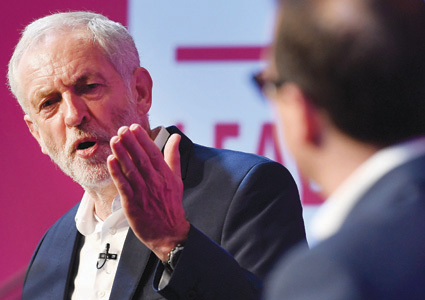
 Wrong focus: Jeremy Corbyn and Owen Smith have proved to be incapable of tuning in to the concerns of Leave-voting Labour supporters (©Jeff J. Mitchell/Getty Images)
The vote to leave the European Union will increasingly be seen to be one of the most transformative actions ever taken by the British people, who were accidentally given the opportunity to decide the future of their country. The electorate seized this opportunity in an astonishing way. Here was a nation instructing its leaders, rather than its leaders, sometimes reluctantly, coming into line with its electorate.
The vote’s final impact could even be greater than that of World War One or World War Two. The Brexit decision marks a totally new phase of British politics which politicians so far are being very slow to comprehend. While Theresa May has responded determinedly to events, it is far from clear that she has yet appreciated the power and scope of the new politics that have been created. Winston Churchill unfairly wrote of Neville Chamberlain’s appeasement record in order to make his own contribution appear greater, but to the detriment of postwar politics that struggled not to see world events through the prism of fighting dictators. Yet the change from Chamberlain to Churchill signalled a transformative move that we should now be equalling. The Chamberlain government saw the war with Hitler as another issue being dealt with using the usual methods of a peacetime government. Churchill made the war total and adopted the government’s machinery so that it reflected the aims and ambitions of the government and the nation. That war was won because victory was the only aim of any importance for the government, even if other peacetime issues pushed their way onto the political agenda. A similar change in the structure of government is needed if our new war by negotiations is to be equally successful.
On the international stage, politics will centre on the repositioning of Britain as a significant player in the world without being part of the EU. This change must not be underestimated. A phase of Britain leading an empire that merged into a commonwealth, followed by a period of what I see as entrapment within the EU, is now at an end. Britain has to refashion its position in the world. While it might be difficult to get politicians to adjust to this new reality, this is the position that we have moved to and from which we have to rebuild our world status.
I hope there will be friendship with the EU, but the period in which we were locked into an inward European arrangement is coming to its peaceful close. How we position ourselves as an independent, but outwardly-looking, moderately significant player on the world stage is a crucial part of the Brexit transition.
Such a transition will, of course, raise our so called “special relationship” with the United States. In the position we will find ourselves it is crucial that we do not treat the US as mother and run to her for protection. One of the weaknesses of our position in postwar politics was the straitjacket into which Churchill brilliantly, but so damagingly, cast Britain. For understandable reasons Churchill was an Americophile. Trying to convince America that it had a special relationship with us, he thought, was crucial to winning World War Two.
Whether there ever was a special relationship that benefitted us in the long term is for others to debate. The idea that this relationship still exists has had a crippling effect on our foreign and defence policy, and has often meant that our country’s long-term interests have been subjected to the short-term demands of our American ally. Brexit will allow this relationship to be recast.
An equally important part of the repositioning of Britain in the world will be the trading links that have to be built upon and greatly expanded. This is not a question of compensating for our lost EU market. The EU holds a huge trading surplus in its favour. This will result, as Sir James Dyson has publicly stated, in the EU’s concession of a free-trade agreement with us. Britain’s repositioning on trade is about how we restructure our economy so that we balance our current account without constantly relying on the inward movement of capital (to be welcomed for other reasons) and the sale of British industry assets (a most unwelcome development) to do so. It is easy to write these words. The task is Herculean. Again one has to question whether the government has yet got the measure of the task for its industrial strategy, and, if it has, why it has settled on a machinery that is so inadequate to deliver that objective.
These are fundamental criticisms of a government embarking on a strategy that no set of politicians has had to undertake since Britain’s fight for survival in 1940 without a governmental machinery that has been reshaped to deliver success.
The government has, however, rightly laid down that one of the cornerstones in its negotiations with Europe — as opposed to the repositioning of Britain in the world — is that we will control our borders. From this decision our negotiations with the EU will commence.
The referendum vote marks a genuine revolt by the masses, and by those people who have the least hold on Britain’s wealth but the greatest affection for their country. This group has had to put up with an ever-growing Europhile elite who have constantly sold Britain short. It is noticeable that in all the time Brian Griffiths spent at the heart of the Thatcher government, as he revealed in the September issue of Standpoint, he never once met a top civil servant who expressed even the slightest whiff of doubt about the European programme in which they had helped trap the British people. This “sell-out” was never more clearly expressed than in the elite’s insistence on an open borders policy and, with it, mass immigration.
But will the Brexit vote be the first of a whole series of transformative actions which not only repudiate the cross-party consensus that our own place is at the very heart of the EU, but begin to build a new chapter in the nation’s history? The government says the vote to leave the EU will be implemented and its strategy is shaped around the control of our borders. This is, I believe, the first move but it must only be a first move.
It should be from the basis of controlling our borders that the government will negotiate its continued access to the single market. That should be the aim, although I do not underestimate the difficulties of holding to the borders cornerstone policy and being successful on this front as well. It will require a huge amount of the government’s time, effort and drive. It is at this point that the machinery the Prime Minister has established again troubles me.
An effective control of our borders needs to operate differently from the present status quo. What will control of the borders mean in practice? The objective must be to control the numbers but there are grave concerns over the machinery that will help achieve that objective. I do not believe that the UK Visas and Immigration Service, as it is currently structured, is able to implement a government policy of bringing down the level of immigration. Such a strategy will take time and, meanwhile, we need whatever border controls we can muster. We must begin to build up an alternative form of border control. This should centre around a system which will allow the government to develop a totally new approach involving in the administration of border controls those sectors of British industry that have most interest in it working successfully.
Universities are a case in point. These are a huge growth industry and wealth creator for the British economy. Whether universities treat overseas students well and honourably is another issue. But through the new Home Secretary, Amber Rudd, the government needs to open negotiations with the Vice-Chancellors, telling them they are free to open their universities to any number of overseas students, providing a key condition is fulfilled. Many of the students coming here will want to have the experience of working in the British economy for two years. One of the leakages is that during this period a number of them will marry and may therefore have the right to remain. That is a price we pay for developing a more dynamic economy. But the universities, in being able to market their wares in the most attractive ways, acquire a duty. Their quota of students must be linked to their guaranteeing that the students return to their countries of origin after two years of work experience. Once the Vice-Chancellors live up to their responsibilities and ensure the new system works, student numbers should come out of the official migration data. The same delegated approach — for instance with the manufacturing and engineering body the EEF — should be adopted whereby the federation applies for a quota of work permits which should be granted in the first instance, but only on the condition that the federation has put in hand a training programme for British workers so that their request for the numbers of work permits will fall.
In negotiating our continued access to the single market, the government will not be going into the negotiating chamber naked. As I mentioned earlier, Europe benefits hugely from its trade surplus in having access to the British market. There is an £89.5 billion surplus on physical trade, as against a £20.9 billion British gain on services.
There has already been talk that the EU may make a deal over manufactured goods, but would resist one on services. That division of our manufacturing and services must be resisted at all costs.
An effective control of our borders needs to operate differently from the present status quo. What will control of the borders mean in practice? The objective must be to control the numbers but there are grave concerns over the machinery that will help achieve that objective. I do not believe that the UK Visas and Immigration Service, as it is currently structured, is able to implement a government policy of bringing down the level of immigration. Such a strategy will take time and, meanwhile, we need whatever border controls we can muster. We must begin to build up an alternative form of border control. This should centre around a system which will allow the government to develop a totally new approach involving in the administration of border controls those sectors of British industry that have most interest in it working successfully.
Universities are a case in point. These are a huge growth industry and wealth creator for the British economy. Whether universities treat overseas students well and honourably is another issue. But through the new Home Secretary, Amber Rudd, the government needs to open negotiations with the Vice-Chancellors, telling them they are free to open their universities to any number of overseas students, providing a key condition is fulfilled. Many of the students coming here will want to have the experience of working in the British economy for two years. One of the leakages is that during this period a number of them will marry and may therefore have the right to remain. That is a price we pay for developing a more dynamic economy. But the universities, in being able to market their wares in the most attractive ways, acquire a duty. Their quota of students must be linked to their guaranteeing that the students return to their countries of origin after two years of work experience. Once the Vice-Chancellors live up to their responsibilities and ensure the new system works, student numbers should come out of the official migration data. The same delegated approach — for instance with the manufacturing and engineering body the EEF — should be adopted whereby the federation applies for a quota of work permits which should be granted in the first instance, but only on the condition that the federation has put in hand a training programme for British workers so that their request for the numbers of work permits will fall.
In negotiating our continued access to the single market, the government will not be going into the negotiating chamber naked. As I mentioned earlier, Europe benefits hugely from its trade surplus in having access to the British market. There is an £89.5 billion surplus on physical trade, as against a £20.9 billion British gain on services.
There has already been talk that the EU may make a deal over manufactured goods, but would resist one on services. That division of our manufacturing and services must be resisted at all costs.
Here is where the machinery, or lack of it, in government begins to come into play. To win this most crucial battle, it is necessary to harness every available source of friendly influence and power in the EU. Some of these powers have broken cover and called for the German government, for example, to negotiate their continued access to the British market.
The lobbying operation that is required to make contact with each European company that exports into our market cannot be underestimated. We need to persuade these individual firms to lobby their own governments, both through their trade associations and, if they are large enough, individually on the open trade access they would like to see continue with Britain. The task is huge, but the prize is equally great.
What of Article 50? It should not be invoked quickly, possibly not for years. Failure to trigger this mechanism must not be seen as a sell-out, but part of the most careful negotiating stance. It is important to remember that no preliminary work on a transition programme was undertaken prior to the referendum vote, as the old elite thought they had the Remain vote in the bag. That work now needs to be undertaken. A response to our failure to trigger Article 50 has brought forth a certain anger from parts of the European Commission. If we negotiate well, there will be much more of that anger in future.
Article 50 should be triggered only when it is in the interests of Britain to do so. The convenience of our European partners is not one of our main concerns. France and Germany have elections next year and little progress in formal negotiations can possibly take place until these elections are completed and new governments formed. This gives us valuable time, but even then Article 50 should only be invoked when we are ready to exploit it.
Our strategy must be explained. The Prime Minister should point this out and say we are busy talking with governments and organisations that will have a bearing on the final outcome of membership and access to the EU’s single market.
The European Commission is assuredly right in that we cannot conclude trading deals with other countries while we are still a member of the EU and have not given notice to leave. But a huge amount of negotiating work can be achieved without moving to a formal stage when new treaties will be signed. We should not forget that we are trying to navigate totally new territory without the aid of a map and compass that our EU exit will provide to other large countries if and when their people have a vote to decide their own destinies.
The lobbying operation that is required to make contact with each European company that exports into our market cannot be underestimated. We need to persuade these individual firms to lobby their own governments, both through their trade associations and, if they are large enough, individually on the open trade access they would like to see continue with Britain. The task is huge, but the prize is equally great.
What of Article 50? It should not be invoked quickly, possibly not for years. Failure to trigger this mechanism must not be seen as a sell-out, but part of the most careful negotiating stance. It is important to remember that no preliminary work on a transition programme was undertaken prior to the referendum vote, as the old elite thought they had the Remain vote in the bag. That work now needs to be undertaken. A response to our failure to trigger Article 50 has brought forth a certain anger from parts of the European Commission. If we negotiate well, there will be much more of that anger in future.
Article 50 should be triggered only when it is in the interests of Britain to do so. The convenience of our European partners is not one of our main concerns. France and Germany have elections next year and little progress in formal negotiations can possibly take place until these elections are completed and new governments formed. This gives us valuable time, but even then Article 50 should only be invoked when we are ready to exploit it.
Our strategy must be explained. The Prime Minister should point this out and say we are busy talking with governments and organisations that will have a bearing on the final outcome of membership and access to the EU’s single market.
The European Commission is assuredly right in that we cannot conclude trading deals with other countries while we are still a member of the EU and have not given notice to leave. But a huge amount of negotiating work can be achieved without moving to a formal stage when new treaties will be signed. We should not forget that we are trying to navigate totally new territory without the aid of a map and compass that our EU exit will provide to other large countries if and when their people have a vote to decide their own destinies.
Again it comes back to the machinery of government and whether the capacity and drive exists to meet the task confronting us. By voting to leave, the British public chose to end our 43-year membership of a Common Market that was developed into a European Union with all the lack of safeguards to dissident members that Europe offers. The Brexit vote means that the electorate wants the governing elite to use its energy in representing to the outside world the type of Britain we are fast becoming. This will take a huge amount of imagination and resources, if it is to be achieved successfully. What relevance has a Corbyn-led Labour Party to these momentous developments?
Sadly, very little; for Labour is increasingly making itself irrelevant to this debate. The Parliamentary Labour Party is overwhelmingly made up of Europhile MPs whose main stance has little appeal to the electorate. Jeremy Corbyn, on the other hand, has been correct in highlighting the role of globalisation as a force for huge losses for our poorest citizens in the short term. But his internationalist position prevents him from having a borders policy or a Labour Party that is relevant to a large sector of the remaining Labour core vote. Labour’s irrelevance to the debate which is beginning to rage on the shape of the new Britain at home and abroad will be seized upon by others, and particularly by UKIP.
Labour has made this UKIP’s opportunity, under its new leader. UKIP are on the right page. The party stands for the politics of identity, locality and links to a culture which is one of shared experiences and memories for local inhabitants. The Labour Party has turned its back on this concern. The problem here is that more than 120 Labour seats voted for Brexit.
These seats are overwhelmingly represented by Europhile Labour MPs. What will these MPs have to say to the UKIP candidate at the next election when all they offer is an undoing of the Brexit decision and a bowl of the same gruel to which the poor have been subjected for the last decade or more?
I have always seen UKIP’s long-term threat to be to the Labour Party while it has been acting as a convenient vehicle for a Tory protest vote. UKIP has replaced the role of the old Liberal Party in gathering such protest votes which, generally speaking, return to the Tory fold at subsequent elections.
Whether UKIP continues in its current form will partly depend on the antics of Arron Banks, the multimillionaire insurance dealer who backed his own Brexit strategy and is now threatening to form a new right-wing party based on the internet. We may well see Nigel Farage reappear as its leader to exercise his natural talents as a public figure as the pleasures of retirement fade.
If this scenario takes shape, it will clear the way for UKIP to become a centre-left party appealing to Labour voters concerned with identity, culture, place and borders. Presumably in such circumstances UKIP would begin to develop an economic and social strategy favouring those who have lost most from the open borders policy that globalisation has entailed. Any young, or perhaps not so young, politician wanting to lead a centre-left party would seriously wait to see how UKIP develops, for in a multi-party new Britain UKIP is quite capable of emerging as a centre-left party shorn of much of its right-wing vote siphoned off into Arron Banks’s new venture.
Sadly, very little; for Labour is increasingly making itself irrelevant to this debate. The Parliamentary Labour Party is overwhelmingly made up of Europhile MPs whose main stance has little appeal to the electorate. Jeremy Corbyn, on the other hand, has been correct in highlighting the role of globalisation as a force for huge losses for our poorest citizens in the short term. But his internationalist position prevents him from having a borders policy or a Labour Party that is relevant to a large sector of the remaining Labour core vote. Labour’s irrelevance to the debate which is beginning to rage on the shape of the new Britain at home and abroad will be seized upon by others, and particularly by UKIP.
Labour has made this UKIP’s opportunity, under its new leader. UKIP are on the right page. The party stands for the politics of identity, locality and links to a culture which is one of shared experiences and memories for local inhabitants. The Labour Party has turned its back on this concern. The problem here is that more than 120 Labour seats voted for Brexit.
These seats are overwhelmingly represented by Europhile Labour MPs. What will these MPs have to say to the UKIP candidate at the next election when all they offer is an undoing of the Brexit decision and a bowl of the same gruel to which the poor have been subjected for the last decade or more?
I have always seen UKIP’s long-term threat to be to the Labour Party while it has been acting as a convenient vehicle for a Tory protest vote. UKIP has replaced the role of the old Liberal Party in gathering such protest votes which, generally speaking, return to the Tory fold at subsequent elections.
Whether UKIP continues in its current form will partly depend on the antics of Arron Banks, the multimillionaire insurance dealer who backed his own Brexit strategy and is now threatening to form a new right-wing party based on the internet. We may well see Nigel Farage reappear as its leader to exercise his natural talents as a public figure as the pleasures of retirement fade.
If this scenario takes shape, it will clear the way for UKIP to become a centre-left party appealing to Labour voters concerned with identity, culture, place and borders. Presumably in such circumstances UKIP would begin to develop an economic and social strategy favouring those who have lost most from the open borders policy that globalisation has entailed. Any young, or perhaps not so young, politician wanting to lead a centre-left party would seriously wait to see how UKIP develops, for in a multi-party new Britain UKIP is quite capable of emerging as a centre-left party shorn of much of its right-wing vote siphoned off into Arron Banks’s new venture.