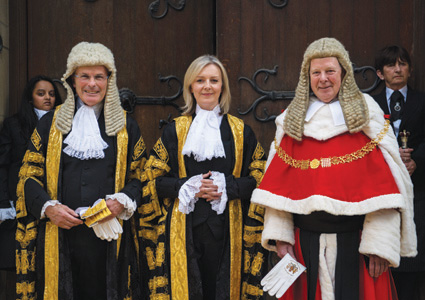
 Not the job it used to be: Lord Chancellor Liz Truss with Lord Thomas (right), the Lord Chief Justice, and Lord Dyson, the Master of the Rolls (©CARL COURT/GETTY IMAGES)
The recent decision of the Divisional Court on Article 50 of the Treaty of European Union (now under appeal) has brought intense public focus to bear on the judges who made that decision, and to a lesser extent on the common law principles with which the court’s reasoning is saturated. However, the vigorously personal denigration in certain quarters of those judges, and the descent of some newspapers to the debating standards of the internet troll, should not conceal the fact that this is an exceptional reaction. For most of the time, non-lawyers take the proper functioning of the English legal system for granted. They know that one of its principal elements is the common law, and that common law is judge-made law, but they usually prefer their judges — even senior judges — to be relatively anonymous. This contrasts with the US, where nominees for the Supreme Court endure wide public exposure through congressional hearings and televised inquisition. As for our own highest court, few would recognise (say) Lord Hoffmann — a great recent judge — by his photograph, and we are broadly content that it should be so.
The present agitation illustrates why judges matter. They form, together with the executive and the legislature, one of the three pillars of our constitution. This is one reason why UKIP’s call for “democratic control” over judges is historically illiterate as well as deplorable. Society axiomatically benefits from a judiciary in good fettle, vigilantly defending our rights and freedoms, even — particularly — when there is violent disagreement over what those rights are. For this reason, senior judges have enjoyed a special status in our settlement: holding independent office under the Crown, uncorrupted and beyond ambition (save to be superior judges) or any reproach of personal interest. They are perhaps the only part of our polity in which the public retains a measure of confidence (excluding, apparently, headline writers in the Daily Mail).
We should be proud of our common law too. It has been said that English common law is as important a contribution to European civilisation as the Gothic cathedrals of France or the quattrocento paintings of the Renaissance. Our political history is intimately connected with it. Moreover, the calibre of the common law depends on that of the judges from whom it emanates. For its distinctive feature is that it emerges from the ground up; it is produced by the resolution of myriad disputes by individual judges over centuries. This process uncovers legal principles which, by a benign fiction, are imagined as having existed forever, and the resultant structure is a body of precedent which stretches back over 400 years. All this is quite different from the codified system of a priori rule-making, which has its origins in Roman law, was adopted by Napoleon and is in place in continental Europe. Judges moreover determine our rights in cases under all manner of statutes and regulations, where they are expected to display those qualities which we value in them, no less than when they are engaged in the more creative task of fashioning the common law.
As a consequence of recent constitutional change, especially the abolition in all but name of the office of Lord Chancellor in 2005, our judges are an endangered species. Any threat to the quality of judges is serious and needs, more than it has been, to be a matter of public debate. The focus is on High Court and Court of Appeal judges who, since few cases progress to the Supreme Court, are responsible for applying and where necessary making most of the law which affects us all. (This is not to imply that lower tier judges are immune to the difficulties their senior colleagues face; far from it.)
Why are judges an endangered species? Not (despite current suggestions to the contrary) because of the unpleasantly populist attacks to which they are occasionally subject: judges are used to trying controversial cases, and they bear occasional gouts of public anger with reasonable equanimity. No, the judiciary is in trouble because for the last decade it has been inadequately defended and represented where it ought to be — at the heart of government — and it has been subjected to increasingly unfavourable and unattractive conditions of entry, work and pay. The result is that fewer good candidates apply to become judges, and those that are appointed are increasingly overworked, demoralised and prone to early retirement. This state of affairs naturally becomes known to barristers, and so fewer apply for promotion. One statistic illustrates the point: a recent recruitment competition held by the Judicial Appointments Commission (JAC) — of which more later — advertised up to 15 High Court vacancies. Only eight places were filled. This was a direct function of the paltry number of candidates who applied. The Family Division is struggling to find any new judges to sit. More and more cases are tried by deputy judges (which is not what litigants expect), so the JAC has had to launch a fresh recruitment campaign for deputies (couched in unseductive albeit peremptory terms).
These facts represent a fundamental change in and challenge to judicial recruitment. Until recently, a place on the High Court bench was thought almost universally among barristers to be the pinnacle of their career, carrying with it not only the coveted knighthood (this at least remains) but an almost automatic gain in respect and status, to compensate for a significant diminution in income. New appointments were envied and congratulated on having achieved an acknowledged career goal. As a result, nearly everyone was prepared to take the shilling. Not any longer.
To understand the background to this trend, one needs to start with the powers of the Lord Chancellor prior to 2005. He was almost the greatest man in the land. In formal precedence standing just below the royal family, between the Archbishops of Canterbury and York and above the Prime Minister, he was by right the presiding officer of the House of Lords, a senior member of the Cabinet, a departmental head (of the Lord Chancellor’s Department, which dwindled successively between 2003 and 2005 into the Department of Constitutional Affairs and then the Ministry of Justice), the presiding Lord of Appeal and President of the Courts of England and Wales. (One can argue the pros and cons of this concentration of powers in one person, although allegations of practical conflict or impropriety have in modern times been non-existent. As Lord Hoffmann has written in this context, one can apply too much “fundamentalist rigour” in relation to the doctrine of separation of powers.)
Why are judges an endangered species? Not (despite current suggestions to the contrary) because of the unpleasantly populist attacks to which they are occasionally subject: judges are used to trying controversial cases, and they bear occasional gouts of public anger with reasonable equanimity. No, the judiciary is in trouble because for the last decade it has been inadequately defended and represented where it ought to be — at the heart of government — and it has been subjected to increasingly unfavourable and unattractive conditions of entry, work and pay. The result is that fewer good candidates apply to become judges, and those that are appointed are increasingly overworked, demoralised and prone to early retirement. This state of affairs naturally becomes known to barristers, and so fewer apply for promotion. One statistic illustrates the point: a recent recruitment competition held by the Judicial Appointments Commission (JAC) — of which more later — advertised up to 15 High Court vacancies. Only eight places were filled. This was a direct function of the paltry number of candidates who applied. The Family Division is struggling to find any new judges to sit. More and more cases are tried by deputy judges (which is not what litigants expect), so the JAC has had to launch a fresh recruitment campaign for deputies (couched in unseductive albeit peremptory terms).
These facts represent a fundamental change in and challenge to judicial recruitment. Until recently, a place on the High Court bench was thought almost universally among barristers to be the pinnacle of their career, carrying with it not only the coveted knighthood (this at least remains) but an almost automatic gain in respect and status, to compensate for a significant diminution in income. New appointments were envied and congratulated on having achieved an acknowledged career goal. As a result, nearly everyone was prepared to take the shilling. Not any longer.
To understand the background to this trend, one needs to start with the powers of the Lord Chancellor prior to 2005. He was almost the greatest man in the land. In formal precedence standing just below the royal family, between the Archbishops of Canterbury and York and above the Prime Minister, he was by right the presiding officer of the House of Lords, a senior member of the Cabinet, a departmental head (of the Lord Chancellor’s Department, which dwindled successively between 2003 and 2005 into the Department of Constitutional Affairs and then the Ministry of Justice), the presiding Lord of Appeal and President of the Courts of England and Wales. (One can argue the pros and cons of this concentration of powers in one person, although allegations of practical conflict or impropriety have in modern times been non-existent. As Lord Hoffmann has written in this context, one can apply too much “fundamentalist rigour” in relation to the doctrine of separation of powers.)
What is important for present purposes is that the Lord Chancellor was the head of the judiciary and responsible for the appointment of judges. He acted as their representative in Parliament and government. He was the champion of their independence and of the maintenance of the rule of law.
Tony Blair’s Constitutional Reform Act 2005 had the principal aim of stripping the Lord Chancellor of almost all of his powers, and the whole of his status (though the formal precedence somewhat forlornly remains). A second purpose of the Act was to replace the House of Lords as the top appellate court by a new Supreme Court, in which the Lord Chancellor was to play no part. It is fair to say that the legal profession remains divided over the wisdom of or necessity for this change. A third function of the Act was radically to alter the way judges were appointed. Here again, the role of the Lord Chancellor was emasculated: there was to be a new, independent appointments body (the JAC), and the Act contained detailed prescriptions as to how it should function.
The story of constitutional reform can be told in graphic form by three pictures. In that part of the Inner Temple reserved for Benchers (senior members of the Inn), there hang at the time of writing three adjacent portraits, appropriately of diminishing size, of successive Lord Chancellors.
First, Lord Irvine, Blair’s first Lord Chancellor and a devoted supporter of Labour in the long march to 1997. Shortly after that first election victory, the then Robert Cranborne let it be known to Conservatives struggling to reconcile themselves to the new order that there was no need to worry about Derry Irvine — he was really a high Tory. The understanding between the two men produced the 1999 compromise over the continued presence of the hereditary peers in the Lords which endures to this day. There is no denying the air of self-confidence about the sitter: his hour has come. Only in retrospect can one see the significance of his justified pride in office. Irvine was a constitutional conservative. He keenly exercised what Lord Hailsham called the first duty of the Lord Chancellor, namely defending the standing of the judiciary. His judicial appointments were made with “a fierce independence” that made our judiciary “the envy of Europe” (Lord Hoffmann again).
The second picture is of Irvine’s successor, Lord Falconer. Blair’s former flatmate was unexpectedly appointed in 2003 to replace Irvine, who had been dismissed in a “brutal and unseemly” gesture — the adjectives are David Blunkett’s — recalling Henry V’s rejection of Falstaff. The Falconer portrait is not reflective of his genial personality; rather, the artist seems to have discerned a note of iconoclastic mischief. For the original plan, once Irvine was out of the way, and without any consultation of, for example, the senior judiciary, was to abolish the Lord Chancellorship altogether. This idea was as technically ill-conceived as it was constitutionally rash. Its execution was chaotic: the then Cabinet Secretary, Lord Turnbull has described it as “on the day . . . a complete mess-up”. The 2010 report of the House of Lords Constitution Committee (insufficiently noticed by the press) was scathing about the process: proper constitutional norms were disregarded in a “particularly disturbing” way; there was a lamentable absence of planning and advice-taking, and “wholly inadequate consultation” both within government and outside, for which there was “no justification”.
Tony Blair’s Constitutional Reform Act 2005 had the principal aim of stripping the Lord Chancellor of almost all of his powers, and the whole of his status (though the formal precedence somewhat forlornly remains). A second purpose of the Act was to replace the House of Lords as the top appellate court by a new Supreme Court, in which the Lord Chancellor was to play no part. It is fair to say that the legal profession remains divided over the wisdom of or necessity for this change. A third function of the Act was radically to alter the way judges were appointed. Here again, the role of the Lord Chancellor was emasculated: there was to be a new, independent appointments body (the JAC), and the Act contained detailed prescriptions as to how it should function.
The story of constitutional reform can be told in graphic form by three pictures. In that part of the Inner Temple reserved for Benchers (senior members of the Inn), there hang at the time of writing three adjacent portraits, appropriately of diminishing size, of successive Lord Chancellors.
First, Lord Irvine, Blair’s first Lord Chancellor and a devoted supporter of Labour in the long march to 1997. Shortly after that first election victory, the then Robert Cranborne let it be known to Conservatives struggling to reconcile themselves to the new order that there was no need to worry about Derry Irvine — he was really a high Tory. The understanding between the two men produced the 1999 compromise over the continued presence of the hereditary peers in the Lords which endures to this day. There is no denying the air of self-confidence about the sitter: his hour has come. Only in retrospect can one see the significance of his justified pride in office. Irvine was a constitutional conservative. He keenly exercised what Lord Hailsham called the first duty of the Lord Chancellor, namely defending the standing of the judiciary. His judicial appointments were made with “a fierce independence” that made our judiciary “the envy of Europe” (Lord Hoffmann again).
The second picture is of Irvine’s successor, Lord Falconer. Blair’s former flatmate was unexpectedly appointed in 2003 to replace Irvine, who had been dismissed in a “brutal and unseemly” gesture — the adjectives are David Blunkett’s — recalling Henry V’s rejection of Falstaff. The Falconer portrait is not reflective of his genial personality; rather, the artist seems to have discerned a note of iconoclastic mischief. For the original plan, once Irvine was out of the way, and without any consultation of, for example, the senior judiciary, was to abolish the Lord Chancellorship altogether. This idea was as technically ill-conceived as it was constitutionally rash. Its execution was chaotic: the then Cabinet Secretary, Lord Turnbull has described it as “on the day . . . a complete mess-up”. The 2010 report of the House of Lords Constitution Committee (insufficiently noticed by the press) was scathing about the process: proper constitutional norms were disregarded in a “particularly disturbing” way; there was a lamentable absence of planning and advice-taking, and “wholly inadequate consultation” both within government and outside, for which there was “no justification”.
To keep Irvine out of the loop in relation to such an important change because he might oppose it (one excuse given) was “a bizarre negation of Cabinet government”. Another (characteristically Blairite) pretext for the absence of consultation was the risk of leaks.
As a result of this shambles, the government found it impossible after all to somersault the Lord Chancellorship backwards out of existence. Instead, Falconer oversaw the dismantling of the constitutional settlement around his position, as well as (crucially) the link between the judiciary and the centre of executive and legislative power. The result was what Baroness Kennedy has called “a dog’s breakfast”, which stemmed from Blair and Blunkett having “got tired of hearing the judiciary being defended by Lord Irvine”. As she said: “The strength of the traditional role was that it was filled by a very experienced lawyer with hinterland who had no further ambition and would therefore fearlessly defend the rule of law and independence of lawyers and judges against bullying authoritarian Cabinet colleagues.”
This result is enshrined in the 2005 Act, one of the more dismal pieces of legislation from the Blair years. By section 3, the Lord Chancellor now shares the duty to uphold the independence of the judiciary with “other ministers of the Crown and all with responsibility for matters relating to the judiciary” (although it is true that Section 3(6) identifies certain matters to which the Lord Chancellor alone must “have regard”, and Section 17 provides the terms of the office-holder’s oath, which include swearing to defend the independence of the judiciary). It is just as well that the Lord Chancellor shares responsibility with others, because the vapid criteria contained in Section 2 provide that the Prime Minister can appoint as Lord Chancellor anyone he or she wants, as long as they are “qualified by experience”, including experience as an MP or minister, or by “other experience that the Prime Minister considers relevant”.
The job of representing the judges to government has now devolved upon the Lord Chief Justice. As a serving judge, he may not take his seat or speak in the House of Lords; if he wishes to listen to a debate, he may, like any Privy Councillor, sit on the steps of the throne. He thus has to make himself heard in Westminster from the Royal Courts of Justice in the Strand. The Act makes him responsible for representing the views of the judiciary to Parliament, to the Lord Chancellor and to ministers. It entitles him “to lay before Parliament written representations on matters that appear to him to be matters of importance relating to the judiciary”. He can, in other words, write a letter. It is no criticism of the present Chief, Lord Thomas of Cwmgiedd, to observe that he is inevitably less effective in standing up for the judges (for all his efforts) than if he were opposite the PM in Cabinet, or addressing Parliament.
It is hard for the eyes not to water when one considers Falconer’s comments on the appointment of the current (and currently notorious) Lord Chancellor, Liz Truss, a non-lawyer, in July 2016. Although Falconer’s website currently proclaims as one of his achievements the “work[ing] out [of] a detailed new relationship between the judiciary and the executive, embodied in” the 2005 Act, he is most unhappy with the way it is operating. Even before the Article 50 brouhaha, he expressed “strong concern that [Theresa May] had failed to comply with her constitutional obligation to appoint . . . someone who appeared qualified to defend the rule of law”.
As a result of this shambles, the government found it impossible after all to somersault the Lord Chancellorship backwards out of existence. Instead, Falconer oversaw the dismantling of the constitutional settlement around his position, as well as (crucially) the link between the judiciary and the centre of executive and legislative power. The result was what Baroness Kennedy has called “a dog’s breakfast”, which stemmed from Blair and Blunkett having “got tired of hearing the judiciary being defended by Lord Irvine”. As she said: “The strength of the traditional role was that it was filled by a very experienced lawyer with hinterland who had no further ambition and would therefore fearlessly defend the rule of law and independence of lawyers and judges against bullying authoritarian Cabinet colleagues.”
This result is enshrined in the 2005 Act, one of the more dismal pieces of legislation from the Blair years. By section 3, the Lord Chancellor now shares the duty to uphold the independence of the judiciary with “other ministers of the Crown and all with responsibility for matters relating to the judiciary” (although it is true that Section 3(6) identifies certain matters to which the Lord Chancellor alone must “have regard”, and Section 17 provides the terms of the office-holder’s oath, which include swearing to defend the independence of the judiciary). It is just as well that the Lord Chancellor shares responsibility with others, because the vapid criteria contained in Section 2 provide that the Prime Minister can appoint as Lord Chancellor anyone he or she wants, as long as they are “qualified by experience”, including experience as an MP or minister, or by “other experience that the Prime Minister considers relevant”.
The job of representing the judges to government has now devolved upon the Lord Chief Justice. As a serving judge, he may not take his seat or speak in the House of Lords; if he wishes to listen to a debate, he may, like any Privy Councillor, sit on the steps of the throne. He thus has to make himself heard in Westminster from the Royal Courts of Justice in the Strand. The Act makes him responsible for representing the views of the judiciary to Parliament, to the Lord Chancellor and to ministers. It entitles him “to lay before Parliament written representations on matters that appear to him to be matters of importance relating to the judiciary”. He can, in other words, write a letter. It is no criticism of the present Chief, Lord Thomas of Cwmgiedd, to observe that he is inevitably less effective in standing up for the judges (for all his efforts) than if he were opposite the PM in Cabinet, or addressing Parliament.
It is hard for the eyes not to water when one considers Falconer’s comments on the appointment of the current (and currently notorious) Lord Chancellor, Liz Truss, a non-lawyer, in July 2016. Although Falconer’s website currently proclaims as one of his achievements the “work[ing] out [of] a detailed new relationship between the judiciary and the executive, embodied in” the 2005 Act, he is most unhappy with the way it is operating. Even before the Article 50 brouhaha, he expressed “strong concern that [Theresa May] had failed to comply with her constitutional obligation to appoint . . . someone who appeared qualified to defend the rule of law”.
He had appraised the performance of a previous lay Lord Chancellor, Chris Grayling, in similar terms, complaining that David Cameron “had failed to comply with the obligations placed upon him by Section 2 . . . to appoint somebody to the job with special qualities that would suit him to performing the job”. (Readers will already have discerned that the Section 2 qualities do not include as a necessary qualification any connection with the law.)
Should one laugh or cry? What did Falconer think was going to happen, when the government of which he was a senior member had opened the Lord Chancellorship to all who fulfilled the near-meaningless conditions in Section 2? The double-think of this matchless Vicar of Bray, who almost uniquely squared his political conscience to serve under both Blair and Jeremy Corbyn, has extended to an expression of regret for ever having supported the abolition of the rôle of Lord Chancellor in the first place. It took him only till 2006 to say: “it was perfectly obvious [sic] that in being a defender of the independence of the judiciary and the rule of law within government, you are greatly assisted by holding a great historical office . . . There is no benefit whatsoever in abolishing the office if one of the things that the office has got to do is defend judges within government”. But by then, the sorcerer’s apprentice had done the damage; and Falconer, in a final piece of nose-thumbing, has since returned to private practice as a barrister and partner in an American law firm in London (something which none of his predecessors would have contemplated, and which judges are not permitted to do).
The Lord Chancellor now doubles as the Minister of Justice (it is of course the other way round: the old title is simply an elegiac shadow of the new). But there is more to the change than the fact that a Ministry of Justice sounds disagreeably Orwellian to English ears: Liz Truss has her hands full with the prison service as well as the legal system, and it remains to be seen how high in her political priorities ranks the well-being of the judiciary, and how influential are any representations which she makes on its behalf. There are few grounds for optimism on either score, all the more so given her widely criticised and apparently reluctant statement following the more Jacobin criticisms of the Article 50 judgment.
And the third picture? This is of Lord Falconer’s 2007 successor as Lord Chancellor, Jack Straw. Although he did at least practise as a barrister — between 1972 and 1974 — his main achievement was as the first Lord Chancellor to sit in the House of Commons since the 16th century. This fact is alluded to in the Inner Temple portrait. The jade-green chair in which he sits rings an artistic bell, but in case one cannot place the quotation, one is prompted by a crumpled postcard in the background, of no less a figure than Sir Thomas More in the Holbein depiction. It is with the saint that the viewer is implausibly invited to compare the sitter — a true case of less is Straw.
Should one laugh or cry? What did Falconer think was going to happen, when the government of which he was a senior member had opened the Lord Chancellorship to all who fulfilled the near-meaningless conditions in Section 2? The double-think of this matchless Vicar of Bray, who almost uniquely squared his political conscience to serve under both Blair and Jeremy Corbyn, has extended to an expression of regret for ever having supported the abolition of the rôle of Lord Chancellor in the first place. It took him only till 2006 to say: “it was perfectly obvious [sic] that in being a defender of the independence of the judiciary and the rule of law within government, you are greatly assisted by holding a great historical office . . . There is no benefit whatsoever in abolishing the office if one of the things that the office has got to do is defend judges within government”. But by then, the sorcerer’s apprentice had done the damage; and Falconer, in a final piece of nose-thumbing, has since returned to private practice as a barrister and partner in an American law firm in London (something which none of his predecessors would have contemplated, and which judges are not permitted to do).
The Lord Chancellor now doubles as the Minister of Justice (it is of course the other way round: the old title is simply an elegiac shadow of the new). But there is more to the change than the fact that a Ministry of Justice sounds disagreeably Orwellian to English ears: Liz Truss has her hands full with the prison service as well as the legal system, and it remains to be seen how high in her political priorities ranks the well-being of the judiciary, and how influential are any representations which she makes on its behalf. There are few grounds for optimism on either score, all the more so given her widely criticised and apparently reluctant statement following the more Jacobin criticisms of the Article 50 judgment.
And the third picture? This is of Lord Falconer’s 2007 successor as Lord Chancellor, Jack Straw. Although he did at least practise as a barrister — between 1972 and 1974 — his main achievement was as the first Lord Chancellor to sit in the House of Commons since the 16th century. This fact is alluded to in the Inner Temple portrait. The jade-green chair in which he sits rings an artistic bell, but in case one cannot place the quotation, one is prompted by a crumpled postcard in the background, of no less a figure than Sir Thomas More in the Holbein depiction. It is with the saint that the viewer is implausibly invited to compare the sitter — a true case of less is Straw.
The link between these constitutional shenanigans and the decline in judicial morale is a simple one. As Lord Hoffmann has observed, that link exemplifies the unintended consequences which can be brought about by the application of approved political theories to effect constitutional change. Nobody within shouting distance of the seat of power (which about describes the Lord Chief Justice’s position) is standing up for the judges any more. There is no effective departmental head to scotch a tide of civil service-driven corrosion of the conditions under which judges work. So it is not surprising that their quality of life has deteriorated sufficiently for many to wonder why they should carry on doing the job. Ultimately, the question is not whether this attitude is reasonable. One can argue about whether the judges should be entitled to stay in (often far from palatial) lodgings while they are working long hours trying important cases dozens or hundreds of miles from home. It is easy to scoff at the supposed inadequacy of judges’ pension arrangements, given that the High Court salary is currently £180,000. This is not the point. Judges always used to be willing to accept appointment, and to do so at the acme of their professional careers and the peak of their earnings, a financial sacrifice which brought lustre to the system and the appointee alike. There is no reason why they would not go on being willing, if the conditions were tolerable, if they were accorded respect and independence, and if they were valued for doing selfless and demanding work of public importance. But they aren’t.
In the old days, judges were appointed by the Lord Chancellor, after he had consulted other judges and senior lawyers. The first that a future judge knew of his or her fate was on receipt of a telephone call from the Lord Chancellor himself, issuing a summons to a meeting in the House of Lords, at which he would then issue a face-to-face invitation. The metaphorical hand on the shoulder and the flattering attention of this demigod nearly always did the trick. Those who were called submitted to being chosen.
To recall the old selection process is not to succumb to a misty-eyed appraisal of the presumed perfection of judges of previous eras: one need only read Richard Davenport-Hines’ account in An English Affair of Lord Parker’s behaviour in connection with the Stephen Ward trial, and of the revered Lord Denning’s prurience and naïveté in the Profumo inquiry, to recognise that there was no invariable pre-lapsarian standard from which current judges must be taken to have departed. But the widespread view in the profession is that, whatever its theoretical demerits, the old system worked.
It is all different now. For a start, individuals must apply to the JAC, if they think that the time has come to put themselves forward for judicial office. The process of application is a mixture of the banal and the distasteful. The guidance on how to apply promulgated by the JAC advises that “it can take several hours to complete a judicial application, particularly if you have never applied before, so you will need to leave plenty of time.” Candidates need to demonstrate their own competencies in numerous areas, providing “specific examples” by way of justification. They have to follow the SOAR model, explaining the Situation facing them, their Objective, the Action they took and the positive Result.
In the old days, judges were appointed by the Lord Chancellor, after he had consulted other judges and senior lawyers. The first that a future judge knew of his or her fate was on receipt of a telephone call from the Lord Chancellor himself, issuing a summons to a meeting in the House of Lords, at which he would then issue a face-to-face invitation. The metaphorical hand on the shoulder and the flattering attention of this demigod nearly always did the trick. Those who were called submitted to being chosen.
To recall the old selection process is not to succumb to a misty-eyed appraisal of the presumed perfection of judges of previous eras: one need only read Richard Davenport-Hines’ account in An English Affair of Lord Parker’s behaviour in connection with the Stephen Ward trial, and of the revered Lord Denning’s prurience and naïveté in the Profumo inquiry, to recognise that there was no invariable pre-lapsarian standard from which current judges must be taken to have departed. But the widespread view in the profession is that, whatever its theoretical demerits, the old system worked.
It is all different now. For a start, individuals must apply to the JAC, if they think that the time has come to put themselves forward for judicial office. The process of application is a mixture of the banal and the distasteful. The guidance on how to apply promulgated by the JAC advises that “it can take several hours to complete a judicial application, particularly if you have never applied before, so you will need to leave plenty of time.” Candidates need to demonstrate their own competencies in numerous areas, providing “specific examples” by way of justification. They have to follow the SOAR model, explaining the Situation facing them, their Objective, the Action they took and the positive Result.
The JAC has drafted a “competency framework” which lists “behaviours” which an applicant must instance — with those examples, of course. So a candidate must provide accounts of their acting with integrity, being fair, demonstrating independence of mind, attentiveness, courtesy, resilience and so on. (One might think that anyone who can provide examples of his own integrity is ipso facto unsuitable for the Bench.) It is fortunate that people of talent are willing to undergo this infantilised process, but they are ever fewer. The leading legal journalist Joshua Rozenberg has referred to a “misconceived appointments system”; many agree.
In the context of the present crisis, it is almost by-the-by to suggest that selection by quango is fallible and, in the minds of many observers, frequently productive of less good judges than the Lord Chancellor’s fiat, for all that our process-mad society holds the former to be superior because more transparent. Announcements of new appointments are not infrequently greeted among barristers with disbelief or bemusement. But in circumstances where the number and quality of candidates volunteering for judicial office are declining, the JAC cannot be blamed if the best candidates available (assuming it chooses them) are sometimes not good enough.
Relatively little seems to have been written by judges on the consequences for them of the Blair reforms, as opposed to the reforms themselves, no doubt in part because judges are a loyal, discreet and publicly uncomplaining bunch, whose own preference for anonymity is antithetical to becoming part of the story themselves. Few serving judges are willing to go on the record, although present and former Chief Justices have been critical of the relegation of the role of Lord Chancellor in particular (for example Lord Judge’s essays in The Safest Shield). Even retired judges have an understandable preference to speak unattributably. But no one can dispute that the judiciary is voting with its feet.
So what, finally, is it that is so unattractive about being a senior judge these days? What are the factors that Lord Thomas has referred to as “very substantial deterrents to joining the Bench”? Why do judges feel, in his words, “not valued or appreciated for their work”?
People often talk of the unwritten covenant between society and its servicemen. There used to be a similar bond between society and the judges. They were not employees, still less civil servants, but (as stated) office-holders under the Crown. Until the mid-1990s, they were often not appointed until about the age of 60 (thereby giving them time to accumulate a self-employed person’s pension), and they retired after 15 years having earned in full an index-linked pension based on half final earnings. This was seen as a very important part of the overall remuneration package. Cushy? Not compared with the sort of earnings which most of them could have commanded and which they renounced for good. Other intangible elements of the covenant were the loyal support of a Lord Chancellor who would know them personally, the joining of a cadre of motivated high-achievers and the assurance that, barring some gross misconduct, they would be left alone to get on with the job of judging cases. And now?
In the context of the present crisis, it is almost by-the-by to suggest that selection by quango is fallible and, in the minds of many observers, frequently productive of less good judges than the Lord Chancellor’s fiat, for all that our process-mad society holds the former to be superior because more transparent. Announcements of new appointments are not infrequently greeted among barristers with disbelief or bemusement. But in circumstances where the number and quality of candidates volunteering for judicial office are declining, the JAC cannot be blamed if the best candidates available (assuming it chooses them) are sometimes not good enough.
Relatively little seems to have been written by judges on the consequences for them of the Blair reforms, as opposed to the reforms themselves, no doubt in part because judges are a loyal, discreet and publicly uncomplaining bunch, whose own preference for anonymity is antithetical to becoming part of the story themselves. Few serving judges are willing to go on the record, although present and former Chief Justices have been critical of the relegation of the role of Lord Chancellor in particular (for example Lord Judge’s essays in The Safest Shield). Even retired judges have an understandable preference to speak unattributably. But no one can dispute that the judiciary is voting with its feet.
So what, finally, is it that is so unattractive about being a senior judge these days? What are the factors that Lord Thomas has referred to as “very substantial deterrents to joining the Bench”? Why do judges feel, in his words, “not valued or appreciated for their work”?
People often talk of the unwritten covenant between society and its servicemen. There used to be a similar bond between society and the judges. They were not employees, still less civil servants, but (as stated) office-holders under the Crown. Until the mid-1990s, they were often not appointed until about the age of 60 (thereby giving them time to accumulate a self-employed person’s pension), and they retired after 15 years having earned in full an index-linked pension based on half final earnings. This was seen as a very important part of the overall remuneration package. Cushy? Not compared with the sort of earnings which most of them could have commanded and which they renounced for good. Other intangible elements of the covenant were the loyal support of a Lord Chancellor who would know them personally, the joining of a cadre of motivated high-achievers and the assurance that, barring some gross misconduct, they would be left alone to get on with the job of judging cases. And now?
First, the basic terms and benefits. If the sacrifice involved in becoming a judge is too financially dispiriting, people will just not make it. A judge nowadays is expected to serve 20 years, not 15, and has to retire at 70. That means that he or she is usually appointed younger than previously, with fewer years of barrister’s earnings under the belt. In the last few years, real pay has gone down 20 per cent or more. (A proposed 3 per cent award in 2016 was not made.) More importantly, the pension entitlement has been radically transformed without regard for what was originally promised judges on appointment. The details are complex, but the amounts payable on retirement, especially if a barrister has contributed to a pension before appointment, are greatly reduced. The pension scheme used to be non-contributory; now judges must contribute. These major changes, instituted by Grayling, were deeply resented, especially their retrospective imposition. The handling of judges’ pensions has, more than any other factor, precipitated the present recruitment crisis and engendered an irremediable loss of trust. The Senior Salaries Review Body’s 2013 report summed up the situation: “The combination of the reduction in the value of the pension and prolonged pay restraint will result in a tipping point when there will be too few of the right quality willing to make the transition. We believe we may be at that tipping point now.”
Second, the workload has increased hugely: judges are now ridiculously overworked. This is not universally understood, especially by those who draw attention to their court hours, which are (paradigmatically) 10.30am to 4.15pm. Quite apart from the fact that judges often sit for much longer than this, there is a total misconception here. The demands of pre-reading (which have increased enormously as advocacy in English courts is increasingly conducted on paper), judgment-writing, dealing with written applications, as well as other administrative tasks, all remorselessly consume judges’ early mornings, evenings and weekends. To a degree, long hours have always been part of the deal, but there is simply much more litigation for judges to cope with: human rights cases, immigration and asylum cases, judicial review applications exist in numbers undreamed-of formerly; the growth in the number of litigants in person imposes especial burdens; and the number of judges has not kept pace with the increase in the volume of work.
Third, judges are now subjected, in a way that would have been unimaginable 20 years ago, to civil service oversight. Whereas judges used to be responsible for their own working conditions and (it was thought) could be trusted to be efficient and diligent, the control of their environment is now in the hands of officials. These appear to be principally interested in ensuring that judges try cases faster, try more of them, and produce judgments in a timescale inimical to the quality of the result. Judges feel pressured by a bureaucracy that appears to have little understanding of the nature of the job, and to be concerned only with targets, efficiency and cost savings. They are also burdened with ever more tasks which have some general connection with the administration of justice, but nothing to do with being a judge. A large proportion of the time of members of the Court of Appeal is spent in performing administrative tasks or overseeing departmental activity. Some members do little else. A recent survey has found that 77 per cent of judges with leadership responsibilities feel that their work has increased significantly in the past three years, and that they have to deal with an increasing number of complex matters in addition to their daily court sittings.
Second, the workload has increased hugely: judges are now ridiculously overworked. This is not universally understood, especially by those who draw attention to their court hours, which are (paradigmatically) 10.30am to 4.15pm. Quite apart from the fact that judges often sit for much longer than this, there is a total misconception here. The demands of pre-reading (which have increased enormously as advocacy in English courts is increasingly conducted on paper), judgment-writing, dealing with written applications, as well as other administrative tasks, all remorselessly consume judges’ early mornings, evenings and weekends. To a degree, long hours have always been part of the deal, but there is simply much more litigation for judges to cope with: human rights cases, immigration and asylum cases, judicial review applications exist in numbers undreamed-of formerly; the growth in the number of litigants in person imposes especial burdens; and the number of judges has not kept pace with the increase in the volume of work.
Third, judges are now subjected, in a way that would have been unimaginable 20 years ago, to civil service oversight. Whereas judges used to be responsible for their own working conditions and (it was thought) could be trusted to be efficient and diligent, the control of their environment is now in the hands of officials. These appear to be principally interested in ensuring that judges try cases faster, try more of them, and produce judgments in a timescale inimical to the quality of the result. Judges feel pressured by a bureaucracy that appears to have little understanding of the nature of the job, and to be concerned only with targets, efficiency and cost savings. They are also burdened with ever more tasks which have some general connection with the administration of justice, but nothing to do with being a judge. A large proportion of the time of members of the Court of Appeal is spent in performing administrative tasks or overseeing departmental activity. Some members do little else. A recent survey has found that 77 per cent of judges with leadership responsibilities feel that their work has increased significantly in the past three years, and that they have to deal with an increasing number of complex matters in addition to their daily court sittings.
In these circumstances, it is not surprising that judicial morale is low. It is scarcely an exaggeration to say that when two or three judges are gathered together, conversation turns to the adverse conditions under which they are trying to do their job. It is the daily subject of high table discussion, another example of something that never used to happen. Recent retirees look 10 years younger, while they pursue third careers in arbitration or mediation. And the proof of the pudding is that the JAC’s problems in recruiting a sufficient volume of new judges are undeniable and serious. Of those that are appointed, a higher than ever proportion are taking early retirement. Indeed, this is increasingly becoming the norm, even among the most loyal and public-spirited.
It is true that there are still some first-class candidates putting themselves forward to become judges. Many judges still produce good or outstanding judgments, and nearly all of them work extraordinarily hard. There is a case for saying that judges cannot be immune from the cuts which affect other public servants. In the light of recent events, a contemptuous tabloid reaction to judicial dissatisfaction can easily be imagined. But if the position suggested in this article is even half-accurate, the long-term future is worrying. The onus then passes to those who maintain that, despite the deterioration in judicial conditions of work, willingness to serve and morale, the system can go on producing high-quality judges and judgments indefinitely. If it cannot, so much the worse for our common law, and for us all. Who knows when the judiciary will be called upon to assert the ancient liberties of British citizens against an overbearing executive or a tyrannical legislative majority — to declare (plucking an example at random) that a government cannot, by purportedly exercising the royal prerogative, abrogate rights conferred by Parliament?
Society is only as healthy as its judges, and its judges will in the end be no better than the way they are treated.
It is true that there are still some first-class candidates putting themselves forward to become judges. Many judges still produce good or outstanding judgments, and nearly all of them work extraordinarily hard. There is a case for saying that judges cannot be immune from the cuts which affect other public servants. In the light of recent events, a contemptuous tabloid reaction to judicial dissatisfaction can easily be imagined. But if the position suggested in this article is even half-accurate, the long-term future is worrying. The onus then passes to those who maintain that, despite the deterioration in judicial conditions of work, willingness to serve and morale, the system can go on producing high-quality judges and judgments indefinitely. If it cannot, so much the worse for our common law, and for us all. Who knows when the judiciary will be called upon to assert the ancient liberties of British citizens against an overbearing executive or a tyrannical legislative majority — to declare (plucking an example at random) that a government cannot, by purportedly exercising the royal prerogative, abrogate rights conferred by Parliament?
Society is only as healthy as its judges, and its judges will in the end be no better than the way they are treated.