In 2011 a Chinese diplomat told his British counterpart, “What you have to remember is that you come from a weak and declining nation.” Two years later Vladimir Putin’s official spokesman commented in public that Britain is “just a small island . . . No one pays any attention to them”. If Henry Kissinger is to be believed, ever since Sun Tzu’s Art of War in the 5th century BC China’s realpolitik has placed a premium on gaining psychological advantage. And, judging by his first formal meeting with Angela Merkel in 2007, so does Putin. Knowing her phobia of dogs, he made sure that the door was left ajar, so that his black Labrador could nudge his way in.
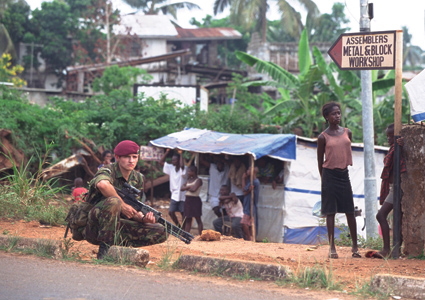
A British soldier on patrol during the Sierra Leone civil war, 2000: Military intervention isn’t necessarily doomed to failure (©Patrick Robert/CORBIS/Sygma via Getty Images)
Our aggressive, authoritarian enemies are keen to talk up Britain’s decline, weakness and irrelevance, because they want us to believe it. And because they know that many of us already do. Every major political party in Britain now includes circles convinced that Britain should stop straining to be a global player. Among Labour’s Corbynistas, most Liberal Democrats and Scottish Nationalists, and even some Conservatives the retirement-narrative prevails. Under Tony Blair in Iraq and Afghanistan, and then under David Cameron in Libya, so the story goes, Britain sought to punch above its weight and got soundly beaten for its pains. The moral of the story is therefore clear: we British must get real, forswear our lingering imperial pretensions, stop trying to live on as a global power by playing poodle to the United States, settle for the modest rank of a middle-class European power, and leave the world’s policing to the UN.
Happily, Theresa May’s view is not so defeatist. Addressing Republican leaders in Philadelphia at the end of January, she asserted that Britain “is a global nation that recognises its responsibilities to the world”, affirmed our commitment to the liberal world order that has prevailed since 1945, and called for the renewal of Anglo-American partnership in leading the free world. “When others step up as we step back,” she said, “it is bad for America, for Britain and the world.” And the following day she extracted a public statement from President Trump that the US is “one hundred per cent behind Nato”.
But the Prime Minister is not only more confident than those urging Britain’s retirement; she is also more realistic. The UN is no substitute for states. Its power to enforce international law and order is limited to the resources that states give it. And not infrequently that power is reduced to the impotent expression of indignation and moral suasion.
This is not to say that the UN is unimportant. Not at all. The UN is enormously valuable as a standing forum for international communication and as an international bar at which states are required to give an account of their actions and to suffer criticism. At its best, it’s a forum for the forging of international consensus as the basis of concerted action.
But it is not a global government, and until trust among states worldwide has risen to a degree that now seems utopian, it will not become one. Adam Roberts, former President of the British Academy, regards the vision of a comprehensive security system based on the UN as “an impossible ideal” and the aspiration to create it as “hopelessly optimistic”. “The Security Council”, he writes, “is not an impartial judicial body, but a deeply political organisation”, whose members have “very different perspectives on the world and the threats it faces”. If that ever came as news to anybody, it surely does not now: the Security Council’s paralysis over Syria writes it big and bold.
So if Britain were to retire from global policing, it could not hand over responsibility to the UN; it could only hand it over to other states. But if some states have to carry it, then why should not we? What special excuse would relieve us of the responsibility? What would give us moral permission to walk away?
II
It is true, of course, that Britain cannot aspire to defend and promote a liberal global order on its own. Yet even at the height of our imperial power we seldom fought alone and we often paid others to do our fighting for us: among the troops that Wellington commanded in defeating Napoleon at Waterloo, Britons were a minority.
It is also true that we are now bound to be a junior partner to the US. Nevertheless, the retirement-narrative is wrong to imply, as it typically does, that this subordinate role humiliates Britain into playing America’s lap-dog. In the 1960s Harold Wilson refused to send British troops to Vietnam; in the 1980s Margaret Thatcher arm-twisted Ronald Reagan into supporting the ejection of the Argentines from the Falkland Islands; and in the 1990s Tony Blair — most unpoodle-like — publicly embarrassed a very reluctant (and resentful) Bill Clinton into deploying US military force in Kosovo and Serbia. Unequal partnership need not involve unconditional compliance.
Some of those who counsel the abandonment of any part in global leadership do so because they object to Britain’s use of hard power. But is that because no one should use it at all, or because someone else should use it instead and better? Unless they buy into an impossibly sunny view of human beings and ignore the obvious lessons of history, they have to acknowledge that intractably malevolent leaders can sometimes move nation-states to do atrocious things. And unless they’re pacifist, they also have to acknowledge that sometimes atrocious things must be stopped by armed force.
So if Britain were to retire from global policing, it could not hand over responsibility to the UN; it could only hand it over to other states. But if some states have to carry it, then why should not we? What special excuse would relieve us of the responsibility? What would give us moral permission to walk away?
II
It is true, of course, that Britain cannot aspire to defend and promote a liberal global order on its own. Yet even at the height of our imperial power we seldom fought alone and we often paid others to do our fighting for us: among the troops that Wellington commanded in defeating Napoleon at Waterloo, Britons were a minority.
It is also true that we are now bound to be a junior partner to the US. Nevertheless, the retirement-narrative is wrong to imply, as it typically does, that this subordinate role humiliates Britain into playing America’s lap-dog. In the 1960s Harold Wilson refused to send British troops to Vietnam; in the 1980s Margaret Thatcher arm-twisted Ronald Reagan into supporting the ejection of the Argentines from the Falkland Islands; and in the 1990s Tony Blair — most unpoodle-like — publicly embarrassed a very reluctant (and resentful) Bill Clinton into deploying US military force in Kosovo and Serbia. Unequal partnership need not involve unconditional compliance.
Some of those who counsel the abandonment of any part in global leadership do so because they object to Britain’s use of hard power. But is that because no one should use it at all, or because someone else should use it instead and better? Unless they buy into an impossibly sunny view of human beings and ignore the obvious lessons of history, they have to acknowledge that intractably malevolent leaders can sometimes move nation-states to do atrocious things. And unless they’re pacifist, they also have to acknowledge that sometimes atrocious things must be stopped by armed force.
Perhaps they think that the UN should do the policing — but the UN commands only as many regiments as states choose to loan it. No doubt a thoroughly post-imperial, Scandinavian-like Britain would lend its troops for peacekeeping purposes. So who, then, would fight the wars to make the just peace to be kept?
Maybe what the advocates of retirement want is not exactly the UK’s abandonment of hard power so much as its strict submission to the collective will of the UN Security Council. If so, however, they would be content for the enforcement capacity of the UN to be at the mercy of the threat of veto by Putin’s Russia and the Communist Party’s China, neither of whose records of humanitarian concern are exactly famous. They would also join Alex Salmond in condemning Nato’s 1999 military intervention to end ethnic cleansing in Kosovo, and prevent the implosion of Macedonia, as a “misguided” policy of “dubious legality and unpardonable folly”. Embarrassingly, however, this would align them against the then UN Secretary-General, Kofi Annan. It would also set them at odds with most international lawyers. Commenting on the Kosovo intervention, Martti Koskenniemi, widely considered to be a leading historian and philosopher of international law, has written that “most lawyers — including myself — have taken the ambivalent position that it was both formally illegal and morally necessary”.
Regardless of Security Council authorisation, surely Britain should forswear “liberal imperialism”. The term is a loaded one, of course, and allows only one answer. If “imperialism” means the unjustified and rapacious domination of foreign peoples, then, of course, Britain should forswear it. But was it “imperialist” to intervene in Kosovo in 1999, to save Muslims from ethnic cleansing and Macedonia from implosion? Was it “imperialist” to defend the government of Sierra Leone in 2000 from take-over by diamond-hungry, drug-crazed, limb-chopping rebels? Was it “imperialist” in 2001 to dislodge the cruelly puritan and misogynist Taliban regime in Afghanistan — and cruel, by the way, not just in Western eyes, but in lots of Afghan ones as well? Was it “imperialist” in 2011 to prevent what might have been another Srebrenica in Libya, and then to uproot its cause?
Which brings us to the elephant in the room: the invasion and occupation of Iraq. Surely that was “imperialist”? Well, no. It might have been foolish and it might have been bungled, but it wasn’t for oil, and it wasn’t for territory, and we really, really did not want to stay there for a moment longer than we had to. (That, of course, was a major part of the original problem.) Even a hostile witness such as the redoubtable Emma Sky, no friend of the invasion, admits that when she arrived in Baghdad in 2003 primed with abject apologies for Western interference, she was astonished to be met with a wave of Iraqi gratitude at the fall of Saddam Hussein’s dreadful regime.
Maybe what the advocates of retirement want is not exactly the UK’s abandonment of hard power so much as its strict submission to the collective will of the UN Security Council. If so, however, they would be content for the enforcement capacity of the UN to be at the mercy of the threat of veto by Putin’s Russia and the Communist Party’s China, neither of whose records of humanitarian concern are exactly famous. They would also join Alex Salmond in condemning Nato’s 1999 military intervention to end ethnic cleansing in Kosovo, and prevent the implosion of Macedonia, as a “misguided” policy of “dubious legality and unpardonable folly”. Embarrassingly, however, this would align them against the then UN Secretary-General, Kofi Annan. It would also set them at odds with most international lawyers. Commenting on the Kosovo intervention, Martti Koskenniemi, widely considered to be a leading historian and philosopher of international law, has written that “most lawyers — including myself — have taken the ambivalent position that it was both formally illegal and morally necessary”.
Regardless of Security Council authorisation, surely Britain should forswear “liberal imperialism”. The term is a loaded one, of course, and allows only one answer. If “imperialism” means the unjustified and rapacious domination of foreign peoples, then, of course, Britain should forswear it. But was it “imperialist” to intervene in Kosovo in 1999, to save Muslims from ethnic cleansing and Macedonia from implosion? Was it “imperialist” to defend the government of Sierra Leone in 2000 from take-over by diamond-hungry, drug-crazed, limb-chopping rebels? Was it “imperialist” in 2001 to dislodge the cruelly puritan and misogynist Taliban regime in Afghanistan — and cruel, by the way, not just in Western eyes, but in lots of Afghan ones as well? Was it “imperialist” in 2011 to prevent what might have been another Srebrenica in Libya, and then to uproot its cause?
Which brings us to the elephant in the room: the invasion and occupation of Iraq. Surely that was “imperialist”? Well, no. It might have been foolish and it might have been bungled, but it wasn’t for oil, and it wasn’t for territory, and we really, really did not want to stay there for a moment longer than we had to. (That, of course, was a major part of the original problem.) Even a hostile witness such as the redoubtable Emma Sky, no friend of the invasion, admits that when she arrived in Baghdad in 2003 primed with abject apologies for Western interference, she was astonished to be met with a wave of Iraqi gratitude at the fall of Saddam Hussein’s dreadful regime.
Putting aside the semantics of “imperialism”, is it not true that we have learned that Western meddling, however well intentioned, has not been successful and does more evil than good? No, I do not think we have. Human affairs seldom occasion perfect success. Most Anglo-Saxons agree that regime-change in Berlin in 1945 was a very good thing, but it did require the deaths of between 60 and 80 million human beings, and it did result in the surrender of eastern Europe to the tender mercies of Stalin. The war against fascism was a success, but it was not morally pure: it involved evils and wrongs, and it entailed them.
Britain’s military interventions in the past two decades have achieved different levels of success: Sierra Leone was perhaps the most successful, followed by Kosovo. The results in Afghanistan, Iraq, and Libya have been much more mixed, but not even these have been simple failures. As the young Iraqi entrepreneur said five years ago, when I asked him whether the 2003 invasion should have happened: “It’s good that it happened; it could have been done better; and it isn’t over.”
III
That said, it is certainly true that our recent experience has rightly chastened us: regime-toppling is the relatively easy bit; regime-reconstruction is a lot more complicated and difficult. In Afghanistan, Iraq and Libya there was clearly a mismatch between our ambition and our commitment, and one lesson that we should learn for the future is to marry the two better, either by lowering our ambitions or raising our commitments.
But the lesson we should not learn is that military intervention is generally hopeless and that in future, Britain should give it a wide berth. In support, I call two witnesses, both of whom have served as soldiers, diplomats, and politicians, and both of whom have had direct experience of responsibility for nation-building: Paddy Ashdown and Rory Stewart.
Ashdown, the international High Representative for Bosnia and Herzegovina from 2002-6, argues that high-profile failures like Iraq should not blind us to the fact that, overall, the success stories outnumber the failures by a wide margin. Notwithstanding the fact that we got it considerably wrong in Iraq and Afghanistan, he remains convinced that there is a way of getting it right.
Britain’s military interventions in the past two decades have achieved different levels of success: Sierra Leone was perhaps the most successful, followed by Kosovo. The results in Afghanistan, Iraq, and Libya have been much more mixed, but not even these have been simple failures. As the young Iraqi entrepreneur said five years ago, when I asked him whether the 2003 invasion should have happened: “It’s good that it happened; it could have been done better; and it isn’t over.”
III
That said, it is certainly true that our recent experience has rightly chastened us: regime-toppling is the relatively easy bit; regime-reconstruction is a lot more complicated and difficult. In Afghanistan, Iraq and Libya there was clearly a mismatch between our ambition and our commitment, and one lesson that we should learn for the future is to marry the two better, either by lowering our ambitions or raising our commitments.
But the lesson we should not learn is that military intervention is generally hopeless and that in future, Britain should give it a wide berth. In support, I call two witnesses, both of whom have served as soldiers, diplomats, and politicians, and both of whom have had direct experience of responsibility for nation-building: Paddy Ashdown and Rory Stewart.
Ashdown, the international High Representative for Bosnia and Herzegovina from 2002-6, argues that high-profile failures like Iraq should not blind us to the fact that, overall, the success stories outnumber the failures by a wide margin. Notwithstanding the fact that we got it considerably wrong in Iraq and Afghanistan, he remains convinced that there is a way of getting it right.
Rory Stewart was the Coalition Provisional Authority’s deputy governor of two provinces of southern Iraq from 2003-4. He approached the task of building a more stable, prosperous Iraq with optimism, but experience brought him disillusion. He now thinks that foreigners’ short-term commitment, ignorance of local conditions, and consequent inability to build on local strengths, hamstrings many of their well-intentioned efforts. Nevertheless, he remains convinced that “there is still a possibility of avoiding the horrors not only of Iraq but also of Rwanda; and that there is a way of approaching intervention than can be good for us and good for the country concerned”.
Ashdown and Stewart know whereof they speak: both have had first-hand experience of trying to make intervention work and, despite being chastened, still believe that intervention can be done well. With the right strategy creating the right conditions, sufficient success is possible. Writing in the wake of the publication of the Chilcot Inquiry’s report, Emma Sky agrees: “We need to put the Iraq war in perspective. It’s not about doing nothing. It’s about doing the right things. Previous interventions saved thousands of lives in Iraqi Kurdistan in 1991, in Kosovo in 1999, and in Sierra Leone in 2000.”
On this point, however, Mrs May appears to disagree. After calling for a renewal of Anglo-Saxon leadership, she told her Philadelphia audience: “This cannot mean a return to the failed policies of the past. The days of Britain and America intervening in sovereign countries in an attempt to remake the world in our own image are over.” Taken by themselves, these two sentences seem to abjure military intervention overseas, and, fitting the template of the familiar retirement-narrative, they were widely reported by the London media. Not reported at all, however, was the passage that followed immediately: “But nor can we afford to stand idly by when the threat is real and when it is in our own interests to intervene. We must be strong, smart and hard-headed. And we must demonstrate the resolve necessary to stand up for our interests.”
The Prime Minister was being too subtle for the journalists. On a diplomatic mission, she was seeking to woo American Republicans, many of them with isolationist tendencies, onto common ground. One easy way to do that, was to agree: “Iraq and Afghanistan: never again!” But in saying this she was doing little more than voicing common sense. No one in their right minds would do Iraq and Afghanistan again in the same way as we did it the first time; serious mistakes in ambition, planning, and execution were made, and only fools would repeat them.
Ashdown and Stewart know whereof they speak: both have had first-hand experience of trying to make intervention work and, despite being chastened, still believe that intervention can be done well. With the right strategy creating the right conditions, sufficient success is possible. Writing in the wake of the publication of the Chilcot Inquiry’s report, Emma Sky agrees: “We need to put the Iraq war in perspective. It’s not about doing nothing. It’s about doing the right things. Previous interventions saved thousands of lives in Iraqi Kurdistan in 1991, in Kosovo in 1999, and in Sierra Leone in 2000.”
On this point, however, Mrs May appears to disagree. After calling for a renewal of Anglo-Saxon leadership, she told her Philadelphia audience: “This cannot mean a return to the failed policies of the past. The days of Britain and America intervening in sovereign countries in an attempt to remake the world in our own image are over.” Taken by themselves, these two sentences seem to abjure military intervention overseas, and, fitting the template of the familiar retirement-narrative, they were widely reported by the London media. Not reported at all, however, was the passage that followed immediately: “But nor can we afford to stand idly by when the threat is real and when it is in our own interests to intervene. We must be strong, smart and hard-headed. And we must demonstrate the resolve necessary to stand up for our interests.”
The Prime Minister was being too subtle for the journalists. On a diplomatic mission, she was seeking to woo American Republicans, many of them with isolationist tendencies, onto common ground. One easy way to do that, was to agree: “Iraq and Afghanistan: never again!” But in saying this she was doing little more than voicing common sense. No one in their right minds would do Iraq and Afghanistan again in the same way as we did it the first time; serious mistakes in ambition, planning, and execution were made, and only fools would repeat them.
But does this really mean that the next time a Rwanda erupts, or a Srebrenica threatens, Mrs May will shut her eyes to the plight of those at the sharp end of atrocity or genocide, and turn away? I certainly hope not, and her public endorsement of Policy Exchange’s recent report, The Cost of Doing Nothing: The Price of Inaction in the Face of Mass Atrocities, gives us reason to think not. She who registered the complaints of the not-quite-managing here at home will not suddenly become deaf to the cries of those seriously-not-managing abroad. So we would intervene.
However, having stopped the slaughter, would we then immediately turn around, exit, and let the killing resume? Not likely. Surely we would take steps to establish political stability. One way would be to put our weight behind whichever tyrant looks most likely to dominate — as Russia has done in the case of Bashar al-Assad in Syria. After all, peace born of terror is a peace of sorts. I trust that Britain would eschew that. But if so, it would only be because we were resolved to find less ruthless, more liberal means of stabilisation. In other words, it would be because we were committed to political reconstruction somewhat in the direction of our own image, if not quite in it.
So in her Philadelphia speech Mrs May was not committing herself to an isolationist policy of non-intervention. She remains open to the possibility of military intervention that is more cautious, less ambitious, and smarter. Most of all, she remains open to intervention, “when it is in our own interests”.
IV
To many ears, this will sound unethical and cynical, since most of our public discourse is informed by a popular and debased Kantianism, which sets interests and ethics at basic odds with one another. According to this view, self-interest is necessarily an immoral motive and that, in order to be ethical, governments must act out of pure altruism. Therefore, whenever national interests motivate military intervention, they vitiate it.
There is, however, an alternative and, I think, superior ethical tradition, which finds classic expression in Thomas Aquinas’s combination of the Biblical book of Genesis with Aristotle. Thomist thought does not view all self-interest as selfish and immoral. Indeed, it holds that there is such a thing as morally obligatory self-love. The human individual has a duty to care for himself properly, to seek what is genuinely his own good. As with an individual, so with a national community and the organ of its cohesion and decision, namely, its government: a national government has a moral duty to look after the well-being of its own people — and in that sense to advance its genuine interests. As the French political philosopher Yves Simon wrote during the Abyssinia crisis of 1935, “What should we think, truly, about a government that would leave out of its preoccupations the interests of the nation that it governs?”
However, having stopped the slaughter, would we then immediately turn around, exit, and let the killing resume? Not likely. Surely we would take steps to establish political stability. One way would be to put our weight behind whichever tyrant looks most likely to dominate — as Russia has done in the case of Bashar al-Assad in Syria. After all, peace born of terror is a peace of sorts. I trust that Britain would eschew that. But if so, it would only be because we were resolved to find less ruthless, more liberal means of stabilisation. In other words, it would be because we were committed to political reconstruction somewhat in the direction of our own image, if not quite in it.
So in her Philadelphia speech Mrs May was not committing herself to an isolationist policy of non-intervention. She remains open to the possibility of military intervention that is more cautious, less ambitious, and smarter. Most of all, she remains open to intervention, “when it is in our own interests”.
IV
To many ears, this will sound unethical and cynical, since most of our public discourse is informed by a popular and debased Kantianism, which sets interests and ethics at basic odds with one another. According to this view, self-interest is necessarily an immoral motive and that, in order to be ethical, governments must act out of pure altruism. Therefore, whenever national interests motivate military intervention, they vitiate it.
There is, however, an alternative and, I think, superior ethical tradition, which finds classic expression in Thomas Aquinas’s combination of the Biblical book of Genesis with Aristotle. Thomist thought does not view all self-interest as selfish and immoral. Indeed, it holds that there is such a thing as morally obligatory self-love. The human individual has a duty to care for himself properly, to seek what is genuinely his own good. As with an individual, so with a national community and the organ of its cohesion and decision, namely, its government: a national government has a moral duty to look after the well-being of its own people — and in that sense to advance its genuine interests. As the French political philosopher Yves Simon wrote during the Abyssinia crisis of 1935, “What should we think, truly, about a government that would leave out of its preoccupations the interests of the nation that it governs?”
This duty is not unlimited, of course. There cannot be a moral obligation to pursue the interests of one’s own nation by riding roughshod over the rights of others. Still, not every pursuit of national interest does involve injustice; so the fact that national interests are among the motives for military intervention does not by itself vitiate the latter’s moral justification. This is politically important, because some kind of national interest has to be involved if military intervention is to attract popular support; and because without such support intervention is hard, eventually impossible, to sustain.
One such interest, however, is moral integrity. Nations usually care about more than just being safe and fat. Usually they want to believe that they are doing the right or the noble thing, and they will tolerate the costs of military intervention in a just cause that could succeed.
I am proud that the British Empire played a leading role in the suppression of the Atlantic and African slave trades in the 19th century. I doubt that it profited the Treasury, and I know that it cost the Royal Navy the lives of 17,000 sailors. And I thank God that Churchill persuaded the Cabinet in May 1940 not to heed the advice of Lord Halifax to pursue peace with Hitler via Mussolini. Had we made peace, we could well have spared ourselves the half-million military casualties, national bankruptcy, the precipitous dissolution of the Empire, and humiliating dependence upon the United States. But Churchill’s instincts were right: the future of humane civilisation in Europe (and beyond) was more important than British economic prosperity and even the bare lives of Britons. A country that heroically took the grave risk of refusing ignominious peace, remembers that heroism, continues to admire it, and measures itself by it, is one deserving of loyalty — and deserving of the confidence of allies. And I am proud to belong to it, as are tens of millions of others. Citizens often care that their country should do the right thing. Moral integrity is part of the national interest.
However, a nation’s interest in its own moral integrity and nobility alone won’t underwrite military intervention that incurs very heavy costs. So other interests — such as national security — are needed to stiffen popular support for a major intervention. But even a nation’s interest in its own security is not simply selfish. After all, it amounts to a national government’s concern for the security of millions of fellow-countrymen. Nor need it be private; for one nation’s security is often bound up with others’.
One such interest, however, is moral integrity. Nations usually care about more than just being safe and fat. Usually they want to believe that they are doing the right or the noble thing, and they will tolerate the costs of military intervention in a just cause that could succeed.
I am proud that the British Empire played a leading role in the suppression of the Atlantic and African slave trades in the 19th century. I doubt that it profited the Treasury, and I know that it cost the Royal Navy the lives of 17,000 sailors. And I thank God that Churchill persuaded the Cabinet in May 1940 not to heed the advice of Lord Halifax to pursue peace with Hitler via Mussolini. Had we made peace, we could well have spared ourselves the half-million military casualties, national bankruptcy, the precipitous dissolution of the Empire, and humiliating dependence upon the United States. But Churchill’s instincts were right: the future of humane civilisation in Europe (and beyond) was more important than British economic prosperity and even the bare lives of Britons. A country that heroically took the grave risk of refusing ignominious peace, remembers that heroism, continues to admire it, and measures itself by it, is one deserving of loyalty — and deserving of the confidence of allies. And I am proud to belong to it, as are tens of millions of others. Citizens often care that their country should do the right thing. Moral integrity is part of the national interest.
However, a nation’s interest in its own moral integrity and nobility alone won’t underwrite military intervention that incurs very heavy costs. So other interests — such as national security — are needed to stiffen popular support for a major intervention. But even a nation’s interest in its own security is not simply selfish. After all, it amounts to a national government’s concern for the security of millions of fellow-countrymen. Nor need it be private; for one nation’s security is often bound up with others’.
So national interest need not vitiate the motivation for military intervention. Indeed, some kind of interest will be necessary to make it politically possible and sustainable. It is not unreasonable for a people to ask why they, rather than others, should suffer the costs of military intervention, especially in remote parts of the world. And the answer to that question will have to present itself in terms of the nation’s own interests. And it could and ought to present itself in terms of the nation’s own morally legitimate interests. Therefore, Mrs May’s resolve to make the engagement of national interest a criterion of military intervention abroad, far from being a symptom of amoral realpolitik, is a sign of ethical sophistication.
V
The Prime Minister is quite right to reject the retirement-narrative. Notwithstanding the UN, international order needs states that are willing to pay the costs and take the risks of policing it. It needs states that are equipped — both mentally and materially — to deploy hard power. And a just international order needs states that are prepared to intervene in remote parts of the world to stop the grave violation of human rights on a massive scale — and to take reconstructive measures to prevent their repetition. Thanks to its imperial history, Britain still remains one of the few powers capable of projecting military force overseas. And as a member of the Permanent Five of the UN Security Council, it has a special obligation to do so.
By all means let’s have post-imperial modesty, but let’s refuse post-imperial sulking. Just because we can’t be Number One any more, doesn’t mean that we’re nothing. If Britain really were a little island of no consequence, Russia and China wouldn’t bother trying to unnerve us. We continue to have significant power, both soft and hard, and we have a moral obligation to use that power to best effect, and to maximise it through alliances. Punching above our weight is not delusional; it’s canny.
V
The Prime Minister is quite right to reject the retirement-narrative. Notwithstanding the UN, international order needs states that are willing to pay the costs and take the risks of policing it. It needs states that are equipped — both mentally and materially — to deploy hard power. And a just international order needs states that are prepared to intervene in remote parts of the world to stop the grave violation of human rights on a massive scale — and to take reconstructive measures to prevent their repetition. Thanks to its imperial history, Britain still remains one of the few powers capable of projecting military force overseas. And as a member of the Permanent Five of the UN Security Council, it has a special obligation to do so.
By all means let’s have post-imperial modesty, but let’s refuse post-imperial sulking. Just because we can’t be Number One any more, doesn’t mean that we’re nothing. If Britain really were a little island of no consequence, Russia and China wouldn’t bother trying to unnerve us. We continue to have significant power, both soft and hard, and we have a moral obligation to use that power to best effect, and to maximise it through alliances. Punching above our weight is not delusional; it’s canny.