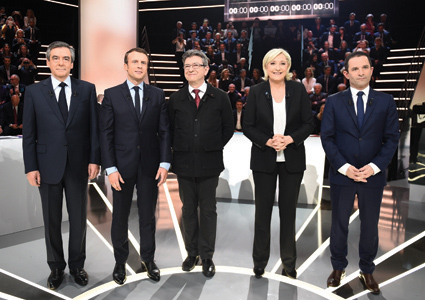
 Left to right: French presidential candidates François Fillon, Emmanuel Macron, Jean-Luc Mélenchon, Marine Le Pen and Benoît Hamon (© ELIOT BLONDET/AFP/Getty Images)
No political observer in his right mind would have expected at the beginning of 2016 a Brexit vote in Britain in June, the resignation of David Cameron, a dogfight between the two main Brexit supporters and propagandists within the Tory party, Boris Johnson and Michael Gove, and eventually the rise of Theresa May. Nor would he have foreseen, for that matter, the election of Donald Trump in the United States on November 8.
Something similar is happening in France now — on a much larger and trickier scale. A few months ago, it was taken for granted that François Hollande’s ineffectual socialist administration would be succeeded after the 2017 election — on April 23 and May 7 — by a conservative government led either by former president Nicolas Sarkozy or former prime minister Alain Juppé: a simple matter of the swing of the pendulum, as is the rule among democracies. What the French are facing now, however, is an unprecedented upsurge of the National Front, the elimination of a generation of political leaders on almost all sides, and the collapse or near collapse of classic Left and Right parties. While many voters welcome the change, others are just in a state of shock. On March 18 — one month or so ahead of the first ballot — 34 per cent of the electorate and 43 per cent of voters under 35 had still not decided whether to vote or not.
On March 20, the five most prominent candidates debated for three and a half hours on TV. About 10 million people watched intently. It was indeed a great show — and probably a defining moment in the campaign.
All five candidates are rebels. Marine Le Pen, 48, the National Front leader, is a rebel by definition. She has managed to upgrade in many ways the party she inherited from her father, Jean-Marie Le Pen, in 2011, to purge it of many unsavoury elements, to trim its formerly racist and anti-Semitic rhetoric (including Holocaust denial) and to switch from Vichy nostalgia to a near-Gaullist statism. In fact, she has even been increasingly reluctant to use the name National Front, and has floated alternative labels, such as Rassemblement Bleu Marine (“Navy Blue Rally”, a play on words with her first name which means “Navy” in French).
For all that, she is still sticking to a binary, undemocratic and utterly revolutionary view of the world, positing a bitter fight between what she calls “the System” (the political and cultural elite, of both Right and Left, the “lobbies”, globalisation, multiculturalism, immigration, the European Union, the euro) and “the people” (the ordinary Frenchmen) whom she claims to represent exclusively. The implication is that either you side with the people and her against the System, and opt for a fully sovereign and autarkic France under her guidance, or you are, willingly or not, an enemy of the people. Interestingly enough, she used this logic against her own father, as he resisted the revamping and defascisation of the National Front, and did not flinch from expelling him from the party at the age of 86.
At the other end of the political spectrum, Jean-Luc Mélenchon, 65, a former minister of vocational education, rebelled against the Socialist party in 2008 to found the more hardline Parti de Gauche (Left Party) and then the Front de Gauche (Left Front) in association with a diminutive Communist Party. He eventually started a new movement in 2016, France Insoumise (Indomitable France).
Mélenchon can be described as the far-Left counterpart to Marine Le Pen. He shares almost entirely her binary, anti-elite, anti-globalisation, anti-lobbies, anti-European philosophy, except on the issue of immigration and multiculturalism, which he accepts as a natural and positive development. Just like her, he supports a strong, autarkic government, and sees himself as a charismatic popular leader who is not supposed, ultimately, to be answerable to any other authority.
A main difference is that Marine Le Pen, while a sharp and forceful debater on some key issues, is much less convincing on many others, and burdened with an unseductive, almost masculine voice. Mélenchon, on the other hand, is an extremely eloquent and articulate tribune, a great orator with a deep voice and a devastating sense of humour, so much so that many listeners don’t pay full attention to the radical content of his words. He sounds like Churchill but thinks like Corbyn.
Benoît Hamon, 49, a former minister of education, is a non-rebel rebel. A member of the Socialist Party since the 1990s, he still shares many of its basic tenets, including a strong pro-European, pro-euro and pro-Nato stance. However, he has always aligned at the same time with the party’s left wing, against the more centrist and social-democratic programme advocated by President Hollande and the prime minister, Manuel Valls. He supports immigration, the religious and cultural rights of minorities, ecology, an universal basic income, and more state intervention in economic affairs within a comprehensive European Union framework. Until 2016, Hamon behaved like a Hollande loyalist and urged him to run as a presidential candidate in 2017. When the outgoing president declined, Hamon declared his own candidacy and handsomely won the socialist primaries last January with 58 per cent of the vote against 41 per cent for Valls. The main reason for his victory, and for Valls’s downfall, may have been the desertion of many socialist activists and supporters. While 2.8 million voters had been involved in the first socialist primaries in 2011, only two million turned up in 2017, a loss of almost one third. Hamon looks like a decent and sincere man, with strong democratic credentials. However, he lacks charisma, especially compared to Mélenchon.
François Fillon, 63, prime minister under Sarkozy from 2007 to 2012, was the surprise winner of the conservative primaries last November. He topped the first ballot with 44 per cent of the vote, against 28 per cent for Alain Juppé, a former prime minister and senior minister under Jacques Chirac and Sarkozy, and 20 per cent for Sarkozy. He then crushed Juppé on the second ballot by 66 per cent against 33 per cent. Since most pollsters and media had forecast a strong showing for Juppé, and 4.5 million voters had been involved, his victory was all the more impressive. One explanation was that Fillon was supposed to be a new man — something he owed to the fact that Sarkozy had haughtily relegated him during his five-year premiership to a subordinate role. A deeper explanation was that he was a rebel within the conservative camp: he ran a much more right-wing campaign that his rivals and was supported, in particular, by extensive conservative Catholic networks. Finally, a lot of personal factors were involved. Fillon was an attractive, elegant man — looking much younger than his actual age — with a deep, sober voice, command of facts and figures, and a lot of self-control. He was also supposed to be honest and ethical. All in all, it was a foregone conclusion by the beginning of 2017 that he would come out first in the presidential first ballot and win handsomely on the second ballot.
A main difference is that Marine Le Pen, while a sharp and forceful debater on some key issues, is much less convincing on many others, and burdened with an unseductive, almost masculine voice. Mélenchon, on the other hand, is an extremely eloquent and articulate tribune, a great orator with a deep voice and a devastating sense of humour, so much so that many listeners don’t pay full attention to the radical content of his words. He sounds like Churchill but thinks like Corbyn.
Benoît Hamon, 49, a former minister of education, is a non-rebel rebel. A member of the Socialist Party since the 1990s, he still shares many of its basic tenets, including a strong pro-European, pro-euro and pro-Nato stance. However, he has always aligned at the same time with the party’s left wing, against the more centrist and social-democratic programme advocated by President Hollande and the prime minister, Manuel Valls. He supports immigration, the religious and cultural rights of minorities, ecology, an universal basic income, and more state intervention in economic affairs within a comprehensive European Union framework. Until 2016, Hamon behaved like a Hollande loyalist and urged him to run as a presidential candidate in 2017. When the outgoing president declined, Hamon declared his own candidacy and handsomely won the socialist primaries last January with 58 per cent of the vote against 41 per cent for Valls. The main reason for his victory, and for Valls’s downfall, may have been the desertion of many socialist activists and supporters. While 2.8 million voters had been involved in the first socialist primaries in 2011, only two million turned up in 2017, a loss of almost one third. Hamon looks like a decent and sincere man, with strong democratic credentials. However, he lacks charisma, especially compared to Mélenchon.
François Fillon, 63, prime minister under Sarkozy from 2007 to 2012, was the surprise winner of the conservative primaries last November. He topped the first ballot with 44 per cent of the vote, against 28 per cent for Alain Juppé, a former prime minister and senior minister under Jacques Chirac and Sarkozy, and 20 per cent for Sarkozy. He then crushed Juppé on the second ballot by 66 per cent against 33 per cent. Since most pollsters and media had forecast a strong showing for Juppé, and 4.5 million voters had been involved, his victory was all the more impressive. One explanation was that Fillon was supposed to be a new man — something he owed to the fact that Sarkozy had haughtily relegated him during his five-year premiership to a subordinate role. A deeper explanation was that he was a rebel within the conservative camp: he ran a much more right-wing campaign that his rivals and was supported, in particular, by extensive conservative Catholic networks. Finally, a lot of personal factors were involved. Fillon was an attractive, elegant man — looking much younger than his actual age — with a deep, sober voice, command of facts and figures, and a lot of self-control. He was also supposed to be honest and ethical. All in all, it was a foregone conclusion by the beginning of 2017 that he would come out first in the presidential first ballot and win handsomely on the second ballot.
However, things deteriorated dramatically over the following weeks. The public prosecutor’s office for financial affairs accused him of having secured highly-paid fictitious employment at the National Assembly for his Welsh-born wife Penelope and his children. Even if many experts concluded that there was nothing strictly illegal about it, or that the public prosecutor’s office had a poor idea of the constitutional separation of powers, it came as a terrible blow to Fillon’s image as a clean politician. More unsavoury matters surfaced. Pressure mounted for the primary winner to withdraw, and there was talk of a Juppé comeback or of an alternative, younger candidate, like François Baroin, 50, the good-looking mayor of Troyes in eastern France.
Eventually, Fillon resolved to stay in the race. The same Catholic networks that had helped him during the primaries worked hard to bring some 100,000 supporters to a pro-Fillon rally in front of the Eiffel Tower in Paris on March 5. Fillon admitted he had made “mistakes” but then warned his fellow conservatives that losing the presidential election would be an ever greater mistake. In the TV debate on March 20, he was clearly the centre of attention. And he showed himself once again to be both a skilled politician and a self-controlled man.
But the ultimate rebel is Emmanuel Macron. At 39, he is a maverick candidate that no political party has endorsed, who criss-crosses from Left to Right and back, and whose private life is both fascinating and unfathomable. A graduate of ENA (the National School of Administration), the top academic college that produces most of the French senior civil service, a senior sofficial in financial affairs for four years, and an associate banker at Rothschilds for three years, he was for two years — 2012 to 2014 — President Hollande’s chief personal assistant. Then, out of the blue Hollande put him in charge of the gigantic Ministry of Economy, Industry and Digital Economy, a position he retained until 2016.
In that post, he engaged in many ambitious reforms that not only ran counter to the French socialist tradition, even in its social democratic guise, but to an even more ingrained statist tradition shared by most French parties. His declared ambition was to modernise and simplify the French economy, get rid of red tape and superfluous regulations, and help entrepreneurs and start-ups. The so-called Macron Act of 2015 eased antiquated restrictions in many professions, from the prohibition of work on Sunday to the overregulation of taxis and buses. Since there was no majority to support it in the National Assembly, the Act was passed under article 49.3 of the constitution: the French equivalent of executive orders. A second and much wider Macron Act that would have scrapped similar restrictions in many more professions and in fact reshaped French companies in an almost Thatcherite way was scheduled for 2016, but finally cancelled by Valls. Bits of it were incorporated into the much narrower El Khomri Law, which elicited intense opposition from the trade unions and the hard Left, and was also passed under article 49.3.
Eventually, Fillon resolved to stay in the race. The same Catholic networks that had helped him during the primaries worked hard to bring some 100,000 supporters to a pro-Fillon rally in front of the Eiffel Tower in Paris on March 5. Fillon admitted he had made “mistakes” but then warned his fellow conservatives that losing the presidential election would be an ever greater mistake. In the TV debate on March 20, he was clearly the centre of attention. And he showed himself once again to be both a skilled politician and a self-controlled man.
But the ultimate rebel is Emmanuel Macron. At 39, he is a maverick candidate that no political party has endorsed, who criss-crosses from Left to Right and back, and whose private life is both fascinating and unfathomable. A graduate of ENA (the National School of Administration), the top academic college that produces most of the French senior civil service, a senior sofficial in financial affairs for four years, and an associate banker at Rothschilds for three years, he was for two years — 2012 to 2014 — President Hollande’s chief personal assistant. Then, out of the blue Hollande put him in charge of the gigantic Ministry of Economy, Industry and Digital Economy, a position he retained until 2016.
In that post, he engaged in many ambitious reforms that not only ran counter to the French socialist tradition, even in its social democratic guise, but to an even more ingrained statist tradition shared by most French parties. His declared ambition was to modernise and simplify the French economy, get rid of red tape and superfluous regulations, and help entrepreneurs and start-ups. The so-called Macron Act of 2015 eased antiquated restrictions in many professions, from the prohibition of work on Sunday to the overregulation of taxis and buses. Since there was no majority to support it in the National Assembly, the Act was passed under article 49.3 of the constitution: the French equivalent of executive orders. A second and much wider Macron Act that would have scrapped similar restrictions in many more professions and in fact reshaped French companies in an almost Thatcherite way was scheduled for 2016, but finally cancelled by Valls. Bits of it were incorporated into the much narrower El Khomri Law, which elicited intense opposition from the trade unions and the hard Left, and was also passed under article 49.3.
Either out of disillusionment about this failure or under a preordained plan, in 2016 Macron launched his own political movement, En Marche! (Forward!), which featured his own initials. In rapid succession, he suggested he had never been a socialist, claimed to be of neither Right nor Left, and declared that he would run for president. He also met all kinds of conservative figures, including the arch-conservative Catholicmonarchist Viscount Philippe de Villiers, who supported Le Pen but was also the visionary behind Le Puy du Fou, France’s most successful theme park. The media started to take a strong interest in Macron, and so did the pollsters.
When he resigned from the Valls cabinet last August, Macron was seen as a much more credible candidate than Hollande. And when Hollande himself made clear, on December 1, that he would not run again, many political analysts wondered whether the president had not engineered a Macron candidacy from the very beginning as the only way to salvage the French Left and his own social democratic heritage. The fact is that many socialist officials, including the powerful mayor of Lyons, Gérard Collomb, have endorsed Macron’s candidacy, a necessary legal step, and that many senior members of the Hollande administration, including the no less powerful defence minister, Jean-Yves Le Drian, have given him their support.
The weirdest aspect of Macron’s life is, however, his marriage. His wife Brigitte, is, at 63, 24 years older than him. When he met her, he was a 17-year-old high school pupil in Amiens, northern France, and she was his French literature teacher, a married woman and mother of three. She divorced her first husband to marry Emmanuel in 2007, when he graduated from ENA. It is commonly assumed that she masterminded his entire career and that she still is involved with his current political project. Which may imply, if Hollande’s own involvement is confirmed, that two Svengalis at least have been behind “Boy Macron”. Even so, his talent cannot be denied.
The five candidates devoted comparatively little time, in the television debate, to international affairs. What was noteworthy was that three of them — Le Pen, Mélenchon and Fillon — gave blanket support to Vladimir Putin’s Russia, either in the Middle East and even in the Russian-Ukraine dispute. In addition, Fillon supported Iran. Hamon, on the contrary, stayed loyal to the Hollande administration line: defiant towards Russia, supporting Europe and Nato. As for Macron, he was the only one to mention France’s affinity with America, based on history and mutual values.
All in all, the debate was an acid test for each candidate. According to a poll taken straight afterwards, Macron was described as “the most convincing” of the five candidates by 29 per cent of the audience: quite an achievement. Mélenchon came second with 20 per cent, closely followed by Le Pen and Fillon, who both got 19 per cent.
When he resigned from the Valls cabinet last August, Macron was seen as a much more credible candidate than Hollande. And when Hollande himself made clear, on December 1, that he would not run again, many political analysts wondered whether the president had not engineered a Macron candidacy from the very beginning as the only way to salvage the French Left and his own social democratic heritage. The fact is that many socialist officials, including the powerful mayor of Lyons, Gérard Collomb, have endorsed Macron’s candidacy, a necessary legal step, and that many senior members of the Hollande administration, including the no less powerful defence minister, Jean-Yves Le Drian, have given him their support.
The weirdest aspect of Macron’s life is, however, his marriage. His wife Brigitte, is, at 63, 24 years older than him. When he met her, he was a 17-year-old high school pupil in Amiens, northern France, and she was his French literature teacher, a married woman and mother of three. She divorced her first husband to marry Emmanuel in 2007, when he graduated from ENA. It is commonly assumed that she masterminded his entire career and that she still is involved with his current political project. Which may imply, if Hollande’s own involvement is confirmed, that two Svengalis at least have been behind “Boy Macron”. Even so, his talent cannot be denied.
The five candidates devoted comparatively little time, in the television debate, to international affairs. What was noteworthy was that three of them — Le Pen, Mélenchon and Fillon — gave blanket support to Vladimir Putin’s Russia, either in the Middle East and even in the Russian-Ukraine dispute. In addition, Fillon supported Iran. Hamon, on the contrary, stayed loyal to the Hollande administration line: defiant towards Russia, supporting Europe and Nato. As for Macron, he was the only one to mention France’s affinity with America, based on history and mutual values.
All in all, the debate was an acid test for each candidate. According to a poll taken straight afterwards, Macron was described as “the most convincing” of the five candidates by 29 per cent of the audience: quite an achievement. Mélenchon came second with 20 per cent, closely followed by Le Pen and Fillon, who both got 19 per cent.
These figures were important because they were a sharp departure from earlier forecasts about the election proper. According to a Kantar/Sofres/OnePoint poll released on March 19 by Le Figaro and LCI, both Macron and Le Pen were supposed to get 26 per cent of the vote on the first ballot, with Fillon on only 17 per cent, and both Melenchon and Hamon on 12 per cent. In the wake of the TV debate, it seemed that Macron had taken off decidely, Le Pen lost ground, Fillon recovered, and Mélenchon had taken over as the sole leader of the Left. While it was previously assumed that a Le Pen-Macron duel would take place on the second and final presidential ballot, and might have produced a 60 per cent victory for Macron, a Macron-Fillon duel was now conceivable, and a Fillon victory could not be ruled out. Even a Macron-Mélenchon scenario could be considered. A lot was likely to depend on the second debate, to be scheduled between the two ballots.
Why did the old political guard collapse? Why did the rebels win? It was, first and foremost, a matter of neglected issues: Muslim immigration and the drift towards a two-tier society. At the same time, the old guard did not realise that confidence in the electoral system, and thus in the political system as a whole, was rapidly eroding.
“We have a problem with Islam, it’s a fact,” President Hollande admitted in Un président ne devrait pas dire ça . . . (Things A President Should Not Say), the 635-page confession, co-authored with journalists Gérard Davet and Fabrice Lhomme, he published last winter after deciding not to run for reelection.The French Muslim community is the largest and fastest-growing in Europe. In 50 years, from 1967 to 2017, the population of the Republic of France (including the overseas territories, which are as French as Hawaii and Alaska are American) grew from 50 million to 67 million, a 34 per cent increase. Meanwhile, the Muslim population has grown, either naturally or as a result of migrational trends, from one million or so to five or six million at least: that is to say a 500-600 per cent increase. As for the ratio of Muslims to the global population, it grew from 2 per cent to 7-9 per cent. No other European nation experienced such a dramatic change in its ethnic and religious fabric, even if some of them — Germany and Austria, Belgium and the Netherlands, Switzerland and the Scandinavian countries — are not far behind.
The real impact of Muslim immigration is even bigger in generational terms: the younger the population, the higher the proportion of Muslims. While less than one tenth of French citizens were Muslims in the early 2010s, the proportion was one-fifth for French citizens or residents under 24 nationwide, and even higher in some places. A 2015 Ipsos investigation in the Greater Marseilles area found that 25.5 per cent of local youths in their mid-teens identified as Muslim. Similar figures were to be found in all other big cities, where most of the population lives. Unless trends are reversed, by 2050 — some 30 years from now — France may thus look like India or Israel (non-Muslim countries with large Muslim communities), if not indeed like Lebanon (a Muslim country with a large Christian minority).
Why did the old political guard collapse? Why did the rebels win? It was, first and foremost, a matter of neglected issues: Muslim immigration and the drift towards a two-tier society. At the same time, the old guard did not realise that confidence in the electoral system, and thus in the political system as a whole, was rapidly eroding.
“We have a problem with Islam, it’s a fact,” President Hollande admitted in Un président ne devrait pas dire ça . . . (Things A President Should Not Say), the 635-page confession, co-authored with journalists Gérard Davet and Fabrice Lhomme, he published last winter after deciding not to run for reelection.The French Muslim community is the largest and fastest-growing in Europe. In 50 years, from 1967 to 2017, the population of the Republic of France (including the overseas territories, which are as French as Hawaii and Alaska are American) grew from 50 million to 67 million, a 34 per cent increase. Meanwhile, the Muslim population has grown, either naturally or as a result of migrational trends, from one million or so to five or six million at least: that is to say a 500-600 per cent increase. As for the ratio of Muslims to the global population, it grew from 2 per cent to 7-9 per cent. No other European nation experienced such a dramatic change in its ethnic and religious fabric, even if some of them — Germany and Austria, Belgium and the Netherlands, Switzerland and the Scandinavian countries — are not far behind.
The real impact of Muslim immigration is even bigger in generational terms: the younger the population, the higher the proportion of Muslims. While less than one tenth of French citizens were Muslims in the early 2010s, the proportion was one-fifth for French citizens or residents under 24 nationwide, and even higher in some places. A 2015 Ipsos investigation in the Greater Marseilles area found that 25.5 per cent of local youths in their mid-teens identified as Muslim. Similar figures were to be found in all other big cities, where most of the population lives. Unless trends are reversed, by 2050 — some 30 years from now — France may thus look like India or Israel (non-Muslim countries with large Muslim communities), if not indeed like Lebanon (a Muslim country with a large Christian minority).
But what really matters is not religion as such, or even ethnicity. It is the future of France as a way of life and a culture. France used to be a very open and inclusive society, where most immigrants, whatever their background, tended to assimilate quickly and thoroughly into the mainstream culture and way of life. This is no longer the case with Muslims. According to a Fondapol 2014 survey, the proportion of “strictly religious” French Muslims rose from 27 per cent in 1994 to 42 per cent 20 years later. To quote again the Ipsos survey on Marseilles, 83 per cent of young Muslims described religion as “something important or very important”, against 40 per cent of non-Muslims (and 22 per cent of Catholics). Another Ifop survey last September suggests that 29 per cent of French Muslims see Sharia as more important than the law of the land, and that 65 per cent condone the Islamic rules of female “modesty” in the public sphere, including the hijab or burka and the burkini, the Edwardian-style all-body bathing suit.
What if such views and attitudes foster “no-go zones” or de facto enclaves in many parts of the country, or terrorism? Over the past four years, more than 2,000 French Muslims have joined Islamic State in Iraq and Syria. Conversely, about 200 people were killed and 300 were wounded or maimed in France by French-born jihadist attackers: from the murder of soldiers and Jewish teachers and kids in southern France in March 2012 to the massacre of cartoonists and Jewish shoppers in Paris in January 2015, and from the killing sprees in Paris in November 2015 and Nice in July 2016 to the murder of an elderly Catholic priest during Mass a few days later. President Hollande warned in his book of a looming “partition” of the country. The right-wing columnist Eric Zemmour, whose essay Le Suicide Français (The Suicide of France) sold more than 200,000 copies in 2014, prophesied a “coming civil war”. France’s most notable writer, Michel Houellebecq, sold 350,000 copies of Soumission (Submission), a 2015 novel about the election of a “moderate Islamist” as president of France in the 2020s, and an ensuing accelerated, albeit peaceful, Islamisation of French government and society.
While everybody agrees that immigration and Islam are major challenges, the mainstream parties have, on the whole, been unable to devise coherent answers. They contend that partition, civil war, or the replacement of the nation state by ethnic-religious communities (referred to as communautarisme) are absolute evils, and must be countered by a “restored” or “reconstructed” secular democracy. Many advise French Muslims to emulate the many compromises made by French Jews after 1789 — not realising that Jews were content to be “emancipated” and never entertained the slightest fantasies about converting the whole of Europe to their faith, whereas most Muslims understand full citizenship as the promise to be fully Muslim, and the right to propagate their own Muslim faith.
However, a growing minority thinks that secular democracy is not a practical answer any more and that the only way to resist an Islamic conquest is to restore a sense of community among the non-Muslim French, based either on the Christian tradition or the Enlightenment, or both. While Le Pen insists she is staunchly secular, she refers to France as an organic community. Among those Catholics who supported Fillon, many belong to a younger generation closer to conservative popes John Paul II and Benedict XVI — or even to the schismatic Archbishop Marcel Lefebvre — than to the Second Vatican Council fathers or their present heir, Pope Francis, and envisage the abolition or the revision of the 1905 Law of Separation of Church and State.
What if such views and attitudes foster “no-go zones” or de facto enclaves in many parts of the country, or terrorism? Over the past four years, more than 2,000 French Muslims have joined Islamic State in Iraq and Syria. Conversely, about 200 people were killed and 300 were wounded or maimed in France by French-born jihadist attackers: from the murder of soldiers and Jewish teachers and kids in southern France in March 2012 to the massacre of cartoonists and Jewish shoppers in Paris in January 2015, and from the killing sprees in Paris in November 2015 and Nice in July 2016 to the murder of an elderly Catholic priest during Mass a few days later. President Hollande warned in his book of a looming “partition” of the country. The right-wing columnist Eric Zemmour, whose essay Le Suicide Français (The Suicide of France) sold more than 200,000 copies in 2014, prophesied a “coming civil war”. France’s most notable writer, Michel Houellebecq, sold 350,000 copies of Soumission (Submission), a 2015 novel about the election of a “moderate Islamist” as president of France in the 2020s, and an ensuing accelerated, albeit peaceful, Islamisation of French government and society.
While everybody agrees that immigration and Islam are major challenges, the mainstream parties have, on the whole, been unable to devise coherent answers. They contend that partition, civil war, or the replacement of the nation state by ethnic-religious communities (referred to as communautarisme) are absolute evils, and must be countered by a “restored” or “reconstructed” secular democracy. Many advise French Muslims to emulate the many compromises made by French Jews after 1789 — not realising that Jews were content to be “emancipated” and never entertained the slightest fantasies about converting the whole of Europe to their faith, whereas most Muslims understand full citizenship as the promise to be fully Muslim, and the right to propagate their own Muslim faith.
However, a growing minority thinks that secular democracy is not a practical answer any more and that the only way to resist an Islamic conquest is to restore a sense of community among the non-Muslim French, based either on the Christian tradition or the Enlightenment, or both. While Le Pen insists she is staunchly secular, she refers to France as an organic community. Among those Catholics who supported Fillon, many belong to a younger generation closer to conservative popes John Paul II and Benedict XVI — or even to the schismatic Archbishop Marcel Lefebvre — than to the Second Vatican Council fathers or their present heir, Pope Francis, and envisage the abolition or the revision of the 1905 Law of Separation of Church and State.
Alternatively, another minority, on the Left, is prepared to acquiesce in many Muslim demands for the sake of civil peace — the path subtly derided by Houellebecq in Soumission. As for Macron, he seems to support immigration and more religious freedom for Islam as long as immigrants and Muslims behave as loyal and hard-working citizens. He is apparently convinced that a more open economy would help them to go mainstream more quickly.
The second problematic issue, as noted earlier, is social justice: a widespread perception that a two-tier system has replaced the much fairer France of the past. Thomas Piketty’s 2013 book Capital in the Twenty-First Century was a neo-Marxist interpretation of such feelings. Of much greater interest are the essays of Louis Chauvel, a sociologist and political scientist, on the decline of the French bourgeoisie: Les Classes Moyennes à la Dérive (The Drifting Middle Class), a pioneering book published in 2006, and the more recent La Spirale du Déclassement (Spiralling Down), published in 2016.
A third author, geographer Christophe Guilluy, became an instant celebrity in 2010 with his claim in Fractures Françaises that the nation was now split between a small, wealthy and thriving “Elite France” that lived and worked in the gentrified big cities and a “Peripheral France” that comprised “60 percent of the French population and 80 percent of the working class” and was relegated to the outer suburbs and the post-agricultural countryside. Elite France, for Guilluy, was one of globalisation’s big winners, whereas Peripheral France saw globalisation as its downfall. Elite France was in love with the free market, value-added immigration and multiculturalism, and the European Union; Peripheral France was longing to go back to the Gaullist era semi-statist economy, the welfare state and the nation state.
Here again, the mainstream parties were not bold or imaginative enough. Hence the spectacular progression of the National Front under Marine Le Pen, from 15 to 25 per cent of the vote nationwide. Since its foundation in the 1970s by Jean-Marie Le Pen, the National Front had focused on the immigration crisis and Islam: the stroke of genius of Marine Le Pen (or of her adviser Florian Philippot) was to raise the social and economic issue to the same level. Likewise, part of Macron’s success lies with his attempts to reform job creation. Take, for instance, the deregulation of bus transport, one of the main measures of the 2015 Macron Act. French public opinion was amazed to learn that railways and airlines had hitherto enjoyed a monopoly on domestic transport, and that accordingly private bus companies had not been allowed to operate between French cities.
A word must be said about the French electoral regulations, and their impact on the rise of the 2017 rebels.
France doesn’t have one single electoral system, but rather, as the 1958 constitution devolves such matters to “organic laws” that can be passed or reformed at will, a host of heterogeneous, competing and usually complex systems tailored for the variegated levels of national or local politics. National elections — the presidential and parliamentary elections every five years — are decided by a modified first-past-the-post system, with two ballots instead of one. Local elections, every six years, and regional elections, every five years, are based on proportional representation; nevertheless, they are also decided over two ballots.
The second problematic issue, as noted earlier, is social justice: a widespread perception that a two-tier system has replaced the much fairer France of the past. Thomas Piketty’s 2013 book Capital in the Twenty-First Century was a neo-Marxist interpretation of such feelings. Of much greater interest are the essays of Louis Chauvel, a sociologist and political scientist, on the decline of the French bourgeoisie: Les Classes Moyennes à la Dérive (The Drifting Middle Class), a pioneering book published in 2006, and the more recent La Spirale du Déclassement (Spiralling Down), published in 2016.
A third author, geographer Christophe Guilluy, became an instant celebrity in 2010 with his claim in Fractures Françaises that the nation was now split between a small, wealthy and thriving “Elite France” that lived and worked in the gentrified big cities and a “Peripheral France” that comprised “60 percent of the French population and 80 percent of the working class” and was relegated to the outer suburbs and the post-agricultural countryside. Elite France, for Guilluy, was one of globalisation’s big winners, whereas Peripheral France saw globalisation as its downfall. Elite France was in love with the free market, value-added immigration and multiculturalism, and the European Union; Peripheral France was longing to go back to the Gaullist era semi-statist economy, the welfare state and the nation state.
Here again, the mainstream parties were not bold or imaginative enough. Hence the spectacular progression of the National Front under Marine Le Pen, from 15 to 25 per cent of the vote nationwide. Since its foundation in the 1970s by Jean-Marie Le Pen, the National Front had focused on the immigration crisis and Islam: the stroke of genius of Marine Le Pen (or of her adviser Florian Philippot) was to raise the social and economic issue to the same level. Likewise, part of Macron’s success lies with his attempts to reform job creation. Take, for instance, the deregulation of bus transport, one of the main measures of the 2015 Macron Act. French public opinion was amazed to learn that railways and airlines had hitherto enjoyed a monopoly on domestic transport, and that accordingly private bus companies had not been allowed to operate between French cities.
A word must be said about the French electoral regulations, and their impact on the rise of the 2017 rebels.
France doesn’t have one single electoral system, but rather, as the 1958 constitution devolves such matters to “organic laws” that can be passed or reformed at will, a host of heterogeneous, competing and usually complex systems tailored for the variegated levels of national or local politics. National elections — the presidential and parliamentary elections every five years — are decided by a modified first-past-the-post system, with two ballots instead of one. Local elections, every six years, and regional elections, every five years, are based on proportional representation; nevertheless, they are also decided over two ballots.
Proportional representation, with one ballot only, is the rule for European elections, every five years. A two-ballot first-past-the-post system involving male/female paired candidates instead of single candidates applies for county constituencies, every six years.
Even more byzantine regulations apply to many ballots as well. In most cases, including the presidential and parliamentary elections, only the first ballot’s frontrunners are allowed to run in the second ballot. And male/female quotas, or parité, as the French have it, apply to most elections, with variable stringency, the gender-based pairing provisions of the county elections being only the oddest and most extreme example.
It is puzzling that the French, who see cartésianisme — the logical, rational philosophy of René Descartes (1596-1650) — as their premium intellectual heritage, and who routinely take pride in the near-geometric redrawing of their social system under the Revolution of 1789, let themselves be drawn into such a mess. But what really matters is the practical consequences.
One unavoidable outcome is that political strategists cannot just focus, within such a framework, on clear-cut campaigns. Consider, for instance, the keystone of French politics: the presidential election. Any citizen may run on the first ballot, provided he or she is endorsed by at least 500 elected officials. But he or she needs an absolute majority (50 per cent of the total vote plus one vote at least) to be elected, something that has never happened. A second ballot thus takes place in which only two candidates are allowed: the two who emerged as the front runners in the first ballot. Every serious presidential candidate must be prepared to switch instantly from a very aggressive campaign on the first ballot, the best way to win one of the two first slots, to a much more inclusive campaign on the second ballot, in order to attract a larger audience.
Moreover, a serious candidate must also keep in mind the ensuing parliamentary elections. Under the 1958 constitution, France is not a presidential republic, as most people think it is, but rather an uneasy combination of presidential rule and Westminster-style democracy. While the French president is extremely powerful with a supportive National Assembly and by implication a loyal prime minister, he is almost powerless when faced with a hostile Assembly and by implication a hostile prime minister. Such “cohabitation” regimes occured twice under François Mitterrand, a socialist president, and once under Jacques Chirac, a conservative. In all three instances, the French republican monarchy was turned into a diarchy of sorts. As a result, important decisions had to be postponed or rescinded.
Another negative outcome of French electoral complexity is that far-Right, far-Left or even centrist voters, realise that while they have quite a say in proportional ballots, they are deprived of almost any representation in first-past-the-post ballots. So they see the retention of the latter at presidential and parliamentary levels as a mere sleight of hand intended to safeguard the mainstream parties’ control over the country.
Even more byzantine regulations apply to many ballots as well. In most cases, including the presidential and parliamentary elections, only the first ballot’s frontrunners are allowed to run in the second ballot. And male/female quotas, or parité, as the French have it, apply to most elections, with variable stringency, the gender-based pairing provisions of the county elections being only the oddest and most extreme example.
It is puzzling that the French, who see cartésianisme — the logical, rational philosophy of René Descartes (1596-1650) — as their premium intellectual heritage, and who routinely take pride in the near-geometric redrawing of their social system under the Revolution of 1789, let themselves be drawn into such a mess. But what really matters is the practical consequences.
One unavoidable outcome is that political strategists cannot just focus, within such a framework, on clear-cut campaigns. Consider, for instance, the keystone of French politics: the presidential election. Any citizen may run on the first ballot, provided he or she is endorsed by at least 500 elected officials. But he or she needs an absolute majority (50 per cent of the total vote plus one vote at least) to be elected, something that has never happened. A second ballot thus takes place in which only two candidates are allowed: the two who emerged as the front runners in the first ballot. Every serious presidential candidate must be prepared to switch instantly from a very aggressive campaign on the first ballot, the best way to win one of the two first slots, to a much more inclusive campaign on the second ballot, in order to attract a larger audience.
Moreover, a serious candidate must also keep in mind the ensuing parliamentary elections. Under the 1958 constitution, France is not a presidential republic, as most people think it is, but rather an uneasy combination of presidential rule and Westminster-style democracy. While the French president is extremely powerful with a supportive National Assembly and by implication a loyal prime minister, he is almost powerless when faced with a hostile Assembly and by implication a hostile prime minister. Such “cohabitation” regimes occured twice under François Mitterrand, a socialist president, and once under Jacques Chirac, a conservative. In all three instances, the French republican monarchy was turned into a diarchy of sorts. As a result, important decisions had to be postponed or rescinded.
Another negative outcome of French electoral complexity is that far-Right, far-Left or even centrist voters, realise that while they have quite a say in proportional ballots, they are deprived of almost any representation in first-past-the-post ballots. So they see the retention of the latter at presidential and parliamentary levels as a mere sleight of hand intended to safeguard the mainstream parties’ control over the country.
The mainstream parties were not unaware of the citizens’ growing discontent. However, instead of taking the truly French, that is Cartesian, step of abolishing a chaotic ballot system altogether and replacing it by either an uniform first-past-the-post system or uniform proportional representation (or even settling for a uniform hybrid system, as is the case in Germany), they resorted to even more complexity by organising, in addition to the existing ballots, optional American-style primaries.
The socialists were the first to do so in the 2012 presidential election, with a measure of success, or so it seemed, since the candidate who emerged from this innovative consultation, François Hollande, eventually beat the outgoing conservative president Nicolas Sarkozy by 51.64 per cent against 48.36 per cent. Under closer scrutiny, the 2012 primaries portended troubles to come: Hollande, who started his campaign as a moderate and market-oriented social democrat, had no choice, in order to be nominated, but to adjust to the more radical rhetoric of most socialist activists and sympathisers, and to make promises he knew he would never be able to fulfill. Once president, he constantly wavered between his real political views and the fake image of himself he had projected as a candidate.
For all that, the 2012 primaries had been popular, and were repeated this year, not just among socialists but conservatives as well. What the political machines did not foresee was that such consultations were weapons of war against them.
Pascal-Emmanuel Gobry, who served as editor at Atlantico, a major conservative online magazine, recently remarked that Jews function in many countries as an advance warning system. When Jews get anxious about their condition, it means that something wrong and ominous may be lurking for the nation at large. Can this Jewish standard be appled to the present situation of France? Maybe. Muslim anti-Semitism (with or without the excuse of anti-Zionism) has been a harbinger of more general Muslim antagonism against mainstream French culture. Repeated acts of anti-Jewish terrorism preceded the anti-French terrorism wave of 2015 and 2016.
By this token, the 2017 presidential campaign is not entirely reassuring. Globalisation, the original sin according to both the far Left and far Right, is frequently associated with the United States, the West — and the Jews. Even with Trump in the White House. Trump may be an America Firster, but he is also a friend of Israel, the father of an Orthodox Jewish daughter and the “proud grandfather”, to quote him, “of Jewish grandchildren”. In a different order of things, French Muslims may support indiscriminately IS or Palestinian groups or Iran or Assad’s Syria as expressions of Muslim power, while many non-Muslim French may support Iran or Hezbollah or Assad’s Syria as allies against IS.
As for the rise of Macron, it fits only too well many stereotypes about elites, bankers, cosmopolitism, conspiracies, or what the Americans call “Manchurian candidates”. Again, these stereotypes tend to include Jews as well. A conservative website recently ran a caricature of Macron as a former Rothschild banker that exaggerated some of his facial features, clearly to suggest, against all the evidence, that he was Jewish. It was swiftly withdrawn, but the damage was done.
The socialists were the first to do so in the 2012 presidential election, with a measure of success, or so it seemed, since the candidate who emerged from this innovative consultation, François Hollande, eventually beat the outgoing conservative president Nicolas Sarkozy by 51.64 per cent against 48.36 per cent. Under closer scrutiny, the 2012 primaries portended troubles to come: Hollande, who started his campaign as a moderate and market-oriented social democrat, had no choice, in order to be nominated, but to adjust to the more radical rhetoric of most socialist activists and sympathisers, and to make promises he knew he would never be able to fulfill. Once president, he constantly wavered between his real political views and the fake image of himself he had projected as a candidate.
For all that, the 2012 primaries had been popular, and were repeated this year, not just among socialists but conservatives as well. What the political machines did not foresee was that such consultations were weapons of war against them.
Pascal-Emmanuel Gobry, who served as editor at Atlantico, a major conservative online magazine, recently remarked that Jews function in many countries as an advance warning system. When Jews get anxious about their condition, it means that something wrong and ominous may be lurking for the nation at large. Can this Jewish standard be appled to the present situation of France? Maybe. Muslim anti-Semitism (with or without the excuse of anti-Zionism) has been a harbinger of more general Muslim antagonism against mainstream French culture. Repeated acts of anti-Jewish terrorism preceded the anti-French terrorism wave of 2015 and 2016.
By this token, the 2017 presidential campaign is not entirely reassuring. Globalisation, the original sin according to both the far Left and far Right, is frequently associated with the United States, the West — and the Jews. Even with Trump in the White House. Trump may be an America Firster, but he is also a friend of Israel, the father of an Orthodox Jewish daughter and the “proud grandfather”, to quote him, “of Jewish grandchildren”. In a different order of things, French Muslims may support indiscriminately IS or Palestinian groups or Iran or Assad’s Syria as expressions of Muslim power, while many non-Muslim French may support Iran or Hezbollah or Assad’s Syria as allies against IS.
As for the rise of Macron, it fits only too well many stereotypes about elites, bankers, cosmopolitism, conspiracies, or what the Americans call “Manchurian candidates”. Again, these stereotypes tend to include Jews as well. A conservative website recently ran a caricature of Macron as a former Rothschild banker that exaggerated some of his facial features, clearly to suggest, against all the evidence, that he was Jewish. It was swiftly withdrawn, but the damage was done.