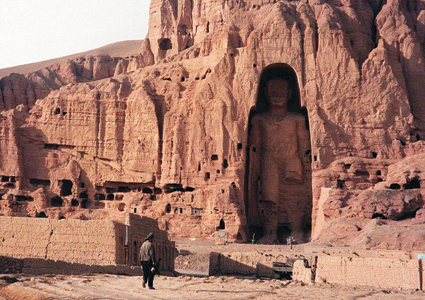
 One of the Bamiyan Buddhas in 1997: The statues’ survival until 2002 spoke to centuries of dialogue between religions along the Silk Road ( © JEAN-CLAUDE CHAPON/AFP/Getty Images)
The Silk Road is actually a network of routes over land, river and sea, which has connected the peoples and the nations of Eurasia for many hundreds of years. There is the northern route over the Caucasus to Europe, the middle one through to Turkey, and the southern ones to Gandhara in what is now northern Pakistan, to the Indus Valley, and one down to northern and south-west India. The sea routes connect the Gulf and India with the spice islands further east.
Naturally, over such a vast area the trade in goods has also been very diverse. Although the term Silk Road is deserved because of the importance of the trade with China in this highly desirable fabric, there was much else besides. There was lively trade eastwards of wool and westwards of spices. There was the selling and buying of precious metals and stones, of tools and raw materials. The list could go on. Equally importantly, there was the transfer of technology, whether in the making of paper, techniques of printing or even the introduction of writing and the reducing of hitherto purely oral languages to a written form.
One of the lasting legacies of the Silk Road has been the bringing together of cultures, beliefs and ideas. This has brought about debate, discussion and dialogue. We cannot pretend that peace has always prevailed. The territories, routes and even the goods being traded have been the subject of wars, piracy and exploitation. People have, nevertheless, talked and learnt from one another about each group’s cherished beliefs and rituals, their sense of right and wrong and their basis for honesty in trade.
In this connection, it is worth noting that what we call religion today was not a separate, hived-off activity but belonged, to borrow a metaphor from the world of textiles, to the very warp and woof of society. It was central to a people’s identity, to its main symbols and to moral understanding and discourse. It was their world view, that is to say, how they understood the universe and their place in it. Arguably, this remains the case in most parts of the world but sometimes has to be explained to secularised European audiences. When groups came into contact with one another through travel and trade, it was natural for them to discover their trading partners’ rituals, values and ways of seeing the world. At other times, there was a more deliberate transmission of ideas and beliefs: scholars, monks and missionaries travelled along the routes, sometimes with trading caravans, sometimes alone, with the express intention of sharing their knowledge, beliefs and practices with others. The arrival of Buddhism in China and the spread of Nestorian Christianity into central Asia and China are certainly to be understood in this way. Islam also arrived with conquest but spread, at least partially, both in central and south Asia through the peaceful exertions of Sufis and merchants. On the other hand, some travelling was intentionally undertaken to establish the origin and authenticity of religious ideas that had been received from elsewhere. The early Buddhist travellers, like Fa-Xian and Xuan Zang, went to India to determine the origin of the scriptures they had received and to check on the accuracy of their translations.
Buddhism and Christianity, in the form of the Church of the East, sometimes erroneously referred to as Nestorian, can be seen to be active in the heartlands of the Silk Road from their earliest periods. Buddhism seems to have entered China at about the same time that the Apostle Thomas arrived in Taxila, now northern Pakistan, to build a palace for Maharaja/Basileus Gundaphores, known to us from contemporary coinage which uses both Greek and Prakrit. Although the surviving ancient churches of south-west India testify to the Thomas tradition in the south, the archaeological evidence is, at least for an initial arrival, in the north.
Be that as it may, the story of Christianity along the Silk Road is closely tied up with the Church of the East. This is a church whose history, before the coming of Islam, is mainly related to the Persian Empire, the second great superpower in the ancient world after Rome. After the arrival of Islam, its heartlands were in the Islamic world but it had important missionary work as far afield as India and China. Bishop William Young, the late bishop of Sialkot in Pakistan, in his history of this church recounts more or less peaceful coexistence and even dialogue during the Parthian period (up to c.225). He tells us of an exchange between Bardaisan (usually regarded in the West as a fatalist and Gnostic) and a Magian in which Bardaisan defends freedom of the will and the distinctive ethics of Christians and Jews.
The emergence of the Sassanids and the turning of the Roman Empire towards Christianity, however, spelt trouble for these eastern Christians. The Sassanids were much more centralised than the loose-knit Parthians and more self-consciously Zoroastrian. The Christians, moreover, began to be seen as a potential fifth column in the Sassanian conflicts with Rome.Although there had been localised persecution under the Parthians, usually instigated by Magian elements, there were now periods of more organised persecution culminating in the great pogrom of Shapur II. Patriarch Shamaoun witnessed the martyrdom of his bishops, clergy and lay people before he was himself executed. The aim seems to have been to exterminate Christianity from Sassanian domains. It was only with the edict of the Shahinshah Yazdigard in 410 that the persecution came to an end and the Church of the East was recognised as a millat, or religious community within the Persian Empire. The edict had a similar effect to that of Milan in the Roman world in that Christians were now acknowledged as a religio licita alongside Jews and others. The term millat, by the way, was to become important much later with the imposition of the dhimma under Islam and the organisation of the Ottoman Empire. This edict did not mean that persecution was at an end. It was still a capital crime for a Zoroastrian to convert to another religion and the penalty was enforced again and again.
Although the Church of the East seems to have been under the nominal oversight of the Patriarchate of Antioch in the early period, this link was severed by the edict. The subsequent influence of Nestorianism further alienated the Church from churches to the west of it. This, to some extent, explains the eastwards thrust of the Church’s missionary expansion. It appears that the Christians of St Thomas of India were within the orbit of Nestorianism, although later on they came under Jacobite influence as well.
In central Asia, however, the Nestorians were everywhere: there were metropolitan sees in cities like Merv, Herat and Turkestan. When papal envoys arrived at the request of the Great Khans, they found the Nestorians there. Many Mongol and Turkic peoples converted to Christianity and this remained the case until the 13th-14th centuries and the gradual Islamisation of the area.
Be that as it may, the story of Christianity along the Silk Road is closely tied up with the Church of the East. This is a church whose history, before the coming of Islam, is mainly related to the Persian Empire, the second great superpower in the ancient world after Rome. After the arrival of Islam, its heartlands were in the Islamic world but it had important missionary work as far afield as India and China. Bishop William Young, the late bishop of Sialkot in Pakistan, in his history of this church recounts more or less peaceful coexistence and even dialogue during the Parthian period (up to c.225). He tells us of an exchange between Bardaisan (usually regarded in the West as a fatalist and Gnostic) and a Magian in which Bardaisan defends freedom of the will and the distinctive ethics of Christians and Jews.
The emergence of the Sassanids and the turning of the Roman Empire towards Christianity, however, spelt trouble for these eastern Christians. The Sassanids were much more centralised than the loose-knit Parthians and more self-consciously Zoroastrian. The Christians, moreover, began to be seen as a potential fifth column in the Sassanian conflicts with Rome.Although there had been localised persecution under the Parthians, usually instigated by Magian elements, there were now periods of more organised persecution culminating in the great pogrom of Shapur II. Patriarch Shamaoun witnessed the martyrdom of his bishops, clergy and lay people before he was himself executed. The aim seems to have been to exterminate Christianity from Sassanian domains. It was only with the edict of the Shahinshah Yazdigard in 410 that the persecution came to an end and the Church of the East was recognised as a millat, or religious community within the Persian Empire. The edict had a similar effect to that of Milan in the Roman world in that Christians were now acknowledged as a religio licita alongside Jews and others. The term millat, by the way, was to become important much later with the imposition of the dhimma under Islam and the organisation of the Ottoman Empire. This edict did not mean that persecution was at an end. It was still a capital crime for a Zoroastrian to convert to another religion and the penalty was enforced again and again.
Although the Church of the East seems to have been under the nominal oversight of the Patriarchate of Antioch in the early period, this link was severed by the edict. The subsequent influence of Nestorianism further alienated the Church from churches to the west of it. This, to some extent, explains the eastwards thrust of the Church’s missionary expansion. It appears that the Christians of St Thomas of India were within the orbit of Nestorianism, although later on they came under Jacobite influence as well.
In central Asia, however, the Nestorians were everywhere: there were metropolitan sees in cities like Merv, Herat and Turkestan. When papal envoys arrived at the request of the Great Khans, they found the Nestorians there. Many Mongol and Turkic peoples converted to Christianity and this remained the case until the 13th-14th centuries and the gradual Islamisation of the area.
In China, similarly, the so-called Nestorian Stele, which dates from the eighth century, tells us of the arrival of the Christian missionary, Alo-Pen, and his team in 635. They received imperial favour and, in spite of opposition, the Church flourished there until the loss of royal patronage and persecution led to its decline from the ninth century onwards. The discovery of a Christian pagoda, from the 8th century, by Dr Peter Saeki, a Japanese scholar, in the 1930s, as well as its rediscovery by Martin Palmer more recently, and also of the so-called Jesus-Sutras at Dunhuang, confirm a flourishing Christian presence in China.
The wonderful account of two Chinese monks, Rabban Sauma and his disciple Markos, who were dispatched from Beijing by the Mongol ruler, Kublai Khan, to worship at Jerusalem, shows the Church still in China in the 13th century. As is well known, Markos was first made Metropolitan of China by the Patriarch, Dinkha I, and then, on the death of the Patriarch, was himself elected Patriarch under the name Yaballaha (“given by God”) III. Both he and the local Khan sent Rabban Sauma to the West to forge an alliance against the Seljuk Turks and to recover Jerusalem. His meetings with representatives of the Pope, his celebration of the Eucharist in Rome and his visits to various monarchs are all found in the journal of their travels published in English by Wallis Budge under the title The Monks of Kublai Khan.
In the subsequent centuries, this Church would experience many ups and downs. There would be serious persecution from the very groups they had tried to reach. In the last days of the Ottoman Empire, there were to be massacres of the Assyrians, as these Christians were also called. They were to be betrayed about promises for a homeland of their own by Western powers. Most recently, they, as well as others, have been the target of Islamist extremism of the most violent kind. To protect themselves and to find fellowship with the wider Church, many of their number have entered into communion with the Roman See, whilst retaining their liturgy and customs. They are now known as the Chaldean Catholic Church.
Both Buddhism and Christianity arrived along the Silk Road at about the same time, in the first and second century AD. Both encountered entrenched religious, philosophical and ethical traditions to which they had to relate. Buddhism, as it spread to China, had to encounter the ethical and civic system of Confucianism and to accommodate itself to the high value given to a structured society, to the worship of ancestors and to a syncretistic tendency among Confucianists. As the Jesus-Sutras show, Christianity in China also had to adapt itself to Taoist and Buddhist terminology so it would make sense in that context.
The encounter between Buddhism, in its Mahayana form, and Christianity in our area of discussion repays some consideration. As the story of Barlaam and Joasaph reveals, it was possible for even a great Eastern theologian like St John of Damascus to use Buddhist motifs and ideas to tell a Christian story about India. At the same time, it appears that the Mahayana emphasis on Buddha as a saviour of the human race has something to do with Christianity’s central beliefs, as may a renewed emphasis on Metta, or the Buddha’s unconditional love for humankind, and on wisdom.
The wonderful account of two Chinese monks, Rabban Sauma and his disciple Markos, who were dispatched from Beijing by the Mongol ruler, Kublai Khan, to worship at Jerusalem, shows the Church still in China in the 13th century. As is well known, Markos was first made Metropolitan of China by the Patriarch, Dinkha I, and then, on the death of the Patriarch, was himself elected Patriarch under the name Yaballaha (“given by God”) III. Both he and the local Khan sent Rabban Sauma to the West to forge an alliance against the Seljuk Turks and to recover Jerusalem. His meetings with representatives of the Pope, his celebration of the Eucharist in Rome and his visits to various monarchs are all found in the journal of their travels published in English by Wallis Budge under the title The Monks of Kublai Khan.
In the subsequent centuries, this Church would experience many ups and downs. There would be serious persecution from the very groups they had tried to reach. In the last days of the Ottoman Empire, there were to be massacres of the Assyrians, as these Christians were also called. They were to be betrayed about promises for a homeland of their own by Western powers. Most recently, they, as well as others, have been the target of Islamist extremism of the most violent kind. To protect themselves and to find fellowship with the wider Church, many of their number have entered into communion with the Roman See, whilst retaining their liturgy and customs. They are now known as the Chaldean Catholic Church.
Both Buddhism and Christianity arrived along the Silk Road at about the same time, in the first and second century AD. Both encountered entrenched religious, philosophical and ethical traditions to which they had to relate. Buddhism, as it spread to China, had to encounter the ethical and civic system of Confucianism and to accommodate itself to the high value given to a structured society, to the worship of ancestors and to a syncretistic tendency among Confucianists. As the Jesus-Sutras show, Christianity in China also had to adapt itself to Taoist and Buddhist terminology so it would make sense in that context.
The encounter between Buddhism, in its Mahayana form, and Christianity in our area of discussion repays some consideration. As the story of Barlaam and Joasaph reveals, it was possible for even a great Eastern theologian like St John of Damascus to use Buddhist motifs and ideas to tell a Christian story about India. At the same time, it appears that the Mahayana emphasis on Buddha as a saviour of the human race has something to do with Christianity’s central beliefs, as may a renewed emphasis on Metta, or the Buddha’s unconditional love for humankind, and on wisdom.
Our concentration on the Church of the East should not mean that we forget Christians of many other kinds — Armenians, Georgians, Jacobites, etc — who were also to be found on the Silk routes. Indeed, just as the fortunes of the Nestorians began to wane, Western religious orders, such as the Dominicans and Franciscans, began to arrive in the area. They too experienced a mixed reception, sometimes being welcomed by rulers and allowed to build churches and, at other times, persecuted viciously for their faith. These missionaries anticipated the famous Jesuit missionary, St Francis Xavier, to Japan and India and the controversy of the Jesuit accommodation to culture in China and India which eventually led to the suppression of the order by Rome. The Jesuits were also one of the main actors in the dialogue among the religions initiated by the Emperor Akbar.Their work continued under Jehangir, with churches built in Lahore and Agra, and Catholic activity continued right up to the beginning of the modern missionary era in the 19th century with many fascinating aspects to it, such as the jurisdiction of an Eastern Catholic bishop and the significant numbers of Christians in the Mughal and Afghan armies.
Although there was tension between Buddhists and Christians, especially in China, Buddhist encounters with Islam have often been seen as more violent. This is summed up in the destruction caused to temples and shrines by Muslim armies from the time of Mahmud of Ghazna (AD 971-1030). Their raids into north-west India were to plunder the wealth of the country but the obvious targets were wealthy temples and shrines. The destruction of the international Buddhist university at Nalanda in 1202 is often regarded as spelling the end of Buddhism in the place of its birth.
As the Chachnama, an account of the Muslim conquest of Sind by Muhammad Bin Qasim in the eighth century, shows, however, earlier conquests were not as destructive and Qasim went so far as to declare Buddhists and Hindus dhimmis, or protected peoples, even though this title had previously been confined to the Ahl Al-Kitab, that is Jews and Christians and, by extension, Zoroastrians. He also issued orders that peasants and artisans were not to be harmed and that, while conversion to Islam was to be encouraged, Hindu and Buddhist worshippers were not to be disturbed.
In his highly revisionist work Buddhism and Islam on the Silk Road, Johan Elverskog has shown that even in situations of tension and violence, tolerance can still be found and dialogue can continue. He mentions the Buddha figures of Bamiyan as having survived through the Ghaznavid period right up to modern times when they were destroyed by the Taliban. How was this possible if rulers like Mahmud were intent only on destruction? To these we can add the Buddhist and Christian remains at locations such as Taxila, which even if defaced, have survived enough to tell the tale. Elverskog recounts instances of dialogue and understanding between Muslims and Buddhists because of trade. There was even Muslim appreciation of the art in figurines of the Buddha and Buddhist terminology was used in poetry. The widespread popularity of the tales of Kalila wa Dimna is another example of literary and artistic exchange. As far as intellectual exchange is concerned, he points simply to the huge Indian influence on the Islamic and Western worlds of Indian mathematics and logic. Under the Barmakide Viziers (who had Buddhist origins), there was a real possibility that intellectual engagement would occur in the Muslim world with the Sanskritic tradition rather than the Hellenistic, which the largely Christian translators made possible. While none of this was exclusively Buddhist, Buddhists cannot be excluded from these exchanges.
Although there was tension between Buddhists and Christians, especially in China, Buddhist encounters with Islam have often been seen as more violent. This is summed up in the destruction caused to temples and shrines by Muslim armies from the time of Mahmud of Ghazna (AD 971-1030). Their raids into north-west India were to plunder the wealth of the country but the obvious targets were wealthy temples and shrines. The destruction of the international Buddhist university at Nalanda in 1202 is often regarded as spelling the end of Buddhism in the place of its birth.
As the Chachnama, an account of the Muslim conquest of Sind by Muhammad Bin Qasim in the eighth century, shows, however, earlier conquests were not as destructive and Qasim went so far as to declare Buddhists and Hindus dhimmis, or protected peoples, even though this title had previously been confined to the Ahl Al-Kitab, that is Jews and Christians and, by extension, Zoroastrians. He also issued orders that peasants and artisans were not to be harmed and that, while conversion to Islam was to be encouraged, Hindu and Buddhist worshippers were not to be disturbed.
In his highly revisionist work Buddhism and Islam on the Silk Road, Johan Elverskog has shown that even in situations of tension and violence, tolerance can still be found and dialogue can continue. He mentions the Buddha figures of Bamiyan as having survived through the Ghaznavid period right up to modern times when they were destroyed by the Taliban. How was this possible if rulers like Mahmud were intent only on destruction? To these we can add the Buddhist and Christian remains at locations such as Taxila, which even if defaced, have survived enough to tell the tale. Elverskog recounts instances of dialogue and understanding between Muslims and Buddhists because of trade. There was even Muslim appreciation of the art in figurines of the Buddha and Buddhist terminology was used in poetry. The widespread popularity of the tales of Kalila wa Dimna is another example of literary and artistic exchange. As far as intellectual exchange is concerned, he points simply to the huge Indian influence on the Islamic and Western worlds of Indian mathematics and logic. Under the Barmakide Viziers (who had Buddhist origins), there was a real possibility that intellectual engagement would occur in the Muslim world with the Sanskritic tradition rather than the Hellenistic, which the largely Christian translators made possible. While none of this was exclusively Buddhist, Buddhists cannot be excluded from these exchanges.
Elverskog also claims that there was convergence on ideas of justice and, for those Muslims living under Buddhist rule, how non-Muslim rulers could be regarded as just. Muslims seem to be aware too of some ethical teachings of the wider Indian tradition, including Buddhism, such as ahimsa, or non-violence, and abstention from intoxicants.
Although it is clear that the earliest stirrings of mysticism in Islam were rooted in the Koran and the sunnah of the Prophet, other influences can by no means be discounted. Muslim scholars, like Muhammad Iqbal, as well as Westerners such as Margaret Smith, have well shown the interaction between Egyptian, Syrian and Mesopotamian Christian mysticism, on the one hand, and Sufis, on the other. Nor can the influence, because of the revival of Hellenistic learning, of Neo-Platonism be discounted. Having said that, the similarities of language, metaphor and parable employed by the Sufis of the wahdat al-wujud (or monism) school are too similar to Hindu and Buddhist discourse to be dismissed as mere coincidence. An obvious example is that of the drop merging into the ocean to signify the soul’s union with Absolute Reality. The greatest similarities with Indian thought are seen in the work of Bu Yazid of Bistam (who had an Indian teacher) and the more esoteric work of Maulana Jalaluddin Rumi, who was originally from Balkh, while Imam Ghazzali’s Persian work, shows the effects of Zoroastrian imagery, if not thinking. In India, at least, there was continual interaction with Hinduism and, in the event, the birth of Sikhism was one result.
One religious system which was hugely successful at one time but which eventually died out was Manichaeism. Its founder Mani seems to have been of Persian origin but belonged to a Jewish Christian Gnostic group known as the Elkesaites. In his writings, as far as we can tell, he developed a dualist system based on the old Persian distinctions between light and darkness, good and evil. The material world, and especially human beings, are a mixture of good and evil, light and darkness. The good spiritual powers are seeking to liberate the light trapped in the darkness and thus lead us to salvation. This is resisted by the evil powers who seek to devour and extinguish the light. The followers of Mani, in a strictly hierarchical system, acknowledged the source of the true light and through their asceticism (including celibacy and vegetarianism, at least among the higher orders) sought to be taken into the sovereignty of the good. Manichaeism was adept at adjusting to cultural conditions, whether Aramaean or Persian or Chinese. St Augustine of Hippo, in North Africa, confessed to having been under its influence before becoming a Christian and it was such a danger in the Islamic world that the term zandiq or heretic originally meant a dualist or Manichee. In addition to Persian dualism, there is some evidence of Hindu and Buddhist influences as Manichaeism developed. It seems that because Mani’s Persian work, Arzang, was beautifully illustrated, he came to be known in Persian literature as the archetypal painter or artist. The importance of Manichaeism lies in the fact that, although it died out, it posed a challenge of world view to Christians, Muslims, Jews and Taoists — a challenge which had to be met, as the writings of St Augustine, Al-Biruni and the Fihrist of Ibn Al-Nadim reveal.
Although it is clear that the earliest stirrings of mysticism in Islam were rooted in the Koran and the sunnah of the Prophet, other influences can by no means be discounted. Muslim scholars, like Muhammad Iqbal, as well as Westerners such as Margaret Smith, have well shown the interaction between Egyptian, Syrian and Mesopotamian Christian mysticism, on the one hand, and Sufis, on the other. Nor can the influence, because of the revival of Hellenistic learning, of Neo-Platonism be discounted. Having said that, the similarities of language, metaphor and parable employed by the Sufis of the wahdat al-wujud (or monism) school are too similar to Hindu and Buddhist discourse to be dismissed as mere coincidence. An obvious example is that of the drop merging into the ocean to signify the soul’s union with Absolute Reality. The greatest similarities with Indian thought are seen in the work of Bu Yazid of Bistam (who had an Indian teacher) and the more esoteric work of Maulana Jalaluddin Rumi, who was originally from Balkh, while Imam Ghazzali’s Persian work, shows the effects of Zoroastrian imagery, if not thinking. In India, at least, there was continual interaction with Hinduism and, in the event, the birth of Sikhism was one result.
One religious system which was hugely successful at one time but which eventually died out was Manichaeism. Its founder Mani seems to have been of Persian origin but belonged to a Jewish Christian Gnostic group known as the Elkesaites. In his writings, as far as we can tell, he developed a dualist system based on the old Persian distinctions between light and darkness, good and evil. The material world, and especially human beings, are a mixture of good and evil, light and darkness. The good spiritual powers are seeking to liberate the light trapped in the darkness and thus lead us to salvation. This is resisted by the evil powers who seek to devour and extinguish the light. The followers of Mani, in a strictly hierarchical system, acknowledged the source of the true light and through their asceticism (including celibacy and vegetarianism, at least among the higher orders) sought to be taken into the sovereignty of the good. Manichaeism was adept at adjusting to cultural conditions, whether Aramaean or Persian or Chinese. St Augustine of Hippo, in North Africa, confessed to having been under its influence before becoming a Christian and it was such a danger in the Islamic world that the term zandiq or heretic originally meant a dualist or Manichee. In addition to Persian dualism, there is some evidence of Hindu and Buddhist influences as Manichaeism developed. It seems that because Mani’s Persian work, Arzang, was beautifully illustrated, he came to be known in Persian literature as the archetypal painter or artist. The importance of Manichaeism lies in the fact that, although it died out, it posed a challenge of world view to Christians, Muslims, Jews and Taoists — a challenge which had to be met, as the writings of St Augustine, Al-Biruni and the Fihrist of Ibn Al-Nadim reveal.
Throughout the region we see religions, philosophies and world views arriving from outside, or originating within the region itself. Islam arrived in most of the area through conquest, but it also spread through instruction, trade and preaching, especially of the Sufis (we are reminded here of Thomas Arnold’s work on the spread of Islam in India). Certainly, as with other religions, patronage played its part as did the restrictions of the dhimma on non-Muslim communities. In our context, though, the astounding cities of central Asia, like Samarkand and Bukhara, already celebrated in the time of the Persian poet Hafiz, with their madrassas, mosques and mausoleums bear witness to a creativity which evokes undiluted admiration. As far as the Silk Road is concerned, the establishing of caravanserais, no more than a day’s journey from one another, shows not only the sophistication of medieval travel but also that which made so much trade possible.
As Professor Akbar Ahmad has noted in his Living Islam, the Marxist attempt, whether in central Asia or China, to uproot people from tribal, ethnic and religious identities to create “industrial man” has failed. People are either returning to their roots, be it Tengrism, or “natural religion” in some of the central Asian countries, Buddhism or Taoism in China, or Islam in Central Asia, Afghanistan, Iran and Pakistan. At the same time, Evangelical and Catholic Christianity continues to grow in China, as well as in central Asia, and Eastern Orthodoxy remains important in the latter. New religious movements are also a feature of the landscape and sometimes attract unwanted government attention and restrictions.
One feature of the religious scene which must be mentioned is both the growth and the fear of Islamist radicalism in many countries in the region. This has resulted in civil war, terrorism, the persecution of minorities like the Christians, Jews, Baha’is and Hindus, as well as of heterodox Muslim groups. It has restricted the freedom of women and had a generally negative effect on creativity and freedom of expression. It is also true that in some states attempts to curb extremism have led to a draconian curtailing of fundamental liberties of belief, expression and association. As ever, religion provides an opportunity for growth, debate, creativity and freedom and the danger of violent extremism, theocracy and totalitarianism. The recent history of the region is full of the tyranny of secular ideology. Let us pray that religion will bring light, peace and love to this beautiful but troubled region.The Sino-Pakistan project of reviving at least one of the routes of the Silk Road is fraught with risk but also holds out the promise, which the Silk Road has always done, of opening up peoples, cultures and religions to one another. Again, let us pray that is what it does rather than being seen as an alliance against other powers or a hegemony of one over the others. The project does show how the Silk Road continues to have relevance today — culturally, commercially, politically and spiritually.
As Professor Akbar Ahmad has noted in his Living Islam, the Marxist attempt, whether in central Asia or China, to uproot people from tribal, ethnic and religious identities to create “industrial man” has failed. People are either returning to their roots, be it Tengrism, or “natural religion” in some of the central Asian countries, Buddhism or Taoism in China, or Islam in Central Asia, Afghanistan, Iran and Pakistan. At the same time, Evangelical and Catholic Christianity continues to grow in China, as well as in central Asia, and Eastern Orthodoxy remains important in the latter. New religious movements are also a feature of the landscape and sometimes attract unwanted government attention and restrictions.
One feature of the religious scene which must be mentioned is both the growth and the fear of Islamist radicalism in many countries in the region. This has resulted in civil war, terrorism, the persecution of minorities like the Christians, Jews, Baha’is and Hindus, as well as of heterodox Muslim groups. It has restricted the freedom of women and had a generally negative effect on creativity and freedom of expression. It is also true that in some states attempts to curb extremism have led to a draconian curtailing of fundamental liberties of belief, expression and association. As ever, religion provides an opportunity for growth, debate, creativity and freedom and the danger of violent extremism, theocracy and totalitarianism. The recent history of the region is full of the tyranny of secular ideology. Let us pray that religion will bring light, peace and love to this beautiful but troubled region.The Sino-Pakistan project of reviving at least one of the routes of the Silk Road is fraught with risk but also holds out the promise, which the Silk Road has always done, of opening up peoples, cultures and religions to one another. Again, let us pray that is what it does rather than being seen as an alliance against other powers or a hegemony of one over the others. The project does show how the Silk Road continues to have relevance today — culturally, commercially, politically and spiritually.