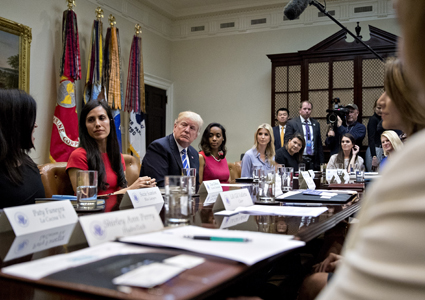
 Donald Trump at a round table for businesswomen last month: Many want a tax overhaul, but the last President to pull it off was Reagan (©Andrew Harrer/Bloomberg via Getty Images)
There are times when the President of the United States, the most powerful man in the world, wishes he were Chancellor of the Exchequer. That British politician retires to muse and consult, emerges with a budget, the details of which have at times been concealed from the Prime Minister, reads it to the House, recommends and receives its approval after answering a few questions from an Opposition politician who has not had the benefit of an advance peek at the policies the budget reflects. The President of the United States, capable of sending 59 Tomahawk missiles at Syria while dining with the President of China, prepares a budget and sends it to the congress which, without reading it, immediately pronounces it DOA — dead on arrival — and proceeds to prepare its own version of national priorities. Let the negotiations begin.
This give-and-take between the legislative and executive branches has its advantages, laid out in detail by the Founding Fathers in The Federalist Papers. But it is at minimum delaying, and at maximum preventing an overhaul of America’s corporate tax code, which is desperately needed, and soon. Here’s why:
• America’s statutory corporate tax rate is 35 per cent, the highest in the industrialised world — 39.1 per cent if state taxes are included. The average for the 35 members of the Organisation for Economic Co-Operation and Development (OECD) is 25 per cent.
• The effective rate, which reflects allowed deductions, is 27.7 per cent for corporations headquartered in the US, according to accountants PricewaterhouseCoopers. That compares to an effective rate of 19.5 per cent for their foreign-headquartered counterparts.
• The high level of the US corporate tax rate is believed by many to be the reason it produces so little revenue — only 10 per cent of the government’s total tax take.
• An American company pays tax on its output whether manufactured in a plant in Michigan or in Mexico; most foreign companies pay tax only on the output of plants located in the taxing country.
• According to a study by the Tax Foundation think tank, the US ranks last among OECD countries in corporate income tax competitiveness.
The results of this competitive disadvantage are a significant drag on economic growth. Several US corporations have fled our shores for the more benign tax environments of Ireland and other lower-tax countries — perhaps soon to include the UK once it successfully Brexits and introduces the 17 per cent rate Prime Minister Theresa May has promised for 2020. Such corporate flight is called “inversion” — buying a small overseas company, then transferring corporate headquarters to that lower-tax jurisdiction. Other gambits include parking intellectual capital (brands, patents) overseas and charging the US company for its use at rates that some claim transfers profits to low-taxing countries.
There is worse. To avoid the 35 per cent US corporate tax rate that would have to be paid if those profits were repatriated, the companies leave those profits — $2.6 trillion worth — overseas in the hope that some day they can be brought home without paying such a high entry fee. Meanwhile, these corporations can invest those funds free of US tax almost anywhere in the world except in America. If the overseas cash piles could be repatriated at a reasonable rate the money would either be dispersed as dividends, increasing the spending power of shareholders, or invested in facilities in the United States via mergers or new construction.
Finally, the corporate tax rate is not some abstraction having little to do with the lives of ordinary Americans. These taxes are a cost of business. There is considerable debate about their incidence — on whom they fall. But we do know that some portion of that cost must be recouped in the prices charged consumers for the products of these corporations. And some portion reduces the corporation’s ability to pay higher wages: the American Enterprise Institute, a Washington-based think tank, estimates that for every 1 percent increase in the corporate tax rate, wages decrease by 1 percent.
The case for an overhaul, a description Robert Rich, a leading expert in this field, has suggested to me is more accurate, because more inclusive, than “reform”, is so compelling that it was once considered to be low-hanging fruit, there for the plucking by President Trump. Those optimists, innocent in the ways of Washington, forgot two things. First, we live in a time of what Pulitzer Prize-winning columnist Charles Krauthammer calls hyperpartisanship, with both parties more eager to deny the opposition a victory than to score one themselves. Second, even before the “Never Trump” opposition took shape, changing the tax code proved beyond the grasp of our political class. The last president to pull this off was Ronald Reagan, and that was more than 30 years ago.
Part of the difficulty stems from the insistence by what are called deficit hawks that any tax overhaul be revenue-neutral — not add to a deficit they already consider dangerously high. During the presidential campaign Trump signed on to the hawks’ restriction, and went even further by promising that in addition to not adding to the deficit he would, first, increase military spending, second, preserve all existing entitlements such as social security and Medicaid, and eventually, third, eliminate the national debt. That was for campaigning: now comes governing. So as Trump reaches for what is the rather high-hanging fruit of tax overhaul he has to offset any losses due to rate reductions by raising new revenue. He can do that by a combination of raising some taxes and broadening the base to which the lower rates are to be applied, “broadening” being a euphemism for taking away special tax advantages now enjoyed by recipients who employ armies of lobbyists specifically charged with preserving their privileges.
Finally, the corporate tax rate is not some abstraction having little to do with the lives of ordinary Americans. These taxes are a cost of business. There is considerable debate about their incidence — on whom they fall. But we do know that some portion of that cost must be recouped in the prices charged consumers for the products of these corporations. And some portion reduces the corporation’s ability to pay higher wages: the American Enterprise Institute, a Washington-based think tank, estimates that for every 1 percent increase in the corporate tax rate, wages decrease by 1 percent.
The case for an overhaul, a description Robert Rich, a leading expert in this field, has suggested to me is more accurate, because more inclusive, than “reform”, is so compelling that it was once considered to be low-hanging fruit, there for the plucking by President Trump. Those optimists, innocent in the ways of Washington, forgot two things. First, we live in a time of what Pulitzer Prize-winning columnist Charles Krauthammer calls hyperpartisanship, with both parties more eager to deny the opposition a victory than to score one themselves. Second, even before the “Never Trump” opposition took shape, changing the tax code proved beyond the grasp of our political class. The last president to pull this off was Ronald Reagan, and that was more than 30 years ago.
Part of the difficulty stems from the insistence by what are called deficit hawks that any tax overhaul be revenue-neutral — not add to a deficit they already consider dangerously high. During the presidential campaign Trump signed on to the hawks’ restriction, and went even further by promising that in addition to not adding to the deficit he would, first, increase military spending, second, preserve all existing entitlements such as social security and Medicaid, and eventually, third, eliminate the national debt. That was for campaigning: now comes governing. So as Trump reaches for what is the rather high-hanging fruit of tax overhaul he has to offset any losses due to rate reductions by raising new revenue. He can do that by a combination of raising some taxes and broadening the base to which the lower rates are to be applied, “broadening” being a euphemism for taking away special tax advantages now enjoyed by recipients who employ armies of lobbyists specifically charged with preserving their privileges.
There is of course one way out of this dilemma: assume that the tax cuts being proposed will stimulate economic growth, generating new revenues for the federal coffers to offset the revenues lost by the cuts. It’s called “dynamic scoring”. Respectable economists, so-called supply-siders, believe the revenue-generating effect of lower corporate taxes will enable the Trump cuts to pay for themselves. Others, such as this writer, agree that lower rates might stimulate an increase in work, risk-taking and economic growth, but worry that the magnitude of the sustained impact on tax receipts is insufficient to make up for all lost revenues. New revenue sources are needed to keep the deficit from ballooning.
That leaves Trump and Congress not only with the pleasant necessity of lowering rates, but also the less pleasant one of devising such other changes in the tax code that, in combination with the rate reductions, will make America competitive again. They must contend with three distinct factions in the House of Representatives, the body charged by the constitution with originating all revenue bills. Establishment Republicans, led by Speaker of the House Paul Ryan, are willing to go along with the President’s demand to cut corporate tax rates and to increase spending on the military, but want to offset the revenue losses by reducing the scale and scope of the welfare state. Which Trump has pledged not to do. Democrats regard Ryan’s plan as a policy suitable only for warmongering Grinches who would rather spend $1 million on a single Tomahawk missile than on food and housing for thousands of poor families. Then there is the Freedom Caucus, a sort of third party with its members masquerading as Republicans. This rump group of Republican congressmen is the rough equivalent of John Major’s “bastards”, although outnumbering the beleaguered former PM’s enemies in his own party by a large enough number to have succeeded in shooting down the Trump/Ryan version of “repeal and replace” Obamacare.
Each of these parties generates numbers to prove that its plan is revenue neutral. Unfortunately, even numbers generated by well-intentioned experts are subject to wide margins of error. They represent projections of the revenue effects over the coming decade, and ten years is a long time for forecasters whose quarterly projections are often far off the mark; they assume no other changes in government policy that might affect the deficit; they are based either on the false assumption that the behaviour of economic actors is unaffected by changes in their take-home, after-tax incomes, or on the assumption that we can quantify that impact with some reasonable degree of precision.
But consider the sad state of economic theory. Some economists say that increasing take-home pay by lowering taxes encourages work and risk-taking. Others argue that many economic players have income targets and will work less when they can more quickly reach those targets, a phenomenon I found to be the case when increases in taxi rates I proposed in New York City, in the hope of increasing the supply of cabs at night, allowed drivers to say “enough is enough” earlier in the evening, reducing the supply of cabs. So quantifying the revenue effect of tax cuts is somewhere between informed guesswork at best, and estimates doomed to miss the mark by orders of magnitude at worst.
That leaves Trump and Congress not only with the pleasant necessity of lowering rates, but also the less pleasant one of devising such other changes in the tax code that, in combination with the rate reductions, will make America competitive again. They must contend with three distinct factions in the House of Representatives, the body charged by the constitution with originating all revenue bills. Establishment Republicans, led by Speaker of the House Paul Ryan, are willing to go along with the President’s demand to cut corporate tax rates and to increase spending on the military, but want to offset the revenue losses by reducing the scale and scope of the welfare state. Which Trump has pledged not to do. Democrats regard Ryan’s plan as a policy suitable only for warmongering Grinches who would rather spend $1 million on a single Tomahawk missile than on food and housing for thousands of poor families. Then there is the Freedom Caucus, a sort of third party with its members masquerading as Republicans. This rump group of Republican congressmen is the rough equivalent of John Major’s “bastards”, although outnumbering the beleaguered former PM’s enemies in his own party by a large enough number to have succeeded in shooting down the Trump/Ryan version of “repeal and replace” Obamacare.
Each of these parties generates numbers to prove that its plan is revenue neutral. Unfortunately, even numbers generated by well-intentioned experts are subject to wide margins of error. They represent projections of the revenue effects over the coming decade, and ten years is a long time for forecasters whose quarterly projections are often far off the mark; they assume no other changes in government policy that might affect the deficit; they are based either on the false assumption that the behaviour of economic actors is unaffected by changes in their take-home, after-tax incomes, or on the assumption that we can quantify that impact with some reasonable degree of precision.
But consider the sad state of economic theory. Some economists say that increasing take-home pay by lowering taxes encourages work and risk-taking. Others argue that many economic players have income targets and will work less when they can more quickly reach those targets, a phenomenon I found to be the case when increases in taxi rates I proposed in New York City, in the hope of increasing the supply of cabs at night, allowed drivers to say “enough is enough” earlier in the evening, reducing the supply of cabs. So quantifying the revenue effect of tax cuts is somewhere between informed guesswork at best, and estimates doomed to miss the mark by orders of magnitude at worst.
As if this were not enough to make an agreement on which geese to pluck to fill treasury coffers rather difficult, there is the added problem that President Trump is coming off an embarrassing (although possibly temporary) defeat of his effort to repeal and replace Obamacare. A bully can be effective only if he succeeds: the Freedom Caucus ignored his threats of retaliation, voted with Democrats to scupper healthcare reform, and lived to tell the tale. A self-proclaimed first-class practitioner of “the Art of the Deal” who failed to negotiate his way through the health-care-reform jungle emerges doubly weakened. Not only was the President proved an impotent bully and ineffectual negotiator: House Speaker Paul Ryan could not deliver the votes which he had promised and which Trump needed, tarnishing his own reputation and making Trump suspicious of the Speaker’s ability to deliver the votes for a key part of the Ryan tax reform plan — a border adjustment tax.
That tax is designed to produce the revenue needed to offset major reductions in the corporate tax rate, from a nominal 35 per cent to 20 per cent (Ryan), more in line with the OECD average of 23 per cent, or 15 per cent (Trump). Stripped of nuance, the proposal is to tax imports at a rate of 20 per cent, to put them on a basis equal to that faced by American imports into countries that rely on value-added taxes. As things now stand, a Cadillac produced in the US is burdened with a 20 per cent tax in most OECD countries, while Jaguars, BMWs, and emissions-spewing Volkswagens face no such charge when sold in America. A Jaguar that is sold in the UK for the equivalent of $60,000, including VAT, is sold in America for $50,000 (ignoring some minor local taxes); a Cadillac that is sold in America for $50,000 must find a customer prepared to shell out $60,000 in Britain.
Ryan proposes to correct that in two ways: tax imports, and relieve goods exported from the US of any taxation by switching to a system that taxes goods at the point of sale. Boeing would pay no tax on the revenue from its sales to China; domestic airlines that prefer Airbus would face a 20 per cent levy, just as Boeing faces when it sells aircraft to countries that charge VAT. A small policy group of which I was a member (the Tax Reform Initiative Group, chaired by Doug Holtz-Eakin, formerly Director of the Congressional Budget Office) noted in its final report:
That tax is designed to produce the revenue needed to offset major reductions in the corporate tax rate, from a nominal 35 per cent to 20 per cent (Ryan), more in line with the OECD average of 23 per cent, or 15 per cent (Trump). Stripped of nuance, the proposal is to tax imports at a rate of 20 per cent, to put them on a basis equal to that faced by American imports into countries that rely on value-added taxes. As things now stand, a Cadillac produced in the US is burdened with a 20 per cent tax in most OECD countries, while Jaguars, BMWs, and emissions-spewing Volkswagens face no such charge when sold in America. A Jaguar that is sold in the UK for the equivalent of $60,000, including VAT, is sold in America for $50,000 (ignoring some minor local taxes); a Cadillac that is sold in America for $50,000 must find a customer prepared to shell out $60,000 in Britain.
Ryan proposes to correct that in two ways: tax imports, and relieve goods exported from the US of any taxation by switching to a system that taxes goods at the point of sale. Boeing would pay no tax on the revenue from its sales to China; domestic airlines that prefer Airbus would face a 20 per cent levy, just as Boeing faces when it sells aircraft to countries that charge VAT. A small policy group of which I was a member (the Tax Reform Initiative Group, chaired by Doug Holtz-Eakin, formerly Director of the Congressional Budget Office) noted in its final report:
While the US has maintained an international tax system that disadvantages US firms competing abroad, many US trading partners have shifted to territorial systems that exempt entirely, or to a large extent, foreign source income. Of the 34 [other] economies in the Organisation for Economic Cooperation and Development (OECD), for example, 28 have adopted such systems.
Two problems. Trump first rejected this plan as too complicated, then decided he favoured it, and now has turned agnostic. It seems that major importers, most notably Walmart and other retailers, met with the President at the White House and informed Trump that the Ryan plan would force them to raise prices by 20 per cent, which would hit Trump’s supporters where it hurts — in their wallets and pocketbooks. That is a bit disingenuous. For one thing, the tax would apply to the cost of the imported goods, not to the higher final sales prices. For another, economists who favour the import levy argue that it would strengthen the dollar sufficiently to offset the tax, since a stronger dollar makes imports cheaper. Walmart employs 1.4 million workers, 1 per cent of the US working population — voters prepared to punish legislators who vote against their employer’s interests. No surprise that several senators have expressed an unwillingness to risk a forced return to the private sector by betting that the economists’ models are better than, say, the ones that failed to predict the financial crisis.
For the moment, the border adjustment tax has been released from intensive care, but not because its prospects have improved. Rather, it is considered DOA, beyond resuscitation. Worse still, the most efficient possible alternative source of revenue, a carbon tax, is unlikely to seem attractive to a President who regards climate change as a “hoax”.
So the question now before Trump and the congress is how to raise the revenues needed to offset a reduction in corporate tax rates. One source might be the feature of the tax code that allows interest to be treated as an expense, but denies such treatment to dividends paid to holders of a company’s equity. This gives corporations an incentive to borrow rather than raise equity capital, to increase the risk they face of a downturn that impairs their revenues, as interest must be paid, and dividends can be reduced in times of stress. Levelling the playing field, treating interest payments the same way as dividends are treated, would discourage dangerous over-leveraging.
But property developers are among the most highly leveraged of entrepreneurs; the deductibility of the interest they pay on the debt load under which they usually labour is crucial to their financial success. And when their business turns down, bankruptcy results, as Trump, known in his business days as “the King of Debt”, well knows.
This change has many proponents, including Speaker Ryan, who couples it with allowing an immediate write-off of equipment purchases, and Stephen Moore, the economist who advised Trump during his campaign. But the former property developer now splitting his time between the White House and Mar-a-Lago is not among them. “He hated the idea,” Moore told an interviewer. Not necessarily because he is acting in his narrow self-interest, although Democrats are accusing him of doing just that, but because he sees the world, and its economic engine, through the lens of a lifetime as a property developer. Take away their tax break and there will be fewer apartment towers built and fewer construction jobs for the nation’s hard-hats, fewer hotels to provide jobs for low-skilled workers.
For the moment, the border adjustment tax has been released from intensive care, but not because its prospects have improved. Rather, it is considered DOA, beyond resuscitation. Worse still, the most efficient possible alternative source of revenue, a carbon tax, is unlikely to seem attractive to a President who regards climate change as a “hoax”.
So the question now before Trump and the congress is how to raise the revenues needed to offset a reduction in corporate tax rates. One source might be the feature of the tax code that allows interest to be treated as an expense, but denies such treatment to dividends paid to holders of a company’s equity. This gives corporations an incentive to borrow rather than raise equity capital, to increase the risk they face of a downturn that impairs their revenues, as interest must be paid, and dividends can be reduced in times of stress. Levelling the playing field, treating interest payments the same way as dividends are treated, would discourage dangerous over-leveraging.
But property developers are among the most highly leveraged of entrepreneurs; the deductibility of the interest they pay on the debt load under which they usually labour is crucial to their financial success. And when their business turns down, bankruptcy results, as Trump, known in his business days as “the King of Debt”, well knows.
This change has many proponents, including Speaker Ryan, who couples it with allowing an immediate write-off of equipment purchases, and Stephen Moore, the economist who advised Trump during his campaign. But the former property developer now splitting his time between the White House and Mar-a-Lago is not among them. “He hated the idea,” Moore told an interviewer. Not necessarily because he is acting in his narrow self-interest, although Democrats are accusing him of doing just that, but because he sees the world, and its economic engine, through the lens of a lifetime as a property developer. Take away their tax break and there will be fewer apartment towers built and fewer construction jobs for the nation’s hard-hats, fewer hotels to provide jobs for low-skilled workers.
Closing this escape hatch was deemed infeasible by the small group of economists and specialists, including this writer, convened to wade through reams of economic data and recommend changes. But if the border adjustment tax is indeed off the table, and if Alan Cole of the Tax Foundation is right that eliminating interest deductibility would produce $1 trillion in revenue over ten years — the same as would a border adjustment tax — Trump might change his mind on this as he has on other matters. That would generate enough cash to allow cuts that would bring the statutory corporate tax rate to a level well below the current 35 per cent, although still above the Ryan and Trump targets, without increasing the deficit.
Which leads to one more proposal. A temporary tax holiday, setting the rate on repatriated earnings to, say, 10 per cent, would bring in considerable cash, and permit at least a temporary reduction in corporate taxes. Add some accounting fudge, and the corporate rate might be lowered another point or two.
That, however, would leave the President between a rock and his hard-faced constituents. He has promised a reduction in personal tax rates for almost all taxpayers, including a cut from to 33 per cent from 39.6 per cent for high earners, who would also be relieved of the 3.8 per cent surtax on interest and dividend income embedded in Obamacare. What Trump giveth Steve Mnuchin, his Treasury Secretary, plans to take away. He has announced that he will reduce high earners’ ability to benefit from various deductions, leaving them paying just as much in tax as they now pay. Trump has also promised to reduce tax rates borne by middle- and lower-income families, but Ryan & Co want to reserve tax-cutting ability for the corporate sector, which they say will flow through to all families via lower prices. Besides, as Larry Lindsey, former Fed governor and chief economist for George W. Bush, points out, increasing middle-class incomes, and hence their effective demand for stuff just when the economy seems to be hitting the ceiling of its ability to increase output, might trigger inflation rather than an increase in the growth rate.
In short, the administration has not got its act together when it comes to tax overhaul. Trump is eager for a victory, although under less pressure to produce one than before his generally approved decision to act in Syria rather than draw erasable red lines, and his presidential-quality performance when playing host to Xi Jinping. He just might accept some modest cut in corporate income rates, and a reduction sufficient to lure home some of the $2.6 trillion in profits stashed overseas, and declare victory. It would be an opportunity missed to overhaul — “reform” is the less accurate but more commonly used word — in the grand tradition of other efforts over the past three decades to engineer a durable structural overhaul of our tax code that just might Make America Great Again.
Which leads to one more proposal. A temporary tax holiday, setting the rate on repatriated earnings to, say, 10 per cent, would bring in considerable cash, and permit at least a temporary reduction in corporate taxes. Add some accounting fudge, and the corporate rate might be lowered another point or two.
That, however, would leave the President between a rock and his hard-faced constituents. He has promised a reduction in personal tax rates for almost all taxpayers, including a cut from to 33 per cent from 39.6 per cent for high earners, who would also be relieved of the 3.8 per cent surtax on interest and dividend income embedded in Obamacare. What Trump giveth Steve Mnuchin, his Treasury Secretary, plans to take away. He has announced that he will reduce high earners’ ability to benefit from various deductions, leaving them paying just as much in tax as they now pay. Trump has also promised to reduce tax rates borne by middle- and lower-income families, but Ryan & Co want to reserve tax-cutting ability for the corporate sector, which they say will flow through to all families via lower prices. Besides, as Larry Lindsey, former Fed governor and chief economist for George W. Bush, points out, increasing middle-class incomes, and hence their effective demand for stuff just when the economy seems to be hitting the ceiling of its ability to increase output, might trigger inflation rather than an increase in the growth rate.
In short, the administration has not got its act together when it comes to tax overhaul. Trump is eager for a victory, although under less pressure to produce one than before his generally approved decision to act in Syria rather than draw erasable red lines, and his presidential-quality performance when playing host to Xi Jinping. He just might accept some modest cut in corporate income rates, and a reduction sufficient to lure home some of the $2.6 trillion in profits stashed overseas, and declare victory. It would be an opportunity missed to overhaul — “reform” is the less accurate but more commonly used word — in the grand tradition of other efforts over the past three decades to engineer a durable structural overhaul of our tax code that just might Make America Great Again.