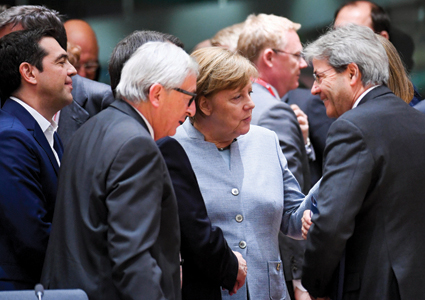
 Calling the shots on Brexit: Jean-Claude Juncker and Angela Merkel at the EU summit in April (© Pool Frederic Sierakowski/Belga/PA Images)
So it really was all about the money. Europe, that is. All along. Forget all that high-flown rhetoric about “Never Again” to war and genocide. Forget all the hot air about a European identity replacing the nationalism of the past. Forget, especially, any spiritual dimension of the European project. In 1962, to be sure, Adenauer and De Gaulle attended a Mass for Peace at Rheims Cathedral, the first of many magnificently mawkish exercises in Euro-ceremonial. Only last month, to the strains of Beethoven’s Ninth, Emmanuel Macron made his entrance as newly-elected President of the Republic in the courtyard of the Louvre, once the palace of the Most Christian Kings of France, now the greatest single repository of Western civilisation. But as far as the French and Germans were concerned, the British were mere offshore islanders. It was always about the money.
We have now, belatedly, been forced to recognise this by the extraordinarily belligerent tone of the leading figures on the Brussels side of the Brexit negotiations, particularly Jean-Claude Juncker. No doubt these officials would prefer the talks to end without a formal agreement, and with Britain subject to unspecified protectionist sanctions and discrimination, because they believe the other 27 member states need to be warned of the consequences of leaving the EU. But their mercenary attitude still has the power to shock. Such arbitrary sums are being bruited about as the “divorce bill” — €100 billion is the latest figure to emerge from Brussels — that you could be forgiven for wondering why, as the second largest net contributor for over four decades, Britain is being asked to pay a penny. By the time Brexit takes effect, the UK will have paid half a trillion pounds to the EU since 1973. France and the Mediterranean countries have been propped up by British taxpayers; the absorption of Central Europe after 1989 could not have been paid for without British subsidies. It is clear that Brexit is a catastrophe for the EU’s shaky finances. The euro crisis was, seen from Berlin, a price worth paying, so that German exporters could keep a cheap currency and continue to control the continental economy. Though Germany has twice bailed out the Greek government, it was the Greeks themselves who took the biggest hit: their economy shrank by a third after 2008 and is still shrinking. Italy has barely grown since the euro was introduced in 1999, while Spain has suffered mass unemployment for a decade. Germany, meanwhile, has enjoyed steady growth, apart from the year after the crash in 2008, and practically no austerity at all. Now the burden of subsidising southern and eastern Europe will fall even more heavily on the booming German economy.
Hence the vindictiveness with which Berlin has turned on the British for opting out of two great German projects: not only the euro but the EU itself. It was the European Commission president’s German chief of staff, Martin Selmayr, who is believed to have leaked a partisan account of the Downing Street dinner to Angela Merkel’s staunchest ally in the German press, the Frankfurter Allgemeine Zeitung. (A belated denial by Jean-Claude Juncker failed to remove this suspicion.) And it was Mr Juncker himself whose phone call, revealingly made immediately afterwards to the German Chancellor, that prompted Mrs Merkel to lecture the British before the Bundestag. “Some people in Great Britain still have illusions” that the UK’s rights after Brexit would remain unchanged, she declared. “And that is a waste of time.” By “some people” she meant Theresa May, of course, and the insult was meant to sting. It is one thing to be patronised by the bibulous Juncker or the garrulous Tusk, neither of whom is even elected; quite another to be rebuked by the most powerful person in Europe, who also happens to be the most senior member of the sisterhood of female leaders.
Mrs Merkel’s unsisterly sally before a parliament united in its assumption that Brexit must be based on malice or misunderstanding was playing to a long-standing German prejudice about the British as self-deluding amateurs compared to continental experts, one that long predates Brexit, or even the European Union itself. A good example is to be found in Hegel’s 1831 essay on the Reform Bill, where he takes the British to task for allowing even a reformed parliament to consist of ignorant foxhunting squires, slick lawyers and others educated merely by newspapers and debates — so inferior to the academic distinction of the bureaucrats who ruled Germany. It may be no exaggeration to see the Hegelian Geist personified in the Selmayrs of our day, still sneering at the successors of Wellington, Peel and Grey.
Mrs May’s dismay was evident in her Downing Street speech a few days later, when she denounced European politicians and officials whose “acts have been deliberately timed to affect the result of the general election”, and who “do not want Britain to prosper”. Her popularity may have soared because of the row with Mr Juncker, but taking on Mrs Merkel is another matter. She is finding out the hard way why a British prime minister needs to understand Germany, and especially German history. Unlike Margaret Thatcher, whose attitudes were shaped by her childhood experience of war and friendship with a Jewish refugee from the Nazis, Mrs May is of a generation that encountered post-war Germany primarily as an economy that had long since overtaken Britain’s: Vorsprung durch Technik. Notoriously, Mrs Thatcher convened a seminar of leading academics at Chequers to inform her about German history. Unhappy with the minute of their discussion prepared by her private secretary Charles (now Lord) Powell, several historians promptly leaked their own highly critical accounts of the Prime Minister’s insurmountable fear of German domination. Mrs May is unlikely to follow her predecessor’s example — she has probably already had enough of leaked accounts of dinners — but she is by all accounts no less thorough than Mrs Thatcher in mastering her brief. An essay is no substitute for such a seminar; at most it may whet the appetite for a deeper encounter with the subject.
We know that German history still matters, because the British keep getting it wrong. Michael Heseltine was only the latest in a long line of politicians to do so when, as Theresa May triggered Article 50 in obedience to last year’s referendum result, he justified his refusal to accept the result by reference to German hegemony: “For someone like myself, it was 1933, the year of my birth, that Hitler was democratically elected in Germany. He unleashed the most horrendous war. This country played a unique role in securing his defeat. So Germany lost the war. We’ve just handed them the opportunity to win the peace. I find that quite unacceptable.”
Lord Heseltine is doing more than stretch a point by his implied analogy between the British referendum and Germany’s March 1933 election. It was that dubious exercise in Nazi “democracy”, notorious for the ubiquity of voter intimidation, which paved the way for Hitler to sweep away all limits on his power with the Enabling Law — though even then he needed the Catholic Centre Party (forerunner of Angela Merkel’s Christian Democrats) to get a majority. Only a man accustomed to himself being compared to Tarzan would have the chutzpah to compare Brexit to the Third Reich. Even more remarkable, though, was Heseltine’s major premise: that Brexit has “handed [the Germans] the opportunity to win the peace” — in other words, that Britain’s withdrawal will lead to the very German domination of Europe that older generations fought against in the war.
Mrs May’s dismay was evident in her Downing Street speech a few days later, when she denounced European politicians and officials whose “acts have been deliberately timed to affect the result of the general election”, and who “do not want Britain to prosper”. Her popularity may have soared because of the row with Mr Juncker, but taking on Mrs Merkel is another matter. She is finding out the hard way why a British prime minister needs to understand Germany, and especially German history. Unlike Margaret Thatcher, whose attitudes were shaped by her childhood experience of war and friendship with a Jewish refugee from the Nazis, Mrs May is of a generation that encountered post-war Germany primarily as an economy that had long since overtaken Britain’s: Vorsprung durch Technik. Notoriously, Mrs Thatcher convened a seminar of leading academics at Chequers to inform her about German history. Unhappy with the minute of their discussion prepared by her private secretary Charles (now Lord) Powell, several historians promptly leaked their own highly critical accounts of the Prime Minister’s insurmountable fear of German domination. Mrs May is unlikely to follow her predecessor’s example — she has probably already had enough of leaked accounts of dinners — but she is by all accounts no less thorough than Mrs Thatcher in mastering her brief. An essay is no substitute for such a seminar; at most it may whet the appetite for a deeper encounter with the subject.
We know that German history still matters, because the British keep getting it wrong. Michael Heseltine was only the latest in a long line of politicians to do so when, as Theresa May triggered Article 50 in obedience to last year’s referendum result, he justified his refusal to accept the result by reference to German hegemony: “For someone like myself, it was 1933, the year of my birth, that Hitler was democratically elected in Germany. He unleashed the most horrendous war. This country played a unique role in securing his defeat. So Germany lost the war. We’ve just handed them the opportunity to win the peace. I find that quite unacceptable.”
Lord Heseltine is doing more than stretch a point by his implied analogy between the British referendum and Germany’s March 1933 election. It was that dubious exercise in Nazi “democracy”, notorious for the ubiquity of voter intimidation, which paved the way for Hitler to sweep away all limits on his power with the Enabling Law — though even then he needed the Catholic Centre Party (forerunner of Angela Merkel’s Christian Democrats) to get a majority. Only a man accustomed to himself being compared to Tarzan would have the chutzpah to compare Brexit to the Third Reich. Even more remarkable, though, was Heseltine’s major premise: that Brexit has “handed [the Germans] the opportunity to win the peace” — in other words, that Britain’s withdrawal will lead to the very German domination of Europe that older generations fought against in the war.
While it is true that Chancellor Merkel calls the shots not only in Berlin and Frankfurt but in Brussels and Strasbourg too, it is far-fetched, to say the least, to compare German economic ascendancy, achieved peacefully through industrial strength and monetary union, with Hitler’s Neuordnung Europas (“New European Order”), imposed by military might. Indeed, Lord Heseltine’s suspicion of the Germans exceeds that of the late Nicholas Ridley, who famously (and, for himself, fatally) dismissed the EU as a “German racket” more than quarter of a century ago. It striking how much these two, on opposite sides of the Europe debate, actually had in common. Like his great rival Margaret Thatcher, Heseltine still fears the continuities in German history.
So too do the Germans themselves. Indeed, in German the words “history” and “past” have acquired uniquely ominous connotations. The reason is obvious: the 12 years of the Third Reich overshadow everything else. It is a cliché beloved of German public discourse to point out that these 12 years should not obscure the country’s astonishing post-war achievements. Indeed, non-Germans also repeat this line ad nauseam, if only to be polite to their German interlocutors. Particularly since the reunification of Germany a generation ago, there has been a compulsion amounting to an obsession to put the Nazi past into a wider context — comparing the German experience to those of other nations, agonising about its uniqueness — in order to relieve the burden of vicarious guilt and shame. As the historian Michael Stürmer put it: “In Germany for a long time the purpose of history was to ensure that it could never happen again.” Only a new way of seeing German history could make possible a new German identity. The curse of history could not be lifted except by historians.
German angst about history long predates the Third Reich. The failure (if that is what it was) of the Germans to create a unified nation state until the late 19th century was a cause for endless soul-searching. So too was the form that this unification took: a “German Reich” that excluded much of the old Holy Roman Empire, still ruled by the Imperial House of Habsburg; that absorbed the Prussian monarchy into a parliamentary system yet preserved its absolutist and military character; and that was forged not by constitutional consent but by Bismarck’s “blood and iron”. And the search for explanations of the uniquely fatal course of German history led scholars further and further back in time, to the Middle Ages and beyond.
Now James Hawes, a British writer (though a novelist and Kafka scholar rather than historian), has produced a sparkling little book, The Shortest History of Germany (Old Street, £12.99), which really does begin at the beginning, with Julius Caesar inventing “Germania”. His point is that these barbarians were thoroughly Romanised, but only within an area bounded by the Rivers Elbe and Danube and the Roman limes (a line of forts similar to Hadrian’s Wall) that roughly coincides with modern West Germany. For Hawes, everything you really need to know about the Germans is already visible in the first accounts by Caesar and Tacitus — if only one knows how to read them. He races through the next two millennia in 200 pages, demonstrating to his own satisfaction that everything bad in German history has come from the east, because the Saxons and Prussians were never really civilised. The Reformation was a Bad Thing because it cut off much of Northern Germany from Rome. So was the rise of Prussia in the 18th century, especially when the British saved Frederick the Great in the Seven Years’ War. Later the British rewarded the Prussians for their help against Napoleon by giving them the Rhineland, which turned out to include what later became Germany’s industrial heartlands. The West has been subsidising the East ever since. Bismarck’s wars of unification were, for Hawes, a thinly-disguised Prussian conquest which led directly to Hitler, because the uncivilised barbarians east of the Elbe dragged the rest of Germany into two world wars. The post-war dismembering of Prussia and division of what was left of Germany was a Good Thing because it kept the East Germans safely behind a wall, leaving the West Germans to get on with rebuilding their prosperity and democracy.
So too do the Germans themselves. Indeed, in German the words “history” and “past” have acquired uniquely ominous connotations. The reason is obvious: the 12 years of the Third Reich overshadow everything else. It is a cliché beloved of German public discourse to point out that these 12 years should not obscure the country’s astonishing post-war achievements. Indeed, non-Germans also repeat this line ad nauseam, if only to be polite to their German interlocutors. Particularly since the reunification of Germany a generation ago, there has been a compulsion amounting to an obsession to put the Nazi past into a wider context — comparing the German experience to those of other nations, agonising about its uniqueness — in order to relieve the burden of vicarious guilt and shame. As the historian Michael Stürmer put it: “In Germany for a long time the purpose of history was to ensure that it could never happen again.” Only a new way of seeing German history could make possible a new German identity. The curse of history could not be lifted except by historians.
German angst about history long predates the Third Reich. The failure (if that is what it was) of the Germans to create a unified nation state until the late 19th century was a cause for endless soul-searching. So too was the form that this unification took: a “German Reich” that excluded much of the old Holy Roman Empire, still ruled by the Imperial House of Habsburg; that absorbed the Prussian monarchy into a parliamentary system yet preserved its absolutist and military character; and that was forged not by constitutional consent but by Bismarck’s “blood and iron”. And the search for explanations of the uniquely fatal course of German history led scholars further and further back in time, to the Middle Ages and beyond.
Now James Hawes, a British writer (though a novelist and Kafka scholar rather than historian), has produced a sparkling little book, The Shortest History of Germany (Old Street, £12.99), which really does begin at the beginning, with Julius Caesar inventing “Germania”. His point is that these barbarians were thoroughly Romanised, but only within an area bounded by the Rivers Elbe and Danube and the Roman limes (a line of forts similar to Hadrian’s Wall) that roughly coincides with modern West Germany. For Hawes, everything you really need to know about the Germans is already visible in the first accounts by Caesar and Tacitus — if only one knows how to read them. He races through the next two millennia in 200 pages, demonstrating to his own satisfaction that everything bad in German history has come from the east, because the Saxons and Prussians were never really civilised. The Reformation was a Bad Thing because it cut off much of Northern Germany from Rome. So was the rise of Prussia in the 18th century, especially when the British saved Frederick the Great in the Seven Years’ War. Later the British rewarded the Prussians for their help against Napoleon by giving them the Rhineland, which turned out to include what later became Germany’s industrial heartlands. The West has been subsidising the East ever since. Bismarck’s wars of unification were, for Hawes, a thinly-disguised Prussian conquest which led directly to Hitler, because the uncivilised barbarians east of the Elbe dragged the rest of Germany into two world wars. The post-war dismembering of Prussia and division of what was left of Germany was a Good Thing because it kept the East Germans safely behind a wall, leaving the West Germans to get on with rebuilding their prosperity and democracy.
But the fall of the Berlin Wall was a Bad Thing: no sooner had the barbarians burst through in 1989, than the old extremist politics of Left and Right resurfaced in the East, unappeased by the West’s trillions. In a series of maps, Hawes tries to show that there is continuity from the Roman Germania, via the Holy Roman Empire, to Adenauer’s late, lamented West Germany. “This Germany,” Hawes assures us, “is Europe’s best hope.” Whoever wins the election in September “will face a world in which the West is tottering” and should act accordingly: as the leader of “a mighty land at the very heart of the West”.
If my summary reads a little like a caricature of Hawes’s Shortest History as a German version of the classic textbook parody by W.C. Sellars and R. J. Yeatman, 1066 and All That, then I can only plead guilty; the temptation is too great. But Hawes is in earnest. He hopes that either Angela Merkel or her left-wing challenger Martin Schulz will emerge as the saviour of the liberal West from the scourge of populism, driven by the barbarians at the Brandenburg Gate. He doesn’t care that Mrs Merkel is, at least by background, herself one of these barbarians: an “Ossi” from the wrong side of the Wall. Many of the great (if not always good) Germans in history also came from East of the Elbe, from Bach to Wagner, from Kant to Nietzsche, and so on. Some of the worst come from the Romanised West or South, from the Crusaders who massacred the Jews of the Rhineland in the 11th century to Hitler, Goebbels and Himmler, who tried to exterminate the entire Jewish population of Europe. It is true, as Hawes claims, that those who voted for the Nazis were mainly Protestant and lived in the North and East, while those who did not were mainly Catholic and lived in the West or South. But the Catholic Centre Party (of which Adenauer, as mayor of Cologne, was a leading member) voted for Hitler’s Enabling Law that created the Nazi dictatorship; and though Hawes makes much of Bishop Galen, who bravely opposed the Nazi euthanasia programme, most prelates of the Catholic Church collaborated as willingly as their Protestant counterparts. Adenauer, who was imprisoned by the Nazis, spoke contemptuously after 1945 of the moral collapse of the German Catholic hierarchy. “Good Germans”, like war criminals, came from very varied backgrounds; the urge to assign guilt or innocence collectively deprives individuals of responsibility. Hannah Arendt fell into the trap of reducing the culpability of Eichmann, an architect of the Shoah, to “the banality of evil”; Hawes risks doing the same by making Prussia the scapegoat instead. The unintended consequence is that he makes Bismarck — who gave the Germans universal male suffrage, Jewish emancipation and the welfare state — a bigger villain than Hitler.
What Hawes has however achieved, like Sellar and Yeatman, is to write a Memorable History: if the Prime Minister reads nothing else, she will know a good deal more about German history than most British politicians. Hawes exemplifies the remarkable contribution of Anglo-Saxon scholarship to post-war German historiography. It is hardly an exaggeration to say that much of the most important political, economic and cultural history of modern Germany has been written in English. Hawes belongs in a grand Anglo-American tradition that includes, among many others, A.J.P. Taylor, Hugh Trevor-Roper, Gordon Craig, Fritz Stern, Peter Gay, Sebastian Haffner, James J. Sheehan, Michael Burleigh, Richard Evans, Jonathan Steinberg, John Röhl, J.P. Stern, Norman Stone, David Blackbourn, Harold James, Nicholas Boyle and Mary Elise Sarotte. It is not accidental that some of the best minds in the Anglosphere have worried away at the German problem ever since 1945. The preceding generation had been dragged into two world wars, the Iron Curtain ran through Berlin, and getting to grips with German history was the key to preventing the Cold War from becoming a Third World War. Hawes has distilled all this into a primer that might be slipped into a prime ministerial red box.
If my summary reads a little like a caricature of Hawes’s Shortest History as a German version of the classic textbook parody by W.C. Sellars and R. J. Yeatman, 1066 and All That, then I can only plead guilty; the temptation is too great. But Hawes is in earnest. He hopes that either Angela Merkel or her left-wing challenger Martin Schulz will emerge as the saviour of the liberal West from the scourge of populism, driven by the barbarians at the Brandenburg Gate. He doesn’t care that Mrs Merkel is, at least by background, herself one of these barbarians: an “Ossi” from the wrong side of the Wall. Many of the great (if not always good) Germans in history also came from East of the Elbe, from Bach to Wagner, from Kant to Nietzsche, and so on. Some of the worst come from the Romanised West or South, from the Crusaders who massacred the Jews of the Rhineland in the 11th century to Hitler, Goebbels and Himmler, who tried to exterminate the entire Jewish population of Europe. It is true, as Hawes claims, that those who voted for the Nazis were mainly Protestant and lived in the North and East, while those who did not were mainly Catholic and lived in the West or South. But the Catholic Centre Party (of which Adenauer, as mayor of Cologne, was a leading member) voted for Hitler’s Enabling Law that created the Nazi dictatorship; and though Hawes makes much of Bishop Galen, who bravely opposed the Nazi euthanasia programme, most prelates of the Catholic Church collaborated as willingly as their Protestant counterparts. Adenauer, who was imprisoned by the Nazis, spoke contemptuously after 1945 of the moral collapse of the German Catholic hierarchy. “Good Germans”, like war criminals, came from very varied backgrounds; the urge to assign guilt or innocence collectively deprives individuals of responsibility. Hannah Arendt fell into the trap of reducing the culpability of Eichmann, an architect of the Shoah, to “the banality of evil”; Hawes risks doing the same by making Prussia the scapegoat instead. The unintended consequence is that he makes Bismarck — who gave the Germans universal male suffrage, Jewish emancipation and the welfare state — a bigger villain than Hitler.
What Hawes has however achieved, like Sellar and Yeatman, is to write a Memorable History: if the Prime Minister reads nothing else, she will know a good deal more about German history than most British politicians. Hawes exemplifies the remarkable contribution of Anglo-Saxon scholarship to post-war German historiography. It is hardly an exaggeration to say that much of the most important political, economic and cultural history of modern Germany has been written in English. Hawes belongs in a grand Anglo-American tradition that includes, among many others, A.J.P. Taylor, Hugh Trevor-Roper, Gordon Craig, Fritz Stern, Peter Gay, Sebastian Haffner, James J. Sheehan, Michael Burleigh, Richard Evans, Jonathan Steinberg, John Röhl, J.P. Stern, Norman Stone, David Blackbourn, Harold James, Nicholas Boyle and Mary Elise Sarotte. It is not accidental that some of the best minds in the Anglosphere have worried away at the German problem ever since 1945. The preceding generation had been dragged into two world wars, the Iron Curtain ran through Berlin, and getting to grips with German history was the key to preventing the Cold War from becoming a Third World War. Hawes has distilled all this into a primer that might be slipped into a prime ministerial red box.
How could Mrs May make positive use of such a working knowledge of German history in her dealings with Berlin, Paris and Brussels? I have no idea. But as it happens, this is the year of the Dutch, French, British and German elections. The sheer ugliness of what Europe is becoming has just been on display again in France, which is worth briefly comparing to Germany. For months the candidates traded insults and smears, conspiracy theories and guilt by association — anything rather than offer the voters what they were crying out for: a certain idea of France, as De Gaulle put it. The General dismissed those like Emmanuel Macron who use Europe as a political slogan: “It amounts to nothing and it signifies nothing.” But he also despised nationalists like Marine Le Pen, who tried and failed to imitate his authentic patriotism. De Gaulle believed in both the Republic and the Catholic Church, the twin pillars of French identity. Neither Macron nor Le Pen appears to appreciate that the Republic cannot flourish without the Church, just as the Church must embrace the whole Republic.
De Gaulle was not the last great Frenchman. The late Cardinal Archbishop of Paris, Aaron Jean-Marie Lustiger, was born a Jew and survived the Holocaust only thanks to the kindness of Catholics. He chose to convert but always considered Christianity to be the fulfillment of Judaism and himself no less a Jew than a Christian: “For me, the vocation of Israel is bringing light to the goyim. That is my hope and I believe that Christianity is the means for achieving it.” He rebuked Marine Le Pen’s father, Jean-Marie, for his anti-Semitism and racism: “The Christian faith says that all men are equal in dignity because they are all created in the image of God.” His epitaph in Notre Dame reads: “Having become Christian by faith and by Baptism, I have remained Jewish as did the Apostles.” By forcing France to confront the Jewish origins of the Christian faith, Lustiger did more to banish anti-Semitism from respectable discourse than all the intellectuals of the Left Bank put together. That anti-Semitism has returned with a vengeance since Lustiger’s death in 2007 and the French Jews are emigrating in ever larger numbers is a terrible indictment of the French political class.
Lustiger was a living symbol of what France at its best could still achieve, just as his friend Joseph Ratzinger, whom he helped to elect as Pope Benedict in 2005, remains a symbol of what is best in Germany. In his debate with the leading philosopher Jürgen Habermas, the Pope Emeritus (as he now is) invoked faith, “that which holds the world together”, as the moral foundation of freedom and the necessary counterpart to reason in what both thinkers concurred in describing as a “post-secular” world. The Ratzinger catchphrase, “the dictatorship of relativism” also implies that relativism leads to dictatorship. Germany, like France, has suffered a catastrophic fall in religious practice; neither the strict separation of church and state (as in France) nor the funding of established churches by taxpayers (as in Germany) has made much difference to this decline.
The forthcoming German election in September has so far proved almost as unedifying as the French one: the candidate of the social democrats, Martin Schulz, has threatened the British with “the hardest Brexit possible”, while the upstart Alternative for Germany has lurched so far to the Right that its best known (and British-educated) politician Frauke Petry was replaced as leader for urging moderation towards Muslims. As in the Weimar Republic, but unlike the postwar Federal Republic, there now seems to be little or no spiritual dimension to prevent German politics spinning out of control. As the daughter of a Lutheran pastor and theologian, Angela Merkel belongs to the Evangelical Church, though she is careful not to wear her faith on her sleeve. On occasion she has been heard to say that Germany suffers not from “too much Islam” but “too little Christianity”. German Catholics now outnumber Protestants; together they still wield considerable influence, which manifests itself in the fact that Germany tends to be more liberal in political than in moral issues: it has not so far followed the rest of Europe in legalising same-sex marriage, for example.
De Gaulle was not the last great Frenchman. The late Cardinal Archbishop of Paris, Aaron Jean-Marie Lustiger, was born a Jew and survived the Holocaust only thanks to the kindness of Catholics. He chose to convert but always considered Christianity to be the fulfillment of Judaism and himself no less a Jew than a Christian: “For me, the vocation of Israel is bringing light to the goyim. That is my hope and I believe that Christianity is the means for achieving it.” He rebuked Marine Le Pen’s father, Jean-Marie, for his anti-Semitism and racism: “The Christian faith says that all men are equal in dignity because they are all created in the image of God.” His epitaph in Notre Dame reads: “Having become Christian by faith and by Baptism, I have remained Jewish as did the Apostles.” By forcing France to confront the Jewish origins of the Christian faith, Lustiger did more to banish anti-Semitism from respectable discourse than all the intellectuals of the Left Bank put together. That anti-Semitism has returned with a vengeance since Lustiger’s death in 2007 and the French Jews are emigrating in ever larger numbers is a terrible indictment of the French political class.
Lustiger was a living symbol of what France at its best could still achieve, just as his friend Joseph Ratzinger, whom he helped to elect as Pope Benedict in 2005, remains a symbol of what is best in Germany. In his debate with the leading philosopher Jürgen Habermas, the Pope Emeritus (as he now is) invoked faith, “that which holds the world together”, as the moral foundation of freedom and the necessary counterpart to reason in what both thinkers concurred in describing as a “post-secular” world. The Ratzinger catchphrase, “the dictatorship of relativism” also implies that relativism leads to dictatorship. Germany, like France, has suffered a catastrophic fall in religious practice; neither the strict separation of church and state (as in France) nor the funding of established churches by taxpayers (as in Germany) has made much difference to this decline.
The forthcoming German election in September has so far proved almost as unedifying as the French one: the candidate of the social democrats, Martin Schulz, has threatened the British with “the hardest Brexit possible”, while the upstart Alternative for Germany has lurched so far to the Right that its best known (and British-educated) politician Frauke Petry was replaced as leader for urging moderation towards Muslims. As in the Weimar Republic, but unlike the postwar Federal Republic, there now seems to be little or no spiritual dimension to prevent German politics spinning out of control. As the daughter of a Lutheran pastor and theologian, Angela Merkel belongs to the Evangelical Church, though she is careful not to wear her faith on her sleeve. On occasion she has been heard to say that Germany suffers not from “too much Islam” but “too little Christianity”. German Catholics now outnumber Protestants; together they still wield considerable influence, which manifests itself in the fact that Germany tends to be more liberal in political than in moral issues: it has not so far followed the rest of Europe in legalising same-sex marriage, for example.
Yet there is no more sign of a spiritual awakening in Germany than anywhere else in Europe. Mrs Merkel once declared: “We as Christians should above all not be afraid of standing up for our beliefs.” Even so, the only concrete example of this standing up for Christian beliefs seems to be welcoming millions of Muslims to settle in Germany, while ignoring the plight of persecuted Christians. Her pitiless treatment of the Mediterranean countries who have been beggared by the euro crisis was anything but Christian. Unlike her French counterparts, the German Chancellor clearly has a spiritual hinterland; but like Luther’s, her compassion is selective. The quality of Mrs Merkel’s mercy seems all too strained.
Another brief historical excursus may help to cast light on this spiritual vacuum. Vittorio Hösle is the Italian-born wunderkind of present-day German philosophy: he teaches at Notre Dame, is fluent in at least 17 languages and is formidably erudite. His Short History of German Philosophy (Princeton, £27.95) points out that the German Geist, as it developed during the 18th and 19th centuries, was “philosophically grandiose but culturally unstable”. German historicism having corroded Christianity, between the wars an all-embracing, nihilistic relativism “solidified into one of history’s most horrifying worldviews”, while eliciting in response “special efforts to provide [moral] foundations that were unknown in other cultures because other cultures had no need of them”. For Hösle, “little has remained of these essential characteristics of the German spirit . . . because sadness and shame over the twelve cursed years has crippled appropriation of the spiritual treasures of the past”. He hopes, nevertheless, that the German Geist is not extinct, but that “the ark of culture will carry these ideas to the salvific shore of a new beginning”.
Germany has given up its own Geist and become a slave to the Zeitgeist instead. It is a self-mutilated land that has equipped itself with an artificial, provisional, prosthetic identity that it calls “Europe”. This ersatz identity is a poor substitute for the real, authentically spiritual glory of German cultural history, evoked here by Hawes and Hösle. Implicitly acknowledging the problem, Mrs Merkel has built her own monument to the German Geist: the Humboldt Forum, sited in the reconstructed schloss of the Prussian kings — Berlin’s postmodern answer to the Louvre. To run it, she lured Neil MacGregor from the British Museum, having been impressed by his “Germany: Memories of a Nation” exhibition. If Theresa May wishes to persuade her German counterpart — whether Mrs Merkel or Mr Schulz — to take her seriously, she could do a lot worse than to give a speech in Berlin, perhaps even at the Humboldt Forum, offering a vision beyond Brexit: of Anglo-German cultural and economic symbiosis, of a rich history in which not only guilt and shame but also the mutual benefits of free trade, artistic synergy and intellectual excellence have their place. Mrs May must show that a Europe of independent nations need not be less noble in its aspirations than the ever-closer union that Britain is now leaving. The past may all have been about the money; the future need not be.
Another brief historical excursus may help to cast light on this spiritual vacuum. Vittorio Hösle is the Italian-born wunderkind of present-day German philosophy: he teaches at Notre Dame, is fluent in at least 17 languages and is formidably erudite. His Short History of German Philosophy (Princeton, £27.95) points out that the German Geist, as it developed during the 18th and 19th centuries, was “philosophically grandiose but culturally unstable”. German historicism having corroded Christianity, between the wars an all-embracing, nihilistic relativism “solidified into one of history’s most horrifying worldviews”, while eliciting in response “special efforts to provide [moral] foundations that were unknown in other cultures because other cultures had no need of them”. For Hösle, “little has remained of these essential characteristics of the German spirit . . . because sadness and shame over the twelve cursed years has crippled appropriation of the spiritual treasures of the past”. He hopes, nevertheless, that the German Geist is not extinct, but that “the ark of culture will carry these ideas to the salvific shore of a new beginning”.
Germany has given up its own Geist and become a slave to the Zeitgeist instead. It is a self-mutilated land that has equipped itself with an artificial, provisional, prosthetic identity that it calls “Europe”. This ersatz identity is a poor substitute for the real, authentically spiritual glory of German cultural history, evoked here by Hawes and Hösle. Implicitly acknowledging the problem, Mrs Merkel has built her own monument to the German Geist: the Humboldt Forum, sited in the reconstructed schloss of the Prussian kings — Berlin’s postmodern answer to the Louvre. To run it, she lured Neil MacGregor from the British Museum, having been impressed by his “Germany: Memories of a Nation” exhibition. If Theresa May wishes to persuade her German counterpart — whether Mrs Merkel or Mr Schulz — to take her seriously, she could do a lot worse than to give a speech in Berlin, perhaps even at the Humboldt Forum, offering a vision beyond Brexit: of Anglo-German cultural and economic symbiosis, of a rich history in which not only guilt and shame but also the mutual benefits of free trade, artistic synergy and intellectual excellence have their place. Mrs May must show that a Europe of independent nations need not be less noble in its aspirations than the ever-closer union that Britain is now leaving. The past may all have been about the money; the future need not be.