At its most basic, this election pits a Prime Minister and her party committed to taking Britain out of the European Union and establishing our country as an independent nation against an informal alliance of forces regretful or resentful about that new course.
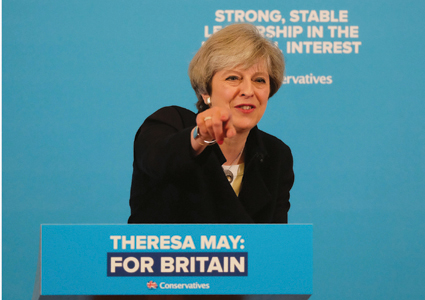 A Burkean with a vision of global Britain: Theresa May hits the campaign trail on Tyneside last month (©Ian Forsyth/Getty Images)
Within the ranks of those who were the Parliamentary Labour Party there is scarcely any enthusiasm for the restoration of British independence; indeed, there is a powerful faction allied to former leaders such as Tony Blair and Peter Mandelson which wishes actively to dilute or frustrate the referendum result. Occupying a similar space, the Liberal Democrats have pitched themselves as an unambiguously pro-EU force, seeking a mandate to get the country to think, and vote, again on exit. The various secessionist parties who were represented in the UK Parliament — the SNP, Plaid Cymru, the SDLP and Sinn Fein — are all enthusiasts for the EU, even though EU membership requires a greater surrender of sovereignty than membership of the United Kingdom.
For any voter who wants the result of the referendum respected, voting for Theresa May is the only safe choice. Whether a passionate supporter of Brexit from the beginning, or a pragmatic democrat who believes, as Paddy Ashdown put it, that “once the British people have spoken you do what they command”, the Conservatives are the obvious party to support. And it seems as I write that many of those who have never voted Conservative before at a a general election, but who voted Leave in the Referendum, and indeed some who voted Remain but now want to move on, will vote for Mrs May as the only leader committed to honouring the democratic instruction the country delivered last June.
But the question of Britain and Europe does not, of course, end there. There are important questions to settle for Britain as we take back control, over everything from how we manage migration to how we pass our laws, how we make power accountable and how we manage nature sensitively, what we teach the next generation and how we shall give them work which confers independence and dignity.
For almost 40 years, important questions that define a nation have been subcontracted to politicians and officials whom we never elected and could never throw out. Our countryside was managed according to the dictates of the Common Agricultural Policy in a way which was neither right for the environment nor the rural economy. Our marine environment was ravaged by a Common Fisheries Policy over which we had no control. The EU controlled whom we could welcome and whom we could deport through its migration policy and its court. It dictated where houses could be built and who we could ask to build our schools and hospitals. It insisted we maintain a punitive tariff wall to keep out goods from developing nations. And it insisted that laws agreed at the EU level be implemented in the UK without the possibility of democratic rejection or even amendment.
A Burkean with a vision of global Britain: Theresa May hits the campaign trail on Tyneside last month (©Ian Forsyth/Getty Images)Within the ranks of those who were the Parliamentary Labour Party there is scarcely any enthusiasm for the restoration of British independence; indeed, there is a powerful faction allied to former leaders such as Tony Blair and Peter Mandelson which wishes actively to dilute or frustrate the referendum result. Occupying a similar space, the Liberal Democrats have pitched themselves as an unambiguously pro-EU force, seeking a mandate to get the country to think, and vote, again on exit. The various secessionist parties who were represented in the UK Parliament — the SNP, Plaid Cymru, the SDLP and Sinn Fein — are all enthusiasts for the EU, even though EU membership requires a greater surrender of sovereignty than membership of the United Kingdom.
For any voter who wants the result of the referendum respected, voting for Theresa May is the only safe choice. Whether a passionate supporter of Brexit from the beginning, or a pragmatic democrat who believes, as Paddy Ashdown put it, that “once the British people have spoken you do what they command”, the Conservatives are the obvious party to support. And it seems as I write that many of those who have never voted Conservative before at a a general election, but who voted Leave in the Referendum, and indeed some who voted Remain but now want to move on, will vote for Mrs May as the only leader committed to honouring the democratic instruction the country delivered last June.
But the question of Britain and Europe does not, of course, end there. There are important questions to settle for Britain as we take back control, over everything from how we manage migration to how we pass our laws, how we make power accountable and how we manage nature sensitively, what we teach the next generation and how we shall give them work which confers independence and dignity.
For almost 40 years, important questions that define a nation have been subcontracted to politicians and officials whom we never elected and could never throw out. Our countryside was managed according to the dictates of the Common Agricultural Policy in a way which was neither right for the environment nor the rural economy. Our marine environment was ravaged by a Common Fisheries Policy over which we had no control. The EU controlled whom we could welcome and whom we could deport through its migration policy and its court. It dictated where houses could be built and who we could ask to build our schools and hospitals. It insisted we maintain a punitive tariff wall to keep out goods from developing nations. And it insisted that laws agreed at the EU level be implemented in the UK without the possibility of democratic rejection or even amendment.
Recovering control in these areas is a welcome rejuvenation of our democratic culture. But the Whitehall muscle memory in some of these policy areas has grown attenuated over the decades. So there is a need for both leadership and radicalism in making the most of the new opportunities democratic control of these policy areas will bring.
There is also a need for something more. A sense not just of the possibilities that Brexit brings but also a shared, noble and idealistic conception of what a new Britain must be. A champion of the very best in our, shared European civilisation. A beacon for the values which Standpoint has defined and promoted over the years — democratic self-government, a belief in the essential dignity of every human soul, freedom of speech and conscience, civil liberties grounded in the rule of law, resolution against extremism, intellectual openness and ambition and respect for grace and beauty in both human culture and the natural world.
In his breathtakingly gripping new book, The Strange Death of Europe (Bloomsbury Continuum, £18.99), the distinguished Standpoint columnist Douglas Murray argues that these values are under siege, their beneficiaries now buckling under the accumulated weight of guilt at their good fortune and the debts incurred by past generosity.
Murray is specifically, and brilliantly, perceptive in anatomising how European elites seem almost deliberately incapable of articulating what has made European nations so attractive to so many newcomers. Our traditions of liberty and our political stability rooted in democracy make the nations of Europe, in common with other nations from Canada to Israel, a welcome refuge for those seeking a better life. But Murray finds a remarkable reticence on the part of European leaders when it comes to taking pride in those traditions and values. He quotes the Swedish government’s lead official on integration questioning whether Swedish culture was worth preserving and saying, “Well, what is Swedish culture? And with that I think I’ve answered the question.”
It seems that faith in our institutions, history and values has become the new love that dare not speak its name.
There is, perhaps, a connection between the views of some European leaders that Europe’s nation states are somehow historic carriers of the virus of violence and prejudice — and so they must be superseded by a wholly new union — and a reluctance to see what newcomers see so clearly — that it is in the very structure of historic European nation states that accountability, democracy, liberty and security best flourish.
But one European leader who is very far from making that mistake is our Prime Minister. Theresa May understands, deeply and instinctively, that attachment to place — parish, town, constituency and country — is the starting point for solidarity, loyalty and social justice. A classic Burkean, she knows that it is by loyalty to these little platoons that concern for the welfare of others — fellow citizens and then all mankind — is fostered.
There is also a need for something more. A sense not just of the possibilities that Brexit brings but also a shared, noble and idealistic conception of what a new Britain must be. A champion of the very best in our, shared European civilisation. A beacon for the values which Standpoint has defined and promoted over the years — democratic self-government, a belief in the essential dignity of every human soul, freedom of speech and conscience, civil liberties grounded in the rule of law, resolution against extremism, intellectual openness and ambition and respect for grace and beauty in both human culture and the natural world.
In his breathtakingly gripping new book, The Strange Death of Europe (Bloomsbury Continuum, £18.99), the distinguished Standpoint columnist Douglas Murray argues that these values are under siege, their beneficiaries now buckling under the accumulated weight of guilt at their good fortune and the debts incurred by past generosity.
Murray is specifically, and brilliantly, perceptive in anatomising how European elites seem almost deliberately incapable of articulating what has made European nations so attractive to so many newcomers. Our traditions of liberty and our political stability rooted in democracy make the nations of Europe, in common with other nations from Canada to Israel, a welcome refuge for those seeking a better life. But Murray finds a remarkable reticence on the part of European leaders when it comes to taking pride in those traditions and values. He quotes the Swedish government’s lead official on integration questioning whether Swedish culture was worth preserving and saying, “Well, what is Swedish culture? And with that I think I’ve answered the question.”
It seems that faith in our institutions, history and values has become the new love that dare not speak its name.
There is, perhaps, a connection between the views of some European leaders that Europe’s nation states are somehow historic carriers of the virus of violence and prejudice — and so they must be superseded by a wholly new union — and a reluctance to see what newcomers see so clearly — that it is in the very structure of historic European nation states that accountability, democracy, liberty and security best flourish.
But one European leader who is very far from making that mistake is our Prime Minister. Theresa May understands, deeply and instinctively, that attachment to place — parish, town, constituency and country — is the starting point for solidarity, loyalty and social justice. A classic Burkean, she knows that it is by loyalty to these little platoons that concern for the welfare of others — fellow citizens and then all mankind — is fostered.
In her audacious and intellectually compelling address to last year’s Conservative Party conference she discomfited some listeners by stating directly that “if you’re a citizen of the world, you’re a citizen of nowhere”. She understands that it is only if you start with a sense of belonging that you can develop a genuinely resilient ethic of giving. And it is only through belief in the dignities, traditions and beauties of your own nation that you best equip yourself to defend European civilisation in its noblest, and broadest, sense.
A commitment to democracy as a way of keeping power accountable and government responsive acquires extra depth and meaning if you yourself have grown up witnessing, and benefitting from, a robust democratic culture. A belief in the importance of individual rights and responsibilities comes more easily from immersion in a culture where the common law has been the rootstock of liberty’s tree. A desire to preserve the global environment springs, most naturally and enduringly, from a love of natural beauty and an attachment to special places which have enchanted our young minds. A willingness to make sacrifices to secure the next generation’s future against threats from totalitarians and extremists flows most naturally from an awareness of how previous generations have served King and Country to defeat militarism and fascism.
That is why it is no contradiction, indeed a natural consequence, of the Prime Minister’s attachment to our nation and its traditions that she should want the country she believes in so deeply to be seen as a leader on the world stage, confident in its values, conscious of how widely they are shared, and committed to their defence and promotion.
The Prime Minister’s vision of global Britain is a reflection of the role our nation has always played throughout history. We have governed ourselves but traded with the world. We have embodied ideals of liberty in our own, peculiar, institutions and encouraged freedom-loving peoples everywhere, we have taken pride in our distinctive culture and national conversation even as our language became a global lingua franca and our fates became entwined with more and more nations.
And that vision is given concrete form in the policies Mrs May has pursued since entering Number Ten.
While we leave the European Union we do not, and cannot, relinquish our responsibility to uphold European solidarity. Our contribution to the defence of the European continent against anti-democratic threats, whether from Putin’s Russia or Islamist extremists, must be redoubled. The Prime Minister’s commitment to spend 2 per cent of our GDP on defence enables us to commit to a presence in the Baltic States to safeguard Nato’s security guarantee. Our growing naval strength, superb special forces and modernised military, alongside superlative intelligence capabilities, makes us an indispensable part of the West’s security architecture.
A commitment to democracy as a way of keeping power accountable and government responsive acquires extra depth and meaning if you yourself have grown up witnessing, and benefitting from, a robust democratic culture. A belief in the importance of individual rights and responsibilities comes more easily from immersion in a culture where the common law has been the rootstock of liberty’s tree. A desire to preserve the global environment springs, most naturally and enduringly, from a love of natural beauty and an attachment to special places which have enchanted our young minds. A willingness to make sacrifices to secure the next generation’s future against threats from totalitarians and extremists flows most naturally from an awareness of how previous generations have served King and Country to defeat militarism and fascism.
That is why it is no contradiction, indeed a natural consequence, of the Prime Minister’s attachment to our nation and its traditions that she should want the country she believes in so deeply to be seen as a leader on the world stage, confident in its values, conscious of how widely they are shared, and committed to their defence and promotion.
The Prime Minister’s vision of global Britain is a reflection of the role our nation has always played throughout history. We have governed ourselves but traded with the world. We have embodied ideals of liberty in our own, peculiar, institutions and encouraged freedom-loving peoples everywhere, we have taken pride in our distinctive culture and national conversation even as our language became a global lingua franca and our fates became entwined with more and more nations.
And that vision is given concrete form in the policies Mrs May has pursued since entering Number Ten.
While we leave the European Union we do not, and cannot, relinquish our responsibility to uphold European solidarity. Our contribution to the defence of the European continent against anti-democratic threats, whether from Putin’s Russia or Islamist extremists, must be redoubled. The Prime Minister’s commitment to spend 2 per cent of our GDP on defence enables us to commit to a presence in the Baltic States to safeguard Nato’s security guarantee. Our growing naval strength, superb special forces and modernised military, alongside superlative intelligence capabilities, makes us an indispensable part of the West’s security architecture.
Even as we prepare to leave the EU’s single market, in truth a bureaucratic cat’s cradle of regulation and market-rigging, we are acting as a dynamic force for freer trade. Free trade, or God’s Diplomacy as Richard Cobden styled it, is a universal force for good but it still requires individual nations to show leadership in advancing its claims.
In the 19th century, after Parliament, at Cobden’s urging, repealed the Corn Laws, there were dire warnings that by dismantling this tariff wall and going it alone Britain would become impoverished. But by making our own markets more open it was not just the case that imports became cheaper, and food in particular, it was also the case that Britain became more competitive. Free trade benefits both buyer and seller, both exporter and importer, indeed it generates far greater prosperity for both through the workings of comparative advantage than either could ever hope to secure unaided.
Britain, outside the EU and trading with the world, will not only become more prosperous in itself it will also encourage the adoption of freer trade globally and, in so doing, uphold not just the vision of Adam Smith, David Ricardo and Richard Cobden but also the insights of men such as Hayek and von Mises and the policies which helped Europe recover so quickly after the Second World War under men such as Ludwig Erhard.
Side by side with our commitment to freer trade there is a pledge to maintain international aid. I recognise that some will bristle at the way in which an arbitrary target of 0.7 per cent of GDP governs how much we spend on international development, not least when there are significant other pressures on government spending. But Britain has always been committed to supporting the poorest, and the oppressed, across the globe to aspire to a better future.
Properly spent, development money can not only alleviate horrendous suffering and preserve the lives of precious individual souls, it can also put countries on a virtuous trajectory away from misgovernment and exploitation and towards the establishment of robust liberal institutions. Aid spending can help entrench the rule of law and support a free press, nurture anti-corruption initiatives and strengthen the hand of reformers. And, once again, if aid money is directed by an individual national ministry, with its political leaders directly accountable to parliament, the money is far more likely to be spent wisely than if responsibility is diffuse and accountability opaque in some multinational body. Which is why the Prime Minister sees Britain delivering its own aid spending and maintaining its own aid target as critical to securing the right outcomes.
In the 19th century, after Parliament, at Cobden’s urging, repealed the Corn Laws, there were dire warnings that by dismantling this tariff wall and going it alone Britain would become impoverished. But by making our own markets more open it was not just the case that imports became cheaper, and food in particular, it was also the case that Britain became more competitive. Free trade benefits both buyer and seller, both exporter and importer, indeed it generates far greater prosperity for both through the workings of comparative advantage than either could ever hope to secure unaided.
Britain, outside the EU and trading with the world, will not only become more prosperous in itself it will also encourage the adoption of freer trade globally and, in so doing, uphold not just the vision of Adam Smith, David Ricardo and Richard Cobden but also the insights of men such as Hayek and von Mises and the policies which helped Europe recover so quickly after the Second World War under men such as Ludwig Erhard.
Side by side with our commitment to freer trade there is a pledge to maintain international aid. I recognise that some will bristle at the way in which an arbitrary target of 0.7 per cent of GDP governs how much we spend on international development, not least when there are significant other pressures on government spending. But Britain has always been committed to supporting the poorest, and the oppressed, across the globe to aspire to a better future.
Properly spent, development money can not only alleviate horrendous suffering and preserve the lives of precious individual souls, it can also put countries on a virtuous trajectory away from misgovernment and exploitation and towards the establishment of robust liberal institutions. Aid spending can help entrench the rule of law and support a free press, nurture anti-corruption initiatives and strengthen the hand of reformers. And, once again, if aid money is directed by an individual national ministry, with its political leaders directly accountable to parliament, the money is far more likely to be spent wisely than if responsibility is diffuse and accountability opaque in some multinational body. Which is why the Prime Minister sees Britain delivering its own aid spending and maintaining its own aid target as critical to securing the right outcomes.
Of course, even as we consider how else we can play our part in upholding progress and defending civilisation, whether that is through fighting environmental degradation, countering Islamist terrorism, ensuring the next generation have access to the best that has been thought and written or ensuring a free market economy is governed by virtue and restraint, these questions of continental, indeed global, importance are, increasingly, best answered by strengthening nation states.
In that sense, Douglas Murray’s obituary for Europe may have been rendered premature by Britain’s departure from the European Union. By being true to our traditions we were proclaiming our faith in the values that had generated so much progress on our continent in the past.
Democracy originally took root in Greek soil centuries ago. And among the citizens of the original democratic city state, Athens, a culture of what was called rivalrous emulation evolved. Men sought to emulate, and then exceed, the qualities and virtues of those thought the best of their time. Democracy was not about conformity or levelling down. It was about openness, experimentation, the pursuit of excellence, the reining in of those who do wrong and the ambition to match or even overtake, those who had achieved great things for their shared homeland. And just as the citizens of Athens believed in rivalrous emulation among themselves so it became the practice between city states, as each sought to exceed the other in cultural distinction, courage in beating back invasions from tyrannical neighbours and the energy with which civilisation was spread.
As with those city states in ancient times, so it has been between nation states in modern times when Europe has been at its best. It has been from national parliaments and within national traditions, as proclaimers of the virtues of liberal nation states, that Europe’s generators of progress have sprung, the de Gaulles and Erhards, Adenauers and Havels, Zolas and Mazzinis, Kossuths and Herzls, Verdis and Sibeliuses.
That is why I believe that Europe’s revival, as a generator of progress, a force for free trade and free expression, a defender of democracy and an advocate for emancipation is at hand, thanks to the decision made by the British people last year and which, I hope, will be reinforced by this general election. It is through restoring confidence in our distinctive traditions that we will be able to enhance the dignity of all.
In that sense, Douglas Murray’s obituary for Europe may have been rendered premature by Britain’s departure from the European Union. By being true to our traditions we were proclaiming our faith in the values that had generated so much progress on our continent in the past.
Democracy originally took root in Greek soil centuries ago. And among the citizens of the original democratic city state, Athens, a culture of what was called rivalrous emulation evolved. Men sought to emulate, and then exceed, the qualities and virtues of those thought the best of their time. Democracy was not about conformity or levelling down. It was about openness, experimentation, the pursuit of excellence, the reining in of those who do wrong and the ambition to match or even overtake, those who had achieved great things for their shared homeland. And just as the citizens of Athens believed in rivalrous emulation among themselves so it became the practice between city states, as each sought to exceed the other in cultural distinction, courage in beating back invasions from tyrannical neighbours and the energy with which civilisation was spread.
As with those city states in ancient times, so it has been between nation states in modern times when Europe has been at its best. It has been from national parliaments and within national traditions, as proclaimers of the virtues of liberal nation states, that Europe’s generators of progress have sprung, the de Gaulles and Erhards, Adenauers and Havels, Zolas and Mazzinis, Kossuths and Herzls, Verdis and Sibeliuses.
That is why I believe that Europe’s revival, as a generator of progress, a force for free trade and free expression, a defender of democracy and an advocate for emancipation is at hand, thanks to the decision made by the British people last year and which, I hope, will be reinforced by this general election. It is through restoring confidence in our distinctive traditions that we will be able to enhance the dignity of all.