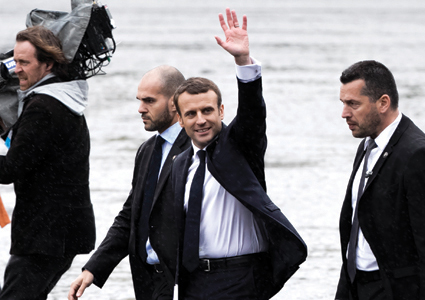
 Emmanuel Macron on the day of his inauguration (©Vincent Isore/IP3/Getty Images)
Listening to the inauguration speech of Emanuel Macron in the Salle des Fêtes of the Elysée Palace on May 14, some of his audience were reminded of a little boy’s birthday wish list. France was being reborn, a new era of equality and social justice was dawning, and Europe too would soon undergo the necessary reforms. Either President Macron is everything his spin doctors have claimed, or a country that has placed a completely unknown quantity at its head is in for a rude awakening.
Beyond the palace walls, the corpses of France’s big political beasts lie scattered across the battlefield. To the left the outgoing president, François Hollande, makes a pathetic figure, so unpopular after five ineffectual years that he was too weak to stand for his own re-election. His reign ended in a cruel public humiliation, the handover of power to a man half his age whom he had plucked from obscurity and who in return had manipulated him and abused his trust. At the same time the Socialist Party which he led for 20 years was chopped into little pieces, its presidential candidate polling an ignominious 6.4 per cent.
To the right the chosen candidate, François Fillon, once prime minister of France and until last February the undisputed favourite to win the election, finds himself turned into a laughing stock, forced to resign his seat in the National Assembly, with his wife and two of his children joining him in the public prosecutor’s outer office, an “exemplary Catholic” family facing criminal charges. Meanwhile his former colleagues, the leaders of the Republican Party, once powerful figures such as ex-President Sarkozy and ex-prime minister Alain Juppé, are undecided as to whether they should oppose the new president or offer their full support — “in the national interest” — to a man they despise.
Most presidential elections end in the triumph of one candidate and the destruction of another. In this case, it is a political system and possibly a constitution that seem to have been destroyed.
Of the many numbers to have emerged from the victory of Macron and the defeat of Marine Le Pen in the second round of the election on 7 May the most significant is surely 34 per cent, the total of abstentions and spoilt ballots. This amounts to more than 16 million voters — that is six million more votes than were cast for the runner-up. It is a record for the Fifth Republic, which was founded almost 60 years ago.
Most of those 16 million protesters simply stayed at home, but more than four million took the trouble to visit their local town hall and invalidate their ballot papers. Some just put a blank slip in the envelope, others wrote an offensive comment. One man — or woman — put a €50 note inside with a message reading “For poor Penelope” — the hapless Madame Fillon (née Clarke, in Abergavenny) accused of taking €680,000 of public money for a non-existent job as her husband’s parliamentary assistant. The refusal to vote was known as the “Ni-ni” response — “neither Macron Nor Le Pen” — and is explained by the fact that without a mainstream candidate from either Left or Right, more than a third of the second-round electorate felt disenfranchised.
France entered the election under terrorist attack following 18 months of living in a “state of emergency”. The 11 candidates standing in the first round were addressing an electorate whose members generally agreed (according to a Harris poll) that “All politicians are liars”. Seven of the 11 candidates wanted to leave the European Union, or the euro, or both. Others were campaigning for radical constitutional reform. Analysts, including the political counsellor of the outgoing prime minister, were questioning whether an elected executive presidency, the cornerstone of the present constitution, was still a viable form of government. It looked like a recent crisis, but in reality the wheels have been coming off the Fifth Republic for many years.
The French constitution designed by Charles de Gaulle created a delicate balance between democracy, ensured by parliamentary government, and efficiency, supplied by an executive presidency. It was the child of nearly 100 years of political chaos. The Third Republic, founded in 1871 following defeat in the Franco-Prussian war, expired in 1940 with defeat and Nazi occupation. In 70 years, it had endowed the country with more than 100 feeble administrations. Its final ignominious act was to hand supreme power to the 84-year-old Marshal Pétain, who proclaimed his disastrous policy of “collaboration” with the Nazi regime. The post-war Fourth Republic, designed as a parliamentary democracy with a titular head of state, lasted for 13 years and proved to be even less stable. During that time, the United Kingdom had four prime ministers; France had 50 changes of government. The Fourth Republic ended with the country bitterly divided over the question of Algerian independence, on the brink of a coup d’état and civil war.
By 1958 a stronger constitution was urgently needed and de Gaulle’s solution was for the president (himself) to be directly elected for seven years while the National Assembly, led by a prime minister of the president’s choice, would sit for only five. In this way, presidential power could be regularly checked by a legislative election. De Gaulle formed his parliamentary majorities from his own party, with alliances where necessary with right-wing, centrist or even left-wing groups. Where he was challenged, he did not hesitate to use the weapons of referendum or presidential decree to force through the reforms he required. Opposition to his rule eventually crystallised under the leadership of François Mitterrand’s Socialist Party, and when de Gaulle left office, after losing a referendum in 1969, an orthodox “Left-Right” party system was in place. It is that system that now lies in ruins. Not for the first time, it seems, de Gaulle may have overestimated his fellow-countrymen.
A constitution based on a directly-elected presidency has an inbuilt weak point: it is heavily dependent on the integrity of the president. At first, following de Gaulle’s departure, under two conventional presidents — Pompidou and Giscard d’Estaing — things worked reasonably well. There were several political scandals, but they did not undermine the constitution. Then came the presidential election of 1981 and the arrival of François Mitterrand. The decline of the Fifth Republic can be summarised in three names: Mitterrand, Chirac, Sarkozy. Of these by far the most destructive was the first.
The French constitution designed by Charles de Gaulle created a delicate balance between democracy, ensured by parliamentary government, and efficiency, supplied by an executive presidency. It was the child of nearly 100 years of political chaos. The Third Republic, founded in 1871 following defeat in the Franco-Prussian war, expired in 1940 with defeat and Nazi occupation. In 70 years, it had endowed the country with more than 100 feeble administrations. Its final ignominious act was to hand supreme power to the 84-year-old Marshal Pétain, who proclaimed his disastrous policy of “collaboration” with the Nazi regime. The post-war Fourth Republic, designed as a parliamentary democracy with a titular head of state, lasted for 13 years and proved to be even less stable. During that time, the United Kingdom had four prime ministers; France had 50 changes of government. The Fourth Republic ended with the country bitterly divided over the question of Algerian independence, on the brink of a coup d’état and civil war.
By 1958 a stronger constitution was urgently needed and de Gaulle’s solution was for the president (himself) to be directly elected for seven years while the National Assembly, led by a prime minister of the president’s choice, would sit for only five. In this way, presidential power could be regularly checked by a legislative election. De Gaulle formed his parliamentary majorities from his own party, with alliances where necessary with right-wing, centrist or even left-wing groups. Where he was challenged, he did not hesitate to use the weapons of referendum or presidential decree to force through the reforms he required. Opposition to his rule eventually crystallised under the leadership of François Mitterrand’s Socialist Party, and when de Gaulle left office, after losing a referendum in 1969, an orthodox “Left-Right” party system was in place. It is that system that now lies in ruins. Not for the first time, it seems, de Gaulle may have overestimated his fellow-countrymen.
A constitution based on a directly-elected presidency has an inbuilt weak point: it is heavily dependent on the integrity of the president. At first, following de Gaulle’s departure, under two conventional presidents — Pompidou and Giscard d’Estaing — things worked reasonably well. There were several political scandals, but they did not undermine the constitution. Then came the presidential election of 1981 and the arrival of François Mitterrand. The decline of the Fifth Republic can be summarised in three names: Mitterrand, Chirac, Sarkozy. Of these by far the most destructive was the first.
François Mitterrand was not only the cleverest political tactician in France, and probably in Europe, he was also the most cynical. As a student during the 1930s he had supported the extreme Right. After the war he learnt the dark political arts of the Fourth Republic when he served as both minister of the interior and minister of justice. In 1959, his political career nearly came to an end when he was the target of an “assassination attempt” that — as was quickly discovered — he had organised himself. In search of sympathetic publicity, he had paid an accomplice to machine-gun his car late at night in central Paris, while he crouched behind a nearby hedge. Under a polished exterior Mitterrand was a rough customer, and he had always loathed both de Gaulle and his constitution. The two men had got off to a bumpy start during the war. Early in 1942, following his return from captivity as a prisoner-of-war, Mitterrand found work as a Vichy bureaucrat. His efforts were rewarded by Pétain with the Francisque, the Vichy equivalent of France’s highest peacetime decoration, the Legion of Honour.
Then, in 1943, following the German occupation of the southern “Free Zone”, Mitterrand sensed that the tide of battle was turning and, like hundreds of other Vichy officials, hedged his bets; in his case he formed a resistance group, recruited from French prisoners of war. This original initiative did not impress de Gaulle when the two were eventually introduced. “The leader of a resistance network of prisoners-of-war!” said the General. “What next? A network of hairdressers?”
A country with an executive president needs to elect a man or woman who places the national interest first. A master chess player like Mitterrand who was also a terrific humbug was always likely to cause problems. During his 14 years as president Mitterrand enjoyed real success in foreign policy and at least one real success in domestic policy — the electoral destruction of his original allies, the French Communist Party.
But in 1986, faced with the likelihood of legislative defeat and the prospect of becoming the first president who would have to sit out two years of cohabitation — that is, power-sharing with a right-wing government — Mitterrand decided to weaken his opponents in a classic Fourth Republic move. He had noticed that an obscure group of xenophobic nationalists, which normally polled less than 1 per cent, was gaining in popularity in local elections. Mitterrand calculated that if he introduced proportional representation he could split the right-wing vote. It was the first blow to de Gaulle’s model constitution and the foreseeable result was that Jean-Marie Le Pen’s National Front, which had previously held one seat in the Assembly, took 35 seats and was transformed into a prominent political force. So, by changing the voting system for his personal advantage, the socialist Mitterrand became the godfather of France’s extreme Right.
Then, in 1943, following the German occupation of the southern “Free Zone”, Mitterrand sensed that the tide of battle was turning and, like hundreds of other Vichy officials, hedged his bets; in his case he formed a resistance group, recruited from French prisoners of war. This original initiative did not impress de Gaulle when the two were eventually introduced. “The leader of a resistance network of prisoners-of-war!” said the General. “What next? A network of hairdressers?”
A country with an executive president needs to elect a man or woman who places the national interest first. A master chess player like Mitterrand who was also a terrific humbug was always likely to cause problems. During his 14 years as president Mitterrand enjoyed real success in foreign policy and at least one real success in domestic policy — the electoral destruction of his original allies, the French Communist Party.
But in 1986, faced with the likelihood of legislative defeat and the prospect of becoming the first president who would have to sit out two years of cohabitation — that is, power-sharing with a right-wing government — Mitterrand decided to weaken his opponents in a classic Fourth Republic move. He had noticed that an obscure group of xenophobic nationalists, which normally polled less than 1 per cent, was gaining in popularity in local elections. Mitterrand calculated that if he introduced proportional representation he could split the right-wing vote. It was the first blow to de Gaulle’s model constitution and the foreseeable result was that Jean-Marie Le Pen’s National Front, which had previously held one seat in the Assembly, took 35 seats and was transformed into a prominent political force. So, by changing the voting system for his personal advantage, the socialist Mitterrand became the godfather of France’s extreme Right.
The second blow to the constitution was delivered by President Mitterrand’s approach to cohabitation. Having lost his parliamentary majority in 1986 Mitterrand used his two-year spell of mitigated power to discredit his prime minister, Jacques Chirac; he re-fashioned the humiliation of the head of government into a springboard for his own re-election. Between 1986 and 1988 Mitterrand and Chirac sat side by side at international conferences, representing France, but without any visible signs of communication. In London, in October 1986, the French president arranged for the French prime minister’s chair to be removed from the conference table. This ruthless behaviour characterised his term of office. In 14 years of his presidency Mitterrand appointed seven prime ministers and humiliated five of them. The only prime minister he treated with open respect, Edouard Balladur, was a political opponent whom Mitterrand wanted to bolster because by doing so he could further undermine Balladur’s rival for the presidency, the hapless Chirac.
Throughout Mitterrand’s years at the Elysée a whiff of sulphur hung over the palace. The president was obsessed with his own privacy. He tried to bury the fact that he had once been a decorated Vichy official, and he was determined to conceal the more recent fact that he was not living with his wife in the conjugal home but was secretly resident in a government apartment with his mistress and their daughter. A special police unit was set up to protect Mitterrand’s privacy. Then, in 1994, the director of this unit shot himself at his desk in the Elysée.
In the previous year Mitterrand’s sixth prime minister, Pierre Bérégovoy, who was involved in a financial scandal, had also committed suicide. It was an unusual case. Bérégovoy left no suicide note, he shot himself with a revolver belonging to his police bodyguard, and according to some reports there were two bullet wounds. During his years in the Elysée, President de Gaulle had lived modestly and insisted on settling his own food bills. The Mitterrand era culminated in an atmosphere of menace and scandal, amid rumours that the president and his circle had been engaged in racketeering.
Mitterrand left office in 1995 without giving any thought to his own succession as Socialist leader. It was a case of après moi, le déluge. A destructive struggle for the leadership of the Socialists broke out, and the eventual beneficiary was François Hollande.
In the 36 years since Mitterrand became head of state, successive presidential campaigns have been dominated by mutual allegations of illegality or corruption. The criminal law has become a routine political weapon; the status of the judiciary has been steadily undermined; and the executive’s control of the supposedly independent prosecutors and judges has gradually increased. A year ago, France’s most senior judge, Bernard Louvel, said that it was past time for politicians to reverse this process and restore judicial independence. Needless to say, nothing has been done. (Significantly, it was three of the “administrative judges” appointed by the Socialist government who steamrollered the case against François Fillon through the usual timetable in order to bring criminal charges against him before the election took place.)
Throughout Mitterrand’s years at the Elysée a whiff of sulphur hung over the palace. The president was obsessed with his own privacy. He tried to bury the fact that he had once been a decorated Vichy official, and he was determined to conceal the more recent fact that he was not living with his wife in the conjugal home but was secretly resident in a government apartment with his mistress and their daughter. A special police unit was set up to protect Mitterrand’s privacy. Then, in 1994, the director of this unit shot himself at his desk in the Elysée.
In the previous year Mitterrand’s sixth prime minister, Pierre Bérégovoy, who was involved in a financial scandal, had also committed suicide. It was an unusual case. Bérégovoy left no suicide note, he shot himself with a revolver belonging to his police bodyguard, and according to some reports there were two bullet wounds. During his years in the Elysée, President de Gaulle had lived modestly and insisted on settling his own food bills. The Mitterrand era culminated in an atmosphere of menace and scandal, amid rumours that the president and his circle had been engaged in racketeering.
Mitterrand left office in 1995 without giving any thought to his own succession as Socialist leader. It was a case of après moi, le déluge. A destructive struggle for the leadership of the Socialists broke out, and the eventual beneficiary was François Hollande.
In the 36 years since Mitterrand became head of state, successive presidential campaigns have been dominated by mutual allegations of illegality or corruption. The criminal law has become a routine political weapon; the status of the judiciary has been steadily undermined; and the executive’s control of the supposedly independent prosecutors and judges has gradually increased. A year ago, France’s most senior judge, Bernard Louvel, said that it was past time for politicians to reverse this process and restore judicial independence. Needless to say, nothing has been done. (Significantly, it was three of the “administrative judges” appointed by the Socialist government who steamrollered the case against François Fillon through the usual timetable in order to bring criminal charges against him before the election took place.)
Mitterrand’s successor, Jacques Chirac, was a neo-Gaullist, who administered the next anti-constitutional blow — though in his case it was through sheer incompetence rather than self-interested calculation. Having survived the distressing experience of serving as Mitterrand’s prime minister, Chirac — on being elected president in 1995 — was unable to face the prospect of another cohabitation. So he delayed the dissolution of the National Assembly and then, in 1997, mismanaged the eventual election so badly that he lost it — and let himself in for five years of power-sharing with a Socialist government rather than two.
When his first term came to an end in 2002, President Chirac who had effectively been politically impotent for five years, decided to run again, but — still unable to face the prospect of a further “cohabitation” — abolished the possibility by reducing the length of the presidential term to match the parliamentary term, thereby wrecking de Gaulle’s delicate balance between president and parliament. In consequence, for the last 15 years, the presidents of the Fifth Republic — successively Chirac, Sarkozy and Hollande — have been all-powerful; their prime ministers — and theoretical heads of government — have been reduced to the status of presidential whipping-boys, and the National Assembly has been unable to function as a corrective to an overbearing or incompetent president.
Despite the fact that he held all the cards, Chirac’s second term was not the most glorious period in his country’s political history. Before becoming prime minister he had been elected mayor of Paris and for many years he had used this power-base to build a personal political machine. He fiddled the books and used city funds to finance his political campaigns. In 2004 his first prime minister, Alain Juppé, who had previously been the city hall treasurer, was sentenced to a suspended prison term for operating this system, and Chirac himself was under criminal investigation when he ran for re-election. His status as president gave him temporary immunity from prosecution but the pending investigation meant that he was desperate to control his own succession and he spent much of his second term plotting against his hyperactive interior minister, Nicolas Sarkozy, whom he suspected, correctly, of presidential ambitions.
In an attempt to block Sarkozy’s progress Chirac’s team at the Elysée Palace tapped the interior minister’s telephone, forged documents and framed him in a fictional bribery case. Sarkozy was furious, not least because, as minister of the interior, he had assumed that he had a monopoly of telephone tapping.
In 2007 Chirac’s efforts failed; he left office and was succeeded in the presidency by Sarkozy, who took a comprehensive revenge on his former leader. He ensured that Dominique de Villepin, who had been Chirac’s last prime minister, was charged with receiving stolen goods and forgery. And he authorised the prosecution of Chirac for embezzlement of public funds. Ex-President Chirac was in due course handed a two-year prison sentence (which he never served, pleading that he had lost his memory and was therefore unable to exercise his right of appeal).
When his first term came to an end in 2002, President Chirac who had effectively been politically impotent for five years, decided to run again, but — still unable to face the prospect of a further “cohabitation” — abolished the possibility by reducing the length of the presidential term to match the parliamentary term, thereby wrecking de Gaulle’s delicate balance between president and parliament. In consequence, for the last 15 years, the presidents of the Fifth Republic — successively Chirac, Sarkozy and Hollande — have been all-powerful; their prime ministers — and theoretical heads of government — have been reduced to the status of presidential whipping-boys, and the National Assembly has been unable to function as a corrective to an overbearing or incompetent president.
Despite the fact that he held all the cards, Chirac’s second term was not the most glorious period in his country’s political history. Before becoming prime minister he had been elected mayor of Paris and for many years he had used this power-base to build a personal political machine. He fiddled the books and used city funds to finance his political campaigns. In 2004 his first prime minister, Alain Juppé, who had previously been the city hall treasurer, was sentenced to a suspended prison term for operating this system, and Chirac himself was under criminal investigation when he ran for re-election. His status as president gave him temporary immunity from prosecution but the pending investigation meant that he was desperate to control his own succession and he spent much of his second term plotting against his hyperactive interior minister, Nicolas Sarkozy, whom he suspected, correctly, of presidential ambitions.
In an attempt to block Sarkozy’s progress Chirac’s team at the Elysée Palace tapped the interior minister’s telephone, forged documents and framed him in a fictional bribery case. Sarkozy was furious, not least because, as minister of the interior, he had assumed that he had a monopoly of telephone tapping.
In 2007 Chirac’s efforts failed; he left office and was succeeded in the presidency by Sarkozy, who took a comprehensive revenge on his former leader. He ensured that Dominique de Villepin, who had been Chirac’s last prime minister, was charged with receiving stolen goods and forgery. And he authorised the prosecution of Chirac for embezzlement of public funds. Ex-President Chirac was in due course handed a two-year prison sentence (which he never served, pleading that he had lost his memory and was therefore unable to exercise his right of appeal).
Sarkozy proved to be as cynical a politician as Mitterrand, though lacking the latter’s elegant style. During his five years at the Elysée he further diminished the prestige of the presidency. At various times he became the target of eight different criminal investigations. Six of the prosecutions were eventually dropped, but even today ex-President Sarkozy — who denies everything — remains under investigation for bribing a judge, and is awaiting trial for electoral fraud.
The contrast between this year’s election and the euphoria that greeted Mitterrand’s victory in 1981 is striking. The downward spiral has left voters with the impression that presidential elections have become a struggle between a succession of second-rate figures, intent on acquiring power rather than committing themselves to the national interest. During that time the country has had many honest and competent political leaders from Left and Right — people of integrity like Jacques Delors, former president of the European Commission, Simone Veil and Phillipe Seguin, and prime ministers such as Michel Rocard and Raymond Barre. In their failure to reach the very highest office all had one thing in common — they were outmanoeuvred by more brutal or less scrupulous opponents. The result of the first round of this year’s presidential election, when the leading candidates of the two parties that have shared power in France for the last 36 years fell by the wayside, was the foreseeable culmination of this disastrous cavalcade.
France’s two main political groups have failed for contrasting reasons. Mitterrand’s Socialist Party is now in an advanced state of decomposition. This is partly due to the incompetence of François Hollande, who was the party’s general secretary for 11 years. Hollande has been described by Ségolène Royal — his fellow Socialist leader, former partner and mother of his four children — as “a man who has never been able to make up his mind about anything”, and by another former Socialist minister, Jean-Luc Mélenchon, as “by far the worst president of the Fifth Republic”. Another reason for the party’s disintegration is the success of Mélenchon himself. If he had not run this year as an independent candidate in the first round, and taken seven million votes off the official Socialist candidate, a Socialist rather than Marine Le Pen might possibly have survived into the second round.
With his extreme left-wing solutions Mélenchon appealed to many of those who have watched the gap widen between rich and poor in France. Between 1983 and 2015 the average income (adjusted for inflation) of 99 per cent of the population increased by 25 per cent, while for the richest 1 per cent it doubled — despite the fact that for 20 of those 32 years the Socialist Party was in power. Socialist measures, such as the wealth tax, introduced in 1989 to pay for increased welfare benefits, failed to slow this process, and the 35-hour week, introduced in 1998 and intended to reduce unemployment, was equally ineffective. Hollande promised to reduce unemployment significantly during his five years in office; in the event the level rose to a 20-year high.
The contrast between this year’s election and the euphoria that greeted Mitterrand’s victory in 1981 is striking. The downward spiral has left voters with the impression that presidential elections have become a struggle between a succession of second-rate figures, intent on acquiring power rather than committing themselves to the national interest. During that time the country has had many honest and competent political leaders from Left and Right — people of integrity like Jacques Delors, former president of the European Commission, Simone Veil and Phillipe Seguin, and prime ministers such as Michel Rocard and Raymond Barre. In their failure to reach the very highest office all had one thing in common — they were outmanoeuvred by more brutal or less scrupulous opponents. The result of the first round of this year’s presidential election, when the leading candidates of the two parties that have shared power in France for the last 36 years fell by the wayside, was the foreseeable culmination of this disastrous cavalcade.
France’s two main political groups have failed for contrasting reasons. Mitterrand’s Socialist Party is now in an advanced state of decomposition. This is partly due to the incompetence of François Hollande, who was the party’s general secretary for 11 years. Hollande has been described by Ségolène Royal — his fellow Socialist leader, former partner and mother of his four children — as “a man who has never been able to make up his mind about anything”, and by another former Socialist minister, Jean-Luc Mélenchon, as “by far the worst president of the Fifth Republic”. Another reason for the party’s disintegration is the success of Mélenchon himself. If he had not run this year as an independent candidate in the first round, and taken seven million votes off the official Socialist candidate, a Socialist rather than Marine Le Pen might possibly have survived into the second round.
With his extreme left-wing solutions Mélenchon appealed to many of those who have watched the gap widen between rich and poor in France. Between 1983 and 2015 the average income (adjusted for inflation) of 99 per cent of the population increased by 25 per cent, while for the richest 1 per cent it doubled — despite the fact that for 20 of those 32 years the Socialist Party was in power. Socialist measures, such as the wealth tax, introduced in 1989 to pay for increased welfare benefits, failed to slow this process, and the 35-hour week, introduced in 1998 and intended to reduce unemployment, was equally ineffective. Hollande promised to reduce unemployment significantly during his five years in office; in the event the level rose to a 20-year high.
The mainstream Right has never been able to overcome its in-built structural faults. Following the departure of de Gaulle it has been based on a shifting alliance between hereditary enemies, the heirs of Gaullism on one side and on the other the representatives of industry and big business — pragmatists whose families frequently did very well under Marshal Pétain. Its lack of clear identity is reflected in its frequent changes of name — most recently it has been known as Les Républicains. Without any principles in common, the Right has been driven by self-interest and the promotion of free market capitalism, and has settled for leadership by the most agile operator. It is run rather like a predatory animal pack, with the new leader devouring the old. Chirac devoured Giscard and Raymond Barre. Sarkozy devoured Chirac, Juppé and de Villepin. Fillon attempted to devour Sarkozy but his electoral failure has left the way clear for Sarkozy’s resurrection.
The failure of the mainstream parties to control immigration and defend France’s expensive social model in an era of globalisation has left the way clear for the “far-Right” (or “radical Right”, as the movement prefers to describe itself) National Front. Although the party has never won enough National Assembly seats to legislate, it won the 2014 European elections and has become dominant on France’s northern and eastern borders, and along the Mediterranean coast. Under Marine Le Pen it has abandoned its founder’s homophobia and anti-Semitism and concentrated on a programme of xenophobic nationalism and racist opposition to immigration that has the support of one-third of the electorate. Marine Le Pen has increasingly cast herself as a neo-Gaullist, a move that has been indignantly rejected by the General’s grandson, Yves de Gaulle, who has said that the National Front actually represents “those who fought against de Gaulle, stripped him of his nationality, condemned him to death and tried to murder him several times as he was founding the Fifth Republic”.
But Marine Le Pen’s 10 million votes in the second round, added to the fact that a further 16 million electors were prepared to run the risk of her victory by abstaining, is a measure of her success.
Politically France is in limbo until next month’s legislative elections. Without a majority in the National Assembly the president is impotent. Macron, who won the presidency without a political party, is being talked up in a silk-smooth media operation. “The youngest French president since Napoleon” is trying to stitch together a majority by recruiting candidates from all strands of opinion and walks of life. “Civilians”, that is men and women without any political experience or proven talent, are prioritised. No one who has already been elected three times is welcome. But what is Macronisme? No one can be sure whether the new president is a man of the Left (the former Socialist minister), a man of the Right (the former investment banker), or just another brainy oligarch remodelled as “the man of the future”. Meanwhile routine inquiries as to how his campaign was funded, or the extent of his personal fortune, have been indignantly rejected by Macron as “intrusive”.
In the stampede to climb onto the Macron bandwagon his disciples, the would-be architects of the new France, may be overlooking some rather important people — the 56 per cent of the electorate who either voted for Le Pen or declined to vote at all and so, by a majority of more than six million, made it clear that, whatever they might disagree about, they were united in their opposition to Macron. On the day after his election the first protest demonstrations marched to the Place de la République. Led by CGT union organisers they were chanting, “We haven’t elected a president, we’ve elected an industrial boss.” In the streets of Paris it was business as usual.
The failure of the mainstream parties to control immigration and defend France’s expensive social model in an era of globalisation has left the way clear for the “far-Right” (or “radical Right”, as the movement prefers to describe itself) National Front. Although the party has never won enough National Assembly seats to legislate, it won the 2014 European elections and has become dominant on France’s northern and eastern borders, and along the Mediterranean coast. Under Marine Le Pen it has abandoned its founder’s homophobia and anti-Semitism and concentrated on a programme of xenophobic nationalism and racist opposition to immigration that has the support of one-third of the electorate. Marine Le Pen has increasingly cast herself as a neo-Gaullist, a move that has been indignantly rejected by the General’s grandson, Yves de Gaulle, who has said that the National Front actually represents “those who fought against de Gaulle, stripped him of his nationality, condemned him to death and tried to murder him several times as he was founding the Fifth Republic”.
But Marine Le Pen’s 10 million votes in the second round, added to the fact that a further 16 million electors were prepared to run the risk of her victory by abstaining, is a measure of her success.
Politically France is in limbo until next month’s legislative elections. Without a majority in the National Assembly the president is impotent. Macron, who won the presidency without a political party, is being talked up in a silk-smooth media operation. “The youngest French president since Napoleon” is trying to stitch together a majority by recruiting candidates from all strands of opinion and walks of life. “Civilians”, that is men and women without any political experience or proven talent, are prioritised. No one who has already been elected three times is welcome. But what is Macronisme? No one can be sure whether the new president is a man of the Left (the former Socialist minister), a man of the Right (the former investment banker), or just another brainy oligarch remodelled as “the man of the future”. Meanwhile routine inquiries as to how his campaign was funded, or the extent of his personal fortune, have been indignantly rejected by Macron as “intrusive”.
In the stampede to climb onto the Macron bandwagon his disciples, the would-be architects of the new France, may be overlooking some rather important people — the 56 per cent of the electorate who either voted for Le Pen or declined to vote at all and so, by a majority of more than six million, made it clear that, whatever they might disagree about, they were united in their opposition to Macron. On the day after his election the first protest demonstrations marched to the Place de la République. Led by CGT union organisers they were chanting, “We haven’t elected a president, we’ve elected an industrial boss.” In the streets of Paris it was business as usual.