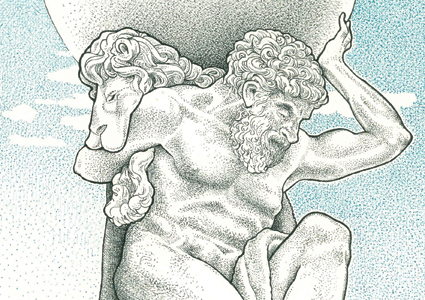
(ILLUSTRATION BY MICHAEL DALEY)
No one seems more confused about the import of the New Nationalism than the nationalists themselves. In Germany, the Alternative für Deutschland (AfD) is a coalition brought together by anger at the Merkel government’s decision to admit well over a million Middle Eastern migrants, but otherwise has no unifying characteristic. After a brief moment in the sun that included dinner with President Trump and a star slot at America’s leading conservative conference last February, Nigel Farage has fallen off America’s radar, and his most prominent admirer in the Trump White House, Steve Bannon, has left the Administration.
Mr Farage campaigned under the Cross of St George rather than the Union Jack; that is, as an English nationalist. But the United Kingdom is not a nation so much as an imperial monarchy, whose head of state is the sovereign of 32 countries. If the Brexit vote embodied more than passing rancour at the meddlesome European Union, what sort of national sentiment does it express? Does President Donald Trump’s call for “America First” mean anything more than a bilateral approach to trade negotiations rather than the multilateralism of the recent past? If that is the case, any change is more likely to be superficial rather than substantive. Mr Trump seems less interested in defining himself than the pundits whose job it is to pigeonhole him. He is neither the creature of the alt-Right nor an Establishment mogul in mufti, but a pragmatist more in the mode of Franklin Delano Roosevelt than Ronald Reagan.
The one European movement that can be termed “nationalist” in the strict sense of the term, namely Catalan independence, has occasioned scant resonance among populist parties on either side of the Atlantic. The Catalans have their own language, after all, and never wanted to be part of Spain; to the extent that a pro-independence majority is in doubt, it is due to immigration into Catalonia from other parts of Spain. Marine Le Pen, the defeated National Front candidate, took the side of the Spanish central government against the Catalans. The Scots Nationalists endorsed the Catalans’ right to hold an independence referendum, a costless call after having lost their own. The Catalans make the formerly separatist Lega Lombarda in Italy squeamish.
Excepting the Catalans, none of the New Nationalism has a clear raison d’etre. But it would be a grave misjudgment to dismiss nationalism as a force in the 21st century. The conventional wisdom has been overturned too many times in the past two years. The same conventional wisdom that deprecates the New Nationalism was shocked by the Brexit vote and the Trump victory in the United States. The nationalist protest vote in Germany has left the AfD in political isolation, but it has so weakened the reigning Volksparteien that Germany is hard-put to assemble a functioning coalition government. Hungary, Poland and now the Czech Republic and Austria have elected nationalist governments that have dug in their heels against the EU’s immigration policies. And the Catalan insurgency is far from over at the time of writing: the new parliamentary elections that Spain’s central government has called for December look likely to return a separatist majority, leaving the country in an intractable constitutional crisis.
The New Nationalists emerged in response to specific irritations: EU meddling in the UK, hollowed-out manufacturing and surging immigration in the US, the migrant wave in Germany, and so forth. But there is a deeper motivation for the nationalist resurgence. This could be seen in November in Poland, when 60,000 nationalist marches paraded through Warsaw, many under signs declaring, “We want God!” Polish nationalism contains chauvinist and anti-Semitic elements at its fringes, to be sure, but the religious fibre that set Poland in opposition to the Soviet Union is not entirely attenuated.
The spiritual centre of the Catalan nationalist movement lies at the ancient Benedictine monastery of Montserrat, where Father Sergi d’Assís Gelpí has preached support for separatism from his pulpit. Four hundred Catholic priests, including several bishops, signed a declaration in support of independence in September, so outraging Spain’s central government that the country’s ambassador to the Vatican filed a formal protest. There are economic grounds for separatist sentiment in Catalonia, certainly. Spain’s richest province contributes a disproportionate share of Spanish taxes, and the Catalans would rather spend their money at home. But tax grievances did not motivate Catalans to interpose themselves between the ballot boxes and Spain’s National Guard during the October 1 referendum and sustain hundreds of injuries in the confrontation.
Donald Trump’s election victory stemmed in part from an economic protest vote, notably in the rust belt states of Ohio, Michigan and Wisconsin. But Trump also garnered a higher proportion of the evangelical Protestant vote than any other candidate in US political history, by a margin of 80-16 among white evangelicals, according to exit polls cited by the Washington Post. He also won overwhelmingly among America’s small but indicative community of Orthodox Jews. It may seem odd to think of the thrice-married and occasionally vulgar Trump as the champion of America’s religious Right, but the data are unambiguous.
These all are manifestations of what is commonly called the identity crisis of the West, but might better be termed the West’s struggle with the sacred. By “sacred”, I mean that which endures beyond our lifetime and beyond the lifetime of our children, the enduring characteristics that make us unique and will continue to distinguish us from the other peoples of the world, and which cannot be violated without destroying our sense of who we are. The sacred is what a country’s soldiers are willing to die to protect; unless there is something for which we are willing to die, we will find nothing for which we are willing to live.
Tradition surely is part of this, but not every part of our tradition is sacred to us: we find within tradition elements that have prevailed through the ages and which we expect to prevail, if our present existence is to have a purpose, beyond our lifetimes. These elements of tradition cannot exist except through a nation: contrary to Hillary Clinton, it takes not a village but a nation to embody the language, customs and ethos that found our identity. The invariant feature of the various expressions of nationalism on both sides of the Atlantic is an attempt to recapture the past in order to envision a future. “Identity” as a concept is meaningless except as it is rooted in the past and pointed toward the future. Who we are at the moment depends on where we came from and where we expect to go. Our present, as Augustine argued in Confessions XI, is a composite of memory and anticipation.
Augustine (in City of God XXIV) famously took issue with Cicero’s definition of a res publica as an association founded on common interest, arguing instead that it was founded on a common love. It might be more accurate to say that it is founded on a common sense of the sacred, for the sacred embodies not only love but also awe and fear, specifically the fear that by violating the elements of tradition that define us we will lose ourselves.
The New Nationalism arose in opposition to the prevailing social philosophy of modern liberalism, namely the assertion that every individual should invent his identity. Existence precedes essence, in Jean-Paul Sartre’s cartoonish existentialism, which for him meant that we can invent our own essence. Many septic currents converged to create what we might term the postmodern notion of identity: Rousseau’s New Man, Nietzsche’s nihilism, Heidegger’s historicism, Ibsen’s assault on bourgeois society, Freud’s conjuring of the unconscious, and of course Sartre. Everything, including the most fundamental determinant of nature, namely gender, has now become a social construct; tradition has become a black museum of past instances of racism, misogyny and colonialism; and self-invention has become the universal and exclusive sacrament of a new secular religion. We mean many things by the term globalism, but the psychic content of globalisation is to leave not one stone of our past atop another so that the ground may be cleared for the arbitrary assertion of individual identity. In the United States, this has been enshrined in law, in Supreme Court Justice Anthony Kennedy’s majority opinion to sweep away barriers to same-sex marriage. According to Kennedy, “The Constitution promises liberty to all within its reach, a liberty that includes certain specific rights that allow persons, within a lawful realm, to define and express their identity.”
The conceit that we can “define and express” our own identity is perhaps the cruellest hoax ever perpetrated on civilised peoples. We are neither clever enough nor strong enough to do so; to the extent that we succeed in such an endeavour, we make ourselves into monsters. There is a better word for postmodern identity, and that is anomie. Cut off from its past, the postmodern West has no vision of its future, and its most characteristic response is to fail to bring children into the world, thus ensuring that it will have no future of any kind.
The New Nationalism proposes instead to return to the well of our national culture. But what is this? T.S. Eliot’s formulation seems quaint today: “[T]he term culture . . . includes all the characteristic activities and interests of a people: Derby Day, Henley Regatta, Cowes, the 12th of August, a cup final, the dog races, the pin table, the dart board, Wensleydale cheese, boiled cabbage cut into sections, beetroot in vinegar, 19th century Gothic churches, and the music of Elgar.” The enumeration of “characteristic activities and interests” hardly seems adequate. The Brexit vote did not coincide with a renewed fancy for grouse shooting. We must isolate what is sacred in our culture from the merely contingent. In the contemporary United Kingdom this may seem an odd endeavour, given that a majority (53 per cent) of all Britons and nearly three-quarters of young people declared themselves to be non-religious in the 2017 Social Attitudes Survey. But the sacred does not necessarily manifest itself in organised religion. One gauge of British identity is stronger than ever. Three-quarters of Britons believe that the monarchy has an important role to play in Britain’s future, compared to only two-thirds shortly after the death of Princess Diana.
Democracy without an overarching sense of the sacred would be a nightmare. The American Jewish theologian Michael Wyschogrod wrote in 2010:
The sanctity of the British Constitution is embodied in the monarch, who is anointed in emulation of the ancient kings of Israel for this reason. The sanctity of the sovereign rises above race; Elizabeth II reigns in Barbados as well as in Birmingham. The rites and rituals of the monarchy infuse Britain’s popular culture. Popular support for the monarchy bespeaks a perception that it protects the rights of Britons against the prospective tyranny of passing parliamentary majorities, by incorporating the distilled experience of centuries of British political life. The sense of the sacred that Britons attach to their Constitution provides the basis for a wholesome and successful nationalism, without making excuses for sometimes sordid acts undertaken by the British Empire in the past. The monarchy is the filter of Britain’s collective memory through which its people forms its sense of identity.
Alexander Gauland, the most influential spokesman for AfD, has characterised Americans as “a people thrown together at random without its own culture”. In fact, it is far easier to identity the unique characteristics of American culture than it is in the case of German culture. America is the progeny of Britain’s radical Protestants, who believed that sovereignty and sanctity must be founded in the individual citizen rather than in the person of the monarch. American political thought flows directly from the revelation theology of the Reformation, which first appeared in the West with John Wycliffe and the 14th-century Lollards, and reemerges in the writings of John Selden and John Milton. Sola scriptura presumes that every individual receives revelation directly from Scripture, and a state founded on American principles thus presumes a nation of Bible readers — which America emphatically was at the time of our Revolution.
Whether or not they attend Church of England services, Britons retain a pronounced sense of the sacred — one might say in spite of the feckless Church of England rather than because of it. Whether or not they read the Bible (and most still do), Americans retain a sense of the sacred which is pervaded by the radical Protestantism of 17th-century British thinkers. This concept of individual sovereignty precludes a monarchy and a state church. No national culture is so monothematically obsessed with the theme of individual redemption. It is a routine observation that the English Separatists who founded the Plymouth Bay Colony saw themselves as a new Mission in the Wilderness whose task was to found a new City on a Hill, an “almost chosen people”, in Lincoln’s bon mot. That is unremarkable; what still astonishes about the United States is that a nonconforming religious doctrine embraced by a small minority of Britons became the foundation of the popular culture of the world’s most powerful country.
America’s high culture is sparse and in many respects deficient, but its provenance and purpose are unmistakable. It is unimportant that not one American in a thousand has actually waded through Bunyan’s allegory. All of our popular fiction, from Mark Twain’s Huckleberry Finn to the protagonists of Westerns and hard-boiled detective fiction descend from John Bunyan’s Pilgrim’s Progress. Huckleberry Finn, who lights out to the new territory ahead of the others; the cowboy who rides off into the sunset; the private detective who fades into the urban nightscape; and the entire host of misfits and loners who stock the pantheon of American literary protagonists are all recognisable versions of Bunyan’s Christian. American literary critics have given little thought to the provenance of their popular heroes, although in private conversation the late Professor Harry Jaffa identified Huck as an avatar of Bunyan’s pilgrim. They are not the knights errant of European Romanticism, but hard men and sinners who hold to their own code of honour, and stand up to corrupt authority. The outlaw William Munny in Clint Eastwood’s 1990 film Unforgiven is a Christian pilgrim in the American understanding as much as is Huckleberry Finn.
Our “America First” President stands squarely in the mainstream of American culture. Donald Trump, I argued on the day of his Inauguration, “is instantly recognisable as the protagonist in a Christian drama: the lone avenger who stands up to the wicked powers of the world and calls them out for combat. Ted Cruz, though an engaged and enthusiastic evangelical Christian, failed to understand the religious impulse of the American electorate. They did not want a politician-pastor to preach to them what they already knew. They wanted a hero, sinner though he be, to give battle to the forces of evil — a Jephtha or a Saul.” No matter how far it strays from conventional religion, American culture remains stamped delibly with the Calvinist doctrine of total depravity. It does not look for saints who live exemplary lives but for sinners in search of redemption.
American identity has proven robust, transmitting the characteristics of the Puritan founders into its popular culture. It has pulverised the ethnic cultures that immigrants brought with them and removed virtually all memory of them by the second or third generation. Unlike the cultures of Europe, it depends on an imagined rather than an actual past. If Britain’s national epics are the histories of Shakespeare or Malory’s retelling of Arthur, America’s national epic is the King James Bible. The American pilgrimage emulates the history of Israel, with one profound difference: in the Protestant incarnation of an “almost chosen people”, Americans know that the City of God is not of this world, and that the goal of the earthly pilgrimage always beckons over the horizon. In a thousand versions, Americans are the poor wayfaring stranger of the song, hoping that “there is no sickness, toil or danger in that bright land to which I go”. In keeping with the limits of imagined memory, American culture is thin and repetitive. It provided poor soil for the flourishing of a literary high culture. Nonetheless, the American sense of the sacred is renewed and reinforced by a popular culture that retells the story of the individual journey to redemption.
What Abraham Lincoln called “the mystic chords of memory” are Hebraic rather than Anglo-Saxon. America retained Britain’s regard for individual rights, but it shifted the source of these rights to the direct and immediate relationship of God and the individual citizen. In different ways, Britain and America anchor their identities in that most ancient and robust of all national cultures, namely Israel. The Americans are Hebrews of the imagination; their mother country hopes to build Jerusalem in England’s green and pleasant land, and identifies its monarchy in symbolic as well as mythological fashion with the throne of David. Curiously, this divide mirrors a Biblical ambiguity over the desirability of monarchy which persisted through ancient and medieval rabbinic commentaries. Selden and Milton cited rabbinical sources who eschewed monarchy on the strength of I Samuel 8. Yet Jewish redemption is founded on the restoration of the Davidic monarchy. Jewish tradition remains ambivalent on the issue. Michael Wyschogrod proposed to resolve Israel’s difficulty in choosing between secular and religious nationalism through monarchy: Israel’s head of state, now a president, would become instead the regent for an absent king, namely the successor of David who can be identified only by prophecy. All other political functions would remain as they are, but the regent would embody Israel’s messianic hope.
Rabbi Jonathan Sacks points to a precedent in the biblical covenant for the modern notion of social contract. “What God and Samuel were proposing was a social contract, on the lines later expounded by the founders of modern political thought: Hobbes, Locke and Rousseau,” he wrote in 2008:
Rabbi Sacks’s insight is important, but it begs the question of what causes a social contract to endure beyond the perceived self-interest of the participating parties. That is the sense of the sacred, which cannot be a philosophical abstraction, but rather must pervade daily life and the ordinary culture of the people.
It is noteworthy in this context that the revival of the Jewish nation-state and its startling success in arms, enterprise and the arts remains a source of inspiration to other nations who have taken Israel as an exemplar. Israel’s victory in the 1967 war was a watershed event for the American evangelical movement, which viewed the outcome as “fulfillment of Biblical prophecy,” according to Rev Stephen Sizer, the author of the 2004 book Christian Zionism. That is an exceptional response, to be sure, but Israel has been the “exemplar and paragon of a nation” (Franz Rosenzweig), the model for Europe’s nascent monarchies from the Low Middle Ages onwards, as Professor Adrian Hastings has shown in his 1996 volume The Construction of Nationhood.
Zionism has become an important if unexpected object of interest among the new nationalists, among whom the Catalan independence movement draws the most explicit inspiration from its example. Jordi Pujol, the president of Catalonia’s Generalitat from 1980 to 2003 and the father of modern Catalan separatism, told Israel’s Knesset in October 2007 that at the age of 17 he read Theodor Herzl’s The Jewish State, as well as the writings of Chaim Weizmann and numerous works on the history of Zionism. “My interest in Zionism,” he told Israel’s parliamentarians, “is explained by my Catalan nationalism, as a citizen of a country that during the past three or four hundred years has been subjected to a harsh policy of linguistic and cultural persecution and general denationalisation.” As it happens, the first printed translation of the Bible to appear on the Iberian peninsula was the Catalan version of 1478, made by the monk Bonafacio Ferrer in Valencia with the assistance of local rabbis. “All available copies were destroyed by the Inquisition before 1500, but a single leaf survives in the Hispanic Society of America’s library,” reports the Cambridge History of the Bible.
Although a great gulf is fixed between the sense of the sacred in Great Britain and America, they remain siblings who in different ways draw upon Israel’s idea of the sacred as conveyed by the Bible. What is sacred in both countries, moreover, pervades the popular culture, and is understood as easily by the least- educated citizens as by the mandarins of their high culture. Herr Gauland could not be more wrong to claim that Americans have no culture. German culture is a far more elusive entity, which helps to explains why German nationalism remains a problematic movement.
A brief aside on the question of what identity is and how it is formed is in order. Identity is above all being and time; we do not need to consult Heidegger on this point, for St Augustine explained it a millennium and a half before him in Confessions XI. The durability of biblical identity stems in part from the fact that it anchors memory in time. “Revelation is the first thing to set its mark firmly into the middle of time; only after Revelation do we have an immovable Before and Afterward,” wrote Franz Rosenzweig. “Then there is a reckoning of time independent of the reckoner and the place of reckoning, valid for all the places of the world.” The peoples of the world look back in time, though innumerable conquests, migrations, and forced assimilations that stretch beyond all records and encounter not time, but “once upon a time,” in myth. America’s identity, like Israel’s, begins with an event. The peoples who imagine themselves to be the autochthonous sons of the soil find that memory dissipates into the mists of time.
That is a conundrum for the Christian world, which sees its spiritual origin at Golgotha but its ethnic origin in the impenetrable mists of the distant past. To be a whole person, the Christian must find a way to reconcile these two demarcations of memory. One solution is to embrace myth. C.S. Lewis argued that Christianity “is simply a true myth: a myth working on us in the same way as the others, but with this tremendous difference that it really happened: and one must be content to accept it in the same way, remembering that it is God’s myth where the others are men’s myths: i. e. the Pagan stories are God expressing Himself through the minds of poets, using such images as He found there, while Christianity is God expressing Himself through what we call real things.”
All of this was said before and better by the earliest German Romantics in the immediate aftermath of the French Revolution. It was Germany’s bad luck to fight its way to nationhood in response to the Napoleonic conquests, at a time when its intellectuals largely had abandoned religion in favor of philosophy. The modern notion of self-invention erupts into history through the Cult of Reason. Its prophets were Rousseau and Kant, who were armed by the French Revolution. In Germany, the first salvo against the Cult of Reason came from J. G. Fichte, who argued that Kant’s transcendental reason could only exist in human consciousness, and that this consciousness must arise from nationality. Fichte’s young student Novalis inquired rather how national consciousness might be formed in the first place. Consciousness, he argued long before Heidegger, is time-consciousness, and our sense of ourselves in the present moment was an ecstatic unity of memory and anticipation. But upon what memory might the Germans draw? In his 1799 essay “Christianity or Europe,” Novalis proposed a return to the Christianity of the early Middle Ages, but a Christianity that would ennoble the tales (Märchen) of the past. The disenchanted world which Schiller bemoaned in his poem “The Gods of Greece” would thus become reenchanted (wiederverzaubert) through the fairytale world that underlay medieval Christianity.
That in summary was the Romantic programme, and a very bad idea it turned out to be. Where Schiller and Hölderlin hoped to re-enchant the world with Hellenism, the Romantics succeeded only in dredging up the raw material for a revived paganism. Heinrich Heine warned in 1834 that “if ever the Cross — the taming talisman — were to fracture, then the wildness of the old warriors will clatter to the surface, their mad berserkers’ rage . . . and the old stone gods will raise themselves up out of the forgotten dust and rub the dust of a millennium from their eyes, and Thor with his giant hammer will at last rise up and smash the Gothic domes.” In the hands of Richard Wagner, the Nibelungenlied became an anti-Christian manifesto. In the 19th century Germany brought forth a peerless high culture in literature, music and the sciences, but its national sense of the sacred lost its way in the land of Märchen and was bewitched by the pagan past.
America’s first writer of any stature, Washington Irving, draws a bright line between American and German culture in his allegory “Rip van Winkle”. Irving’s feckless Dutchman wanders into the hills of the Hudson Valley before the American Revolution and finds himself in the middle of a Märchen, one found in a different version in the collection of the Grimm Brothers. He encounters the ghosts of Henry Hudson’s lost crew, and spends the night with drink and ninepins. He awakes and makes his way home unaware that he has slept for 20 years. In the world of “once upon a time” an enchanted traveller may mistake seven days for seven years; what is different in Irving’s story is that Rip wakes up in the modern world of time, in which the Revolution has set a permanent temporal marker. Irving lived in Germany and knew the Romantic sources, but his best-known story is not Romantic, as some critics argue, but rather an ironical reversal of the Romantic view. The American Revolution has disenchanted the world and banished the ghosts of the pre-modern world. Irving’s story thus helps explain the strength and staying power of American culture.
Germans continued to look to their high culture as a wellspring of identity until the end of the First World War. Most of its leading intellectuals, including a dozen Nobel laureates, signed the Manifesto of the Ninety-Three of 1914, alleging that the war was an attack on German culture. Thomas Mann famously contrasted German Kultur with the mere commercial civilisation of France and Britain. Max Weber supported the war wholeheartedly and, after the defeat, looked forward to Germany’s victory in a future war. The identification of war aims with Kultur discredited high culture among the defeated German people. That is why Nazi playwright Hans Johst has a character say that when he hears the word “culture,” he releases the safety catch on his pistol.
Recently I spoke with a regional leader of the AfD, a professor of philosophy without an iota of racial bias. The AfD sought to preserve German culture, he told me, against the threat of unlimited immigration. If he were Germany’s education minister, I asked, what would he do for German culture? The question surprised him, and after some thought he offered that he might revive the old German system of classical education. Much as I think classical education desirable, it seems a thin gruel to offer to a country still traumatised by the brutality of defeat and the guilt of Nazi genocide. Germany had the misfortune to worship itself in the past, and in consequence most Germans today have no access to the sacred. They do not know how to begin to ask the relevant questions.
Earlier I argued that the New Nationalism should be not be dismissed as a nostalgic effusion. The reversion to nationalism is not an atavistic reflex but a renewal of purpose that offers the hope that the best days of the West may not be behind us. It arises from the most compelling human need, namely the need for a sense of purpose in life. The nationalist political movements that have upended political life during the past two years all responded to specific issues, but they draw their energy from deep sources. But it would be equally wrong to see in these movements a generic populism directed against established elites. The West cannot long survive without restoring a sense of the sacred, that is, repairing and adding to the work of many generations. The only successes we observe occur when the sense of the sacred arises from a biblical foundation. Restoring the sacred will require a hardy alliance of reflection and commitment; in some cases the past may be irretrievably lost.
Mr Farage campaigned under the Cross of St George rather than the Union Jack; that is, as an English nationalist. But the United Kingdom is not a nation so much as an imperial monarchy, whose head of state is the sovereign of 32 countries. If the Brexit vote embodied more than passing rancour at the meddlesome European Union, what sort of national sentiment does it express? Does President Donald Trump’s call for “America First” mean anything more than a bilateral approach to trade negotiations rather than the multilateralism of the recent past? If that is the case, any change is more likely to be superficial rather than substantive. Mr Trump seems less interested in defining himself than the pundits whose job it is to pigeonhole him. He is neither the creature of the alt-Right nor an Establishment mogul in mufti, but a pragmatist more in the mode of Franklin Delano Roosevelt than Ronald Reagan.
The one European movement that can be termed “nationalist” in the strict sense of the term, namely Catalan independence, has occasioned scant resonance among populist parties on either side of the Atlantic. The Catalans have their own language, after all, and never wanted to be part of Spain; to the extent that a pro-independence majority is in doubt, it is due to immigration into Catalonia from other parts of Spain. Marine Le Pen, the defeated National Front candidate, took the side of the Spanish central government against the Catalans. The Scots Nationalists endorsed the Catalans’ right to hold an independence referendum, a costless call after having lost their own. The Catalans make the formerly separatist Lega Lombarda in Italy squeamish.
Excepting the Catalans, none of the New Nationalism has a clear raison d’etre. But it would be a grave misjudgment to dismiss nationalism as a force in the 21st century. The conventional wisdom has been overturned too many times in the past two years. The same conventional wisdom that deprecates the New Nationalism was shocked by the Brexit vote and the Trump victory in the United States. The nationalist protest vote in Germany has left the AfD in political isolation, but it has so weakened the reigning Volksparteien that Germany is hard-put to assemble a functioning coalition government. Hungary, Poland and now the Czech Republic and Austria have elected nationalist governments that have dug in their heels against the EU’s immigration policies. And the Catalan insurgency is far from over at the time of writing: the new parliamentary elections that Spain’s central government has called for December look likely to return a separatist majority, leaving the country in an intractable constitutional crisis.
The New Nationalists emerged in response to specific irritations: EU meddling in the UK, hollowed-out manufacturing and surging immigration in the US, the migrant wave in Germany, and so forth. But there is a deeper motivation for the nationalist resurgence. This could be seen in November in Poland, when 60,000 nationalist marches paraded through Warsaw, many under signs declaring, “We want God!” Polish nationalism contains chauvinist and anti-Semitic elements at its fringes, to be sure, but the religious fibre that set Poland in opposition to the Soviet Union is not entirely attenuated.
The spiritual centre of the Catalan nationalist movement lies at the ancient Benedictine monastery of Montserrat, where Father Sergi d’Assís Gelpí has preached support for separatism from his pulpit. Four hundred Catholic priests, including several bishops, signed a declaration in support of independence in September, so outraging Spain’s central government that the country’s ambassador to the Vatican filed a formal protest. There are economic grounds for separatist sentiment in Catalonia, certainly. Spain’s richest province contributes a disproportionate share of Spanish taxes, and the Catalans would rather spend their money at home. But tax grievances did not motivate Catalans to interpose themselves between the ballot boxes and Spain’s National Guard during the October 1 referendum and sustain hundreds of injuries in the confrontation.
Donald Trump’s election victory stemmed in part from an economic protest vote, notably in the rust belt states of Ohio, Michigan and Wisconsin. But Trump also garnered a higher proportion of the evangelical Protestant vote than any other candidate in US political history, by a margin of 80-16 among white evangelicals, according to exit polls cited by the Washington Post. He also won overwhelmingly among America’s small but indicative community of Orthodox Jews. It may seem odd to think of the thrice-married and occasionally vulgar Trump as the champion of America’s religious Right, but the data are unambiguous.
These all are manifestations of what is commonly called the identity crisis of the West, but might better be termed the West’s struggle with the sacred. By “sacred”, I mean that which endures beyond our lifetime and beyond the lifetime of our children, the enduring characteristics that make us unique and will continue to distinguish us from the other peoples of the world, and which cannot be violated without destroying our sense of who we are. The sacred is what a country’s soldiers are willing to die to protect; unless there is something for which we are willing to die, we will find nothing for which we are willing to live.
Tradition surely is part of this, but not every part of our tradition is sacred to us: we find within tradition elements that have prevailed through the ages and which we expect to prevail, if our present existence is to have a purpose, beyond our lifetimes. These elements of tradition cannot exist except through a nation: contrary to Hillary Clinton, it takes not a village but a nation to embody the language, customs and ethos that found our identity. The invariant feature of the various expressions of nationalism on both sides of the Atlantic is an attempt to recapture the past in order to envision a future. “Identity” as a concept is meaningless except as it is rooted in the past and pointed toward the future. Who we are at the moment depends on where we came from and where we expect to go. Our present, as Augustine argued in Confessions XI, is a composite of memory and anticipation.
Augustine (in City of God XXIV) famously took issue with Cicero’s definition of a res publica as an association founded on common interest, arguing instead that it was founded on a common love. It might be more accurate to say that it is founded on a common sense of the sacred, for the sacred embodies not only love but also awe and fear, specifically the fear that by violating the elements of tradition that define us we will lose ourselves.
The New Nationalism arose in opposition to the prevailing social philosophy of modern liberalism, namely the assertion that every individual should invent his identity. Existence precedes essence, in Jean-Paul Sartre’s cartoonish existentialism, which for him meant that we can invent our own essence. Many septic currents converged to create what we might term the postmodern notion of identity: Rousseau’s New Man, Nietzsche’s nihilism, Heidegger’s historicism, Ibsen’s assault on bourgeois society, Freud’s conjuring of the unconscious, and of course Sartre. Everything, including the most fundamental determinant of nature, namely gender, has now become a social construct; tradition has become a black museum of past instances of racism, misogyny and colonialism; and self-invention has become the universal and exclusive sacrament of a new secular religion. We mean many things by the term globalism, but the psychic content of globalisation is to leave not one stone of our past atop another so that the ground may be cleared for the arbitrary assertion of individual identity. In the United States, this has been enshrined in law, in Supreme Court Justice Anthony Kennedy’s majority opinion to sweep away barriers to same-sex marriage. According to Kennedy, “The Constitution promises liberty to all within its reach, a liberty that includes certain specific rights that allow persons, within a lawful realm, to define and express their identity.”
The conceit that we can “define and express” our own identity is perhaps the cruellest hoax ever perpetrated on civilised peoples. We are neither clever enough nor strong enough to do so; to the extent that we succeed in such an endeavour, we make ourselves into monsters. There is a better word for postmodern identity, and that is anomie. Cut off from its past, the postmodern West has no vision of its future, and its most characteristic response is to fail to bring children into the world, thus ensuring that it will have no future of any kind.
The New Nationalism proposes instead to return to the well of our national culture. But what is this? T.S. Eliot’s formulation seems quaint today: “[T]he term culture . . . includes all the characteristic activities and interests of a people: Derby Day, Henley Regatta, Cowes, the 12th of August, a cup final, the dog races, the pin table, the dart board, Wensleydale cheese, boiled cabbage cut into sections, beetroot in vinegar, 19th century Gothic churches, and the music of Elgar.” The enumeration of “characteristic activities and interests” hardly seems adequate. The Brexit vote did not coincide with a renewed fancy for grouse shooting. We must isolate what is sacred in our culture from the merely contingent. In the contemporary United Kingdom this may seem an odd endeavour, given that a majority (53 per cent) of all Britons and nearly three-quarters of young people declared themselves to be non-religious in the 2017 Social Attitudes Survey. But the sacred does not necessarily manifest itself in organised religion. One gauge of British identity is stronger than ever. Three-quarters of Britons believe that the monarchy has an important role to play in Britain’s future, compared to only two-thirds shortly after the death of Princess Diana.
Democracy without an overarching sense of the sacred would be a nightmare. The American Jewish theologian Michael Wyschogrod wrote in 2010:
To discuss theological criteria for the constitution of a secular republic runs against the grain of modern political thought, even though constitutional restrictions on popular sovereignty imply reliance on an authority that is greater than human. In a republic the people are sovereign, yet the purpose of a constitution is precisely to restrict the power of any future majority . . . The only basis for a polity to accept severe restrictions on popular majority rule is the conviction that the founding constitution derives its power from a higher form of sovereignty than the voters in any given legislative session. Without such a theological foundation, a republic cannot feel bound by the rules laid down by its founders. A purely secular republic would self-destruct because it could not protect its constitution from constant amendment.
The sanctity of the British Constitution is embodied in the monarch, who is anointed in emulation of the ancient kings of Israel for this reason. The sanctity of the sovereign rises above race; Elizabeth II reigns in Barbados as well as in Birmingham. The rites and rituals of the monarchy infuse Britain’s popular culture. Popular support for the monarchy bespeaks a perception that it protects the rights of Britons against the prospective tyranny of passing parliamentary majorities, by incorporating the distilled experience of centuries of British political life. The sense of the sacred that Britons attach to their Constitution provides the basis for a wholesome and successful nationalism, without making excuses for sometimes sordid acts undertaken by the British Empire in the past. The monarchy is the filter of Britain’s collective memory through which its people forms its sense of identity.
Alexander Gauland, the most influential spokesman for AfD, has characterised Americans as “a people thrown together at random without its own culture”. In fact, it is far easier to identity the unique characteristics of American culture than it is in the case of German culture. America is the progeny of Britain’s radical Protestants, who believed that sovereignty and sanctity must be founded in the individual citizen rather than in the person of the monarch. American political thought flows directly from the revelation theology of the Reformation, which first appeared in the West with John Wycliffe and the 14th-century Lollards, and reemerges in the writings of John Selden and John Milton. Sola scriptura presumes that every individual receives revelation directly from Scripture, and a state founded on American principles thus presumes a nation of Bible readers — which America emphatically was at the time of our Revolution.
Whether or not they attend Church of England services, Britons retain a pronounced sense of the sacred — one might say in spite of the feckless Church of England rather than because of it. Whether or not they read the Bible (and most still do), Americans retain a sense of the sacred which is pervaded by the radical Protestantism of 17th-century British thinkers. This concept of individual sovereignty precludes a monarchy and a state church. No national culture is so monothematically obsessed with the theme of individual redemption. It is a routine observation that the English Separatists who founded the Plymouth Bay Colony saw themselves as a new Mission in the Wilderness whose task was to found a new City on a Hill, an “almost chosen people”, in Lincoln’s bon mot. That is unremarkable; what still astonishes about the United States is that a nonconforming religious doctrine embraced by a small minority of Britons became the foundation of the popular culture of the world’s most powerful country.
America’s high culture is sparse and in many respects deficient, but its provenance and purpose are unmistakable. It is unimportant that not one American in a thousand has actually waded through Bunyan’s allegory. All of our popular fiction, from Mark Twain’s Huckleberry Finn to the protagonists of Westerns and hard-boiled detective fiction descend from John Bunyan’s Pilgrim’s Progress. Huckleberry Finn, who lights out to the new territory ahead of the others; the cowboy who rides off into the sunset; the private detective who fades into the urban nightscape; and the entire host of misfits and loners who stock the pantheon of American literary protagonists are all recognisable versions of Bunyan’s Christian. American literary critics have given little thought to the provenance of their popular heroes, although in private conversation the late Professor Harry Jaffa identified Huck as an avatar of Bunyan’s pilgrim. They are not the knights errant of European Romanticism, but hard men and sinners who hold to their own code of honour, and stand up to corrupt authority. The outlaw William Munny in Clint Eastwood’s 1990 film Unforgiven is a Christian pilgrim in the American understanding as much as is Huckleberry Finn.
Our “America First” President stands squarely in the mainstream of American culture. Donald Trump, I argued on the day of his Inauguration, “is instantly recognisable as the protagonist in a Christian drama: the lone avenger who stands up to the wicked powers of the world and calls them out for combat. Ted Cruz, though an engaged and enthusiastic evangelical Christian, failed to understand the religious impulse of the American electorate. They did not want a politician-pastor to preach to them what they already knew. They wanted a hero, sinner though he be, to give battle to the forces of evil — a Jephtha or a Saul.” No matter how far it strays from conventional religion, American culture remains stamped delibly with the Calvinist doctrine of total depravity. It does not look for saints who live exemplary lives but for sinners in search of redemption.
American identity has proven robust, transmitting the characteristics of the Puritan founders into its popular culture. It has pulverised the ethnic cultures that immigrants brought with them and removed virtually all memory of them by the second or third generation. Unlike the cultures of Europe, it depends on an imagined rather than an actual past. If Britain’s national epics are the histories of Shakespeare or Malory’s retelling of Arthur, America’s national epic is the King James Bible. The American pilgrimage emulates the history of Israel, with one profound difference: in the Protestant incarnation of an “almost chosen people”, Americans know that the City of God is not of this world, and that the goal of the earthly pilgrimage always beckons over the horizon. In a thousand versions, Americans are the poor wayfaring stranger of the song, hoping that “there is no sickness, toil or danger in that bright land to which I go”. In keeping with the limits of imagined memory, American culture is thin and repetitive. It provided poor soil for the flourishing of a literary high culture. Nonetheless, the American sense of the sacred is renewed and reinforced by a popular culture that retells the story of the individual journey to redemption.
What Abraham Lincoln called “the mystic chords of memory” are Hebraic rather than Anglo-Saxon. America retained Britain’s regard for individual rights, but it shifted the source of these rights to the direct and immediate relationship of God and the individual citizen. In different ways, Britain and America anchor their identities in that most ancient and robust of all national cultures, namely Israel. The Americans are Hebrews of the imagination; their mother country hopes to build Jerusalem in England’s green and pleasant land, and identifies its monarchy in symbolic as well as mythological fashion with the throne of David. Curiously, this divide mirrors a Biblical ambiguity over the desirability of monarchy which persisted through ancient and medieval rabbinic commentaries. Selden and Milton cited rabbinical sources who eschewed monarchy on the strength of I Samuel 8. Yet Jewish redemption is founded on the restoration of the Davidic monarchy. Jewish tradition remains ambivalent on the issue. Michael Wyschogrod proposed to resolve Israel’s difficulty in choosing between secular and religious nationalism through monarchy: Israel’s head of state, now a president, would become instead the regent for an absent king, namely the successor of David who can be identified only by prophecy. All other political functions would remain as they are, but the regent would embody Israel’s messianic hope.
Rabbi Jonathan Sacks points to a precedent in the biblical covenant for the modern notion of social contract. “What God and Samuel were proposing was a social contract, on the lines later expounded by the founders of modern political thought: Hobbes, Locke and Rousseau,” he wrote in 2008:
A group of self-interested individuals will find it worthwhile to appoint a leader who will defend them from lawlessness within and enemies outside. To do so they will have to sacrifice some of their liberty and wealth, but the alternative is anarchy and foreign conquest. Samuel’s appointment of Saul is the first recorded instance of a social contract.
Rabbi Sacks’s insight is important, but it begs the question of what causes a social contract to endure beyond the perceived self-interest of the participating parties. That is the sense of the sacred, which cannot be a philosophical abstraction, but rather must pervade daily life and the ordinary culture of the people.
It is noteworthy in this context that the revival of the Jewish nation-state and its startling success in arms, enterprise and the arts remains a source of inspiration to other nations who have taken Israel as an exemplar. Israel’s victory in the 1967 war was a watershed event for the American evangelical movement, which viewed the outcome as “fulfillment of Biblical prophecy,” according to Rev Stephen Sizer, the author of the 2004 book Christian Zionism. That is an exceptional response, to be sure, but Israel has been the “exemplar and paragon of a nation” (Franz Rosenzweig), the model for Europe’s nascent monarchies from the Low Middle Ages onwards, as Professor Adrian Hastings has shown in his 1996 volume The Construction of Nationhood.
Zionism has become an important if unexpected object of interest among the new nationalists, among whom the Catalan independence movement draws the most explicit inspiration from its example. Jordi Pujol, the president of Catalonia’s Generalitat from 1980 to 2003 and the father of modern Catalan separatism, told Israel’s Knesset in October 2007 that at the age of 17 he read Theodor Herzl’s The Jewish State, as well as the writings of Chaim Weizmann and numerous works on the history of Zionism. “My interest in Zionism,” he told Israel’s parliamentarians, “is explained by my Catalan nationalism, as a citizen of a country that during the past three or four hundred years has been subjected to a harsh policy of linguistic and cultural persecution and general denationalisation.” As it happens, the first printed translation of the Bible to appear on the Iberian peninsula was the Catalan version of 1478, made by the monk Bonafacio Ferrer in Valencia with the assistance of local rabbis. “All available copies were destroyed by the Inquisition before 1500, but a single leaf survives in the Hispanic Society of America’s library,” reports the Cambridge History of the Bible.
Although a great gulf is fixed between the sense of the sacred in Great Britain and America, they remain siblings who in different ways draw upon Israel’s idea of the sacred as conveyed by the Bible. What is sacred in both countries, moreover, pervades the popular culture, and is understood as easily by the least- educated citizens as by the mandarins of their high culture. Herr Gauland could not be more wrong to claim that Americans have no culture. German culture is a far more elusive entity, which helps to explains why German nationalism remains a problematic movement.
A brief aside on the question of what identity is and how it is formed is in order. Identity is above all being and time; we do not need to consult Heidegger on this point, for St Augustine explained it a millennium and a half before him in Confessions XI. The durability of biblical identity stems in part from the fact that it anchors memory in time. “Revelation is the first thing to set its mark firmly into the middle of time; only after Revelation do we have an immovable Before and Afterward,” wrote Franz Rosenzweig. “Then there is a reckoning of time independent of the reckoner and the place of reckoning, valid for all the places of the world.” The peoples of the world look back in time, though innumerable conquests, migrations, and forced assimilations that stretch beyond all records and encounter not time, but “once upon a time,” in myth. America’s identity, like Israel’s, begins with an event. The peoples who imagine themselves to be the autochthonous sons of the soil find that memory dissipates into the mists of time.
That is a conundrum for the Christian world, which sees its spiritual origin at Golgotha but its ethnic origin in the impenetrable mists of the distant past. To be a whole person, the Christian must find a way to reconcile these two demarcations of memory. One solution is to embrace myth. C.S. Lewis argued that Christianity “is simply a true myth: a myth working on us in the same way as the others, but with this tremendous difference that it really happened: and one must be content to accept it in the same way, remembering that it is God’s myth where the others are men’s myths: i. e. the Pagan stories are God expressing Himself through the minds of poets, using such images as He found there, while Christianity is God expressing Himself through what we call real things.”
All of this was said before and better by the earliest German Romantics in the immediate aftermath of the French Revolution. It was Germany’s bad luck to fight its way to nationhood in response to the Napoleonic conquests, at a time when its intellectuals largely had abandoned religion in favor of philosophy. The modern notion of self-invention erupts into history through the Cult of Reason. Its prophets were Rousseau and Kant, who were armed by the French Revolution. In Germany, the first salvo against the Cult of Reason came from J. G. Fichte, who argued that Kant’s transcendental reason could only exist in human consciousness, and that this consciousness must arise from nationality. Fichte’s young student Novalis inquired rather how national consciousness might be formed in the first place. Consciousness, he argued long before Heidegger, is time-consciousness, and our sense of ourselves in the present moment was an ecstatic unity of memory and anticipation. But upon what memory might the Germans draw? In his 1799 essay “Christianity or Europe,” Novalis proposed a return to the Christianity of the early Middle Ages, but a Christianity that would ennoble the tales (Märchen) of the past. The disenchanted world which Schiller bemoaned in his poem “The Gods of Greece” would thus become reenchanted (wiederverzaubert) through the fairytale world that underlay medieval Christianity.
That in summary was the Romantic programme, and a very bad idea it turned out to be. Where Schiller and Hölderlin hoped to re-enchant the world with Hellenism, the Romantics succeeded only in dredging up the raw material for a revived paganism. Heinrich Heine warned in 1834 that “if ever the Cross — the taming talisman — were to fracture, then the wildness of the old warriors will clatter to the surface, their mad berserkers’ rage . . . and the old stone gods will raise themselves up out of the forgotten dust and rub the dust of a millennium from their eyes, and Thor with his giant hammer will at last rise up and smash the Gothic domes.” In the hands of Richard Wagner, the Nibelungenlied became an anti-Christian manifesto. In the 19th century Germany brought forth a peerless high culture in literature, music and the sciences, but its national sense of the sacred lost its way in the land of Märchen and was bewitched by the pagan past.
America’s first writer of any stature, Washington Irving, draws a bright line between American and German culture in his allegory “Rip van Winkle”. Irving’s feckless Dutchman wanders into the hills of the Hudson Valley before the American Revolution and finds himself in the middle of a Märchen, one found in a different version in the collection of the Grimm Brothers. He encounters the ghosts of Henry Hudson’s lost crew, and spends the night with drink and ninepins. He awakes and makes his way home unaware that he has slept for 20 years. In the world of “once upon a time” an enchanted traveller may mistake seven days for seven years; what is different in Irving’s story is that Rip wakes up in the modern world of time, in which the Revolution has set a permanent temporal marker. Irving lived in Germany and knew the Romantic sources, but his best-known story is not Romantic, as some critics argue, but rather an ironical reversal of the Romantic view. The American Revolution has disenchanted the world and banished the ghosts of the pre-modern world. Irving’s story thus helps explain the strength and staying power of American culture.
Germans continued to look to their high culture as a wellspring of identity until the end of the First World War. Most of its leading intellectuals, including a dozen Nobel laureates, signed the Manifesto of the Ninety-Three of 1914, alleging that the war was an attack on German culture. Thomas Mann famously contrasted German Kultur with the mere commercial civilisation of France and Britain. Max Weber supported the war wholeheartedly and, after the defeat, looked forward to Germany’s victory in a future war. The identification of war aims with Kultur discredited high culture among the defeated German people. That is why Nazi playwright Hans Johst has a character say that when he hears the word “culture,” he releases the safety catch on his pistol.
Recently I spoke with a regional leader of the AfD, a professor of philosophy without an iota of racial bias. The AfD sought to preserve German culture, he told me, against the threat of unlimited immigration. If he were Germany’s education minister, I asked, what would he do for German culture? The question surprised him, and after some thought he offered that he might revive the old German system of classical education. Much as I think classical education desirable, it seems a thin gruel to offer to a country still traumatised by the brutality of defeat and the guilt of Nazi genocide. Germany had the misfortune to worship itself in the past, and in consequence most Germans today have no access to the sacred. They do not know how to begin to ask the relevant questions.
Earlier I argued that the New Nationalism should be not be dismissed as a nostalgic effusion. The reversion to nationalism is not an atavistic reflex but a renewal of purpose that offers the hope that the best days of the West may not be behind us. It arises from the most compelling human need, namely the need for a sense of purpose in life. The nationalist political movements that have upended political life during the past two years all responded to specific issues, but they draw their energy from deep sources. But it would be equally wrong to see in these movements a generic populism directed against established elites. The West cannot long survive without restoring a sense of the sacred, that is, repairing and adding to the work of many generations. The only successes we observe occur when the sense of the sacred arises from a biblical foundation. Restoring the sacred will require a hardy alliance of reflection and commitment; in some cases the past may be irretrievably lost.