PPP. That’s what you need to keep in mind if you are to understand American politics: Trump the Person; Trump the Policymaker; Trump the President. But first the background against which the current political drama is being played out here in America. Understand this, and the three Ps, and you might even be able to do what is clearly in Britain’s interest: invite the President of the United States to a Britain that now needs all the friends it can get, and receive him with civility if not enthusiasm.
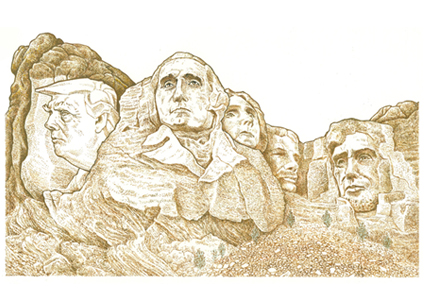
Donald Trump: The Person is flawed, but the President has put the US on track (COVER ILLUSTRATION BY MICHAEL DALEY)
No one was more surprised at Trump’s electoral victory than the man himself, unless it was supporters of Hillary Clinton, a candidate who never did explain just why she wanted to be president and who continually badgered her team to come up with a theme for the pudding that was her campaign. How was it possible that this vulgar misogynist could beat Hillary Clinton, she the shatterer of glass ceilings; the defender of abortion on demand, financed if necessary by orders of Catholic nuns; and of young persons’ rights to choose their gender and their toilets regardless of gender; of the right of illegal immigrants to become American citizens. She was consort to beneficiaries of globalisation who filled her coffers with speaking fees, and representative of all that “deplorables”, as she called Trump supporters, find so offensive about the social agenda of the bicoastal liberal establishment. The Russians must have done it. Or the really dumb Founding Fathers who established an electoral system that gave voice to less densely populated states rather than rely entirely on the popular vote. No matter the cause, Trump is an illegitimate president.
Which means that the Democratic minority, with the support of an overwhelmingly liberal-establishment media, is not merely obligated to oppose those of his policies they deem not to be in the national interest, but to have him removed from office, preferably in handcuffs. The virulence of the attacks on the President makes the battle between Momentum and the Blairites seem tame by comparison. Trump’s response is to lash out indiscriminately at anyone who disagrees with whatever his whim-of-the-moment seems to be. His weapon of choice is the tweet, which a frustrated media must report, giving these short bursts of often incoherent, often nasty impulses an even wider audience. Trump supporters liken the tweets to FDR’s use of radio — the famous Fireside Chats — to go over the heads of a hostile press directly to the American people, but a better comparison would be to the “nya, nya, you’re one, too” response of a witless schoolboy to some disagreeable remark by a playmate.
So much for Trump the person, and why his natural propensity to lie — not so much to lie, but to invent an alternative “truth” in which he really, really believes — and to substitute invective for reason, is justified by his supporters. To that 35 to 40 per cent of the electorate, largely white, rural, poor or middle class, religious and male, Trump might be a sinful New York property developer claiming to be a billionaire, but, oddly, he is “one of us”, to borrow a descriptive once popular in Britain, eager to poke a finger in the eye of the elites who remain unaware of our existence and problems.
On to policy. It is important to distinguish Trump the Person from Trump the Policymaker. Trump the person believes that the current international trading system is rigged in favour of the rich, of what David Goodhart calls “the anywheres”, who couldn’t care less about Making America Great Again. This is the New York crowd that kept a thrusting Trump at arm’s length, and only now have found reason to invite him into their more tasteful, less gilt-covered apartments for dinner. Trump the campaigner promised to smash that system in favour of one that protects American interests.
Trump the President is a different matter. Yes, he withdrew from the Trans-Pacific Partnership, but Clinton had promised to do the same, in deference to the trade unions that contributed so much manpower and cash to her campaign, and no one ever accused her of protectionist tendencies. Yes, he has imposed temporary tariffs on washing machines and solar panels, but several of his predecessors used the same procedure to levy duties on imports, and no one accused them of wanting to bring down the entire trading system. Yes, he threatens to scupper the North Atlantic Free Trade Agreement (Nafta), but meanwhile negotiations proceed and seem to be making progress. Besides, most experts contend that, since Congress ratified the agreement with legislation, Trump can’t take America out of the trade agreement with Canada and Mexico without congressional approval.
Trump the Person would like to nuke North Korea to prove that his nuke is bigger than Kim Jong-un’s, but Trump the policymaker has had his Secretary of State and Vice President make it known that the United States is prepared to meet and negotiate with North Korea if sanctions remain in place so that dragged-out negotiations do not provide Kim with the cover he needs to continue to develop a capability to reach North America with nuclear-armed ballistic missiles.
Trump the Person promised to put an end to illegal immigration, to deport those who arrived here illegally, with special emphasis on Mexican nationals. Trump the President has offered the approximately 800,000 registered “Dreamers”, men and women brought here illegally at a very young age by their parents, legal status and a path to citizenship. And similar treatment for another million who failed to register for leave to remain under the Deferred Action for Childhood Arrivals (DACA) programme instituted by President Obama. Trump dare not admit it to his core supporters, who have suffered job losses, downward pressure on their wages and a crowding of their hospitals and other social services from which the “anywheres” have been immune, but this is the equivalent of an amnesty. In return, he quite sensibly requests congressional funding of his “beautiful wall” and other enhanced border-security measures, lest the amnesty encourage another wave of “undocumented immigrants”, to use the designation preferred by the wealthier elites whose lawns need mowing and pools need cleaning, and who are unaffected by the pressures non-English-speaking immigrants put on educational and other social services.
Finally, Trump the person promised to roll back the regulatory state bloated by the Obama administration, and Trump the policymaker is doing just that. Almost every businessman I have met attributes at least part of the stepped-up rate of economic growth in the US to the fact that he no longer wakes up wondering what the government will do to him rather than for him. And so far it seems that in key areas, such as financial services, deregulation is being practised with a scalpel rather than an axe, more a trimming around the edges of rules that have proved excessively costly rather than the wholesale repeal of laws such as Dodd-Frank.
Not that Trumpian policy is all that it should be. His blinkered attitude towards the need for policies to cope with the possibility that the planet is warming goes far beyond appropriate scepticism of what Barack Obama and others like to call “the settled science of climate change”. The recent tax cuts, and the consequent addition of about $1 trillion to the national debt over the next ten years — $1.5 trillion if you don’t believe the reductions will increase the growth rate and hence generate at least some new tax receipts — were a bad idea. Even the great John Maynard Keynes would not countenance running large deficits in the presence of full employment, and the unemployment rate in the US is now only 4.1 per cent. And he would probably either splutter in rage or fall down laughing at the President’s newly-unveiled $4.4 trillion budget that adds an additional $7 trillion to the national debt over the next ten years.
Fortunately, that budget is DOA at the Congress, which has no intention of cutting social services as Trump’s budget calls for, or of raising taxes without White House support. Instead, Micawber-like, Congress seems to be hoping that something will turn up to prevent the country from going over the fiscal cliff towards which it is racing. Only an acceleration by the Federal Reserve Board of its plans gradually to raise interest rates, or a rescue by the so-called “bond vigilantes”, investors who sell off bonds to drive their prices down and thereby drive up interest rates, can restore a bit of sanity to economic policy. It is just such a fear — that interest rates might rise to 3 per cent — that prompted the spectacular share sell-off early in the New Year. Trump, the titular leader of the Republican Party — in fact, a New York Democrat who engineered a hostile takeover of the Republican Party — has ended his adopted party’s long-standing position as guardian of the national fisc and of money that is worth as much tomorrow as it was yesterday. Trumpian populism has thus gone the way of older populist movements that have cropped up in the course of America’s history. These favoured inflationary printing of money to enable debtors to repay their loans with cheap money, something with visceral appeal to Trump, a perpetually over-indebted businessman who in that life styled himself “the king of debt”.
Which brings us from Trump, the highly flawed Person, and Trump, the Policymaker with both sensible and nonsensical policies to his credit or blame, to Trump the President. And it is here that the debate becomes most difficult to resolve. There are some, and not only members of Trump’s core, who say we must view Trump the Person and Trump the Policymaker separately to form a reasonable view of Trump the President. The Person, they concede, is appalling — post-literate in the words of Steve Bannon, Trump’s one-time self-styled puppet-master, now in exile after aiding and abetting the writing of Michael Wolff’s Fire and Fury, or Sopranos on the Potomac as Financial Times editor Lionel Barber would have it. A vulgar consumer of McDonald’s Big Macs, chocolate milk shakes, and Fox News, the Person is not a man with whom you would choose to associate. But that, they contend, is a separate matter from his policies, which have put the country on the right track.
His trade policy is set to end decades in which the elite’s reverence for free trade blinded it both to Adam Smith’s warning of the need to retaliate against protectionist trade practices by trading partners, and the devastating effect of unfair Chinese trading practices on entire communities.
His efforts to stem the tide of illegal immigration, and replace the current legal system with one based on merit, is the policy that best serves American interests.
His deregulation policy is uncaging the animal spirits of American entrepreneurs and businessmen, and ending an era in which sub-par economic growth was accepted as “the new norm”.
His fiscal policy might some day unleash inflationary pressures, although none such seem in view at the moment, but at least it has made possible the end of a cash drought that has reduced the military to curtailing training exercises and cannibalising planes and weapons for spare parts.
And his belligerent foreign policy forced North Korea to seek an easing of the pressures on it by a show of comity at the winter Olympic games in South Korea, and at least some Nato nations to step up their military expenditures.
To which the response is that it is impossible to separate the Person from the President, no matter the Policies pursued. Just as the flawed person that was Richard Nixon, who had among his credits the opening to China, eventually brought him down, so, too, with Donald Trump. His personal behaviour has demeaned the office he holds, and reduced America’s standing in the world. Polling by the Pew Research Center shows “a considerable drop” in the share of the public in 37 countries that hold “a favourable view” of America, a worrying trend in a world in which we will need allies in dealing with Iran, North Korea and other bad actors. His misrepresentations about seemingly trivial matters such as the size of the crowd at his inaugural, the margin of his victory over Hillary Clinton, the size of his tax cuts relative to those of his predecessors would be worrying if, as his critics claim, they were mere lies. But I think they are worse than that: what Cole Porter calls self-deceptions that believe the lies. A President who can’t accept reality is a danger to the nation, if not the world, and should be removed even if some of his policies warrant applause.
That debate will not be resolved soon. Meanwhile, the November elections loom on the horizon. If the Democrats gain control of the House of Representatives in November, now deemed more rather than less likely, and vote to impeach the President, as they will almost certainly try to do, even though the Senate is unlikely to vote to remove Trump from office, ugly will turn uglier in an America already “at war with itself”, as Dov Zakheim put it in a recent issue of this journal.
Meanwhile, we can take comfort from Pulitzer Prize-winning columnist Charles Krauthammer’s observation that “at . . . critical junctures, the sinews of our democracy held against the careening recklessness of this presidency”. The courts did not allow Trump’s ill-considered restrictions on Muslim immigrants to take effect; senate support for Attorney General Jeff Sessions prevented Trump from firing him; a threat by his own counsel to resign prevented Trump from firing Robert Mueller III, special counsel investigating possible obstruction of justice and collusion with the Russians during the presidential election; Trump could not persuade the Congress to repeal Obamacare; some of his least attractive nominees for positions in the government could not obtain Senate confirmation and have withdrawn from consideration. Surveying year one of the age of Trump, Krauthammer concludes: “The guardrails of our democracy — Congress, the courts, the states, the media, the Cabinet — were keeping things in bounds.” So far.
Donald Trump: The Person is flawed, but the President has put the US on track (COVER ILLUSTRATION BY MICHAEL DALEY)
No one was more surprised at Trump’s electoral victory than the man himself, unless it was supporters of Hillary Clinton, a candidate who never did explain just why she wanted to be president and who continually badgered her team to come up with a theme for the pudding that was her campaign. How was it possible that this vulgar misogynist could beat Hillary Clinton, she the shatterer of glass ceilings; the defender of abortion on demand, financed if necessary by orders of Catholic nuns; and of young persons’ rights to choose their gender and their toilets regardless of gender; of the right of illegal immigrants to become American citizens. She was consort to beneficiaries of globalisation who filled her coffers with speaking fees, and representative of all that “deplorables”, as she called Trump supporters, find so offensive about the social agenda of the bicoastal liberal establishment. The Russians must have done it. Or the really dumb Founding Fathers who established an electoral system that gave voice to less densely populated states rather than rely entirely on the popular vote. No matter the cause, Trump is an illegitimate president.
Which means that the Democratic minority, with the support of an overwhelmingly liberal-establishment media, is not merely obligated to oppose those of his policies they deem not to be in the national interest, but to have him removed from office, preferably in handcuffs. The virulence of the attacks on the President makes the battle between Momentum and the Blairites seem tame by comparison. Trump’s response is to lash out indiscriminately at anyone who disagrees with whatever his whim-of-the-moment seems to be. His weapon of choice is the tweet, which a frustrated media must report, giving these short bursts of often incoherent, often nasty impulses an even wider audience. Trump supporters liken the tweets to FDR’s use of radio — the famous Fireside Chats — to go over the heads of a hostile press directly to the American people, but a better comparison would be to the “nya, nya, you’re one, too” response of a witless schoolboy to some disagreeable remark by a playmate.
So much for Trump the person, and why his natural propensity to lie — not so much to lie, but to invent an alternative “truth” in which he really, really believes — and to substitute invective for reason, is justified by his supporters. To that 35 to 40 per cent of the electorate, largely white, rural, poor or middle class, religious and male, Trump might be a sinful New York property developer claiming to be a billionaire, but, oddly, he is “one of us”, to borrow a descriptive once popular in Britain, eager to poke a finger in the eye of the elites who remain unaware of our existence and problems.
On to policy. It is important to distinguish Trump the Person from Trump the Policymaker. Trump the person believes that the current international trading system is rigged in favour of the rich, of what David Goodhart calls “the anywheres”, who couldn’t care less about Making America Great Again. This is the New York crowd that kept a thrusting Trump at arm’s length, and only now have found reason to invite him into their more tasteful, less gilt-covered apartments for dinner. Trump the campaigner promised to smash that system in favour of one that protects American interests.
Trump the President is a different matter. Yes, he withdrew from the Trans-Pacific Partnership, but Clinton had promised to do the same, in deference to the trade unions that contributed so much manpower and cash to her campaign, and no one ever accused her of protectionist tendencies. Yes, he has imposed temporary tariffs on washing machines and solar panels, but several of his predecessors used the same procedure to levy duties on imports, and no one accused them of wanting to bring down the entire trading system. Yes, he threatens to scupper the North Atlantic Free Trade Agreement (Nafta), but meanwhile negotiations proceed and seem to be making progress. Besides, most experts contend that, since Congress ratified the agreement with legislation, Trump can’t take America out of the trade agreement with Canada and Mexico without congressional approval.
Trump the Person would like to nuke North Korea to prove that his nuke is bigger than Kim Jong-un’s, but Trump the policymaker has had his Secretary of State and Vice President make it known that the United States is prepared to meet and negotiate with North Korea if sanctions remain in place so that dragged-out negotiations do not provide Kim with the cover he needs to continue to develop a capability to reach North America with nuclear-armed ballistic missiles.
Trump the Person promised to put an end to illegal immigration, to deport those who arrived here illegally, with special emphasis on Mexican nationals. Trump the President has offered the approximately 800,000 registered “Dreamers”, men and women brought here illegally at a very young age by their parents, legal status and a path to citizenship. And similar treatment for another million who failed to register for leave to remain under the Deferred Action for Childhood Arrivals (DACA) programme instituted by President Obama. Trump dare not admit it to his core supporters, who have suffered job losses, downward pressure on their wages and a crowding of their hospitals and other social services from which the “anywheres” have been immune, but this is the equivalent of an amnesty. In return, he quite sensibly requests congressional funding of his “beautiful wall” and other enhanced border-security measures, lest the amnesty encourage another wave of “undocumented immigrants”, to use the designation preferred by the wealthier elites whose lawns need mowing and pools need cleaning, and who are unaffected by the pressures non-English-speaking immigrants put on educational and other social services.
Finally, Trump the person promised to roll back the regulatory state bloated by the Obama administration, and Trump the policymaker is doing just that. Almost every businessman I have met attributes at least part of the stepped-up rate of economic growth in the US to the fact that he no longer wakes up wondering what the government will do to him rather than for him. And so far it seems that in key areas, such as financial services, deregulation is being practised with a scalpel rather than an axe, more a trimming around the edges of rules that have proved excessively costly rather than the wholesale repeal of laws such as Dodd-Frank.
Not that Trumpian policy is all that it should be. His blinkered attitude towards the need for policies to cope with the possibility that the planet is warming goes far beyond appropriate scepticism of what Barack Obama and others like to call “the settled science of climate change”. The recent tax cuts, and the consequent addition of about $1 trillion to the national debt over the next ten years — $1.5 trillion if you don’t believe the reductions will increase the growth rate and hence generate at least some new tax receipts — were a bad idea. Even the great John Maynard Keynes would not countenance running large deficits in the presence of full employment, and the unemployment rate in the US is now only 4.1 per cent. And he would probably either splutter in rage or fall down laughing at the President’s newly-unveiled $4.4 trillion budget that adds an additional $7 trillion to the national debt over the next ten years.
Fortunately, that budget is DOA at the Congress, which has no intention of cutting social services as Trump’s budget calls for, or of raising taxes without White House support. Instead, Micawber-like, Congress seems to be hoping that something will turn up to prevent the country from going over the fiscal cliff towards which it is racing. Only an acceleration by the Federal Reserve Board of its plans gradually to raise interest rates, or a rescue by the so-called “bond vigilantes”, investors who sell off bonds to drive their prices down and thereby drive up interest rates, can restore a bit of sanity to economic policy. It is just such a fear — that interest rates might rise to 3 per cent — that prompted the spectacular share sell-off early in the New Year. Trump, the titular leader of the Republican Party — in fact, a New York Democrat who engineered a hostile takeover of the Republican Party — has ended his adopted party’s long-standing position as guardian of the national fisc and of money that is worth as much tomorrow as it was yesterday. Trumpian populism has thus gone the way of older populist movements that have cropped up in the course of America’s history. These favoured inflationary printing of money to enable debtors to repay their loans with cheap money, something with visceral appeal to Trump, a perpetually over-indebted businessman who in that life styled himself “the king of debt”.
Which brings us from Trump, the highly flawed Person, and Trump, the Policymaker with both sensible and nonsensical policies to his credit or blame, to Trump the President. And it is here that the debate becomes most difficult to resolve. There are some, and not only members of Trump’s core, who say we must view Trump the Person and Trump the Policymaker separately to form a reasonable view of Trump the President. The Person, they concede, is appalling — post-literate in the words of Steve Bannon, Trump’s one-time self-styled puppet-master, now in exile after aiding and abetting the writing of Michael Wolff’s Fire and Fury, or Sopranos on the Potomac as Financial Times editor Lionel Barber would have it. A vulgar consumer of McDonald’s Big Macs, chocolate milk shakes, and Fox News, the Person is not a man with whom you would choose to associate. But that, they contend, is a separate matter from his policies, which have put the country on the right track.
His trade policy is set to end decades in which the elite’s reverence for free trade blinded it both to Adam Smith’s warning of the need to retaliate against protectionist trade practices by trading partners, and the devastating effect of unfair Chinese trading practices on entire communities.
His efforts to stem the tide of illegal immigration, and replace the current legal system with one based on merit, is the policy that best serves American interests.
His deregulation policy is uncaging the animal spirits of American entrepreneurs and businessmen, and ending an era in which sub-par economic growth was accepted as “the new norm”.
His fiscal policy might some day unleash inflationary pressures, although none such seem in view at the moment, but at least it has made possible the end of a cash drought that has reduced the military to curtailing training exercises and cannibalising planes and weapons for spare parts.
And his belligerent foreign policy forced North Korea to seek an easing of the pressures on it by a show of comity at the winter Olympic games in South Korea, and at least some Nato nations to step up their military expenditures.
To which the response is that it is impossible to separate the Person from the President, no matter the Policies pursued. Just as the flawed person that was Richard Nixon, who had among his credits the opening to China, eventually brought him down, so, too, with Donald Trump. His personal behaviour has demeaned the office he holds, and reduced America’s standing in the world. Polling by the Pew Research Center shows “a considerable drop” in the share of the public in 37 countries that hold “a favourable view” of America, a worrying trend in a world in which we will need allies in dealing with Iran, North Korea and other bad actors. His misrepresentations about seemingly trivial matters such as the size of the crowd at his inaugural, the margin of his victory over Hillary Clinton, the size of his tax cuts relative to those of his predecessors would be worrying if, as his critics claim, they were mere lies. But I think they are worse than that: what Cole Porter calls self-deceptions that believe the lies. A President who can’t accept reality is a danger to the nation, if not the world, and should be removed even if some of his policies warrant applause.
That debate will not be resolved soon. Meanwhile, the November elections loom on the horizon. If the Democrats gain control of the House of Representatives in November, now deemed more rather than less likely, and vote to impeach the President, as they will almost certainly try to do, even though the Senate is unlikely to vote to remove Trump from office, ugly will turn uglier in an America already “at war with itself”, as Dov Zakheim put it in a recent issue of this journal.
Meanwhile, we can take comfort from Pulitzer Prize-winning columnist Charles Krauthammer’s observation that “at . . . critical junctures, the sinews of our democracy held against the careening recklessness of this presidency”. The courts did not allow Trump’s ill-considered restrictions on Muslim immigrants to take effect; senate support for Attorney General Jeff Sessions prevented Trump from firing him; a threat by his own counsel to resign prevented Trump from firing Robert Mueller III, special counsel investigating possible obstruction of justice and collusion with the Russians during the presidential election; Trump could not persuade the Congress to repeal Obamacare; some of his least attractive nominees for positions in the government could not obtain Senate confirmation and have withdrawn from consideration. Surveying year one of the age of Trump, Krauthammer concludes: “The guardrails of our democracy — Congress, the courts, the states, the media, the Cabinet — were keeping things in bounds.” So far.