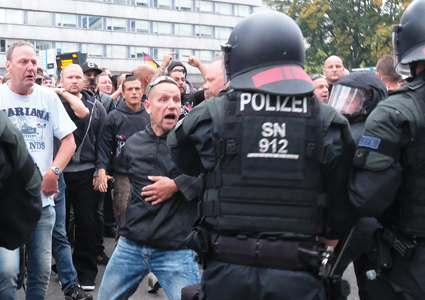
Far-Right protesters face riot police in Chemnitz the day after a man was stabbed to death in an incident with a Syrian and an Iraqi (©SEBASTIAN WILLNOW/AFP/Getty Images)
Recently, I sat in my hotel a few steps away from the Gedächtniskirche — West Berlin’s iconic “church of remembrance,” left in ruin at the end of World War II to remind Germans of the horror of their aggression — preparing for a meeting with Reiner Haseloff, minister president of the east German state of Saxony-Anhalt. The 64-year-old Haseloff is a member of Angela Merkel’s Christian Democratic Union (CDU). Like the Chancellor, Haseloff grew up on the country’s communist side, in the so-called German Democratic Republic. He, too, was trained as a scientist. Merkel holds a PhD in quantum chemistry; Haseloff’s doctorate is in physics.
I wanted to speak with Haseloff about the growing tensions between East and West Germans, three decades after the fall of the Berlin Wall; about the country’s shifting political landscape, about social cohesion and security, and Germany’s migration policies, the last being a subject where Haseloff and Merkel part ways. Haseloff has distanced himself from the Chancellor’s liberal migration policy; in 2015, Germany permitted some one million refugees from mostly Muslim majority countries to enter the country.
At the last minute my meeting with Haseloff was cancelled. The minister president was on his way to Köthen where a fight at a playground between two young Afghan men and a 22-year-old German man resulted in the German suffering a fatal heart attack. In Köthen, the mood was tense. Two weeks earlier, on August 26, violent protests had erupted in the east German city of Chemnitz where a 35-year-old German man was stabbed to death at a festival celebrating the city’s founding. A 22-year-old Iraqi and a 23-year-old Syrian were arrested for murder. If that were not enough, the same Sunday afternoon of the death in Köthen, September 9, a killing occurred in Neukölln, a Berlin neighbourhood where Turks and hipsters rub shoulder. In this case, a 36-year-old Lebanese-born man was shot to death, with five men fleeing the scene by car. Authorities suspect a clan dispute. Police estimate that 20 large families of foreign extraction in Berlin are involved in drug running, prostitution, and other organised crime. After Neukölln, Chemnitz, and Köthen a senior Berlin official said to me, with resignation, “People will have to accept some of this violence as the new normal.”
That’s a lot to swallow. And Germany’s confused public discussion about migrants, refugees and the rising Right makes none of this palatable, or easier to manage.
Start with Chemnitz. I’ve come here, my second visit in six months, to try to sort some of this out in my own mind. I started with the details of September’s disturbances. Chemnitz is an industrial town in the state of Saxony — to the south-east of Haseloff’s Saxony-Anhalt — which was called Karl-Marx-Stadt in communist times. Chemnitz and region are known for left-wing politics. The precursor to Germany’s Social Democratic Party was founded in nearby Leipzig in the 19th century; Chemnitz’s mayor today is an SPD politician, Barbara Ludwig. Today, though, Chemnitz has become reviled for its neo-Nazi scene, its reputation being further damaged by allegations that the population is swinging hard to the Right. This is in part due to the city’s recent social unrest.
Exactly what happened in Chemnitz after the fatal stabbing of the carpenter Daniel Hillig on August 26 remains a matter of dispute. First reports had it that the murder of Hillig — who had sought to mediate an argument of some sort — was followed by spontaneous protests staged by groups of right-wing radicals, facing off with small groups of left-wing counter-protesters, alongside much larger demonstrations of concerned citizens. Violence between extremists ensued, with social media suggesting that football hooligans and right-wing radicals were hunting down foreigners in the city.
Subsequently, local authorities determined that extremist violence on Left and Right was anything but spontaneous: the groups were well-networked, prepared and strategic. Neo-Nazi groups, which outnumbered their left-wing counterparts by two or three to one, had planned in advance to use larger groups of ordinary citizens in demonstrations as scenery to project images of large neofascist crowds. Such was the state of play as the dust began to settle.
But then came the strange intervention of Hans-Georg Maassen, head of Germany’s domestic intelligence agency. Maassen gave an interview to the mass circulation daily Bild in which he claimed there was no evidence of foreigners being “hunted” in Chemnitz and — without offering explanation — suggested that some manipulation and fabrication may have been at play. Maassen’s remarks provoked a mainstream media outcry and a rebuke from the Chancellor — yet praise from locals in Chemnitz who decry the image of their city as an out-of- control site for neo-Nazi terror. Maassen has now been removed from his job and reassigned to the post of deputy interior minister.
Indeed, much of the mainstream media have painted Chemnitz as having come under the spell of right-wing radicals, just as many national news outlets have broad-brushed eastern Germany for several years now — singling out the state of Saxony for special attention — as a hotbed of fascist ferment. Der Spiegel ran a story recently with the word Sachsen (Saxony) in brown letters. “It’s all outrageous,” says Antje Hermenau, a former Green Bundestag member from Leipzig who now lives in Dresden and who joined me for meetings in Chemnitz. I’ve heard the same indignation from a teacher, a businessman, a judge and a local reporter, three of the four — like Hermenau — women. Hermenau left the Greens several years ago over disagreement on how and whether to engage disaffected voters drifting to the Right. She is regarded throughout the region as a persistent advocate for dialogue and building bridges.
Andreas Bochmann, a dissident imprisoned during communist times and today, unlike Hermenau, still a member of the Green Party, tells me over lunch in Chemnitz that all people want is law and order and respect from newcomers. Chemnitz, population 247,000, has taken in 7,000 refugees. Bochmann talks about his daughter enduring cat-calls and insults walking in the city centre, and young men on street corners who turn hostile toward him when he fails to give them a cigarette. “Scheiss-Deutsche,” he claims to have heard.
Indeed, across Germany, not just in the east, one hears stories of young Muslim men behaving badly. A writer in Cologne told me this past summer of how her girlfriend witnessed a boy from North Africa punching a German girl in the face at a railway station. In Berlin, a vocational school teacher told me she felt obliged to take self-defence training. “Some of our young Muslim men only respect force,” she claimed, recounting an instance of male Syrian students attacking a couple of gay German boys in her school because the two kissed. These are vignettes, impressions, but fair or unfair they form a narrative that seems to have taken hold in many circles. Over dinner on my previous visit to Chemnitz, Andreas Bochmann was full of foreboding, arguing that a social explosion was coming.
Step back and there’s a bigger picture, and context for much of this. For some years now across much of the West voter ties to establishment parties have been weakening. Germany is no exception. And, as far as we know, there is no exception to the rule that nature abhors a vacuum.
Franz Josef Strauss, the legendary former leader of the conservative Christian Social Union (CSU), the Bavarian sister party of the Christian Democrats, used to say, “To the right of me is only the wall.” In other words, he would allow no room for right-wing antics outside his control: the CSU would absorb and endeavour to manage all the unsavoury temptations floating around in conservative circles.
Merkel might have considered the thought. Instead, she moved the CDU leftward over the past dozen years, on everything from nuclear energy to gay marriage to borders and refugees. She is the socially liberal daughter of a Protestant pastor, after all. Merkel is also a shrewd politician who understood for her first decade in power that votes were to be had in the centre. Times changed. The 2015 refugee crisis was a catalyst. A gaping hole opened on the Right.
I recall the conventional wisdom in Berlin before national elections a year ago that the right-wing protest party Alternative für Deutschland (AfD) would get into the Bundestag, with 7-8 per cent of the vote; and that Merkel’s Christian Democrats would end up with roughly 40 per cent. The CDU settled for a disappointing 33 per cent. With 20 per cent, the Social Democrats suffered their worst result since the end of World War II. And the upstart AfD did indeed enter the Bundestag — with 12.6 per cent of the electorate’s support. Half a dozen years after its founding AfD is now represented in 14 of Germany’s 16 state parliaments.
Recent polls have the CDU sagging further at 29 per cent, and the SPD neck and neck with the AfD at around 17 per cent. AfD keeps gaining sympathy and votes from Right and Left. I’m told in Chemnitz by an eclectic cross-section of people, “AfD is the only party which will listen to us.”
I’ve spent the better part of the last year travelling around Germany, including AfD stronghold Saxony, through cities and towns like Dresden and Leipzig, Meissen and Bautzen, Bischofswerda, Grimma, and Chemnitz. I’ve met with small-business owners and mayors, pastors and police, bookstore owners and bakers. One schoolteacher told me his vote for AfD was cast as a pure protest, so fed-up had he become with those sneering, condescending politicians in Berlin. A dentist in Dresden told me AfD won his support because he was anxious about Germany losing its culture to politically-correct multiculturalism. “But I’m not joining the party,” he added. “I don’t trust AfD’s leadership.”
There are unsavoury elements. Bernd Höcke is one. This hard-core ideologue leads the AfD in Thuringia, and flagrantly employs rhetoric reminiscent of the Nazis.
When we finally meet in October I want to ask Saxon-Anhalt’s minister president Haseloff to help me to sort all this further. He says right-wing extremism is not just an East German phenomenon. Case in point, Höcke, a Wessi who had been a secondary school teacher in the western state of Hessen before he entered politics.
I also want to ask Haseloff about the concerns of my Dresden dentist who is worried about AfD duplicity. AfD insists it’s a national conservative party, to the clear Right of the CDU yet operating within democratic boundaries. Rough around the edges, outright vulgar at times, this seems to be the case until now. In the Chemnitz unrest something new emerged, however: credible indications that elements of AfD had been cooperating and coordinating with neo-Nazi groups involved in attacks on counter-protesters and police.
Two dilemmas loom. First, the CDU must close off space on the Right. This means taking conservative positions on issues of family, faith, nation and borders. Yet to do so will be a non-starter for the Social Democrats, who in such a case would certainly withdraw from the grand coalition and end CDU rule.
Second, since Chemnitz there have been growing calls from the Social Democrats and the Greens to put the AfD under surveillance. This might be warranted in some instances. Yet it is hard to think of a better way to fire up the AfD base, already enraged that Berlin elites dismiss them as Germany’s “deplorables.” Fuel this feeling, and parts of the country will explode.
Recently, I sat in my hotel a few steps away from the Gedächtniskirche — West Berlin’s iconic “church of remembrance,” left in ruin at the end of World War II to remind Germans of the horror of their aggression — preparing for a meeting with Reiner Haseloff, minister president of the east German state of Saxony-Anhalt. The 64-year-old Haseloff is a member of Angela Merkel’s Christian Democratic Union (CDU). Like the Chancellor, Haseloff grew up on the country’s communist side, in the so-called German Democratic Republic. He, too, was trained as a scientist. Merkel holds a PhD in quantum chemistry; Haseloff’s doctorate is in physics.
I wanted to speak with Haseloff about the growing tensions between East and West Germans, three decades after the fall of the Berlin Wall; about the country’s shifting political landscape, about social cohesion and security, and Germany’s migration policies, the last being a subject where Haseloff and Merkel part ways. Haseloff has distanced himself from the Chancellor’s liberal migration policy; in 2015, Germany permitted some one million refugees from mostly Muslim majority countries to enter the country.
At the last minute my meeting with Haseloff was cancelled. The minister president was on his way to Köthen where a fight at a playground between two young Afghan men and a 22-year-old German man resulted in the German suffering a fatal heart attack. In Köthen, the mood was tense. Two weeks earlier, on August 26, violent protests had erupted in the east German city of Chemnitz where a 35-year-old German man was stabbed to death at a festival celebrating the city’s founding. A 22-year-old Iraqi and a 23-year-old Syrian were arrested for murder. If that were not enough, the same Sunday afternoon of the death in Köthen, September 9, a killing occurred in Neukölln, a Berlin neighbourhood where Turks and hipsters rub shoulder. In this case, a 36-year-old Lebanese-born man was shot to death, with five men fleeing the scene by car. Authorities suspect a clan dispute. Police estimate that 20 large families of foreign extraction in Berlin are involved in drug running, prostitution, and other organised crime. After Neukölln, Chemnitz, and Köthen a senior Berlin official said to me, with resignation, “People will have to accept some of this violence as the new normal.”
That’s a lot to swallow. And Germany’s confused public discussion about migrants, refugees and the rising Right makes none of this palatable, or easier to manage.
Start with Chemnitz. I’ve come here, my second visit in six months, to try to sort some of this out in my own mind. I started with the details of September’s disturbances. Chemnitz is an industrial town in the state of Saxony — to the south-east of Haseloff’s Saxony-Anhalt — which was called Karl-Marx-Stadt in communist times. Chemnitz and region are known for left-wing politics. The precursor to Germany’s Social Democratic Party was founded in nearby Leipzig in the 19th century; Chemnitz’s mayor today is an SPD politician, Barbara Ludwig. Today, though, Chemnitz has become reviled for its neo-Nazi scene, its reputation being further damaged by allegations that the population is swinging hard to the Right. This is in part due to the city’s recent social unrest.
Exactly what happened in Chemnitz after the fatal stabbing of the carpenter Daniel Hillig on August 26 remains a matter of dispute. First reports had it that the murder of Hillig — who had sought to mediate an argument of some sort — was followed by spontaneous protests staged by groups of right-wing radicals, facing off with small groups of left-wing counter-protesters, alongside much larger demonstrations of concerned citizens. Violence between extremists ensued, with social media suggesting that football hooligans and right-wing radicals were hunting down foreigners in the city.
Subsequently, local authorities determined that extremist violence on Left and Right was anything but spontaneous: the groups were well-networked, prepared and strategic. Neo-Nazi groups, which outnumbered their left-wing counterparts by two or three to one, had planned in advance to use larger groups of ordinary citizens in demonstrations as scenery to project images of large neofascist crowds. Such was the state of play as the dust began to settle.
But then came the strange intervention of Hans-Georg Maassen, head of Germany’s domestic intelligence agency. Maassen gave an interview to the mass circulation daily Bild in which he claimed there was no evidence of foreigners being “hunted” in Chemnitz and — without offering explanation — suggested that some manipulation and fabrication may have been at play. Maassen’s remarks provoked a mainstream media outcry and a rebuke from the Chancellor — yet praise from locals in Chemnitz who decry the image of their city as an out-of- control site for neo-Nazi terror. Maassen has now been removed from his job and reassigned to the post of deputy interior minister.
Indeed, much of the mainstream media have painted Chemnitz as having come under the spell of right-wing radicals, just as many national news outlets have broad-brushed eastern Germany for several years now — singling out the state of Saxony for special attention — as a hotbed of fascist ferment. Der Spiegel ran a story recently with the word Sachsen (Saxony) in brown letters. “It’s all outrageous,” says Antje Hermenau, a former Green Bundestag member from Leipzig who now lives in Dresden and who joined me for meetings in Chemnitz. I’ve heard the same indignation from a teacher, a businessman, a judge and a local reporter, three of the four — like Hermenau — women. Hermenau left the Greens several years ago over disagreement on how and whether to engage disaffected voters drifting to the Right. She is regarded throughout the region as a persistent advocate for dialogue and building bridges.
Andreas Bochmann, a dissident imprisoned during communist times and today, unlike Hermenau, still a member of the Green Party, tells me over lunch in Chemnitz that all people want is law and order and respect from newcomers. Chemnitz, population 247,000, has taken in 7,000 refugees. Bochmann talks about his daughter enduring cat-calls and insults walking in the city centre, and young men on street corners who turn hostile toward him when he fails to give them a cigarette. “Scheiss-Deutsche,” he claims to have heard.
Indeed, across Germany, not just in the east, one hears stories of young Muslim men behaving badly. A writer in Cologne told me this past summer of how her girlfriend witnessed a boy from North Africa punching a German girl in the face at a railway station. In Berlin, a vocational school teacher told me she felt obliged to take self-defence training. “Some of our young Muslim men only respect force,” she claimed, recounting an instance of male Syrian students attacking a couple of gay German boys in her school because the two kissed. These are vignettes, impressions, but fair or unfair they form a narrative that seems to have taken hold in many circles. Over dinner on my previous visit to Chemnitz, Andreas Bochmann was full of foreboding, arguing that a social explosion was coming.
Step back and there’s a bigger picture, and context for much of this. For some years now across much of the West voter ties to establishment parties have been weakening. Germany is no exception. And, as far as we know, there is no exception to the rule that nature abhors a vacuum.
Franz Josef Strauss, the legendary former leader of the conservative Christian Social Union (CSU), the Bavarian sister party of the Christian Democrats, used to say, “To the right of me is only the wall.” In other words, he would allow no room for right-wing antics outside his control: the CSU would absorb and endeavour to manage all the unsavoury temptations floating around in conservative circles.
Merkel might have considered the thought. Instead, she moved the CDU leftward over the past dozen years, on everything from nuclear energy to gay marriage to borders and refugees. She is the socially liberal daughter of a Protestant pastor, after all. Merkel is also a shrewd politician who understood for her first decade in power that votes were to be had in the centre. Times changed. The 2015 refugee crisis was a catalyst. A gaping hole opened on the Right.
I recall the conventional wisdom in Berlin before national elections a year ago that the right-wing protest party Alternative für Deutschland (AfD) would get into the Bundestag, with 7-8 per cent of the vote; and that Merkel’s Christian Democrats would end up with roughly 40 per cent. The CDU settled for a disappointing 33 per cent. With 20 per cent, the Social Democrats suffered their worst result since the end of World War II. And the upstart AfD did indeed enter the Bundestag — with 12.6 per cent of the electorate’s support. Half a dozen years after its founding AfD is now represented in 14 of Germany’s 16 state parliaments.
Recent polls have the CDU sagging further at 29 per cent, and the SPD neck and neck with the AfD at around 17 per cent. AfD keeps gaining sympathy and votes from Right and Left. I’m told in Chemnitz by an eclectic cross-section of people, “AfD is the only party which will listen to us.”
I’ve spent the better part of the last year travelling around Germany, including AfD stronghold Saxony, through cities and towns like Dresden and Leipzig, Meissen and Bautzen, Bischofswerda, Grimma, and Chemnitz. I’ve met with small-business owners and mayors, pastors and police, bookstore owners and bakers. One schoolteacher told me his vote for AfD was cast as a pure protest, so fed-up had he become with those sneering, condescending politicians in Berlin. A dentist in Dresden told me AfD won his support because he was anxious about Germany losing its culture to politically-correct multiculturalism. “But I’m not joining the party,” he added. “I don’t trust AfD’s leadership.”
There are unsavoury elements. Bernd Höcke is one. This hard-core ideologue leads the AfD in Thuringia, and flagrantly employs rhetoric reminiscent of the Nazis.
When we finally meet in October I want to ask Saxon-Anhalt’s minister president Haseloff to help me to sort all this further. He says right-wing extremism is not just an East German phenomenon. Case in point, Höcke, a Wessi who had been a secondary school teacher in the western state of Hessen before he entered politics.
I also want to ask Haseloff about the concerns of my Dresden dentist who is worried about AfD duplicity. AfD insists it’s a national conservative party, to the clear Right of the CDU yet operating within democratic boundaries. Rough around the edges, outright vulgar at times, this seems to be the case until now. In the Chemnitz unrest something new emerged, however: credible indications that elements of AfD had been cooperating and coordinating with neo-Nazi groups involved in attacks on counter-protesters and police.
Two dilemmas loom. First, the CDU must close off space on the Right. This means taking conservative positions on issues of family, faith, nation and borders. Yet to do so will be a non-starter for the Social Democrats, who in such a case would certainly withdraw from the grand coalition and end CDU rule.
Second, since Chemnitz there have been growing calls from the Social Democrats and the Greens to put the AfD under surveillance. This might be warranted in some instances. Yet it is hard to think of a better way to fire up the AfD base, already enraged that Berlin elites dismiss them as Germany’s “deplorables.” Fuel this feeling, and parts of the country will explode.