


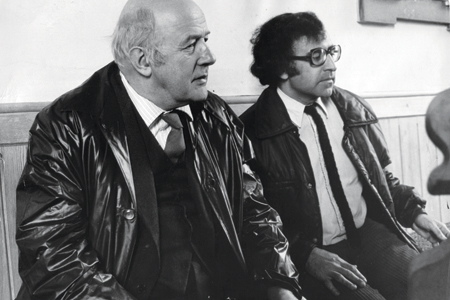
Betjeman with the author of this piece, Edward Mirzoeff (right), in 1974 during the filming of “A Passion for Churches” in Felbrigg Church, Norfolk (photo: Archant Norfolk)
"Laureate Productions" was the name we gave to the Independent Television Production Company that we dreamed of setting up in the mid-1970s, an idea that turned out to be about 20 years ahead of its time.
"We" in this case meant three of us: the Poet Laureate, Sir John Betjeman, a wonderfully funny and sensitive film editor called Ted Roberts, and me. We had made a few films together for the BBC, and fantasised about creating many more without the interference of talentless executives — "Brigstockes", John called them. We would sell our works of art to the BBC, or to the highest bidder, and make our fortunes. It never came to pass, of course.
Betjeman was a man of many parts — journalist, critic, poet, performer, dramatist even, architectural expert, railway enthusiast, conservationist. He had a passion for churches, and for the Church of England. And there were private passions too. But I want to concentrate here on Betjeman and broadcasting, specifically my experience of making half a dozen television documentaries with him in the late 1960s and 1970s, and the light it cast on the character and personality of our hero.
We first met in 1968 when the BBC, most unusually awash with cash from colour TV licences, decided to hire a helicopter for three years. The original "Brigstocke", a boss-man called Aubrey Singer, thought it would be in demand for every hour of every day by every BBC department. When it turned out that nobody had much interest in a chopper, he came up with Plan B — a 13-part documentary series, to be filmed, over three years, entirely from a helicopter — Bird's-Eye View.
A gaggle of potential writers convened at our then offices, Kensington House, which Betjeman always called "The Palace of Arts". (It's now an hotel — you could book my old office, Room 2066.) He was the most distinguished of the group, but he seemed affable and approachable, and I enjoyed talking to him. He was prepared to risk a flight in the whirly-bird to see if it inspired him.
So one day we collected him at Oxford station and drove to Kidlington Airport, where the Alouette 3 helicopter was based. It was a misty, rather gloomy day, and things went wrong from the start. The radio intercom wouldn't work, so we couldn't talk. The Polish pilot seemed to have some difficulty in working out where we were, dropping down out of the sky to read road signs. And it was bumpy. "Oh, I am enjoying myself," Betjeman shouted, meaning that he was not. Then after a while, he pulled out his cheque-book and wrote on the back "Please can we go home now." It was not an auspicious beginning, only slightly alleviated by brandies at Oxford station buffet to calm his nerves.
Like this article? Share, save or print using the icons below:


More Text
- Salerno Diary
- Saved From The Bonfire: The Tom Wolfe Papers
- Liberty And Sovereignty
- Art And Public Culture In The 1830s And Today
- The Casanova Of LaSalle Street
- The Writer
- New Poetry
- Cartagena Poems
- A British Subject
- Kizerman and Feigenbaum
- Communism’s Comeback?
- Irving Kristol on Jews and Judaism
- The State of Charity
- Teeth
- La Buena Muerte
- Judaeophobia
- Cool It
- Rachmones
- From 'Russia'
- 'Going Out' and Five Other Poems
Popular Standpoint topics

2:03 PM
5:02 PM
10:01 AM