


Yet things are more complex, not to say confused. Just when we think we have got Jiang’s number, as some exotic species of nature-worshipping romantic patriot with fascistic frills, we learn from interviews he has given that he is a democrat who has been jailed for his liberal beliefs. In one such interview, he invokes the lessons of Nazi history: China without democracy, he says, would be in danger of becoming like Germany in the 1930s.
A comforting view — were it not that in 1930s Germany there was a democracy of sorts, and it elected the Führer, not least because the Germans were persuaded that foreigners had done them down, and because of his racist attacks on Jews. And like Jiang, with his mystical descriptions of nature red in tooth and claw, the Nazis were big on life in the wild too.
A difficulty about criticising Jiang (and resurgent nationalism in general) is that there is truth in what he says about China being too enfeebled in the 19th-century to stand up to Europe’s buccaneering spirit. “No fightee, my coward John Chinaman” jeered Punch magazine in 1858 at a time when we were imposing the Treaty of Tianjin on a prostrate China. Jiang’s critique of his gutless countrymen reminds me of the 19th century Chinese commander obliged to explain yet another defeat to his emperor at the hands of the barbarians, who decided to take the high ground. Imagine China as an exquisite piece of porcelain, he wrote in a fancy memorial to the Throne. Now think of the foreign invaders as a rough stone…
But that was then. Although the Chinese indeed displayed herd-like instincts in totalitarian times, Mao and his legions of Party faithful, who slaughtered some 70 million of their flock, can hardly be described as lacking wolfish appetites. And having myself encountered plenty of heartfelt racial hostility during the Cultural Revolution, I recall how easily the sheep could turn wolfish when spurred on by chauvinist propaganda. Nor was China under Mao quiescent internationally: the Korean War, fomenting revolution in Indonesia or Malaya, the border war with India, the near-war she provoked with Russia on the Ussuri river in 1969, or her later incursion into Vietnam are examples.


- The US Can Still Help Save Syria — and Iraq
- Russian Resurgence has Blindsided Nato
- On Europe, Nothing Less than Treaty Change will do
- Putin has his Useful Idiots on the Left and the Right
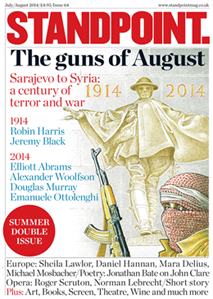
- Sarajevo: Where the Century of Terror Began
- Allen Lane’s Pelicans Take Wing Once More
- How Not to Remember the First World War
- Opera is Not Just Our Most Expensive Noise
- Jonathan Miller: One Man, Two Cultures
- Without a Big Idea, Cameron Will Lose
- A Christian Country? No, a Conservative One
- How to Get School Competition Right
- The War on the Firmest Bulwark of our Liberty
- How Modern Liberals Created Nigel Farage
- Caught in the Trap of His Own Metaphysics
- In Search of My Father, Agent of the Comintern
- Geoffrey Hill and the poetry of ideas
- Master of the Glories of the English Country Garden
- Independence Will Do Nothing for Scots
- Bullying and Bluff on the Road to Referendum

3:08 AM