


Only in March 1950 did he again attempt his mission, this time in camouflage and accompanied by a secret guide. After holing up in a safe house on a farm owned by the anti-communist Tous family, Dvoracek travelled to Prague, again seeking Vaclavik. The person he found, however, was Militka, whom he hadn't seen in over a year. She was by now enrolled at Charles University, living in the Kolonka residence hall, which doubled as a salon for budding socialist intellectuals. Though Militka wasn't a party member herself, her current boyfriend, a student named Miroslav Dlask, was. The two had met at a student work camp where Dlask, the son of an Auschwitz survivor, impressed Militka with his prophesies of how social democracy would fuse seamlessly with communism and usher in a new age of humanism.
Someone who shared Dlask's views, albeit with a greater degree of self-criticism, was an extraordinarily gifted film student named Milan Kundera, who was already known among the leftist intelligentsia in Prague as a café-haunting prodigy, ever questioning and heterodox in Marxism. He had joined the party in his youth, writing poems and songs about proletarian revolution that have justly been forgotten. But like his future character Sabina in The Unbearable Lightness of Being he loathed May Day parades. "He was a reserved sort of person and had no liking for stupid mass rallies," his friend Milan Uhde told Adam Hradelik (the researcher whose sleuthing later uncovered the whole affair). "I tended to think of him as someone with courage who wasn't afraid to express inconvenient opinions." So when Dvoracek found Militka again, it's safe to say she was keeping dangerous company. "I was immensely pleased to see him," she recounted. "I didn't give it much thought. I asked Miroslav how Juppa was and then he walked me back to the hall of residence. He asked me if he could leave his case there for a couple of hours. He told me he had some things to sort out in Prague and he'd come back for it in the afternoon."
Dvoracek never found his chemical engineer. When he returned to Kolonka later in the evening to retrieve his briefcase - which, by the way, contained nothing incriminating - two armed policemen were waiting for him. He was arrested, interrogated and probably tortured. According to security archives, Dvoracek probably refused at first to give up the identities of his associates in Czechoslovakia, including the keepers of the safe house. He also protected Militka and her family. In September 1950, Dvoracek was convicted of desertion, espionage and high treason. He received a sentence of 22 years' hard labour, a 10,000 crown fine, the forfeiture of all his property and the suspension of his civic rights for a decade. Meanwhile, whether because Dvoracek ultimately did confess, or because the secret police had obtained further evidence independently, the Touses were arrested. Josef Tous, the youngest, received 10 years' imprisonment, others 20 years. One guide on the farm that had sheltered Dvoracek was executed. Between 1952 and 1963, Dvoracek was confined to a small, unheated concrete cell. He mined uranium, took part in a famous hunger strike and was several times penalised for violating camp regulations, such as "inciting" slogans, reading an English detective novel and studying the English language.
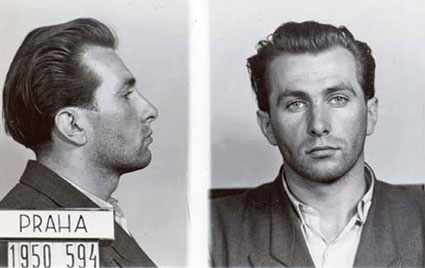
Miroslav Dvoracek, the spy who was imprisoned for 14 years after allegedly being betrayed to the Czechoslovak police (Getty)


Post your comment
- Admit It, Mr Kerry: You Blundered
- Bismarck Versus Blair — A Foreign Policy Crossroads
- Arab Spring, Islamist Summer — What Next?
- The Diplomat the Whole World Ignores
- The Blob Has Run Schools For Decades. Not Any More
- Would You Intervene — Or Pass On The Other Side?
- He Died That Others Might Live In Peace
- The Hero's Journey is Hollywood's McMyth
- Online Only: Countering the Counter-Jihadists
- Online Only: The Price Paid for Criticising Islam
- 'Please Sir, I Just Want to Learn More'
- Why Students Should Be Glad To Pay Tuition Fees
- A 'Liberal Racist'? Me? I Felt Like a Heretic
- Demolish the Relics of Yesterday's Future
- Was Britain Right To Go To War In 1914?
- German Victorians Who Helped Transform Britain
- The Alternative History of an Undivided India
- Online Only: Heirs to the Left
- ONLINE ONLY: The Hayward Gallery's Fashionable Primitives
- ONLINE ONLY: A Spiritual Corner of Southwark

- The Zombie Argument that Refuses to Die
- Online Only: The Price Paid for Criticising Islam
- Overrated: Dan Brown
- Overrated: George Monbiot
- Is the Brain the Key to Understanding Religion?
- 'Please Sir, I Just Want to Learn More'
- An Assault on Free Speech at the LSE
- The Alternative History of an Undivided India
- The Zombie Argument that Refuses to Die
- Online Only: The Price Paid for Criticising Islam
- Overrated: Dan Brown
- Overrated: George Monbiot
- Is the Brain the Key to Understanding Religion?
- 'Please Sir, I Just Want to Learn More'
- An Assault on Free Speech at the LSE
- The Alternative History of an Undivided India
- Decline and Fall of the History Men
- Uncritical Theorists Who Misread the Nazis
- The Zombie Argument that Refuses to Die
- The Banality of Hannah Arendt
- From Kitsch to Cool: Picasso and Modern Art
- Is the Brain the Key to Understanding Religion?
- Time to Wise Up to the Muslim Brotherhood
- Midfield Virtuoso Finds His Perfect Pitch