


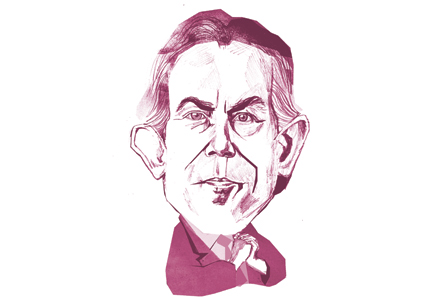
There was a time — around the turn of the millennium — when Tony Blair could do no wrong. There were, to be sure, holdouts on the Right against "Phoney Tony", and on the Left against the man who had taken on the unions and was seen as too close to the rich. By and large, however, the country welcomed the more inclusive, confident and outward-looking vision that New Labour offered. Above all, Blair bestrode the world with an authority not enjoyed by any British prime minister since the Second World War, perhaps including even Margaret Thatcher.
Since then, the nimbus has evaporated, not least because of the economic crisis, the controversy over immigration, and the general sense that the New Labour project has unravelled. In no sphere, however, has the collapse been as precipitate as in foreign policy, where Blair's legacy is widely regarded as having been a stooge of the US whose utopian design to remake the Middle East came disastrously unstuck when confronted with reality. The pro-Islamist Respect MP George Galloway claims to be making a film entitled The Killing of Tony Blair, as part of a campaign to have the former PM tried for war crimes in an international court (thought not President Assad for massacring his own people). The recent refusal of Parliament to support intervention in Syria to punish the Assad regime's use of chemical weapons against civilians has been celebrated as the moment when Britain emancipated itself from the US, and secured "payback" for the "lies" it was told over Iraq.
Some of these criticisms are justified. The then Prime Minister did not consciously mislead the country, but he was wrong to believe that Saddam Hussein had retained his chemical weapons programme. Like many interventionists, including this author, he was too confident that the post-invasion vacuum could be quickly filled with the democratic structures the region so desperately needs.
The pendulum has swung far too far the other way, however. Blair's legacy in foreign affairs may be complex but it is largely positive. More than anybody else, he showed that the defence of human rights and the promotion of democracy internationally was in Britain's national interest, because the failure to do so both emboldened aggressors and allowed terrorist elements to nestle in failed or repressive states. This was a profound departure from the previous "realist" consensus, which took a much narrower view of what constituted British interests, and tended to see in Middle Eastern dictatorships a safeguard against the radicalism of their populations. In his famous Chicago speech of 1999, Blair formally set out these principles, which became known as the "doctrine of the international community".


9:10 AM
2:10 AM