



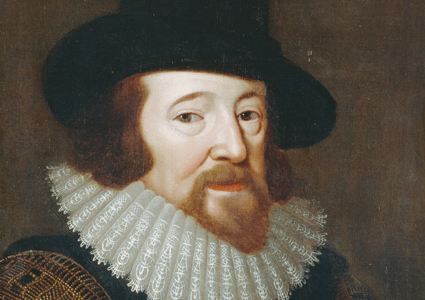
 Francis Bacon: Pioneer of a fact-based culture
 “We may therefore acquiesce in the pleasing conclusion that every age of the world has increased, and still increases, the real wealth, the happiness, the knowledge, and perhaps the virtue, of the human race.” These words were written by Edward Gibbon in 1781 at the end of his account of the fall of the Roman empire in the West. The claim seems obviously false when one thinks of the history of Europe over the five centuries after the fall of Rome; more plausible if one thinks of the history of Europe and the world over the two centuries from the French Revolution to the fall of Communism, the two centuries that followed the publication of Gibbon’s Decline and Fall. In 1781 the Watt steam engine was newly invented, but the industrial revolution was still unimaginable, let alone all the technological revolutions that have followed from it. Somehow, a belief in progress took root when real progress — scientific and technical progress — was still in its infancy. But perhaps that was how it had to be — perhaps it was the belief in progress that made progress possible.
For the past quarter century Joel Mokyr has been trying to explain how Western Europe became the first society to make rapid, continuous technological (and with it economic) progress. He writes as an economic historian, but his is a new economic history in which cultural factors are every bit as important as prices and profits. This book presents the latest version of his account of the triumph of the West, or (to give it its politically correct name) the great divergence.
It falls into three parts. The first five chapters present cultural history in Darwinian terms. The last two address the Needham question: why was there no industrial revolution in China, which for centuries had a more advanced technology than western Europe? Darwinism is very popular in the humanities at the moment, but as Mokyr grasps there is a fundamental difference between the natural selection of random mutations and the social selection of cultural variations — cultural choices are made deliberately, even if the consequences of those choices are rarely foreseeable. Darwinian language hardly helps to explain cultural change. Equally unhelpful is the application of economic metaphors: to describe Jesus, Machiavelli and Newton as “cultural entrepreneurs” creates a false equivalence between fundamentally different types of activity. It would be more helpful to think about the ways in which market societies turn cultural activities into economic enterprises — Erasmus was the first living author to become a bestseller, Hume the first philosopher to acquire wealth by writing.
But let’s skip past the opening chapters to the core of the argument. Mokyr’s claim is that the West was uniquely placed to enter on an extended period of scientific, technological and industrial progress because of three factors: a respect for useful knowledge (Bacon being the “cultural entrepreneur” who was most important in inculcating this outlook); the division of Western Europe into competing states, each of which had to try to improve on its competitors and no one of which was capable of imposing a stultifying intellectual conformity; and lastly, the emergence in the late 17th century of a transnational “republic of letters” through which intellectuals exchanged information and co-operated to advance useful knowledge. These three factors made the industrial revolution possible. They are the cause of the great divergence.
Like this article? Share, save or print using the icons below:


- Cyril Ramaphosa's poisoned chalice
- Is South Africa about to fall apart?
- The onslaught against the West's moral codes
- The inevitability of Fortress Europe
- Technology menaces childhood and culture
- Presidents for life Putin and Xi menace the West
- Is the mental illness epidemic just a myth?
- How Monet created motion pictures
4:12 PM
5:12 PM
4:12 PM
6:12 PM
7:12 PM
7:12 AM
4:12 AM
4:12 PM
9:12 AM