


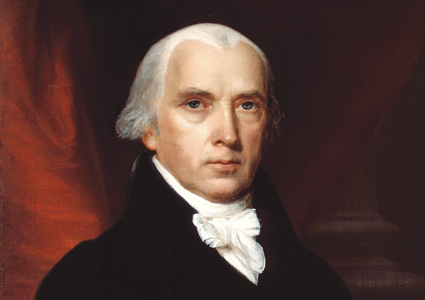
 James Madison: He understood that civic freedom begins with religious freedom
In what seems a curious way to begin a book advancing a more "principled" and "morally defensible" approach to religion in public life, the Chicago philosopher and legal scholar Brian Leiter makes little effort to conceal his contempt for people of faith. It was, he confesses, "the pernicious influence of reactionary Christians" — a charge never explained or defended — that prompted his inquiry.
The result, Why Tolerate Religion?, is a slim polemic that would unleash its own version of religious zealotry: a brooding, merciless, and militant secularism.
The core argument of Leiter's book is that religion must be stripped of its privileged status in the American constitutional order. Religious belief, he writes, deserves no special legal treatment or accommodation because it possesses no greater moral or social currency than any other claims of conscience. Quite the opposite: unlike secular appeals to conscience, religious convictions are hopelessly irrational and prone to dangerous and undemocratic behaviors:
There is no apparent moral reason why states should carve out special protections that encourage individuals to structure their lives around categorical demands that are insulated from the standards of evidence and reasoning we everywhere else expect to constitute constraints on judgment and action.
The author seems astonishingly unaware of the Judaeo-Christian intellectual tradition and its contribution to the foundations of liberal democracy. The scientific revolution, the concept of human dignity, an ethos of compassion for the poor, the political ideals of equal rights and government by consent — all of these developments are unthinkable without the influence of the Judaeo-Christian tradition in the West.


