


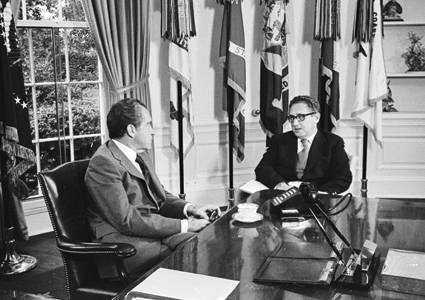
 Winning the Cold War: Nixon and Kissinger in October 1973
Henry Kissinger is a unique phenomenon in American history. Still alive and active in his early nineties, he was born in 1923 and was ten when Hitler came to power, 15 when his Jewish parents brought him to New York. Unlike his younger brother, he never lost his German accent, though from 18 he did his thinking, especially on important matters, in English. Aged 19 he was drafted into the US Army, where he became an expert in de-Nazification. Eligible for the GI Bill of Rights, he applied in 1947, late, to New York University, Princeton, Columbia, Cornell and Pennsylvania. All turned him down, flat. Harvard alone not only accepted him but awarded him a scholarship. Thereafter he became a Harvard star, though he had to struggle ferociously for tenure and professional status.
Kissinger was basically a historian, though his studies encompassed philosophy and government, among many other things. His work was characterised by intense industry, pellucid intelligence, imagination and inventiveness, and, not least, sardonic humour. His thesis was a remarkable study of the early-19th-century Congress of Vienna, published as A World Restored, in which Castlereagh emerged as the hero. But this was quickly followed by essays, articles and reviews, published in Foreign Affairs and other specialist journals, on foreign and military policy. Kissinger was among the first to tackle the risky subject of the use of nuclear weapons, strategic and tactical, in the conduct of foreign affairs, and his treatment aroused passion and interest in book form, selling tens of thousands of copies. Almost inevitably, he was drawn into politics, first as advisor to the Republican presidential contender Nelson Rockefeller, then in the early ’60s to the Kennedy Administration, and finally in the ’70s under Nixon, as National Security Advisor and Secretary of State, the first foreign-born citizen to rise to this eminence.
Niall Ferguson, himself something of a Harvard star, has chosen to tackle this topic on the grandest possible scale. This volume takes us only up to 1968, when Kissinger was 45 and not yet ensconced in his Washington fortress. But it is a thousand pages. I groaned when I felt its weight in my hands. But my resistance soon turned to admiration. Ferguson is not afraid to put in the background to all the key phases through which he carries his hero: the New York public school system, wartime army intelligence, Harvard in the late ’40s, the last years of Stalin, the various Berlin crises, the Korean War, the impact of Khrushchev’s adventurism, the Cuban Missile Crisis and the origin of American involvement in Vietnam. On all these matters I acquired valuable knowledge, elegantly conveyed. Although Kissinger’s combination of intelligence and perception made him an ideal participant in the formation of policy at the highest level, he had to learn the hard way the diabolical arts of Washington political necromancy. His first spell in government, under Kennedy, was an almost total failure. Kennedy’s National Security Advisor McGeorge Bundy, for reasons known best to himself — the author hints at jealousy — kept him away from all levels of power. But Kissinger learned from his mistakes and did not repeat them.
Like this article? Share, save or print using the icons below:


1:09 PM
1:09 PM
2:08 PM