


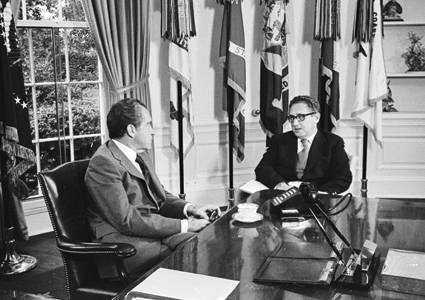
 Winning the Cold War: Nixon and Kissinger in October 1973
Henry Kissinger is a unique phenomenon in American history. Still alive and active in his early nineties, he was born in 1923 and was ten when Hitler came to power, 15 when his Jewish parents brought him to New York. Unlike his younger brother, he never lost his German accent, though from 18 he did his thinking, especially on important matters, in English. Aged 19 he was drafted into the US Army, where he became an expert in de-Nazification. Eligible for the GI Bill of Rights, he applied in 1947, late, to New York University, Princeton, Columbia, Cornell and Pennsylvania. All turned him down, flat. Harvard alone not only accepted him but awarded him a scholarship. Thereafter he became a Harvard star, though he had to struggle ferociously for tenure and professional status.
Kissinger was basically a historian, though his studies encompassed philosophy and government, among many other things. His work was characterised by intense industry, pellucid intelligence, imagination and inventiveness, and, not least, sardonic humour. His thesis was a remarkable study of the early-19th-century Congress of Vienna, published as A World Restored, in which Castlereagh emerged as the hero. But this was quickly followed by essays, articles and reviews, published in Foreign Affairs and other specialist journals, on foreign and military policy. Kissinger was among the first to tackle the risky subject of the use of nuclear weapons, strategic and tactical, in the conduct of foreign affairs, and his treatment aroused passion and interest in book form, selling tens of thousands of copies. Almost inevitably, he was drawn into politics, first as advisor to the Republican presidential contender Nelson Rockefeller, then in the early ’60s to the Kennedy Administration, and finally in the ’70s under Nixon, as National Security Advisor and Secretary of State, the first foreign-born citizen to rise to this eminence.
Niall Ferguson, himself something of a Harvard star, has chosen to tackle this topic on the grandest possible scale. This volume takes us only up to 1968, when Kissinger was 45 and not yet ensconced in his Washington fortress. But it is a thousand pages. I groaned when I felt its weight in my hands. But my resistance soon turned to admiration. Ferguson is not afraid to put in the background to all the key phases through which he carries his hero: the New York public school system, wartime army intelligence, Harvard in the late ’40s, the last years of Stalin, the various Berlin crises, the Korean War, the impact of Khrushchev’s adventurism, the Cuban Missile Crisis and the origin of American involvement in Vietnam. On all these matters I acquired valuable knowledge, elegantly conveyed. Although Kissinger’s combination of intelligence and perception made him an ideal participant in the formation of policy at the highest level, he had to learn the hard way the diabolical arts of Washington political necromancy. His first spell in government, under Kennedy, was an almost total failure. Kennedy’s National Security Advisor McGeorge Bundy, for reasons known best to himself — the author hints at jealousy — kept him away from all levels of power. But Kissinger learned from his mistakes and did not repeat them.
In due course he became a towering figure of a stature no other American of his time achieved without running for office. Just in his Washington years he appeared 15 times of the cover of Time. In 1973 he appeared fourth in Gallup’s “Most Admired Man in America” Index. The following year he was Number One.
His approved rating was 85 per cent, unique for a non-elected American. He was also hated to a unique degree. Rumours abounded that he was a Soviet spy, a British agent, a diabolist, a secret emissary for the Vatican, the Quai d’Orsay, the Israeli intelligence service and the Chinese. At one time or another Kissinger emerged as any (and all) of the horror figures from the Elders of Zion, and he figured constantly in the anti-Semitic cartoons and comic strips of the Soviet and Arab worlds. His physiognomy lent itself to caricature, and no one seized on the possibilities more eagerly than the brilliant but ruthless David Levine. He did Kissinger a score of times, mostly for the New York Review of Books. Two the Review refused to print: one showing Kissinger naked, covered in sinister tattoos, the other ravishing a nude maiden with a global head. This last eventually appeared in the Nation. He figured in a number of pop songs, some unpublishable because of their obscenity, and in a variety of world famous cartoons and comic strips, such as The Simpsons, Lil’ Abner, Superman and even Blondie. He was also made the anti-hero in The Adventures of Superkraut, and was accused of trying to solve the world’s population explosion by masterminding the spread of Aids.
Kissinger never minded the attacks, calculating they cancelled each other out. Over the quarter century of his greatest prominence he featured in more prime-time TV interviews than any other American, apart from the presidents. That was the kind of popularity he valued since it made it more likely he could get things done. He liked to quote a saying of Benjamin Jowett, the Master of Balliol College, Oxford: “You are more likely to achieve things if you don’t care who gets the credit for them.” It is a thousand pities that he was not called to Washington in a senior capacity during the Johnson Administration: if so, the real catastrophe of Vietnam might have been averted, by never happening in the first place. As he often remarked, what matters most in world affairs are the things that don’t go wrong, because they are avoided. It is a miracle that the Cold War, which lasted for 45 years and was fought with great intensity, never became an open conflict which would have destroyed the world.
Kissinger played a part in winning the Cold War for America second only to President Reagan, but mainly behind the scenes. Yet his open record is pretty impressive. He negotiated the first Strategic Arms Limitation Treaty and the Anti-Ballistic Missile Treaty, both with the Soviets.. He was a key figure in the Nuclear Arms Non-Proliferation Treaty, the Convention banning biological weapons and the Helsinki Final Act. He negotiated the end of the Yom Kippur War and prepared the way to the Camp David Accords between Israel and Egypt. Kissinger opened up diplomacy between America and China and was the intellectual driving force behind the process which brought China into the international community.
His approved rating was 85 per cent, unique for a non-elected American. He was also hated to a unique degree. Rumours abounded that he was a Soviet spy, a British agent, a diabolist, a secret emissary for the Vatican, the Quai d’Orsay, the Israeli intelligence service and the Chinese. At one time or another Kissinger emerged as any (and all) of the horror figures from the Elders of Zion, and he figured constantly in the anti-Semitic cartoons and comic strips of the Soviet and Arab worlds. His physiognomy lent itself to caricature, and no one seized on the possibilities more eagerly than the brilliant but ruthless David Levine. He did Kissinger a score of times, mostly for the New York Review of Books. Two the Review refused to print: one showing Kissinger naked, covered in sinister tattoos, the other ravishing a nude maiden with a global head. This last eventually appeared in the Nation. He figured in a number of pop songs, some unpublishable because of their obscenity, and in a variety of world famous cartoons and comic strips, such as The Simpsons, Lil’ Abner, Superman and even Blondie. He was also made the anti-hero in The Adventures of Superkraut, and was accused of trying to solve the world’s population explosion by masterminding the spread of Aids.
Kissinger never minded the attacks, calculating they cancelled each other out. Over the quarter century of his greatest prominence he featured in more prime-time TV interviews than any other American, apart from the presidents. That was the kind of popularity he valued since it made it more likely he could get things done. He liked to quote a saying of Benjamin Jowett, the Master of Balliol College, Oxford: “You are more likely to achieve things if you don’t care who gets the credit for them.” It is a thousand pities that he was not called to Washington in a senior capacity during the Johnson Administration: if so, the real catastrophe of Vietnam might have been averted, by never happening in the first place. As he often remarked, what matters most in world affairs are the things that don’t go wrong, because they are avoided. It is a miracle that the Cold War, which lasted for 45 years and was fought with great intensity, never became an open conflict which would have destroyed the world.
Kissinger played a part in winning the Cold War for America second only to President Reagan, but mainly behind the scenes. Yet his open record is pretty impressive. He negotiated the first Strategic Arms Limitation Treaty and the Anti-Ballistic Missile Treaty, both with the Soviets.. He was a key figure in the Nuclear Arms Non-Proliferation Treaty, the Convention banning biological weapons and the Helsinki Final Act. He negotiated the end of the Yom Kippur War and prepared the way to the Camp David Accords between Israel and Egypt. Kissinger opened up diplomacy between America and China and was the intellectual driving force behind the process which brought China into the international community.
What is remarkable is that Kissinger did all this, and yet remained likeable. His humour, always close to the surface, occasionally bubbled over it: “To be absolutely certain about something, one must know everything or nothing about it.” “The history of things which didn’t happen has never been longer.” “Power is the great aphrodisiac.” I met Kissinger only occasionally but what I liked about him was that, at these meetings, however brief, he always told me something I didn’t know, and was well worth knowing. No other public figure I met had to the same degree this pleasing characteristic. And always, one felt, his ultimate aspirations were on higher things. He was often compared to Machiavelli. Few characters in history he despised more. He wrote extensively on Metternich and Bismarck, making it clear he had a low opinion of both. The man he most admired and tried to follow was Kant. At heart and in his inmost thoughts, Kissinger was an idealist, working for the perpetual peace of which Kant wrote, using the imperfect means of an imperfect world. He enjoyed — still enjoys — life, and sees its funny side, especially the way in which his power brought him access to women. In short, behind the colossal intellect, the huge output of ideas, and the prodigies of diplomacy and theorising, Doctor Kissinger was fun to know. I liked him and valued him and am glad Niall Ferguson is giving him the meticulous scrutiny he deserves.
Like this article? Share, save or print using the icons below:


1:09 PM
1:09 PM
2:08 PM