



Despite his love for the game, Reshevsky managed to abandon it throughout his somewhat delayed formal education. As an adult he became the Western world's strongest chess grandmaster, but sadly, his earning powers as a mature human being were nothing compared to what he had made for his family as a prodigy. In the 1940s he decided that he could not provide properly for his own wife and children — this was not the Soviet Union, where grandmasters were paid salaries by the state — and so he declared that he was abandoning the game for good in order to pursue a career as a Certified Public Accountant. He noted that "I found the CPA examinations far more difficult than most of the chess games I've played."
It was only through private sponsorships that Reshevsky could be persuaded to take part in the 1948 tournament to decide the world chess championship. He came third, and it was Mikhail Botvinnik who won, to become the first Soviet world champion. In 1955 Reshevsky gained a small measure of revenge, beating Botvinnik over four games in a remarkable Cold War match between the Soviet Union and the United States.
Perhaps that was the high point of his career. In 1958 his star was utterly eclipsed when the 15-year-old Bobby Fischer won the US championship — ahead of Reshevsky. Now it was Fischer's turn for coast-to-coast mass media attention; and unlike Reshevsky, he was able — although not until 1972 — to wrest the world title from the apparently invincible Soviet school of chess.
Not surprisingly, there had been considerable commercial interest in a match between Fischer and Reshevsky, and one was finally arranged in 1961. Although scheduled for 16 games, after 11 of them, with the score tied at 5.5 points each, Fischer walked out, leaving Reshevsky the unsatisfied victor by default. In a rare interview to mark his 80th birthday, Reshevsky claimed that he had "broken Fischer's confidence". That might be true. Fischer's refusal to put his world title on the line after 1972, and his subsequent abandonment of the game, suggested that he lacked the psychological self-assurance which his extraordinary natural talent should have guaranteed.
Puzzle: Reshevsky found the great Danish player Bent Larsen a real handful. But in this position, from a game in 1971, he finished him off with élan. Can you see how Reshevsky (White) to play, forced immediate resignation?
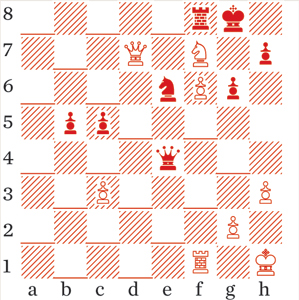
Solution: Reshevsky played 37.Ng5!! If 37...Nxg5 then 38.Qg7 mate; but if Larsen moves his Queen from the Knight’s attack, then his own Knight on e6 falls, and with it all possible defence to mate.


Post your comment

- The Loss Of Faith Made Music Mute
- The Great Betrayal: How Liberals Appease Islam
- Political Correctness Is Devouring Itself
- The New Language Of Political Narcissism
- Why The World Still Loves Shakespeare
- Don’t Listen to Britain’s Designer Demagogues
- An English parliament: the only way to save the UK
- Death By Clickbait
- The Loss Of Faith Made Music Mute
- The Great Betrayal: How Liberals Appease Islam
- Political Correctness Is Devouring Itself
- The New Language Of Political Narcissism
- Why The World Still Loves Shakespeare
- Don’t Listen to Britain’s Designer Demagogues
- An English parliament: the only way to save the UK
- Death By Clickbait
- The Loss Of Faith Made Music Mute
- The Great Betrayal: How Liberals Appease Islam
- Why The World Still Loves Shakespeare
- Political Correctness Is Devouring Itself
- Who Will Lead The Berlin Band?
- Putin and the Art of Political Fantasy
- The New Language Of Political Narcissism
- Inside The World Of 'Non-Violent' Islamism