



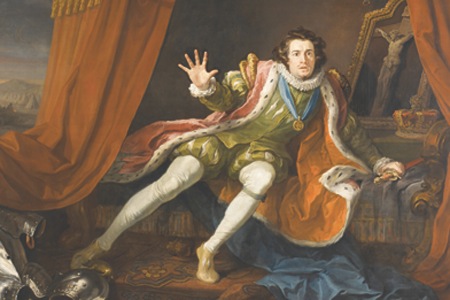
"David Garrick as Richard III" (1745) by William Hogarth
Samuel Johnson knew why Shakespeare's plays were so popular. The guiding principle was clear: "Nothing can please many, and please long, but just representations of general nature." For Johnson, Shakespeare's popularity rested on the fact that his writings embodied that principle more richly and more fully than did those of any other author:
Shakespeare is above all writers, at least above all modern writers, the poet of nature; the poet that holds up to his readers a faithful mirror of manners and of life. His characters are not modified by the customs of particular places, unpractised by the rest of the world; by the peculiarities of studies or professions, which can operate but upon small numbers; or by the accidents of transient fashions or temporary opinions: they are the genuine progeny of common humanity, such as the world will always supply and observation will always find.
For more than 200 years after Johnson wrote those words in 1765 that view of the foundation of Shakespeare's greatness as a writer more or less prevailed. Of course, Shakespearean criticism did not remain static during those centuries. Romantic critics reacted against Johnson, and were reacted against in their turn by the Victorians. The character-based criticism associated with A. C. Bradley was challenged by the rise in the mid-20th century of a criticism that put poetic coherence above psychological realism. But all these successive critical phases had in common the assumption that Shakespeare's plays addressed human questions of perennial importance, and that it was the task of the critic to explain how they did so by revealing what the plays seemed to say about those questions. So when Derek Traversi wrote in the conclusion to his influential An Approach to Shakespeare that "Shakespeare's ‘problem' (if we may use so self-conscious a word) is that of imparting order and poetic significance to the keenly felt but separate elements of human experience", it is easy to see how that formulation reached back to Johnson, by way perhaps of the Arnoldian notion of poetry as a "criticism of life".
However, the advent of theory in the last decades of the 20th century drove from the field that way of thinking about how and why great literature holds our attention. Suddenly all the commonsensical ideas about language and literature which had seemed so unproblematic that one could safely treat them as axioms — that works of literature had discoverable (albeit often complex) meanings, that language was a system of signification which referred to things outside itself — were derided as mere prejudices. In fact, both sides of Johnson's memorable phrase — "just representations of general nature" — were put under devastating pressure by theory. These theoretical critiques sought to unmask the idea of a "just representation" as a delusion. According to the theorists, literature (and indeed language) could do nothing more than point mournfully to its own impotence as representation. Delusional, too, was the concept of a "general nature". Politically-minded critics took pleasure in showing how what we had been offered as the "natural' tended to be socially-constructed in deference to dominant, oppressive, usually male and white, social interests. And since those interests were themselves not timeless, no more timeless were the fictions of the natural that they created.
Like this article? Share, save or print using the icons below:


- Why On Earth Should Anyone Study Philosophy?
- The Dying Days Of Zuma's South Africa
- His Master's Voice: Scruton On Wagner
- Why The Most Civilised Of Men Felt Like A Fraud
- Political Misconduct
- Cicero's Analysis Of Decline Offers Lessons For The West
- The Dead End Of Identity Politics
- Trump's Appeal Is More Roosevelt Than Reagan
4:03 PM
3:01 PM
8:01 PM
10:01 PM
6:01 PM
2:01 PM
5:01 PM
4:01 PM
11:12 AM
6:12 AM