


1.e4 e5 2.f4 exf4 3.Nf3 d5 4.exd5 Bd6 5.Nc3 Ne7 6.d4 0-0 7.Bd3 Nd7 8.0-0 h6 9.Ne4 Nxd5 10.c4 Ne3 11.Bxe3 fxe3 12.c5 Be7 13.Bc2 Re8 14.Qd3 e2 15.Nd6 Nf8 16.Nxf7 exf1=Q+ 17.Rxf1 Bf5 18.Qxf5 Qd7 19.Qf4 Bf6 20.N3e5 Qe7 21.Bb3 Bxe5 22.Nxe5+ Kh7 23.Qe4+ and Bronstein resigned. In 200 Open Games, he admits "regretting to this day" not finding the refutation of Spassky's sacrifice, but adds, with characteristic generosity of spirit, that his opponent's dazzling conception was "a blue bird soaring in the clouds".
Bronstein is just one of the great Russian grandmasters lovingly portrayed by Gennadi Sosonko in a series of superb biographical sketches, Russian Silhouettes, published by the Dutch firm New in Chess. Sosonko, a Russian grandmaster who emigrated to Holland in 1972, has triumphantly succeeded in evoking an extraordinary world that is now lost forever-of geniuses, usually Jewish, attempting to retain their creative integrity under a crudely conformist regime. Here is Sosonko on his friend, the other-worldly former world champion Mikhail Tal: "He never wore a watch. ‘What's that? You've got something ticking on your arm!' For Mischa, time in the accepted sense did not exist."
It is not necessary to be a great player to write a great book about chess. Dr Anthony Saidy, although once US Open Champion, never became a grandmaster; but I have regularly reread his Battle of Chess Ideas (Batsford) for pure pleasure. It is now somewhat dated, ending as it does in 1972 before the computer's influence took hold. Yet the sheer quality of Saidy's writing will make this book endure longer than many that might as well have been written by a silicon chip.
The chess books most avidly devoured by club players are those on opening theory — the readers are promised that thus armed, they will gain an advantage right at the outset.
Yet very few of these monographs — and there are thousands of them — have anything original to say; if a grandmaster has some genuine secrets about opening strategy, he will keep them to himself. Tiger's Modern (Quality Chess Europe), by the Swedish grandmaster Tiger Hillarp Persson, is a glorious exception. For Persson, who has played the Modern Defence in his own special and very risky way for years, this is a real labour of love. As he writes in the introduction: "Playing these lines is a constant struggle. Occasionally I wake up thinking ‘I must play something else' but then a few mornings later (after some hard work) I wake up thinking ‘It's alive! It's a miracle!' and so it goes on. Don't let the first of these mornings scare you. If you are not too lazy the other kind of morning is waiting around the corner."
My final book selection is the only one by a Briton: Chess for Zebras: Thinking Differently about Black and White (Gambit), by Jonathan Rowson. The Scottish grandmaster has produced a memorable account of the efforts involved in trying to become a very strong player; a noted chess tutor, he imparts with seriousness and passion the mental techniques that must be mastered. This is one of those few books that really do make you a better player, having read it. Above all, it teaches you how to think. What could be more important?
Puzzle: One of the prettiest finishes from My 60 Memorable Games, from an offhand game in 1963 between the 20-year-old Bobby Fischer and the much older Reuben Fine, who had been the strongest US player in the 1930s. How did Fischer force immediate resignation?
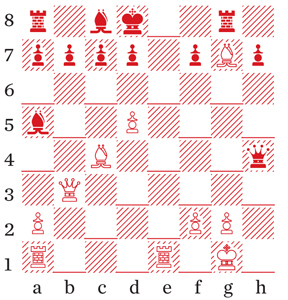
Solution: Fischer played 17.Qg3! which pulls the Black Queen off the critical h4-d8 diagonal: after 17… Qxg3 18.Bf6 is checkmate.


Post your comment

- The Zombie Argument that Refuses to Die
- Online Only: The Price Paid for Criticising Islam
- Overrated: Dan Brown
- Is the Brain the Key to Understanding Religion?
- Overrated: George Monbiot
- Time to Wise Up to the Muslim Brotherhood
- 'Please Sir, I Just Want to Learn More'
- The Alternative History of an Undivided India
- The Zombie Argument that Refuses to Die
- Online Only: The Price Paid for Criticising Islam
- Overrated: Dan Brown
- Is the Brain the Key to Understanding Religion?
- Overrated: George Monbiot
- Time to Wise Up to the Muslim Brotherhood
- 'Please Sir, I Just Want to Learn More'
- The Alternative History of an Undivided India
- Decline and Fall of the History Men
- Uncritical Theorists Who Misread the Nazis
- The Zombie Argument that Refuses to Die
- The Banality of Hannah Arendt
- From Kitsch to Cool: Picasso and Modern Art
- Is the Brain the Key to Understanding Religion?
- Time to Wise Up to the Muslim Brotherhood
- Midfield Virtuoso Finds His Perfect Pitch