



In the real — as opposed to the fictional — world, chess players are not more than normally prone to criminal activities, still less murder. There are, however, two examples of murders by men obsessed with chess, both of them American. Claude Bloodgood (born Klaus Frizzel Bluttgutt III, if you please) killed his mother in 1969, apparently over a row involving money, nine days after he had been released from a stretch for forgery. According to the Virginian-Pilot, in its obituary of Bloodgood in 2001: "He beat her head with a screwdriver, strangled her with his hands, then smothered her with a pillow." Thorough, these chess players.
Bloodgood was condemned to death but the sentence was commuted to life imprisonment. Thus confined, he played many thousands of games by correspondence and also wrote several chess books, including The Tactical Grob, a monograph on his favourite opening. Then in 1996, he suddenly appeared on the US chess rankings list in second place, behind only Gata Kamsky, suggesting that he had become a world-championship-standard player. It later transpired, much to the embarrassment of the US Chess Federation, that Bloodgood had found a way allegedly of fixing the ratings system to his own advantage by rigging countless games within the prison network.
Bloodgood was, in reality, not even of international master strength. That, however, was very much true of the other chess-playing murderer, Raymond Weinstein. An outstanding talent, Weinstein won the US junior championship in 1958, and two years later shared the gold medal for best individual performance in the world student team championship in Leningrad. In the 1960-61 US championships, Weinstein came third behind only Bobby Fischer and William Lombardy (later Fischer's second in his 1972 world championship match against Boris Spassky).
In 1964 the British Chess Magazine reported from that year's US championship: "One of the players commented that, outside of Fischer, Weinstein was the one person in the tournament with real talent...there is nothing to stop him going right to the top if he wants to, for Weinstein has...a ruthless killer instinct." This was an unfortunate turn of phrase. That championship was Weinstein's final appearance over the chess board. Shortly afterwards-having already been diagnosed as schizophrenic-he slit the throat of an 83-year-old man. Unfit to stand trial, he was remanded to the Kirby Forensic Psychiatric Centre on Ward Island, Manhattan, where, now 70, he remains.
Puzzle: The young Raymond Weinstein, in his 1959 US championship debut, produced a stunning finish against the experienced Sidney Bernstein. Can you see what he came up with? (Clue: it’s a right-left combination of blows.)
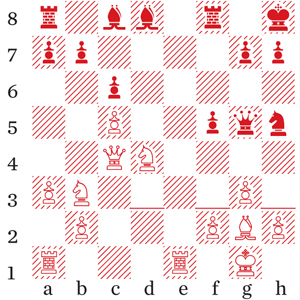
Solution: 22.Qf7! Rg8 (if 22...Rxf7 23.Re8 mates) 23.Nxc6! Qg6 (If 23...bxc6 24.Bxc6 Rb8 25.Re8 Nf6 26.Rxg8+ Nxg8 27.Bd5 Be6 28.Bxe6 Bf6 29.c6 wins) 24.Ne5! Qh6 (if 24...Qxf7 25.Nxf7 mate) 25.Bd5 and Bernstein resigned, rather than endure 25... Nf6 26.Qxg8+ Nxg8 27.Nf7 checkmate.


Post your comment

- The Zombie Argument that Refuses to Die
- Online Only: The Price Paid for Criticising Islam
- Overrated: Dan Brown
- Is the Brain the Key to Understanding Religion?
- Overrated: George Monbiot
- Time to Wise Up to the Muslim Brotherhood
- 'Please Sir, I Just Want to Learn More'
- The Alternative History of an Undivided India
- The Zombie Argument that Refuses to Die
- Online Only: The Price Paid for Criticising Islam
- Overrated: Dan Brown
- Is the Brain the Key to Understanding Religion?
- Overrated: George Monbiot
- Time to Wise Up to the Muslim Brotherhood
- 'Please Sir, I Just Want to Learn More'
- The Alternative History of an Undivided India
- Decline and Fall of the History Men
- Uncritical Theorists Who Misread the Nazis
- The Zombie Argument that Refuses to Die
- The Banality of Hannah Arendt
- From Kitsch to Cool: Picasso and Modern Art
- Is the Brain the Key to Understanding Religion?
- Time to Wise Up to the Muslim Brotherhood
- Midfield Virtuoso Finds His Perfect Pitch