


It seems that there was a particular reason for this startling breach of chess ethics. The English chess spectators of the day were in the habit of applauding noisily at the end of a well-played game. Von Bardeleben clearly could not face the thought of the thunderous applause for his opponent. Despite avoiding this indignity, as he saw it, von Bardeleben's confidence had been shot by this one game: he collapsed in the second half of the tournament, finishing only seventh. The way his life ended also indicated a pervasive despair: in 1924, he killed himself by jumping out of his Berlin apartment.
It is no accident that this was the fate Vladimir Nabokov allotted to Luzhin, the tormented chess grandmaster at the heart of his novel The Luzhin Defence. Apparently, Nabokov knew von Bardeleben — and the novel was published only six years after that real-life suicide. In Nabokov's account, it is not so much losing to a human opponent that finally drives Luzhin to take his life. It was more that he suddenly understood that chess itself was a merciless opponent: this insight strikes him at the moment he accidentally burns himself with a match while considering his next move: "The pain immediately passed, but in the fiery gap he had seen something unbearably awesome, the full horror of the abysmal depths of chess. He glanced at the chessboard and his brain wilted from hitherto unprecedented weariness. But the players were pitiless, they held and absorbed him. There was horror in this, but in this also was the sole harmony, for what else exists in the world besides chess?"
One can see exactly this dichotomy in Ivanchuk's anguish: he declares that chess is "playing against me...chess is destroying me...I don't see the way out", but then realises that he can't live without chess, either. I very much hope — and believe — that Ivanchuk will not emulate the only "way out" that Luzhin discovered. Over the past 20 years, a number of former Soviet players have followed the exit chosen by von Bardeleben, and which Nabokov seized on for his novel's bleak conclusion. In 1989, Georgy Ilivitsky, one of the strongest Russian players of his day, threw himself to his death. In 1997, the same method was chosen by the former Latvian champion, Alvis Vitiolins.
These are all different individuals, of course, and we cannot know what was in their individual minds at the moment they chose to leave the world. Yet Nabokov, with his great novelist's feel for the inner workings of the human mind, was surely correct in seeing the unique mental demands of chess as not just uplifting, but also soul-destroying.
Here, for the record, is that game between Steinitz (playing White) and von Bardeleben, a transcendent triumph for the winner, an eternal torment to the loser:
1.e4 e5 2.Nf3 Nc6 3.Bc4 Bc5 4.c3 Nf6 5.d4 exd4 6.cxd4 Bb4+ 7.Nc3 d5 8.exd5 Nxd5 9.0-0 Be6 10.Bg5 Be7 11.Bxd5 Bxd5 12.Nxd5 Qxd5 13.Bxe7 Nxe7 14.Re1 f6 15.Qe2 Qd7 16.Rac1 c6 17.d5! (an inspired pawn sacrifice) cxd5 18.Nd4 Kf7 19.Ne6 Rhc8 20.Qg4 g6 21.Ng5+ Ke8 22.Rxe7+!! Kf8 (if 22...Kxe7 23.Re1+ Kd6 24.Qb4+ Rc5 25.Re6+ wins) 23. Rf7+! (Not, of course, capturing Black's Queen on d7, after which Black mates with Rxc1+) Kg8 24.Rg7+!... and it was at this point that von Bardeleben walked out, denying Steinitz the following beautiful forced mate in eleven moves: 24...Kh8 25.Rxh7+ Kg8 26.Rg7+ Kh8 27.Qh4+! Kxg7 28.Qh7+ Kf8 29.Qh8+ Ke7 30.Qg7+ Ke8 31.Qg8+ Ke7 32.Qf7+ Kd8 33.Qf8+ Qe8 34.Nf7+ Kd7 35.Qd6 checkmate.
Puzzle: Poor von Bardeleben is known now only as the loser of one brilliant game to Steinitz. So here’s something else to remember him by. In this position, playing Black in a 1908 game against Alexander Fritz, he found a devastating move. What was it?
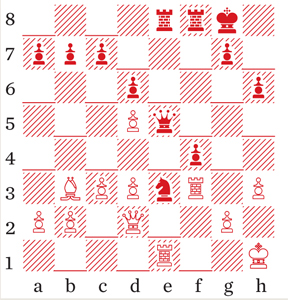
Solution: von Bardeleben played 23…Nc4! and after 24.Rxe5 Nxd2 25.Rxe8 Rxe8 Fritz resigned. He can not simultaneously save his Rook on f3 and prevent a back-rank mate with Re1+.


Post your comment

- Conduct Unbecoming: The Classical Commentaries of Norman Lebrecht in Standpoint
- Propaganda Shouldn’t Pay
- The US Can Still Help Save Syria — and Iraq
- A Putrid Pact between Devils
- Strangers in their own Holy Land
- The Taboo of the Tombola
- Putin has his Useful Idiots on the Left and the Right
- Russian Resurgence has Blindsided Nato