



The reason Nezhmetdinov himself gave for not having become one of the leading players — although he did win the Russian Federation Championship on five occasions — was that "I came to chess too late, as a 17-year-old, whereas all the champions — Botvinnik, Smyslov, Spassky, Petrosian, Tal-received training from the age of seven or eight."
It was something of a miracle that Nezhmetdinov ever became a chess player. He was born to Tartar farmhands in the Kazakh town of Aktubinsk. The years of his childhood were dreadful ones in what became the new Soviet Union. His parents died of sheer physical exhaustion; he himself was saved by being taken in by a Muslim orphanage in Kazan. There he discovered chess, although his initial obsession was with chequers; he became Russian chequers champion at a time when that game was taken very seriously as another method of elevating the consciousness of the peasantry.
Nezhmetdinov's pet phrase, according to his friends, was "our time will come". It did for him in 1960, when to widespread astonishment Mikhail Tal invited the Tartar to be his assistant for his (successful) challenge against the world champion Mikhail Botvinnik. The surprise was partly because as Tal's strength was overwhelmingly as an attacking player, it hardly seemed he needed coaching in that aspect.
The reason might have been simple pleasure on Tal's part. He and Nezhmetdinov were good friends; moreover Tal adored playing blitz games, even when he was meant to be studying. What more morale-enhancing joie de vivre could he get during the grimmer hours of a world championship event than by playing rapid friendly games against the greatest artist of the 64 squares?
Puzzle: This was the last game Nezhmetdinov played, in the Latvian championship of 1973. He was taken ill immediately afterwards and didn’t complete the tournament, but this finish won him the brilliancy prize. Can you see how the ailing genius (Black, to move) finished off his chess career with a flourish?
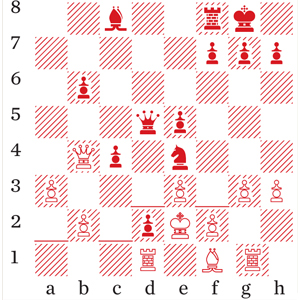
Solution: Nezhmetdinov played 24...c3!! 25.bxc3 Nxc3+! and his opponent resigned. The point is that after 26.Qxc3 Ba6+ the King can no longer escape via f3, and so after the forced 27.Qd3 Qxd3+ it will be mate in four moves, at most.


