


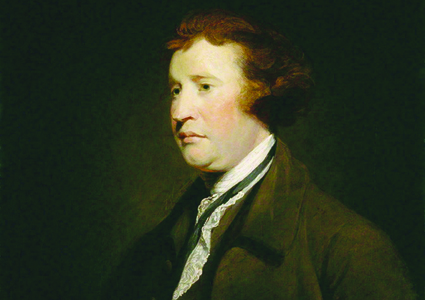
Edmund Burke: His thoughts are relevant to our present discontents
Of all the great British political thinkers, only Burke has any present currency. Hobbes and Locke both possessed arguably more penetrating minds, and Mill wrote on issues that are more germane to our current preoccupations. Yet, for all their superiority of intellectual equipment or apparent relevance, these writers are not living presences in our political culture in the way that Burke, however tenuously, still seems to be. Modern politicians still reflect on Burke, and the more literate among them (such as Jesse Norman) even still write about him. By contrast, Hobbes and Locke are firmly imprisoned in the Schools. Academics love to pore over their subtleties, so vividly practical as they were in the 17th century, so utterly estranged as they now are from any present urgency. Backroom policy aides are occasionally interested in Mill, but I have never met a practising politician who was. And fascinating political thinkers such as Harrington, Selden, Bolingbroke, Hume, Coleridge and Arnold are today all but forgotten even by academics. Why should it be that Burke alone still has the power to engage, even if only infrequently, the current political class? And what does that enduring power tell us about the nature and scope of Burke's achievement?
The probing and subtle first volume of David Bromwich's The Intellectual Life of Edmund Burke: From the Sublime and Beautiful to American Independence (a second volume will consider his writings on India and France) helps us glimpse the sources of Burke's surprising longevity. Bromwich begins by offering sharply intelligent readings of the two books Burke published in the 1750s: his disingenuous imitation of Bolingbroke in A Vindication of Natural Society, and his influential treatise on aesthetics, A Philosophical Enquiry into the Origin of Our Ideas of the Sublime and Beautiful. Bromwich then moves on to consider the more narrowly political writings generated by three convulsions of the British body politic in the late 1760s and 1770s: first, the controversy surrounding John Wilkes and the conflict between the rights of parliament and the prerogative of the Crown it set in train; second, the conflict with the American colonies and the loss of Britain's western empire; and finally the Gordon Riots of 1780 and the issues of representation and popular sovereignty which they raised.
As Bromwich points out when explaining his particular angle of approach, his focus is on Burke's ideas as they found expression in his speeches and writings. He aspires to grasp "the originality and continuities of Burke's thinking and not the rise and fall of his fortunes" (those who feel a need to plot the circumstances of Burke's day-to-day life should consult F.P. Lock's recent two-volume biography from OUP, which is unlikely soon to be surpassed on that score); and he hopes also to provide a more adequate account of "the scope and depth" of Burke's genius for those who are presently acquainted only with Reflections on the Revolution in France and a handful of speeches. However, that does not mean that Bromwich has confined himself to a seriatim parsing of what we might call the propositional content of Burke's major writings. Bromwich is also concerned to bring out how Burke's conception of his role as a public moralist shaped and conditioned his political interventions.
Like this article? Share, save or print using the icons below:


- Shame On The Liberals Who Rationalise Terror
- The Cowardice Of John Le Carré
- The Establishment Is In Denial — Yet Again
- Is There A Right Way To Write?
- A Fascist Coup In Poland? Give Us Poles A Break
- The Stalinist Past Of Corbyn’s Strategist
- The Spectre Of Mayor Khan's Islamist London
- The Long Shadow Of Malthus
- Shame On The Liberals Who Rationalise Terror
- The Cowardice Of John Le Carré
- The Establishment Is In Denial — Yet Again
- Is There A Right Way To Write?
- A Fascist Coup In Poland? Give Us Poles A Break
- The Stalinist Past Of Corbyn’s Strategist
- The Spectre Of Mayor Khan's Islamist London
- The Long Shadow Of Malthus
- Shame On The Liberals Who Rationalise Terror
- The Cowardice Of John Le Carré
- The Establishment Is In Denial — Yet Again
- Is There A Right Way To Write?
- Did Burke Betray The Cause Of Liberty?
- A Fascist Coup In Poland? Give Us Poles A Break
- Double Games Of The UK Muslim Brotherhood
- Two Languages And The Chasm Between Them
3:08 AM
9:08 PM
1:07 AM
2:07 PM
6:07 AM
8:06 PM
8:06 PM