


There is one living human being who has combined a career as a virtuoso, in the musical sense, with that of a chess grandmaster. Mark Taimanov was one of Russia's leading concert pianists, although his greatest successes had been as part of a duet with his wife, Lyubov Bruk, whom he had met at the Leningrad Conservatory. Some years ago, Phillips released several discs of the couple's performances as part of its series of "100 greatest pianists of the 20th century". Yet Taimanov, now 84, also found the time to become one of the Soviet Union's most successful chess grandmasters, in which role he developed his own line of the Sicilian Defence — the Taimanov Variation, of course.
Perhaps it was because he kept these two aspects of his life entirely separate that Taimanov managed to achieve so much in each field. As he said: "When I gave concerts I was taking a rest from chess and when I played chess I was resting from the piano. As a result my life has been one long holiday."
It was no holiday in 1971, however, when Taimanov played Bobby Fischer in a world chess championship quarter-final. Fischer won every game. In Soviet eyes, this was a political humiliation, and they treated Taimanov as they would a dissident: "I was deprived of my civil rights, my salary was taken away from me. I was prohibited from travelling abroad and censored in the press." One man who stuck by him, apparently, was Smyslov. The two had on occasions performed informally together, Taimanov at the piano, Smyslov singing (of course).
I have had the pleasure of meeting both these men of deep culture and intellect, although I recall with embarrassment the look Taimanov gave me in Moscow in 1985, when I told him that I had had a pleasant conversation with a man, who, it turned out, had been one of his persecutors within the Soviet chess federation. Smyslov I had met briefly a couple of years earlier, during his world championship semi-final in London against the Hungarian Zoltán Ribli.
Smyslov was by then 62, his always bad eyesight deteriorating. We all thought him most unlikely to last the pace against a very durable opponent fully 30 years younger. In fact, it was Smyslov who showed the greater energy throughout, winning the match and earning the right to a final eliminator against Garry Kasparov. This is the stupendous game with which Smyslov, with the white pieces, took control of his match against Ribli — to see it being played live was a privilege, like hearing a Beethoven or Mozart in the act of composition at the piano:
1.d4 Nf6 2.Nf3 e6 3.c4 d5 4.Nc3 c5 5.cxd5 Nxd5 6.e3 Nc6 7.Bd3 Be7 8.0-0 0-0 9.a3 cxd4 10.exd4 Bf6 11.Qc2 h6 12.Rd1 Qb6 13.Bc4 Rd8 14.Ne2 Bd7 15.Qe4 Nce7 16.Bd3 Ba4 17.Qh7+ Kf8 18.Re1 Bb5 19.Bxb5 Qxb5 20.Ng3 Ng6 21.Ne5 Nde7 22.Bxh6! Nxe5 23.Nh5! Nf3+ 24.gxf3 Nf5 25.Nxf6 Nxh6 26.d5 Qxb2 (with a combination of rare geometric beauty, Smyslov now finds a way of exploiting the new position of Black's Queen on b2) 27. Qh8+ Ke7 28.Rxe6+!! fxe6 29.Qxg7+ Nf7 30.d6+! Rxd6 (if Kxd6 31.Ne4+ is another way of winning the Q on b2) 31.Nd5+! Rxd5 32.Qxb2 b6 (Black has some material compensation for his lost Queen, but his King remains fatally exposed) 33.Qb4+ Kf6 34.Re1 Rh8 35.h4 Rhd8 36.Re4 Nd6 37.Qc3+ e5 38.Rxe5! Rxe5 39.f4 Nf7 40.fxe5+ Ke6 41.Qc4+ and a shell-shocked Ribli resigned.
Puzzle: In 1977 the concert pianist Grandmaster Mark Taimanov finished off the then world champion Anatoly Karpov with a dazzling chess cadenza. Can you see what he played in this position? Here's a clue: Taimanov (Black) uses the full length of the keyboard.
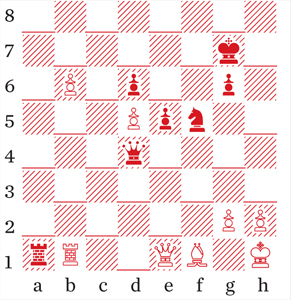
Solution: Taimanov hammered out 38... Ng3+!! and after 39.hxg3 Ra8! Karpov had no defence to mate with Rh8. Prestissimo!


Post your comment

- The Zombie Argument that Refuses to Die
- Online Only: The Price Paid for Criticising Islam
- Overrated: Dan Brown
- Is the Brain the Key to Understanding Religion?
- Overrated: George Monbiot
- Time to Wise Up to the Muslim Brotherhood
- 'Please Sir, I Just Want to Learn More'
- The Alternative History of an Undivided India
- The Zombie Argument that Refuses to Die
- Online Only: The Price Paid for Criticising Islam
- Overrated: Dan Brown
- Is the Brain the Key to Understanding Religion?
- Overrated: George Monbiot
- Time to Wise Up to the Muslim Brotherhood
- 'Please Sir, I Just Want to Learn More'
- The Alternative History of an Undivided India
- Decline and Fall of the History Men
- Uncritical Theorists Who Misread the Nazis
- The Zombie Argument that Refuses to Die
- The Banality of Hannah Arendt
- From Kitsch to Cool: Picasso and Modern Art
- Is the Brain the Key to Understanding Religion?
- Time to Wise Up to the Muslim Brotherhood
- Midfield Virtuoso Finds His Perfect Pitch