


It was only two years after that ordeal was over that Liu, playing for China in the 1978 Chess Olympiad, became the first Chinese to beat a western grandmaster in such an event — and in a game so spectacular it went round the world. He was later appointed coach of the Chinese national training team, in which role, he recorded without false modesty, “Teaching by personal example as well as by verbal instruction, I can say without exaggeration that my chessplaying skills and moral authority influenced every member of the national team.”
One can see in this something of the same character as Mikhail Botvinnik, the first Soviet world champion, who also imposed his ferocious work ethic on a generation of players. One difference is that Liu was nothing like as strong a player as Botvinnik: he never became a grandmaster himself. Another difference is that the Soviet school made enormous contributions to the theory of openings, whereas the Chinese school — and perhaps this is an element of Liu’s stress on the intuitive over the scientific method — has not produced material which can readily be assimilated by those outside the system.
There have been suggestions that Chinese players have a sharper and more tactical style than their western rivals as a legacy of the fact that Xiangqi is a much more fluid game than chess. I would argue that there are no “Russian” or “Chinese” chess moves — just good and bad, and China now seems to be playing more good ones than any other nation.
Here is that game from the 1978 Chess Olympiad in which Liu Wenzhe astounded not just his opponent, the Dutch grandmaster Jan Donner, but the whole chess world. 1.e4 d6 2.d4 Nf6 3. Nc3 g6 4.Be2 Bg7 5.g4!? (On seeing this extraordinary move, Donner thought for no less than half an hour. His eventual reply was widely criticised, but his error came later) h6 6.h3 c5 7.d5 0-0?! 8.h4! (This looks odd after 6.h3 — why take two moves to get the pawn to h4? But with Black’s King castled this crude pawn storm is now hugely effective.) e6 9.g5 hxg5? (Only move 9, but this is already the fatal error. Donner had to play unconventionally himself with 9…Nh7! 10.gxh6 Bxc3+ 11.bxc3 Qf6 when he would at least have counterplay) 10.hxg5 Ne8 11.Qd3! (The unmistakable intention is to shift the Queen to the open h-file — and this can’t be prevented) exd5 12.Nxd5 Nc6 13.Qg3 Be6 14.Qh4 (Liu wrote that while thinking about this move he suddenly saw the winning sacrifice: “My excitement took complete control of me”) f5 15.Qh7+ Kf7 (Liu recalled “at this point Donner still seemed optimistic, in view of his threat to win the Queen with 16…Rh8”) 16.Qxg6+!! (Amazingly, this forces mate in seven moves. But Donner played on imperturbably) Kxg6 17.Bh5+ Kh7 18.Bf7+ Bh6 19.g6+! (Perhaps Donner had counted on 18. Rxh6+ Kg7 after which the mate disappears and Black is winning) Kg7 20.Bxh6+ resigns. It will be mate after 20…Kh8 21.Bg7 (double check!) Kxg7 22.Rh7.
According to the Czech grandmaster Lubosh Kavalek, who was playing in the event: “After he resigned Donner sat in his chair for another 15 minutes, staring at the chessboard with amazement.” Then he recovered sufficiently to observe that he would be famous for ever in China.
One can see in this something of the same character as Mikhail Botvinnik, the first Soviet world champion, who also imposed his ferocious work ethic on a generation of players. One difference is that Liu was nothing like as strong a player as Botvinnik: he never became a grandmaster himself. Another difference is that the Soviet school made enormous contributions to the theory of openings, whereas the Chinese school — and perhaps this is an element of Liu’s stress on the intuitive over the scientific method — has not produced material which can readily be assimilated by those outside the system.
There have been suggestions that Chinese players have a sharper and more tactical style than their western rivals as a legacy of the fact that Xiangqi is a much more fluid game than chess. I would argue that there are no “Russian” or “Chinese” chess moves — just good and bad, and China now seems to be playing more good ones than any other nation.
Here is that game from the 1978 Chess Olympiad in which Liu Wenzhe astounded not just his opponent, the Dutch grandmaster Jan Donner, but the whole chess world. 1.e4 d6 2.d4 Nf6 3. Nc3 g6 4.Be2 Bg7 5.g4!? (On seeing this extraordinary move, Donner thought for no less than half an hour. His eventual reply was widely criticised, but his error came later) h6 6.h3 c5 7.d5 0-0?! 8.h4! (This looks odd after 6.h3 — why take two moves to get the pawn to h4? But with Black’s King castled this crude pawn storm is now hugely effective.) e6 9.g5 hxg5? (Only move 9, but this is already the fatal error. Donner had to play unconventionally himself with 9…Nh7! 10.gxh6 Bxc3+ 11.bxc3 Qf6 when he would at least have counterplay) 10.hxg5 Ne8 11.Qd3! (The unmistakable intention is to shift the Queen to the open h-file — and this can’t be prevented) exd5 12.Nxd5 Nc6 13.Qg3 Be6 14.Qh4 (Liu wrote that while thinking about this move he suddenly saw the winning sacrifice: “My excitement took complete control of me”) f5 15.Qh7+ Kf7 (Liu recalled “at this point Donner still seemed optimistic, in view of his threat to win the Queen with 16…Rh8”) 16.Qxg6+!! (Amazingly, this forces mate in seven moves. But Donner played on imperturbably) Kxg6 17.Bh5+ Kh7 18.Bf7+ Bh6 19.g6+! (Perhaps Donner had counted on 18. Rxh6+ Kg7 after which the mate disappears and Black is winning) Kg7 20.Bxh6+ resigns. It will be mate after 20…Kh8 21.Bg7 (double check!) Kxg7 22.Rh7.
According to the Czech grandmaster Lubosh Kavalek, who was playing in the event: “After he resigned Donner sat in his chair for another 15 minutes, staring at the chessboard with amazement.” Then he recovered sufficiently to observe that he would be famous for ever in China.
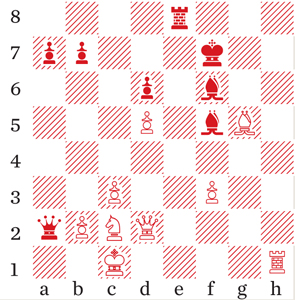
Puzzle: In this game from an England-China match in 1981, Jon Speelman, who later became a world championship candidate, has just played his Bishop from h6 to g5. This overlooked a fiendish Black tactic, which Liu played without hesitation. Can you see what it was?
Solution: Liu played 28…Re2!! and Speelman resigned. The rook must be captured, but after 29.Qxe2 Bxg5+ 30.Ne3 Qa1+ 31.Kd2 Qxh1 White’s position is completely hopeless.
Like this article? Share, save or print using the icons below:


