


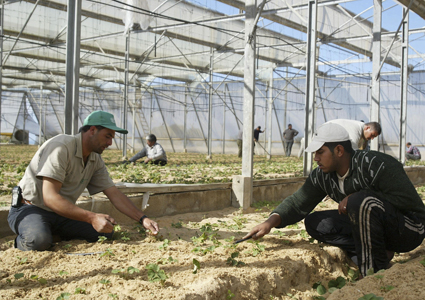
 Palestinian farmers working in a former settlers’ greenhouse in November, 2005. Border crossing disputes meant much of the harvest was lost (photo: Abid Katib/Getty Images)
In August 2005, the Palestinian businessman Dr Bassil Jabir was watching the events unfolding in the Gaza Strip with a mixed sense of trepidation and excitement. On the flickering TV screen, Israeli soldiers were carrying out Israeli settlers and placing them on buses which would take them out of the narrow coastal enclave, never to return.
The Israeli withdrawal from Gaza after a 38-year occupation presented new opportunities for the Palestinians. As CEO of the Palestine Economic Development Company (PED), Jabir had a daunting task before him, yet one which could produce the crowning achievement of his career so far. He would spearhead the first major economic project in Gaza that could turn round the fortunes of his people. The project carried great risks but also immeasurable rewards, perhaps even for the future of the Palestinian state as a whole.
Until August 2005, close to 8,000 Israeli Jewish settlers lived in the Gaza Strip. Occupying approximately 30 per cent of the land, they were guarded by thousands of Israeli soldiers, who imposed restrictions on the movements of the approximately 1.5 million Palestinian residents.
Ask former Israeli settlers about life in Gaza at the time, and many will wax lyrical about the “paradise on earth” — the endless sandy beaches, the bountiful farms, the sense of community with others who had decided to establish a home on territory conquered from Egypt during the 1967 Six Day War.
Ask a Palestinian the same question and you will get the distinct impression that you are talking about two separate continents, not the same meagre strip of land measuring 45 kilometres in length and just five kilometres in width at its narrowest point.
Five years before David Cameron and others called the coastal enclave a “prison camp”, many Israeli NGOs had already been using the term to describe life in Gaza. Since 1967, Israel exercised a military occupation, controlling its airspace and territorial waters. This was relaxed after the Oslo Accords, but following the Palestinian suicide bombings, rocket attacks and angry protests of the Second Intifada in the early 2000s, Israel reimposed restrictive measures that took a heavy toll on the lives of the Palestinians: strict entry and exit regulations, and control of airspace and naval borders. Egypt controlled Gaza’s southern entry crossing. Gazan militants continued fighting, firing more than 500 rockets and 3,000 mortar shells into southern Israel between 2000 and 2005; 124 Israelis and hundreds of Palestinians in Gaza were killed, with many more injured. Palestinian trade was curtailed and unemployment rates soared sky-high as people struggled to make ends meet. Poverty rates in Gaza had risen by more than 40 per cent in just five years, the Israeli NGO B’tselem reported.
Like this article? Share, save or print using the icons below:


Post your comment
More Dispatches
- Beirut: Hariri — An Assassination Too Far
- New York: A ‘Post-racial’ American vs an Old Coot
- Pristina: Kosovo's Liberal Islam
- Oslo: Courage and Cowardice in Scandinavia
- ONLINE ONLY: Washington, D.C.: It's Not Rocket Science!
- La Hague: Recycling the French Model
- Jerusalem: No Via Media for Anglicans
- ONLINE ONLY: Beirut: Blood Holiday
- Rome: Arrivederci Roma
- Darfur: Panic at the Palace
- ONLINE ONLY: Letter from Bamian
- Caucasus: Diary, August-September, 2008
- ONLINE ONLY: South-East Asia: The Demons of Ignorance
- New York: Diary
- Ypres: Never Say Never Again
- New York: A Cousin in the White House
- Caracas: Chávez's Secret Fan Club
- Prague: Diary
- Park City, Utah: Movie that Pulls Aside the Veil
- Beirut: Blood on the Streets
- India: Tariq Ali's Plan for Pakistan
- Berlin and Cologne: A Tale of Two German Cities
- Mumbai: On the 'Slumdog' Trail
- Budapest: Screwed Left, Right and Centre
- Paris: Mayhem in the Marais
- Stanford, CA: Intellectual Life Under Obama
- Colombia: A Nation Reborn
- Paris: Prisoner of the Barbarians
- United States: The Path to Rome via San Francisco
- ONLINE ONLY: Black Russian
- South Africa: The ANC'S Health Lesson for Obama
- Lisieux, France: Relics of Thérèse
- Germany: Heidegger - Being, Time and Place
- Moscow: Putin's Empire Strikes Out
- Connecticut: My Battle Against Google
- Montana: Home From Home on the Range
- Siberia: In Search of the Gulag
- Rio's Heart of Darkness
- Mogadishu: Armageddon on Steroids
- Havana: The Castros Will Not Be Absolved
- Kaliningrad: Russia's Outpost in Europe's Heart
- Bishkek: Bloodsoaked Revolution
- Bishkek: Downfall of a Dictator
- Oslo: Signing OFF on Human Rights
- Bajaur: A Talk with the Taliban
- Bahrain: Women Drivers Welcome Here
- Tajikistan: In Search of the Yeti
- ONLINE Only: Ankara's Proxy
- Johannesburg: Hard Pressed
- Istanbul: Press Freedom Alla Turca
- Xinjiang: Taming China's Wild West
- The Lesson of Oz
- The Surge is Working — So Far
- A Tale of Love, Bulls and Goats
- Old-order Collapse
- Egypt's New Dawn Chorus
- From Carthage to Kasserine
- After Gaddafi: A New Libya Emerges
- To the Polo Saddle Born
- The Settlements: Life Between the Lines
- Exposed: Carnita's Cover Story
- "At last, I feel proud to be Libyan"
- Books Do Furnish a Little Freedom
- Fat Chance for Christie—This Time
- Easy Lies the Head that Wears the Crown
- Putin's Chinese Whispers
- Cain Isn't Able and Newt Defies Gravity
- The Ten Years' War against the Taliban
- We The People Say: Get Out of The Way
- Wanted: A New Ronald Reagan
- Time to Crunch the Numbers
- Who's Really Supreme?
- From Art as Life to Blood and Soil
- Talking Tactics
- The Wagner Family Soap Opera Rolls On
- Winning the Veepstakes
- Romney Takes a Risk with Ryan
- Window Brothels Get the Red Light
- Can Romney Spring an October surprise?
- Canada's Crusader for Conservatism
- No-Go Areas on the Campaign Trail
- Republicans Must Avoid Civil War
- Norway's Problem with Anti-Semitism
- Turks, Arabs and Jews: The Middle East in Crisis
- Nations United in Hypocrisy
- Siberia: Shamans, Spies and the Secret Police
- Barracked by Obama's Oratory
- Women Come Last in Syrian Refugee Camps
- The Dawn of Obamageddon
- Americans Know Her True Worth. Do We?
- Hapless Hollande’s French Farce Flops
- Save the NYPD So It Can Save the City
- Obama's Secrets Start Unravelling
- Syria Isn't Bosnia: Don't Arm the Rebels
- Who Can Stop Hilary in 2016?
- Teaching China's Anglophiles
- On Pilgrimage with the Hasids
- From Eastern Europe to the East End
- True Grits
- The Rise and Rise of Marine Le Pen
- Cold Comfort On Global Warming
- Hunting the Lynx with the Old Believers
- High-tech Israelis Aim For The Moon
- The Russians Are Coming
- The Turbulent Minister is Right
- Bad Times for Good Samaritans
- This Expat Paradise is a Woman’s Nightmare
- Two Generations Lost to Communism
- Strangers in their own Holy Land
- The Isles are Full of Big Noises
- The Kurds: Israel's not so Improbable Allies
- Islam and Innocence: Canada’s Predicament
- The Fifth Republic’s Darkest Days?
- Let's Make Putin's London Cronies Sweat
- The Global Politics Of Netanyahu's Victory
- A Grim Prospect For South Africa's Jews
- No End In Sight To The Exodus From Libya
- Undeterred, Erdogan Usurps Ataturk's Legacy
- Gaza Withdrawal Symptoms
- I'm Not Antisemitic, But...
- The ELM, Dispatches and Awlaki
- A Larger Than Life Predator
Popular Standpoint topics
