


Four years passed before Capablanca's father allowed him to play again, and it is clear that the family wanted him to have a normal life. It was only while he was at Columbia University reading engineering and chemistry that he abandoned his studies to concentrate on chess, at which point his financial support was withdrawn. A few months later Capablanca turned up in Spain to lay waste to the might of European chess, winning the first prize of 5,000 francs, thus proving a point to his family as well as his disrespectful rivals.
The chess theorist Richard Réti, who played Capablanca on eight occasions, observed that he was unique in that chess was "his mother tongue": for him visualising chess moves was as simple as it is for the rest of us to speak. Capablanca was not averse to pointing this out himself. In an interview in 1939 he said: "I recall that during the 1925 Moscow tournament...various famous chess players had been studying a particular position for three hours, without being able to reach a conclusion. I was passing by at that moment and they asked me my opinion. I was not in doubt for a single second, and I told them: ‘This is won; and it is won like this, and this.' And I was not mistaken."
Capablanca also claimed to have attained "perfection in reasoning". It was probably this serene faith in his own unique genius which lost Capablanca the crown of world chess champion in his first defence of the title in 1927. His challenger, Alexander Alekhine, had never taken so much as a single win from Capablanca during their 12 previous encounters. The ferociously hardworking Russian prepared for the match in obsessive detail, analysing every game his rival had played, searching for the weaknesses that no one else could see. The complacent Capablanca was caught unawares, and to universal astonishment lost the gruelling, two-and-a-half-month-long encounter.
For the rest of his life, Capablanca fought to secure a rematch with Alekhine, but in those days the world title was essentially the personal possession of the champion, and the Russian skilfully evaded every attempt to organise one. The strain of such an event might in any case have been too much for Capablanca; though pure chess calculation itself was absurdly easy for him, he suffered increasingly from hypertension. In 1942 at the age of 53 he suffered a fatal cerebral haemorrhage while observing a friendly game at the Manhattan Chess Club.
It might seem strange that he had been casually watching ordinary mortals play — shouldn't it have been the other way around? Part of the answer to this question is provided by the memoir of his widow Olga. She described how during the Buenos Aires Olympiad of 1939, "A few chess players...begged me to ask Capa why he didn't pay more attention to chess. I promised to do my best. That evening Capa and I had dinner alone...he was in one of his best moods...only then did I venture the question: ‘The players would like to know why you don't pay more attention to chess.' Instead of cutting me short, as I half-expected, Capa smiled. ‘You, too, would like to know?' As I nodded, he said slowly and clearly: ‘Because if I did, there would be nothing left for them.'"
Puzzle: Capablanca has often been described as the Mozart of chess. The clean elegance of this finish, from an offhand game against Fonaroff in 1918, explains why. Can you see how Capa, (White, to move) finished con brio?
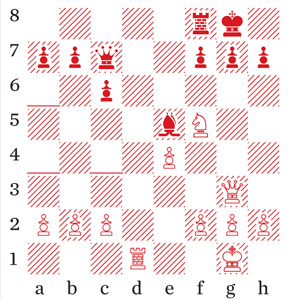
Solution: 1.Nh6+ Kh8 2.Qxe5!! Qxe5 3.Nxf7+ and Fonaroff resigned. After 3...Rxf7 4.Rd8+ mates in two more moves; and if 3...Kg8 4.Nxe5 and Capa is a piece up.


Post your comment

- The Zombie Argument that Refuses to Die
- Online Only: The Price Paid for Criticising Islam
- Overrated: Dan Brown
- Is the Brain the Key to Understanding Religion?
- Overrated: George Monbiot
- Time to Wise Up to the Muslim Brotherhood
- 'Please Sir, I Just Want to Learn More'
- The Alternative History of an Undivided India
- The Zombie Argument that Refuses to Die
- Online Only: The Price Paid for Criticising Islam
- Overrated: Dan Brown
- Is the Brain the Key to Understanding Religion?
- Overrated: George Monbiot
- Time to Wise Up to the Muslim Brotherhood
- 'Please Sir, I Just Want to Learn More'
- The Alternative History of an Undivided India
- Decline and Fall of the History Men
- Uncritical Theorists Who Misread the Nazis
- The Zombie Argument that Refuses to Die
- The Banality of Hannah Arendt
- From Kitsch to Cool: Picasso and Modern Art
- Is the Brain the Key to Understanding Religion?
- Time to Wise Up to the Muslim Brotherhood
- Midfield Virtuoso Finds His Perfect Pitch
- Online Only: The Price Paid for Criticising Islam
- Overrated: George Monbiot
- Letter from Ukraine: Reviving Lost Literature
- On Pilgrimage with the Hasids
- Tsar Of The Holy Land
- The Blob Has Run Schools For Decades. Not Any More
- Bismarck Versus Blair — A Foreign Policy Crossroads
- My Dieting Guide: Listen To Mother